Aluminum Panel Stretch Forming Alloy Selection Tooling Costs and Defect Prevention for Curved Architectural Facades
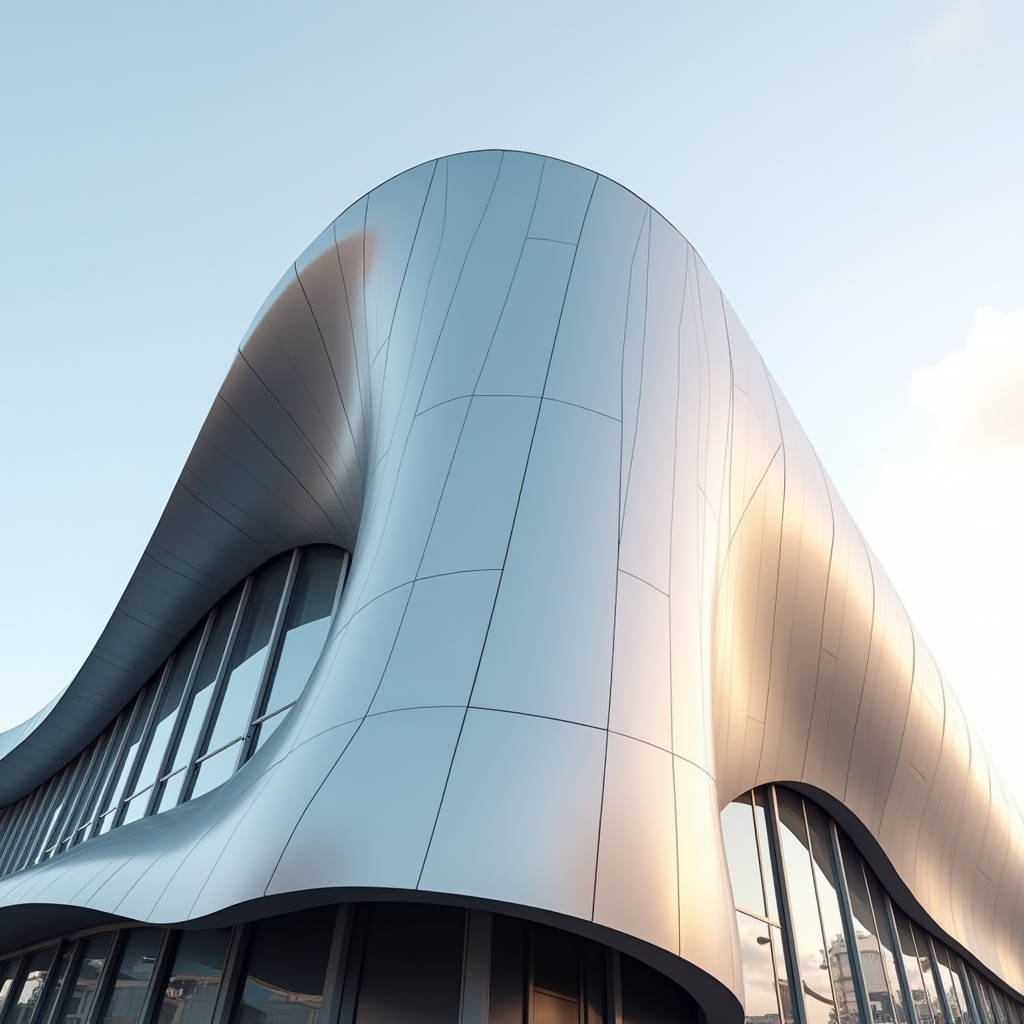
When a facade design calls for sweeping curves, compound radii, or flowing architectural forms in solid aluminum, Aluminum Panel Stretch Forming becomes the go-to fabrication method. Unlike press braking or roll bending, stretch forming pulls the aluminum sheet past its yield point while wrapping it over a precision-machined die. The result is a panel that holds its contour with minimal springback and zero surface wrinkles. For architects and facade contractors working on projects where visual continuity matters—airport terminals, performing arts centers, corporate headquarters—understanding how stretch forming behaves with solid 2.0mm to 3.0mm aluminum sheets is the difference between a facade that reads as one continuous surface and one that looks pieced together. This article digs into the material science, tooling economics, defect prevention, and quality control protocols that govern successful stretch-formed aluminum cladding panels.
What Actually Happens to the Aluminum During Stretch Forming
Stretch forming operates on a principle that separates it from every other bending method: the aluminum sheet is clamped at both ends, pulled in tension beyond its elastic limit, and then wrapped around a form die. The axial tensile stress superimposes on the bending stress, shifting the neutral axis of the cross-section. In practical terms, this means the entire cross-section of the sheet experiences plastic deformation rather than just the outer fibers. The payoff is dramatic. Springback—the eternal headache in cold forming—drops to a fraction of what you would see in pure bending. With 3003-H14 or 5052-H32 aluminum alloys commonly used for cladding panels, stretch forming can hold dimensional tolerances within ±0.5mm across a 3-meter arc length when process parameters are dialed in correctly.
The material choices matter enormously here. 5052-H32 offers higher tensile strength (around 230 MPa) compared to 3003-H14 (roughly 150 MPa), which means it resists the initial stretch differently. Forming technicians need to calculate the required elongation percentage based on the specific alloy and temper. Most solid aluminum cladding sheets in the 2.0mm to 3.0mm thickness range can handle 8-12% elongation during stretch forming before necking becomes a concern. Push beyond that and you risk localized thinning or fracture, particularly at the clamp jaws where stress concentrates. The AAMA 2605 standard for architectural coatings requires that the PVDF finish survive this elongation without cracking or delamination, which adds another layer of complexity to the process.
Tooling Investment and the Economics Nobody Talks About
Stretch forming dies represent the single largest upfront cost in any curved panel project. A precision-machined die for a 6-meter-long facade panel with a compound radius can run anywhere from $8,000 to $25,000 depending on complexity, material (Kirksite, steel, or high-density polyurethane), and surface finish requirements. For a project requiring 15 different radii—not uncommon on a large cultural building—tooling alone can exceed $150,000 before the first panel is formed.
This is where early collaboration between the architect and the fabricator pays off. Rationalizing radii across the facade can cut tooling costs by 40% or more without compromising the design intent. A facade with 12 unique radii might achieve the same visual effect with 6 or 7 if the design team understands the cost implications upfront. Smart fabricators, including Futeng® when consulted on complex cladding packages, will run a value engineering analysis that maps every curved panel on the building envelope and identifies opportunities to consolidate die profiles. The savings flow directly to the project budget.
Beyond the die itself, there is the question of minimum order quantities. Stretch forming is inherently a batch process. Setting up a die, aligning the sheet, running test pieces, and dialing in tension parameters takes time. The first panel off a new die might require 45-60 minutes of setup. Subsequent panels from the same die run faster—typically 8-12 minutes per panel for a 3-meter-long sheet. This means per-unit costs drop sharply as volume increases. A project requiring 50 panels of a given radius will have a dramatically different unit economics than one requiring 5 panels.
Cost Breakdown by Project Scale
| Project Scale | Panel Count per Radius | Tooling Amortization per Panel | Labor & Machine Time per Panel | Estimated Total per Panel (2.5mm 5052-H32) |
|---|---|---|---|---|
| Small (boutique retail, private residence) | 5–15 | $180–$540 | $95–$145 | $275–$685 |
| Medium (corporate lobby, mid-rise feature wall) | 30–80 | $45–$120 | $65–$95 | $110–$215 |
| Large (airport, stadium, convention center) | 150–500+ | $12–$40 | $40–$65 | $52–$105 |
| Mega-scale (entire building envelope) | 1,000+ | $5–$15 | $28–$45 | $33–$60 |
These figures assume standard single-radius dies with no compound curvature. Compound curves, reverse curves, or panels requiring intermediate annealing steps will push costs higher. The numbers also assume PVDF coating is applied post-forming, which is the standard sequence for architectural cladding. Pre-painted coil can be stretch-formed but requires extremely careful process control to avoid coating damage—a topic worth its own discussion.
Defects That Show Up in the Field and How to Prevent Them
Stretch forming aluminum panels for exterior cladding is unforgiving. Defects that might be acceptable in an industrial application become glaringly obvious when the panel hangs on a building facade under grazing sunlight. The three most common failure modes are Lüders bands, orange peel texture, and springback drift.
Lüders bands appear as subtle surface striations running perpendicular to the stretch direction. They result from inhomogeneous yielding—certain aluminum alloys, particularly 5xxx series in softer tempers, exhibit a yield point phenomenon where localized bands of plastic deformation propagate through the material. The fix involves specifying the correct temper. 5052-H32 and 5052-H34 are far less prone to Lüders banding than 5052-O or 5052-H111. For projects where the architect specifies a bright metallic PVDF finish that will highlight every surface imperfection, fabricators should insist on H32 or H34 temper and run sample panels under the specified lighting conditions before committing to production.
Orange peel texture emerges when the grain structure of the aluminum becomes visible through the coating after stretching. The root cause is excessive grain size in the base metal. According to ASTM B209, the standard specification for aluminum and aluminum-alloy sheet, grain size should be controlled to ASTM No. 5 or finer for architectural applications. Fabricators should request mill test reports that include grain size measurements and reject material that falls outside this range. The cost of rejecting a coil is trivial compared to replacing 200 panels after the architect rejects the installation.
Springback drift is the most insidious defect because it might not show up until weeks after forming. The panel comes off the die within tolerance, gets coated, gets shipped to site, and then gradually relaxes by 2-3mm over a 4-meter span. The mechanism is stress relaxation at ambient temperature, accelerated by thermal cycling during shipping and storage. The countermeasure is over-forming: stretching the panel slightly beyond the target radius by an amount determined through empirical testing on the specific alloy batch. Most experienced stretch forming shops maintain a database of springback compensation factors for different alloys, thicknesses, and radii. A 3.0mm 5052-H32 panel bent to a 2-meter radius might require 3-5% over-forming, while a 2.0mm 3003-H14 panel on a 5-meter radius might only need 1-2%.
Alloy Selection for Stretch-Formed Architectural Panels
Not all aluminum alloys handle stretch forming equally well. The cladding industry has settled on a narrow range of alloys that balance formability, strength, corrosion resistance, and cost. Here is how the practical options compare:
| Alloy & Temper | Tensile Strength (MPa) | Elongation at Break | Stretch Formability | Corrosion Resistance | Typical Cladding Application |
|---|---|---|---|---|---|
| 3003-H14 | 150–170 | 8–12% | Good | Very Good | Flat panels, gentle curves, interior cladding |
| 5052-H32 | 230–250 | 10–14% | Excellent | Excellent (marine-grade) | Exterior curved panels, coastal environments |
| 5083-H111 | 270–290 | 12–16% | Very Good | Excellent | High-wind zones, large-span panels |
| 6061-T6 | 290–310 | 8–10% | Moderate (requires annealing) | Good | Structural cladding, stiffeners, framing |
| 1100-H14 | 110–130 | 15–20% | Excellent | Very Good | Deep-drawn forms, complex compound curves |
For most architectural cladding projects, 5052-H32 hits the sweet spot. It stretches cleanly, holds tight radii without cracking, and handles coastal environments without special coatings beyond the standard PVDF system. The 2.5% magnesium content gives it the corrosion resistance that building owners expect for a 30-year facade. 3003-H14 works well for interior applications or mild exterior curves where cost is the primary driver, but it lacks the strength for large unsupported spans. 5083-H111 is the choice for extreme conditions—think hurricane-prone coastal regions where wind loads demand higher strength and the marine atmosphere demands maximum corrosion resistance.
Coating Sequence: Before or After Forming?
This decision shapes the entire production workflow. Coating before stretch forming—using pre-painted coil—eliminates the logistical headache of shipping formed panels to a coating line. The material arrives at the stretch forming cell already finished. But the risks are substantial. The PVDF coating must survive 8-12% elongation without micro-cracking. Most architectural PVDF systems, applied per AAMA 2605 at 25-35 microns dry film thickness, can handle this elongation if the coating formulation includes sufficient flexibility additives. However, not all PVDF formulations are created equal. A standard 70% PVDF resin system with inorganic pigments will generally outperform a 50% system or a system with organic pigments when it comes to elongation tolerance.
Coating after forming is the safer route and the one most fabricators prefer for critical architectural work. The panel is formed, inspected for dimensional accuracy, and then sent through the coating line. The flat areas of the panel receive uniform coating thickness, and the curved areas are not subjected to post-coating strain. The trade-off is handling: formed panels are bulkier to ship and rack on the coating line, and the 3D geometry can create shadowing effects during spray application if the line operator is not experienced with curved parts. For panels with compound curves, manual touch-up of recessed areas might be necessary.
The industry consensus, reflected in the MBMA metal building systems manual and various fabricator technical bulletins, is that post-forming coating produces more reliable long-term results for exterior cladding. The extra handling cost is insurance against coating failure that would be far more expensive to remediate after installation.
Quality Control: What to Check Before the Panels Leave the Factory
A rigorous QC protocol for stretch-formed aluminum cladding panels goes beyond dimensional checks. The following inspection points should be mandatory for every batch:
- Radius verification at multiple points. Use a template or coordinate measuring machine to check the formed radius at the panel center, quarter points, and edges. Deviation should not exceed ±1.5mm for panels up to 3 meters in length.
- Surface inspection under oblique lighting. Set up a light source at a 15-degree angle to the panel surface and visually inspect for Lüders bands, orange peel, or die marks. Any visible surface texture that will be amplified by the PVDF coating is grounds for rejection.
- Thickness measurement at the clamp zones. The areas where the stretch forming jaws gripped the panel will have experienced the highest stress. Measure thickness at these points with an ultrasonic gauge. Thinning should not exceed 10% of the nominal sheet thickness per ISO 7802 guidelines for metal forming.
- Springback stability test. After forming, measure the panel radius. Wait 48 hours and measure again. The difference should be within 0.5% of the target radius. If the panel continues to relax, the over-forming compensation needs adjustment.
- Coating adhesion after forming. Perform a cross-hatch adhesion test per ASTM D3359 on a sample panel from each batch. The coating must achieve a 4B or 5B rating even after the substrate has been stretched.
These checks add perhaps 15-20 minutes per batch but catch problems before they become field failures. For large projects, the cost of QC is negligible compared to the cost of scaffolding, labor, and schedule delay required to replace defective panels on an installed facade.
Designing for Manufacturability: What Architects Need to Know
The most successful curved aluminum facades come from design teams that understand the constraints of Aluminum Panel Stretch Forming before the schematic design phase ends. Several rules of thumb make the difference between a smooth fabrication process and a project that bleeds contingency funds:
Minimum bend radius. For 2.5mm 5052-H32, the practical minimum inside radius is approximately 3 times the material thickness, or about 7.5mm. Tighter radii are possible but increase the risk of cracking and require more aggressive over-forming. For 3.0mm material, plan on 4T (12mm) as a safe minimum. These numbers assume the bend axis is perpendicular to the rolling direction. Bending parallel to the rolling direction reduces formability and may require a 20-30% larger radius.
Straight lead-in and lead-out. Stretch forming requires flat sections at each end of the panel where the clamping jaws grip the material. These flat sections typically measure 75-150mm per end and are trimmed off after forming. Architects should account for this material loss in their panel sizing and nesting layouts. On a project with 500 panels, 150mm of trim per panel translates to 75 meters of wasted material—roughly $2,500-$4,000 in aluminum cost alone.
Compound curves multiply complexity. A panel curved in one direction is straightforward. A panel curved in two directions—a dome section, for example—requires a much more sophisticated die, potentially multiple forming stages, and a significantly higher scrap rate. The cost multiplier for compound curvature can range from 2x to 5x compared to single-radius panels. Before committing to compound-curved panels, the design team should verify that the visual effect is worth the cost premium.
Panel size limits. Stretch forming machines have physical limits on bed length and clamping force. A typical architectural stretch former can handle panels up to 6 meters long and 2 meters wide. Beyond these dimensions, the panel must be formed in sections or the project must seek out a fabricator with specialized large-format equipment—of which there are relatively few globally. The Aluminum Association publishes guidelines on available mill product sizes that can help designers understand what is realistically achievable.
When Stretch Forming Is Not the Right Answer
Despite its advantages, Aluminum Panel Stretch Forming is not universally applicable. For simple single-radius curves with large radii (say, 10 meters or more), roll bending may produce acceptable results at a lower cost. For panels with sharp corners or tight radii under 5mm, press braking with a radius die is more appropriate. For extremely complex geometries with multiple reverse curves, hydroforming or superplastic forming might be necessary, though these processes are rarely cost-effective for architectural cladding volumes.
The decision tree should start with the architectural requirement: what does the panel need to look like from the viewing distance? If the facade will be viewed from 2 meters away in a lobby, the wrinkle-free surface quality of stretch forming justifies the cost. If the panel is 20 meters up on a building facade viewed from the street, roll bending with its slight surface texture might be perfectly acceptable. The best fabricators will have an honest conversation about this trade-off rather than defaulting to the most expensive process.
Stretch forming solid aluminum panels for architectural cladding is a precision manufacturing process that rewards careful planning and punishes shortcuts. The projects that go smoothly are the ones where the architect, general contractor, and fabricator align on expectations before tooling is cut. Material selection, radius rationalization, coating sequence, and QC protocols all need to be locked in early. When those pieces come together, the result is a facade with curves that look effortless—precisely because the effort was invested in the right places.