Anti Graffiti Aluminum Panel Coating Technologies Compared for Solid Facade Cladding
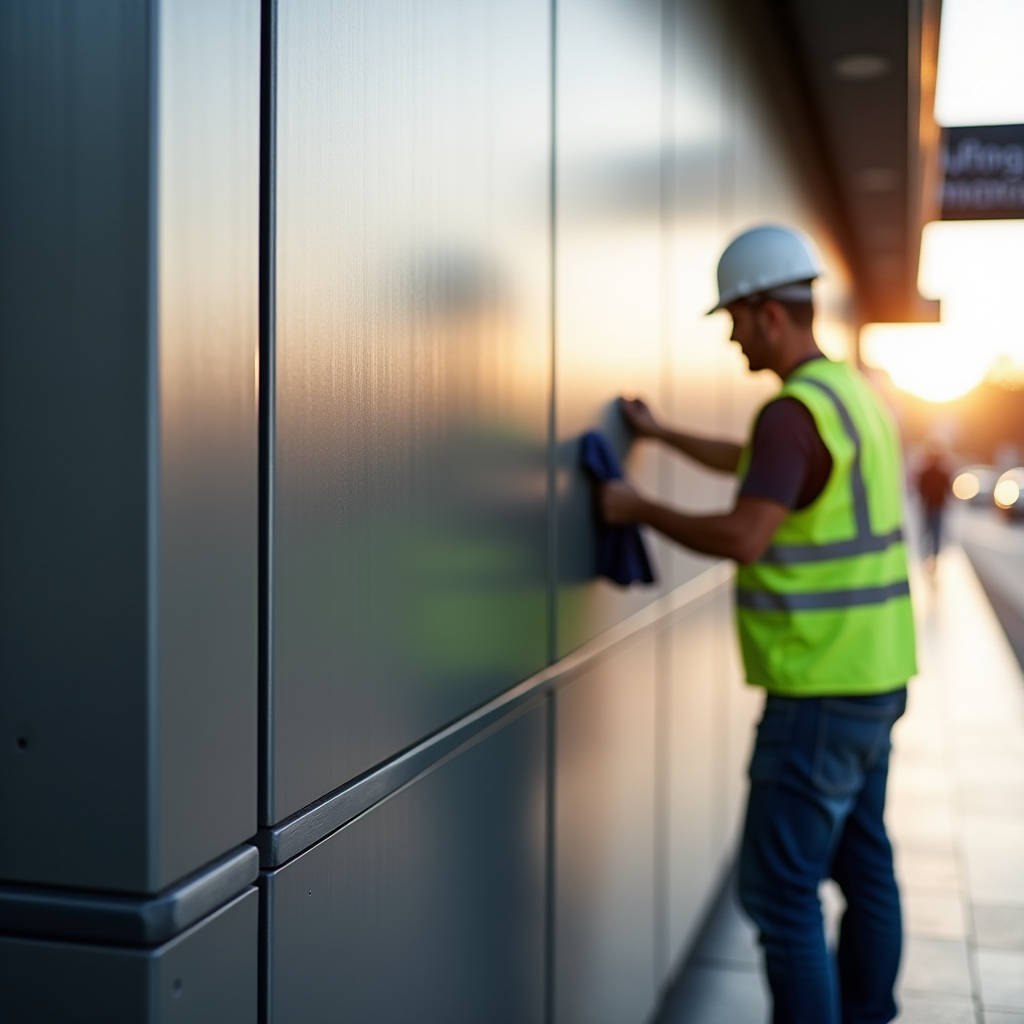
When a city council in Hamburg specified solid aluminium panels for a transit station renovation, the brief was blunt: the cladding had to survive spray paint, permanent markers, and acidic cleaning chemicals without losing its finish within fifteen years. That requirement points directly to what an Anti Graffiti Aluminum Panel actually is — not a coated sheet with a marketing label, but a 2.5mm or 3.0mm solid aluminium facade panel treated with a cross-linked protective system that prevents paint adhesion at the molecular level while allowing aggressive solvent cleaning without surface degradation. The distinction matters because not every panel sold as "anti-graffiti" performs the same way. Some rely on sacrificial wax films that wash off with the paint. Others use a permanent nano-ceramic layer fused into the PVDF topcoat. The difference determines whether a building still looks clean after its fifth or fiftieth removal cycle.
What Separates a Real Anti Graffiti Aluminum Panel from a Coated Pretender
Specifiers often conflate "easy-clean" surfaces with genuine anti-graffiti performance. The two are not interchangeable. An easy-clean PVDF coating sheds dirt and atmospheric grime reasonably well, but when a permanent marker or aerosol lacquer hits the surface, the paint bites into the polymer matrix. Scrubbing it off with methyl ethyl ketone (MEK) or xylene-based removers dulls the gloss and erodes the coating thickness. A properly engineered Anti Graffiti Aluminum Panel addresses both problems: the surface energy is low enough that most graffiti media cannot form a mechanical bond, and the cross-link density of the clear coat is high enough to resist solvent penetration even after repeated exposure.
The technical mechanism sits in the top 15–25 microns of the coating system. Standard architectural PVDF (polyvinylidene fluoride) coatings, typically applied at 25–35 microns total dry film thickness on solid aluminium sheets, rely on a 70/30 PVDF-acrylic resin ratio. The acrylic component provides pigment wetting and adhesion; the PVDF delivers weatherability. But acrylic domains are vulnerable to solvent attack. Anti-graffiti formulations modify this by introducing a clear top layer — either a fluorinated silane nano-coating or a second PVDF clear coat with higher cross-link density and lower surface energy. The result is a surface where water contact angles routinely exceed 100 degrees, and where spray paint beads rather than spreads.
How the Coating System Works: Nano-Silane vs. Sacrificial vs. Hard Clear Coat
Three distinct anti-graffiti technologies dominate the solid aluminium cladding market. Each has a different cost profile, maintenance cycle, and lifespan, and choosing the wrong one for a given project creates long-term headaches.
Permanent nano-silane treatments bond covalently to the PVDF or polyester topcoat. The silane molecules form a glass-like network roughly 2–4 microns thick that is chemically inert to most solvents. Because the treatment becomes part of the coating rather than sitting on top, it survives hundreds of cleaning cycles. The trade-off is upfront cost: applying a nano-silane layer adds approximately 15–22% to the panel coating cost, and the application requires controlled factory conditions — humidity and substrate temperature must stay within narrow windows during curing.
Sacrificial anti-graffiti films work differently. A wax or acrylic dispersion is applied over the finished coating. When graffiti strikes, the cleaning solvent dissolves the sacrificial layer along with the paint. The surface then needs reapplication. This approach costs less initially — roughly 8–12% over standard coating — but the lifecycle cost escalates quickly on high-risk sites. A railway underpass might need re-waxing every three to six months, which means access equipment, labor, and panel downtime.
Hard clear coat systems represent a middle ground. A second PVDF clear layer, often with a slightly modified resin ratio and higher bake temperature, creates a dense, solvent-resistant barrier. These systems typically achieve 50–80 double rubs with MEK before showing any gloss reduction, compared to 20–30 for standard architectural PVDF. The cost premium runs 10–18%, and the coating carries the same 20–30 year exterior durability as the underlying color layer.
| Technology | Thickness | MEK Double Rubs (ASTM D5402) | Cleaning Cycles Before Recoat | Cost Premium vs. Standard PVDF | Best Application |
|---|---|---|---|---|---|
| Nano-Silane Permanent | 2–4 μm | 200+ | 500+ | 15–22% | Transit hubs, public buildings, high-risk urban facades |
| Sacrificial Wax/Acrylic Film | 5–10 μm | N/A (removed with graffiti) | 1 (reapplication required) | 8–12% | Low-risk areas, temporary installations |
| Hard PVDF Clear Coat | 12–18 μm | 50–80 | 100–200 | 10–18% | Schools, retail, medium-risk commercial facades |
| Standard PVDF (No AG) | 25–35 μm total | 20–30 | 5–10 before visible damage | Baseline | Upper floors, low-contact zones |
Solid Aluminium Matters: Why Substrate Choice Affects Graffiti Resistance
The anti-graffiti conversation often fixates on coatings while ignoring the substrate. That is a mistake. A 2.0mm or 3.0mm solid aluminium sheet behaves fundamentally differently from laminated panels when graffiti removal chemicals are applied. Solid aluminium has no polyethylene core, no adhesive layers, and no edges where solvents can wick between laminations. This matters because aggressive graffiti removers — particularly those containing N-methyl-2-pyrrolidone (NMP) or dibasic esters — can delaminate composite panels if they penetrate edge seams or fastener holes. Solid panels eliminate that failure mode entirely.
Thermal stability also plays a role. Cleaning crews often use hot water pressure washers at 80–90°C to soften graffiti before chemical application. Solid aluminium panels with a coefficient of thermal expansion around 2.4 × 10⁻⁵ m/m/°C expand and contract uniformly. Composite panels with dissimilar skin and core materials can develop micro-cracks at the paint interface under thermal shock, creating pathways for future graffiti penetration. For a project manager specifying cladding on a school building that will see graffiti removal twice a month for twenty years, this difference is not academic — it determines whether the facade still performs in year fifteen.
Cleaning Protocols That Preserve the Anti-Graffiti Surface
Even the best Anti Graffiti Aluminum Panel degrades under improper cleaning. The field reality is that maintenance crews are often third-party contractors with limited training on architectural coatings. A specification that ignores this reality is incomplete.
The cleaning sequence should follow a graduated approach. Start with the mildest effective method and escalate only if needed. For water-based spray paints and felt-tip markers, a microfiber cloth with warm water and a pH-neutral detergent often suffices. The low surface energy of the anti-graffiti coating means many water-based media never fully adhere in the first place. If the mark persists, move to isopropyl alcohol (70% concentration) applied with a clean white cloth — never a colored rag that might transfer dye. For stubborn solvent-based paints, a dedicated graffiti remover formulated for coated aluminium is the next step. Products containing benzyl alcohol or dibasic esters are generally safer for PVDF coatings than MEK or acetone, though the permanent nano-silane systems tolerate even aggressive ketone solvents.
One specification detail worth including in project documentation: require that cleaning contractors test any new chemical on an inconspicuous panel area and wait 24 hours before proceeding. This simple step catches incompatibility before it becomes visible damage across the facade.
Performance Standards and Testing: What to Ask for in Submittals
Specifying an Anti Graffiti Aluminum Panel without referencing test standards leaves the door open for substitution with inferior products. Several key standards provide an objective basis for evaluation.
AAMA 2605 is the baseline for high-performance architectural coatings on aluminium. It mandates minimum 10-year Florida exposure with specific color and gloss retention thresholds. But AAMA 2605 does not directly address graffiti resistance. For that, specifiers should reference ASTM D6578, the standard practice for determining graffiti resistance of coatings. This test applies several common graffiti media — spray paint, permanent marker, lipstick, crayon — and evaluates ease of removal with specified cleaning agents. Panels are rated on a 0–10 scale based on visual assessment after cleaning.
ASTM D5402 measures solvent resistance via MEK double rubs and provides a practical proxy for cross-link density. A value above 50 double rubs without breakthrough indicates a tightly cross-linked system likely to resist graffiti remover damage. ISO 2812-1 and ISO 2812-4 cover resistance to liquids and spotting agents respectively, and are useful for evaluating chemical resistance beyond graffiti removal.
For projects in Europe, the EN 13523 series covers coil-coated metals and includes specific tests for resistance to marking and chemical agents. A panel that passes EN 13523-16 (resistance to graffiti) with a rating of Class 0 or Class 1 provides documented performance that holds up under contract scrutiny.
Additional relevant standards include ASTM D6578 for graffiti resistance testing protocols, AAMA 2605 for coating durability specifications, and ISO 2812-4 for spot resistance evaluation.
Cost Engineering: Lifecycle Analysis of Anti-Graffiti Solid Aluminium Facades
Procurement managers often compare anti-graffiti panel costs on a per-square-meter basis and stop there. That approach misses the bulk of the financial picture. A proper cost comparison must account for the cleaning frequency, cleaning cost per incident, coating recoating intervals, and access equipment requirements over the building's service life.
Consider a 2,000 m² facade on a public library in a mid-sized city. The baseline specification uses 2.5mm solid aluminium panels with standard PVDF coating at roughly $85/m² installed. Graffiti incidents occur 12 times per year, concentrated on the ground-floor panels (roughly 400 m²). Each cleaning requires a scissor lift rental at $350/day and two workers for four hours at $45/hour each, totaling $710 per incident. Annual cleaning cost: $8,520. Over 20 years, assuming 3% annual inflation on labor and equipment, the cumulative cleaning cost approaches $230,000. Additionally, the standard coating on the ground-floor panels shows visible gloss reduction after roughly 5 years of aggressive cleaning and requires recoating at $65/m², adding $26,000.
Now the same project with a permanent nano-silane Anti Graffiti Aluminum Panel on the ground-floor zone. The panel cost premium is 18%, adding roughly $6,120 to the initial budget. But cleaning time drops from four hours to one hour per incident because the graffiti wipes off with mild detergent rather than requiring solvent dwell time and scrubbing. Annual cleaning cost falls to $2,130. Over 20 years, the cumulative cleaning cost is roughly $57,500 — a saving of over $172,000. The coating never needs recoating for graffiti-related damage. The net present value of the anti-graffiti specification, discounted at 5%, is approximately $98,000 positive versus the baseline.
This math shifts when the entire facade is at risk versus only the lower floors. For a multi-story parking structure where graffiti can reach upper levels via stairwells, the calculation might justify anti-graffiti treatment on all panels. For a high-rise tower where only the podium faces real risk, a zoned specification — anti-graffiti on levels 1–3, standard PVDF above — often delivers the optimal cost-benefit ratio.
Fabrication Considerations: Bending, Welding, and Edge Treatment
Anti-graffiti coatings affect fabrication workflow in ways that shop managers need to understand before ordering material. The additional clear coat layer, whether nano-silane or hard PVDF, slightly increases the coating's brittleness. This matters when panels are bent to tight radii or when fabricators weld attachment clips to the panel rear.
For brake-formed panels, the minimum inside bend radius should be 2.5 times the metal thickness for 3.0mm sheet with anti-graffiti coating, compared to 2.0 times for standard PVDF. This prevents micro-cracking at the bend tangent where tensile stress peaks. Most fabricators already work within these limits, but it is worth confirming during the shop drawing review.
Welding presents a different challenge. The anti-graffiti coating burns off in the heat-affected zone, and the welded area needs post-fabrication treatment. For panels where rear-side welding is specified, fabricators should mask the front surface during welding to prevent spatter damage, then apply a field-grade anti-graffiti touch-up solution to any affected edges. Several coating manufacturers supply two-part touch-up kits that approximate the factory-applied performance, though specifiers should note that field-applied touch-ups typically achieve 70–80% of the factory coating's solvent resistance.
Edge treatment also deserves attention. On a solid aluminium panel, the cut edges are raw metal. If the panel edge is exposed — for example, on an open-joint rainscreen system — water carrying dissolved graffiti remover can wick behind the coating at the edge and cause filiform corrosion. Specifying a shop-applied edge sealant or specifying that exposed edges receive a clear coat wrap minimizes this risk. Several suppliers, including Futeng®, offer factory edge sealing as part of the anti-graffiti panel package, which eliminates the need for fabricators to handle this step separately.
Color and Gloss: The Aesthetic Constraints of Anti-Graffiti Finishes
Architects sometimes assume that specifying an anti-graffiti treatment has no impact on color selection. That assumption can lead to disappointment during the sample review stage. The additional clear layer shifts the perceived color slightly — typically by less than 1.0 Delta E on the CIELAB scale, but potentially more on dark or highly saturated colors. The shift tends toward a slight yellowing on bright whites and a slight deepening on dark blues and blacks.
Gloss range is also constrained. Standard PVDF coatings are available from 15–80 gloss units at 60° measurement angle. Adding a nano-silane anti-graffiti layer narrows the practical range to roughly 25–65 gloss units. Below 25, the matting agents interfere with the silane bonding chemistry. Above 65, the high gloss reveals every microscopic variation in the clear coat thickness, creating an uneven appearance that some architects find objectionable.
The practical solution is to request anti-graffiti coated samples in the specified color and gloss early in the design development phase — ideally before the specification goes out to tender. This allows the design team to adjust the color formula or accept the subtle shift rather than discovering it during the submittal process when schedule pressure makes changes costly.
Regional Performance Differences: Climate, Pollution, and Graffiti Media
An Anti Graffiti Aluminum Panel that performs flawlessly in Stockholm might struggle in Singapore. The coating's chemical resistance interacts with local environmental conditions in ways that affect long-term performance.
In coastal environments with salt spray, the anti-graffiti clear coat must resist chloride ion penetration in addition to solvent exposure. The combination of salt crystallization cycles and graffiti removal chemicals can accelerate coating degradation if the cross-link density is marginal. Specifying panels that have passed a minimum 3,000-hour neutral salt spray test (ASTM B117 or ISO 9227) with no blistering or adhesion loss provides a safety margin.
In high-UV regions like the Middle East or Australia, the anti-graffiti layer must maintain its surface energy properties despite intense solar radiation. Some nano-silane treatments show a gradual increase in surface energy after 5–7 years of extreme UV exposure, which reduces their graffiti resistance. The testing protocol should include accelerated weathering per AAMA 2605 (which requires 10-year Florida-equivalent exposure) followed by graffiti resistance testing, not just initial performance.
Local graffiti media also vary. European cities deal predominantly with aerosol lacquers and acrylic spray paints. North American transit systems face more permanent markers and acid-etching materials. Southeast Asian markets encounter a wider range of oil-based paints and adhesives from stickers and posters. The anti-graffiti specification should reference the specific graffiti media expected in the project's location and require test data for those media specifically.
Integrating Anti-Graffiti Panels into Rainscreen and Ventilated Facade Systems
The majority of solid aluminium panels specified with anti-graffiti treatment end up in rainscreen applications. The open-joint or pressure-equalized design handles moisture management behind the panel, while the anti-graffiti coating handles surface contamination. But the two systems interact in ways that affect detailing.
In an open-joint rainscreen, the panel edges are visible and the air gap behind the panel is exposed to exterior conditions. Graffiti remover applied to the panel face can drip through the open joints and onto the insulation or waterproofing layer behind. Specifying a closed-cell insulation board with chemical-resistant facing, or detailing a protective flashing at the joint locations, prevents secondary damage. Some project teams specify that the air barrier membrane behind the rainscreen must also be solvent-resistant at the joint locations.
For pressure-equalized systems with gasketed joints, the concern shifts to gasket material compatibility. EPDM gaskets generally resist the solvents used in graffiti removal, but silicone gaskets can swell when exposed to certain hydrocarbon-based removers. Specifying EPDM or confirming solvent compatibility with the gasket manufacturer closes this gap.
Warranty and Long-Term Performance Guarantees
Coating warranties for anti-graffiti panels require careful reading. A standard PVDF coating warranty from a major paint manufacturer (PPG, AkzoNobel, Sherwin-Williams) typically covers film integrity, color retention, and gloss retention for 20–30 years. But the anti-graffiti clear coat may carry a separate warranty with different terms and exclusions.
Key questions to ask during the submittal review: Does the anti-graffiti warranty cover the same duration as the base coating warranty? Does it require documented cleaning procedures and approved chemical lists? Does it exclude damage from unauthorized cleaning methods? What is the claims process if the anti-graffiti performance degrades before the warranty period ends?
Some coating manufacturers offer a combined warranty that covers both the color coat and the anti-graffiti clear layer under a single document. This is preferable because it eliminates finger-pointing between the base coating supplier and the anti-graffiti treatment applicator if a problem arises. When the anti-graffiti treatment is applied by a third party over a factory-finished PVDF panel, the warranty responsibility splits — and split warranties tend to complicate claims.
For project teams seeking additional assurance, independent third-party testing per ASTM D6578 on production-run samples provides documented performance data that supplements the manufacturer's warranty. Some specifiers require that the panel fabricator submit graffiti resistance test results from each production batch, not just from the initial qualification samples.
Making the Specification Decision: A Practical Framework
The decision to specify an Anti Graffiti Aluminum Panel should follow a structured evaluation rather than a reflexive "add it to the spec" approach. The framework below organizes the key variables:
- Risk assessment: Map the facade zones by accessibility and historical graffiti frequency. Ground-floor street-facing panels typically carry the highest risk. Upper floors on buildings with controlled access may need no treatment.
- Cleaning access: Evaluate how the maintenance team will reach affected panels. Boom lifts, swing stages, and rope access each have different cost structures that affect the lifecycle calculation.
- Expected graffiti media: Survey the local graffiti types. If the area sees predominantly water-based markers, a mid-range hard clear coat may suffice. If solvent-based lacquers are common, permanent nano-silane is justified.
- Budget timeline: Run the net present value calculation over 20 or 30 years, not just the initial procurement cost. Include cleaning labor, equipment, chemical costs, and coating recoating intervals.
- Color and gloss requirements: Confirm that the desired aesthetic falls within the anti-graffiti coating's achievable range before locking the specification.
- Warranty alignment: Require a single-source warranty covering both the base coating and the anti-graffiti treatment for the full specified duration.
This framework shifts the conversation from "should we specify anti-graffiti panels?" to "which anti-graffiti technology, applied to which facade zones, delivers the best value for this specific project?" That is the level of analysis that distinguishes a well-engineered facade specification from a generic one. The panels themselves — solid aluminium sheets with a properly cross-linked protective coating — are a known quantity. The engineering challenge lies in matching the right treatment to the right location, and in documenting the performance requirements clearly enough that the installed product matches the specified performance.