Color Changing Aluminum Panel Specification Guide for Solid Facade Cladding Systems
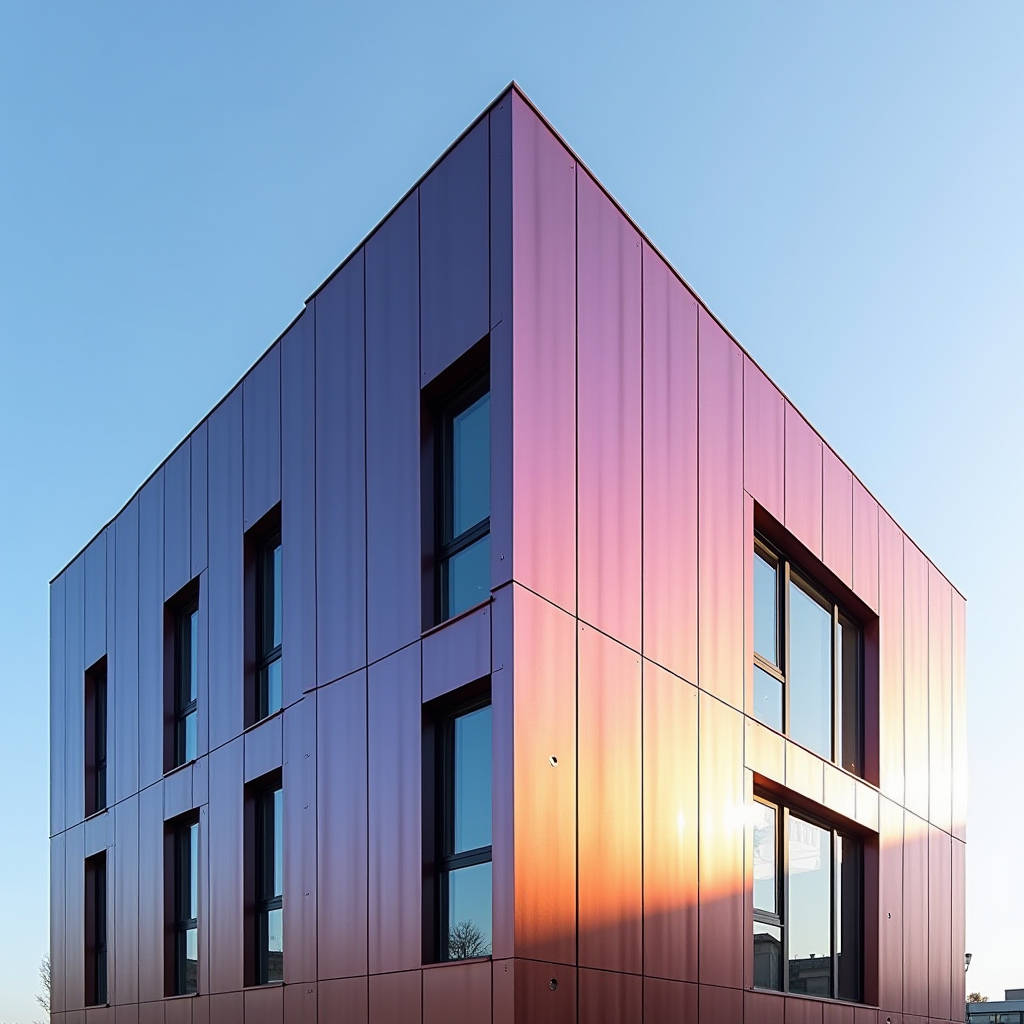
Specifying a Color Changing Aluminum Panel for a building facade means committing to a material that refuses to sit still. Unlike a standard PVDF solid color that reads the same at 8:00 AM and 4:00 PM, an iridescent or chameleon-coated solid aluminum panel shifts its perceived hue as the sun tracks across the sky or as a pedestrian walks past the elevation. This optical behavior comes from precisely engineered multi-layer interference pigments suspended in high-performance fluoropolymer coatings. For the architect, the payoff is a facade that feels alive. For the contractor and the specifier, the real work lies in understanding how the coating is built, how to write a specification that holds up, and what happens to warranty coverage when a panel changes color by design rather than by defect. The following sections unpack the coating chemistry, the fabrication constraints unique to solid aluminum sheet, the cost implications, and the testing standards that separate a legitimate architectural product from a short-lived novelty.
What Makes the Color Shift: Interference Pigments vs. Conventional Coatings
A standard architectural PVDF coating gets its color from absorption pigments. Light hits the surface, certain wavelengths get absorbed, and the eye sees what bounces back. A Color Changing Aluminum Panel works on a different principle. The coating contains microscopic interference pigments, typically constructed from mica flakes or synthetic silica platelets coated with multiple layers of metal oxides, most commonly titanium dioxide (TiO₂) and iron oxide (Fe₂O₃). Each layer has a carefully controlled thickness measured in nanometers. When light strikes the panel, some wavelengths reflect off the top oxide layer while others penetrate deeper and reflect off the substrate layer. The two reflected waves either reinforce or cancel each other depending on the viewing angle, producing the color shift.
This is the same physics that creates the iridescence in a soap bubble or a butterfly wing, but engineered for a 30-year building envelope. The critical difference is durability. Interference pigments for architectural use must be encapsulated in a resin system that bonds to aluminum and withstands UV radiation without yellowing or delaminating. The industry standard is a 70% PVDF fluoropolymer resin system, typically Kynar 500® or Hylar 5000®, loaded with the interference pigment and applied at a minimum dry film thickness of 25-35 microns over a primer that itself runs 5-8 microns. Some coating systems add a clear topcoat for additional gloss control and abrasion resistance, bringing total dry film thickness to 40-50 microns.
Angle-Dependent vs. Light-Dependent Shifts
Not all color-shifting coatings behave the same way. The specifier needs to distinguish between two mechanisms. Angle-dependent shift, sometimes called goniochromism, means the color changes as the observer moves relative to the panel. A facade might read as deep violet from directly below but shift to copper when viewed from the street corner. Light-dependent shift means the color changes with the quality of the light source itself — direct noon sunlight versus overcast diffuse light versus warm sunset. Most architectural interference coatings exhibit both effects to varying degrees. The manufacturer should provide spectral reflectance data measured at multiple angles (typically 15°, 25°, 45°, 75°, and 110° from specular) so the design team can anticipate how the building will read under different conditions.
Coating System Architecture: Why PVDF Matters for Solid Aluminum
The color-shifting pigment is only as good as the resin that carries it. For solid aluminum cladding panels — typically 2.0mm, 2.5mm, or 3.0mm thick 3003-H14 or 5005-H14 alloy sheet — the coating system must perform three jobs simultaneously: anchor to the metal, protect the pigment, and resist environmental degradation for decades. The standard architectural coating sequence for a Color Changing Aluminum Panel is:
- Chromate conversion coating applied directly to the cleaned and pre-treated aluminum surface, providing corrosion resistance and a tooth profile for the primer.
- Epoxy or polyurethane primer at 5-8 microns, creating the bond bridge between metal and color coat.
- PVDF color coat containing the interference pigment at 25-35 microns. This is where the color shift lives.
- Clear PVDF topcoat (optional but recommended for exterior applications) at 12-15 microns, providing UV shielding and surface hardness.
The total system thickness runs 45-60 microns. Anything thinner and the color shift intensity drops off. Anything thicker and the coating risks mud-cracking during panel forming. This is a tighter tolerance window than a standard solid-color PVDF system, and it requires a coating line with precise roll-coat or spray-booth control.
Per AAMA 2605, the highest voluntary specification for architectural coatings on aluminum, the coating system must pass 4,000 hours of salt spray resistance (ASTM B117), 4,000 hours of humidity resistance (ASTM D2247), and 10 years of South Florida exposure with no more than 5 Delta-E color change and no chalking above rating 8. Interference-pigment coatings that meet AAMA 2605 are the only ones that belong on an exterior wall.
Fabrication Constraints: Solid Aluminum Sheet vs. Coil-Coated Limitations
Here is where the conversation gets practical for the fabricator and the installer. A Color Changing Aluminum Panel starts as a flat sheet that gets cut, routed, bent, and assembled into a rainscreen cassette, a flat-lock panel, or a custom-formed cladding element. The interference pigment creates specific fabrication constraints that do not exist with standard PVDF colors.
First, bend radii matter more. The multi-layer coating is thicker and more brittle than a standard color coat. A tight 90-degree bend on a press brake can micro-crack the clear topcoat, which becomes visible as a whitish haze along the bend line when the panel is viewed at an angle. The fix is to specify a minimum inside bend radius of 2.5 times the material thickness for 3.0mm sheet (7.5mm minimum radius) and to orient the bend so the coated face is on the outside of the bend, not compressed on the inside.
Second, touch-up is nearly impossible. A scratched standard PVDF panel can be field-touched with a color-matched paint pen. An interference coating cannot be field-matched because the color shift depends on the exact film thickness and pigment orientation achieved in the factory coating line. Any field-applied paint will read as a dead spot at certain angles. The practical implication is that the contractor must protect panels during handling and staging with more care than usual, and the specification should include a realistic allowance for factory-replacement panels rather than assuming field repair.
Third, panel orientation on the building must be consistent. The interference pigment has a directional grain imparted by the coating process. If panels are installed upside down or rotated 180 degrees relative to each other, the color shift will not match from panel to panel. The fabricator must mark directional arrows on the protective film, and the installer must follow them. This sounds obvious but gets missed on large projects with multiple crews.
Specifying the Color Shift: How to Write a Measurable Performance Spec
A specification that reads "color shall shift from blue to purple" is unenforceable. The specifier needs objective, measurable criteria. The following parameters should be included in the coating specification section for a Color Changing Aluminum Panel:
Required Specification Data Points
- Pigment type: Synthetic silica or mica-based interference pigment, not absorption dye or printed film.
- Resin system: Minimum 70% PVDF resin (Kynar 500® or Hylar 5000®) by weight in the color coat, per AAMA 2605.
- Color measurement protocol: Spectrophotometer readings at 15°, 25°, 45°, 75°, and 110° from specular, using D65 illuminant and 10° observer. The spec should define the acceptable Delta-E range at each angle relative to the approved control sample.
- Gloss: Measured at 60° per ASTM D523. Interference coatings typically read 25-45 gloss units. A clear topcoat can push this higher.
- Film thickness: Total dry film thickness 45-60 microns, measured by eddy-current gauge per ASTM D7091.
- Accelerated weathering: Minimum 4,000 hours QUV-B or xenon arc per ASTM G154/G155 with no more than 5 Delta-E shift and no blistering, cracking, or adhesion loss.
- South Florida exposure: 10-year natural weathering data for the specific interference pigment formulation, not just the resin system.
The spec should also require the coating applicator to be licensed by the resin manufacturer and to provide a written warranty covering film integrity, color retention, and chalk resistance for a minimum of 20 years on the interference coating specifically — not just a generic PVDF warranty.
Cost Structure: Where the Money Goes
A Color Changing Aluminum Panel carries a material premium over standard PVDF solid colors. Understanding the cost breakdown helps the estimator build an accurate budget and helps the architect justify the specification to the client.
| Cost Component | Standard PVDF Solid Color | Interference/Chameleon PVDF | Delta |
|---|---|---|---|
| Coating material (per sqm) | $8-12 | $22-38 | +180-220% |
| Minimum order quantity | 50-100 sqm | 200-500 sqm | Custom batch |
| Lead time (coating only) | 2-3 weeks | 4-6 weeks | +2-3 weeks |
| Waste factor (cutting/fabrication) | 8-12% | 15-20% | Directional matching |
| Replacement panel cost | Standard | 2-3x standard | Batch matching risk |
| Warranty premium | Included | +$3-6/sqm | Specialized coating |
The higher waste factor deserves attention. Because panels must be oriented consistently relative to the coating grain, the fabricator cannot nest parts as efficiently as with a non-directional solid color. On a complex facade with many different panel sizes, the waste factor can push toward 20%. The specification should account for this in the bid documents rather than surprising the contractor at the fabrication stage.
Suppliers like Futeng® that run dedicated architectural aluminum coating lines can manage batch consistency across larger production runs, which matters when a project requires 2,000 square meters of panels and the color shift must read identically across all of them. The key is asking the supplier for a single-batch commitment for the entire project and verifying that the coating line can handle the full quantity in one continuous production window.
Testing and Validation: What to Ask for Before Approving a Submittal
When the contractor submits a Color Changing Aluminum Panel for approval, the review should go beyond checking the color against a sample chip. The following test reports should be requested as part of the submittal package:
- AAMA 2605 compliance certificate from an independent laboratory (not the coating manufacturer's in-house lab). This covers adhesion, impact resistance, chemical resistance, and accelerated weathering.
- Multi-angle spectrophotometer report showing L*a*b* values at the five angles specified above, for both the submitted sample and the project control standard.
- Adhesion test: Cross-hatch or pull-off test per ASTM D3359, performed on the actual coated aluminum substrate, not a steel test panel.
- Pencil hardness: Minimum H-2H per ASTM D3363, relevant for panels within reach of pedestrian contact.
- Chemical resistance: 10% HCl and 10% NaOH spot test for 24 hours with no blistering or softening, per AAMA 2605.
- Florida exposure data: At minimum 5 years of real-time South Florida exposure at 45° south-facing for the specific interference pigment formulation. Xenon arc data alone is not sufficient because accelerated tests cannot fully replicate the angle-dependent degradation behavior of interference coatings.
One nuance that catches specifiers off guard: the color shift itself can change slightly over the first 6-12 months of exposure as the coating fully cures and the topcoat stabilizes. This is normal and typically falls within 2-3 Delta-E. The specification should acknowledge this curing drift and define the post-cure measurement window (e.g., readings taken 6 months after installation) as the baseline for warranty evaluation.
Installation Considerations: Managing the Visual Outcome on Site
The best coating specification in the world cannot save a facade that is installed without attention to the optical behavior of the material. A Color Changing Aluminum Panel facade demands installation protocols that a standard solid-color job does not.
Panel layout must be reviewed under the actual site lighting conditions, not just in the fabrication shop. A mock-up is non-negotiable. The mock-up should be at least 3 panels wide by 3 panels high, installed on the actual building orientation, and reviewed at three times of day: morning (low-angle east light), noon (overhead), and late afternoon (low-angle west light). The color shift can look dramatically different at each time, and the design team needs to confirm that the effect is intentional rather than chaotic.
Adjacent panels from different production batches should be checked side-by-side on the mock-up. Even with a single-batch commitment, there can be subtle drift in pigment concentration across a large coating run. The mock-up is the place to catch this, not after 500 panels are on the wall.
Fastener and clip selection also matters more than usual. The interference coating is visually active, which means any shadow line, fastener head, or clip stand-off becomes part of the visual composition. Concealed fastener systems — rainscreen carriers, cassette systems with hidden clips, or structurally bonded panels — tend to produce a cleaner result. Exposed fasteners in a contrasting color can either complement the color shift or fight it. The design team should specify fastener finish as part of the coating submittal, not as a separate procurement decision.
Long-Term Performance: What 10 Years of Data Actually Shows
Interference-pigment PVDF coatings have been on the market for roughly 15 years in architectural applications, which means there is now a meaningful body of real-world performance data. The findings are generally positive but with specific caveats.
Color stability is excellent in the resin system itself. The PVDF matrix does not yellow or chalk significantly over 10-15 years of exposure. However, the interference pigment can undergo subtle changes. The metal oxide layers are chemically stable, but the resin-to-pigment interface can degrade microscopically, causing a slight reduction in color shift intensity over time. A panel that showed a dramatic 30-Delta-E shift between 15° and 110° when new might show a 22-Delta-E shift after 10 years. The color is still shifting, but the effect is less dramatic. This is rarely a warranty issue because the shift is gradual and uniform, but it is worth discussing with the client upfront.
Chalking resistance is where the clear topcoat earns its cost. Interference pigments without a clear topcoat can develop a slight surface haze after 5-7 years that dampens the color shift. A 12-15 micron clear PVDF topcoat eliminates this issue. The specification should mandate the clear topcoat for any exterior application, regardless of whether the coating manufacturer offers a lower-cost single-coat option.
For reference, the American Architectural Manufacturers Association (AAMA) publishes AAMA 2605, the governing standard for high-performance architectural coatings. The ASTM International maintains the relevant test methods including ASTM D3359 for adhesion, ASTM B117 for salt spray, and ASTM G155 for xenon arc weathering. The Fluoropolymer Coatings Industry provides technical resources on PVDF resin systems and applicator certification programs.
When a Color Changing Aluminum Panel Makes Sense — and When It Does Not
The honest assessment from a procurement and engineering standpoint is that this material is not for every project. It makes strong sense on feature elements: a building entry canopy, a lobby facade, a penthouse screen wall, an accent band that wraps a parking structure. These are applications where the color shift is visible from multiple viewing distances and angles, and where the premium cost is concentrated on a limited area rather than spread across 10,000 square meters of background wall.
It makes less sense on large expanses of uniform facade where the viewing angle is consistently head-on, such as a tower's upper floors seen only from a distance. At 200 meters, the color shift between 15° and 25° viewing angle is negligible, and the owner is paying a premium for an effect that nobody sees.
It also makes less sense in climates with predominantly overcast skies. The interference pigment needs directional light to produce the shift. Under flat gray cloud cover, a Color Changing Aluminum Panel reads as a muted mid-tone, and the effect is largely lost. The specifier should honestly assess the site's typical lighting conditions before committing to the material.
The decision ultimately comes down to whether the color shift is integral to the architectural concept or just a decorative afterthought. When it is integral — when the building is designed around the idea of a facade that changes over the course of a day — the material delivers. When it is a last-minute substitution for a standard color, the cost and complexity rarely justify the result. The specifier who understands the coating chemistry, writes a tight performance specification, and plans for the fabrication and installation realities will get a facade that performs as intended. The one who treats it as just another color choice will not.