Chameleon Aluminum Panel Engineering Guide for Solid Aluminium Facade Systems
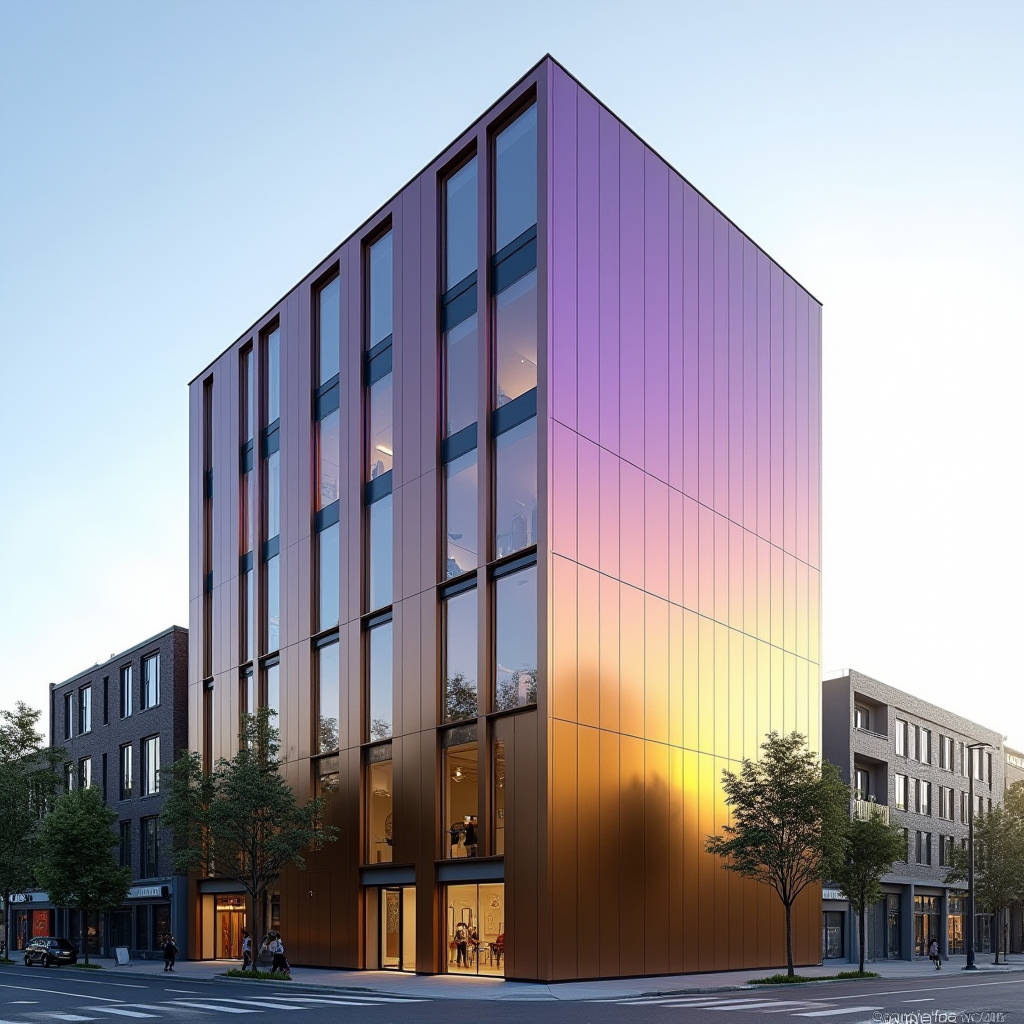
Chameleon Aluminum Panel technology has shifted from a niche decorative curiosity into a serious cladding specification for architects and facade engineers who need to deliver visual impact without compromising on the structural performance of a solid aluminium system. Unlike early-generation iridescent coatings that faded within five years, today's formulations pair multi-layer PVDF chemistry with precisely controlled pigment orientation to produce a colour-shifting surface that reads differently at dawn, noon, and dusk. The engineering challenge is not the pigment itself. It is maintaining that optical consistency across 2.5 mm and 3.0 mm solid aluminium sheets that span 1,200 mm to 1,500 mm in width, while meeting the same wind load, flatness, and fire performance standards that apply to any conventional PVDF solid panel. This article examines the specific technical factors that determine whether a Chameleon Aluminum Panel performs as specified over a 20-year building lifecycle, from coating architecture and ASTM testing to fabrication tolerances and on-site handling.
What Actually Produces the Colour Shift
The visual effect in a Chameleon Aluminum Panel is not a dye or a tinted clear coat. It is a physical optics phenomenon driven by multi-layer interference. The coating stack contains semi-transparent metal oxide platelets suspended in a fluoropolymer carrier. Each platelet is a microscopic Fabry-Pérot cavity: a thin reflective core of aluminium or titanium dioxide sandwiched between layers of silica or similar dielectric material with a controlled refractive index. When white light hits the surface, specific wavelengths are constructively reinforced at specific angles while others are cancelled. As the viewing angle changes, the reinforced wavelength shifts, and the perceived colour moves along the spectrum.
This is the same physics that produces iridescence in butterfly wings, but engineered for industrial durability. The pigment manufacturer — typically Merck or BASF under their respective effect pigment divisions — controls the colour travel by adjusting the thickness of the dielectric layers. A thinner dielectric stack produces a tighter colour shift, say from bronze to green. A thicker stack creates a wider travel, from violet through gold to teal. The specifier needs to understand that the colour shown on a small laboratory drawdown card will look different on a 1,500 mm wide solid aluminium panel installed on a south-facing elevation at latitude 35°N. The angle of incidence from the sun, the observer's distance from the facade, and the surrounding reflected light all modulate the perceived colour.
Coating Architecture: Why PVDF Matters
The interference pigments are only as durable as the resin system that encapsulates them. For exterior solid aluminium cladding, the baseline specification is a three-coat PVDF system based on Kynar 500® or Hylar 5000® resin, containing a minimum 70% PVDF by weight in the colour coat. A typical Chameleon Aluminum Panel coating stack from a qualified applicator looks like this:
- Pre-treatment: Chromate conversion coating per ASTM B449, or a chromium-free alternative per AAMA 2605 requirements, applied to a 3003-H14 or 5052-H32 aluminium substrate.
- Primer coat: 5–8 μm epoxy or polyurethane primer, oven-cured to bond the substrate and provide corrosion isolation.
- Base coat: 15–20 μm PVDF colour coat containing the interference pigment platelets. The orientation of these platelets is critical — they must lie parallel to the substrate surface to produce uniform colour shift. Spray application parameters (viscosity, gun distance, pass speed) directly control platelet alignment.
- Clear top coat: 12–15 μm PVDF clear coat with UV absorbers and hindered amine light stabilisers (HALS). This layer protects the interference pigments from photo-oxidation and provides the gloss finish (typically 25–35 GU at 60°).
Total dry film thickness for a properly specified Chameleon Aluminum Panel coating is 35–45 μm, measured per ASTM D7091. Anything below 30 μm raises questions about long-term colour retention, particularly in coastal or high-UV environments.
Performance Testing: Beyond the Standard PVDF Data Sheet
Standard PVDF coatings on solid aluminium panels are tested to AAMA 2605-20, which sets pass/fail criteria for colour change (ΔE ≤ 5.0 after 10 years South Florida exposure), chalk rating (≥ 8), and gloss retention (≥ 50%). A Chameleon Aluminum Panel introduces an additional variable: the colour shift itself must remain stable over the weathering period. A panel that shifts from bronze to green when new should not degrade to shifting from brown to olive after five years of UV exposure.
The test protocol that matters here is ASTM G155 accelerated weathering with xenon arc lamps, run for a minimum of 4,000 hours. The pass criterion for a Chameleon Aluminum Panel should be tighter than the generic AAMA 2605 ΔE limit. A practical specification benchmark is ΔE ≤ 3.0 when measured at the same angle (typically 15° from specular) before and after exposure. This accounts for the fact that the colour measurement itself is angle-dependent — a multi-angle spectrophotometer (X-Rite MA98 or similar) must be used, with measurements taken at 15°, 45°, and 110° from the specular reflection.
Salt spray resistance per ASTM B117 (4,000 hours with no blistering, no creepage from scribe exceeding 2 mm) is equally relevant. The interface between the interference pigment platelets and the PVDF resin is a potential failure point if moisture penetrates the clear coat. Suppliers like Futeng®, who operate their own PVDF coating lines rather than outsourcing to third-party applicators, can control this interface through real-time film thickness monitoring and oven profile management. This vertical integration becomes a practical differentiator when evaluating Chameleon Aluminum Panel sources for projects exceeding 5,000 square metres.
Comparative Coating Durability Data
The table below compares the performance characteristics of a Chameleon PVDF coating against conventional PVDF solid colours and metallic PVDF coatings, based on published AAMA 2605 test data and accelerated weathering results.
| Parameter | Chameleon PVDF (3-Coat) | Standard Solid PVDF (3-Coat) | Metallic PVDF (3-Coat) | Test Standard |
|---|---|---|---|---|
| Total DFT (μm) | 35–45 | 30–38 | 32–42 | ASTM D7091 |
| ΔE after 4000 hrs Xenon | ≤ 3.0 (multi-angle avg.) | ≤ 3.0 | ≤ 4.0 | ASTM G155 |
| Gloss retention (60°) | ≥ 65% | ≥ 70% | ≥ 60% | ASTM D523 |
| Salt spray (4000 hrs) | No blisters, creep ≤ 2 mm | No blisters, creep ≤ 2 mm | No blisters, creep ≤ 2 mm | ASTM B117 |
| Acid resistance (10% HCl, 15 min) | No colour shift change | No visible change | Slight darkening possible | AAMA 2605 |
| Colour measurement method | Multi-angle spectrophotometer required | Standard sphere spectrophotometer | Multi-angle recommended | — |
Fabrication: Why Solid Aluminium Demands Different Handling
The interference pigment platelets that create the colour shift are physically aligned in the wet film during spraying. When the coated flat sheet enters the fabrication stage — routing, bending, welding, and assembling into a finished panel system — that alignment can be disrupted at fold lines, welded joints, and routed edges. This is a fabrication problem that does not exist for solid-colour PVDF panels.
On a 2.5 mm or 3.0 mm solid aluminium sheet, the standard fabrication sequence is: CNC routing of the perimeter and any stiffener grooves, followed by folding on a press brake to form the panel edges and returns. The fold radius at the corner of a typical cassette panel is 1.5 to 2.0 times the material thickness. At this radius, the coating on the outside of the bend experiences tensile strain. For a Chameleon Aluminum Panel, this strain can physically reorient the pigment platelets, creating a visible colour discontinuity at the bend line that appears as a lighter or differently coloured stripe when viewed from an acute angle.
The mitigation is twofold. First, the coating applicator should run bend tests on sample coupons before full production, measuring the colour difference between the flat area and the bend area using a multi-angle spectrophotometer. An acceptable result is ΔE ≤ 2.0 at the bend compared to the flat surface. Second, the fabricator should keep the bend radius as large as the architectural design permits — 3.0 mm minimum for a 2.5 mm sheet, 4.0 mm for a 3.0 mm sheet — to reduce coating strain. If the design requires a sharp 90° corner, a welded and ground corner detail with post-fabrication touch-up coating may be necessary, though touch-up on a Chameleon Aluminum Panel will never perfectly match the factory-applied finish due to the difficulty of replicating platelet orientation in a field-applied repair.
Flatness and Optical Uniformity Across Large Panels
Oil canning — the waviness visible on the surface of a flat metal panel under certain lighting conditions — is a known issue for all solid aluminium cladding. On a Chameleon Aluminum Panel, the problem is amplified because the colour-shifting surface acts as an optical amplifier. Any deviation from flatness changes the local angle of the surface relative to the light source and the observer, which in turn changes the perceived colour. A panel that is flat within a 3 mm deviation across a 1,200 mm span may show acceptable colour uniformity. A panel with 6 mm of waviness will display visible colour banding that has nothing to do with the coating quality and everything to do with the substrate.
Controlling this starts with the aluminium temper. For flat panels, H14 temper (half-hard) on 3003 alloy provides a yield strength of approximately 145 MPa, which resists the compressive stresses introduced during fabrication. For panels with deep returns or complex geometries, 5052-H32 at 195 MPa yield strength offers better stiffness. The stiffener system — typically aluminium extrusions bonded to the rear face with structural adhesive — must be designed to limit panel deflection to L/180 under the project's design wind load, where L is the span between attachment points. For a Chameleon Aluminum Panel, a tighter flatness specification of L/240 is a prudent upgrade, adding approximately 8–12% to the stiffener material cost but eliminating the risk of colour banding from deflection.
Wind Load and Span Considerations
The structural design of a Chameleon Aluminum Panel system follows the same principles as any solid aluminium rainscreen. The key parameters are the panel thickness, the stiffener layout, and the attachment system. For a typical open-joint rainscreen on a mid-rise commercial building with a design wind pressure of 1.5 kPa (approximately 155 km/h wind speed, ASCE 7-16 basic wind speed map), the following span limits apply:
- 2.5 mm thick, 3003-H14, stiffeners at 500 mm centres: Maximum panel dimension 1,200 mm × 2,400 mm, deflection limited to L/180.
- 3.0 mm thick, 3003-H14, stiffeners at 400 mm centres: Maximum panel dimension 1,500 mm × 3,000 mm, deflection limited to L/180.
- 3.0 mm thick, 5052-H32, stiffeners at 400 mm centres: Maximum panel dimension 1,500 mm × 3,600 mm, deflection limited to L/240 (recommended for Chameleon finish).
These are conservative numbers based on four-side support with aluminium extrusion stiffeners and a safety factor of 1.5 on yield. The attachment system — typically aluminium brackets with stainless steel screws — must accommodate thermal movement of approximately 2.4 mm per metre of panel length for a 50°C temperature swing (coefficient of thermal expansion for aluminium: 23.6 × 10⁻⁶ /°C). Fixed-point and sliding-point connections should be specified to prevent buckling that would disrupt the colour-shifting surface.
Specifying the Colour: The Sample Problem
A 100 mm × 150 mm flat sample of a Chameleon Aluminum Panel tells you almost nothing about how the colour will read on a 10-metre-high facade. The colour shift depends on the angle between the light source, the surface, and the observer. A small sample held in the hand can be rotated to see the full colour travel. A fixed facade panel cannot. The specifier sees only the colour that corresponds to the specific geometry of that building at that time of day.
The practical solution is a full-size mock-up. A minimum of two panels, 1,200 mm × 2,400 mm, installed on the actual building orientation at the correct height above ground, viewed at the times of day that matter most — typically 10:00, 14:00, and 17:00 for the primary elevation. The mock-up should be evaluated under both direct sunlight and overcast conditions, because the diffuse light on a cloudy day produces a different colour reading than the directional light of full sun. The colour shift is more dramatic under direct light; under diffuse light, the panel tends toward its mid-travel colour.
This is not a trivial cost — a two-panel mock-up with framing and installation might run USD 2,000–4,000 depending on access requirements — but it is negligible compared to the cost of rejecting 2,000 square metres of finished panels because the colour does not match the architect's expectation. When sourcing from manufacturers like Futeng®, request a documented mock-up procedure that includes the specific batch of pigment, the coating line parameters, and the multi-angle colour measurements from the mock-up panels. This data becomes the quality control reference for the production run.
Supply Chain and Lead Time Realities
The interference pigments used in a Chameleon Aluminum Panel are specialty products with lead times of their own. A typical pigment manufacturer holds limited stock of the more exotic colour shifts. If a project specifies a specific colour travel — say, violet-to-gold-to-green — that requires a custom pigment blend, the pigment lead time alone can be 6–8 weeks. Add 2–3 weeks for PVDF coating, 3–4 weeks for panel fabrication, and 4–6 weeks for ocean freight from Asia to a North American or European project site, and the total procurement timeline is 15–21 weeks from order placement to site delivery.
This timeline has practical implications for the construction schedule. The Chameleon Aluminum Panel order should be placed before the facade substructure installation begins, not after. The colour specification must be locked at the same time as the structural engineering package, because the panel thickness and stiffener design depend on the wind load calculations, and the coating specification depends on the colour choice. A late colour change from a standard PVDF to a Chameleon finish can add 8 weeks to the facade programme and potentially trigger liquidated damages if the main contractor has not built that buffer into the schedule.
Cost Structure: Where the Premium Goes
A Chameleon Aluminum Panel carries a cost premium of 30–50% over an equivalent solid-colour PVDF panel of the same thickness and dimensions. This premium breaks down roughly as follows:
- Pigment cost: Interference pigments cost 5–10 times more per kilogram than standard inorganic pigments. For a 2.5 mm panel with a 20 μm colour coat, the pigment cost alone can be USD 8–15 per square metre above the baseline.
- Application complexity: The spray parameters must be tightly controlled to achieve platelet alignment. This reduces line speed and increases the rejection rate. A typical PVDF line might run at 3–4 metres per minute for solid colours; a Chameleon coating may run at 2–2.5 metres per minute.
- Quality control: Multi-angle colour measurement is more time-consuming than standard spectrophotometry. Each production batch requires measurement at three angles, and the acceptance criteria are tighter.
- Waste factor: The directional nature of the colour shift means that panels cannot be rotated or flipped to hide minor defects. A solid-colour panel with a small scratch on one edge can sometimes be reoriented; a Chameleon panel with the same scratch must be rejected if the scratch is visible from the primary viewing direction.
For budget estimation, a 2.5 mm solid aluminium Chameleon Aluminum Panel system, including stiffeners, brackets, and fixings but excluding the substructure, runs approximately USD 180–260 per square metre FOB, depending on the complexity of the panel geometry and the specific colour shift specified. This compares to USD 120–160 per square metre for a standard PVDF solid-colour panel of the same gauge. The substructure, installation labour, and design fees are additional and largely independent of the coating choice.
Installation and On-Site Handling
The directional colour shift of a Chameleon Aluminum Panel introduces a handling requirement that does not apply to conventional panels: every panel must be installed in the orientation specified on the shop drawing. A solid-colour panel can be rotated 180° and still read identically. A Chameleon panel rotated 180° will show the colour shift in the opposite direction, creating a visible mismatch with adjacent panels. The shop drawings must clearly indicate the "up" direction for each panel, and the installation crew must follow this direction without exception.
Protective film is standard on all PVDF-coated panels during transport and installation. For a Chameleon Aluminum Panel, the film should be a UV-resistant type rated for outdoor exposure of up to 6 months, because the installation sequence may leave panels exposed to sunlight for weeks before the film is removed. Standard PE film can degrade under UV, leaving adhesive residue that is difficult to remove without damaging the clear coat. A paper-based or UV-stabilised PE film with a low-tack acrylic adhesive is the recommended specification.
On-site touch-up of a Chameleon Aluminum Panel is a last resort. The interference pigment cannot be reliably applied with a brush or aerosol can because the platelet orientation is uncontrolled. If a panel is damaged during installation, the correct remedy is replacement with a panel from the same production batch. Maintaining 2–3% spare panels in the project order — stored on site in the same orientation — is a cost-effective insurance policy against installation damage.
ASTM International's Committee D01 on Paint and Related Coatings maintains the test standards referenced throughout this article. Their published methods for film thickness measurement (D7091), accelerated weathering (G155), and colour measurement (E1331) form the basis of any defensible Chameleon Aluminum Panel specification. See www.astm.org for the current versions.
Long-Term Maintenance and Colour Stability
The maintenance profile of a Chameleon Aluminum Panel is similar to that of any PVDF-coated solid aluminium cladding: periodic cleaning with a mild detergent and water, using a soft brush or sponge at low pressure. The recommended cleaning interval is 6–12 months depending on the local environment. Buildings in coastal zones with salt spray or in industrial areas with airborne particulates should be cleaned every 6 months to prevent deposit buildup that can alter the perceived colour shift.
One maintenance consideration specific to the Chameleon finish is that scratches are more visible than on a solid-colour panel because the scratch disrupts the interference pigment layer and creates a local colour discontinuity. The PVDF clear coat provides reasonable scratch resistance — typically 2H to 3H pencil hardness per ASTM D3363 — but it is not scratch-proof. Facade access systems should be designed to prevent ladders, platforms, or cleaning equipment from contacting the panel surface. A 50 mm minimum standoff between any access equipment and the panel face is a practical detail to include in the maintenance plan.
After 15–20 years of exterior exposure, a well-maintained Chameleon Aluminum Panel should retain its colour-shifting effect with a ΔE of no more than 5.0 from the original multi-angle measurements. The clear coat may show some gloss reduction — from an initial 30 GU to perhaps 20 GU — but the underlying interference pigments, protected by the PVDF clear coat and the UV absorber package, should remain optically active. This is the fundamental advantage of the three-coat PVDF system: the functional layer is buried under a sacrificial clear layer that takes the environmental damage.
Making the Specification Decision
A Chameleon Aluminum Panel is not a universal solution. It is a high-impact material for projects where the facade is a primary architectural statement: cultural buildings, corporate headquarters, high-end retail, transportation hubs. The cost premium, the longer lead time, and the tighter fabrication and installation tolerances are justified only when the colour-shifting effect is integral to the design intent, not when it is a decorative afterthought.
The decision to specify should be based on a clear-eyed assessment of four factors: the project budget can absorb the 30–50% coating premium; the construction schedule allows 15–21 weeks from order to delivery; the design team has reviewed a full-size mock-up under site conditions and confirmed the colour shift meets expectations; and the installation contractor has experience with directional finishes and understands the orientation requirements. If all four conditions are met, a Chameleon Aluminum Panel delivers a facade that no solid-colour or standard metallic coating can replicate. If any condition is not met, the project carries a real risk of cost overruns, schedule delays, or a finished facade that disappoints.
The global supply base for this product is concentrated among manufacturers who operate their own PVDF coating lines and have invested in the spray application technology required for consistent platelet alignment. When evaluating sources, the technical differentiators are in-house coating capability, documented multi-angle colour measurement procedures, and a track record of projects exceeding 5,000 square metres with the Chameleon finish. The AAMA 2605 certificate is the baseline; the specific experience with interference pigment systems is the discriminator.