Matte Finish Aluminum Panel Specification Guide Gloss Units PVDF Chemistry and Facade Performance
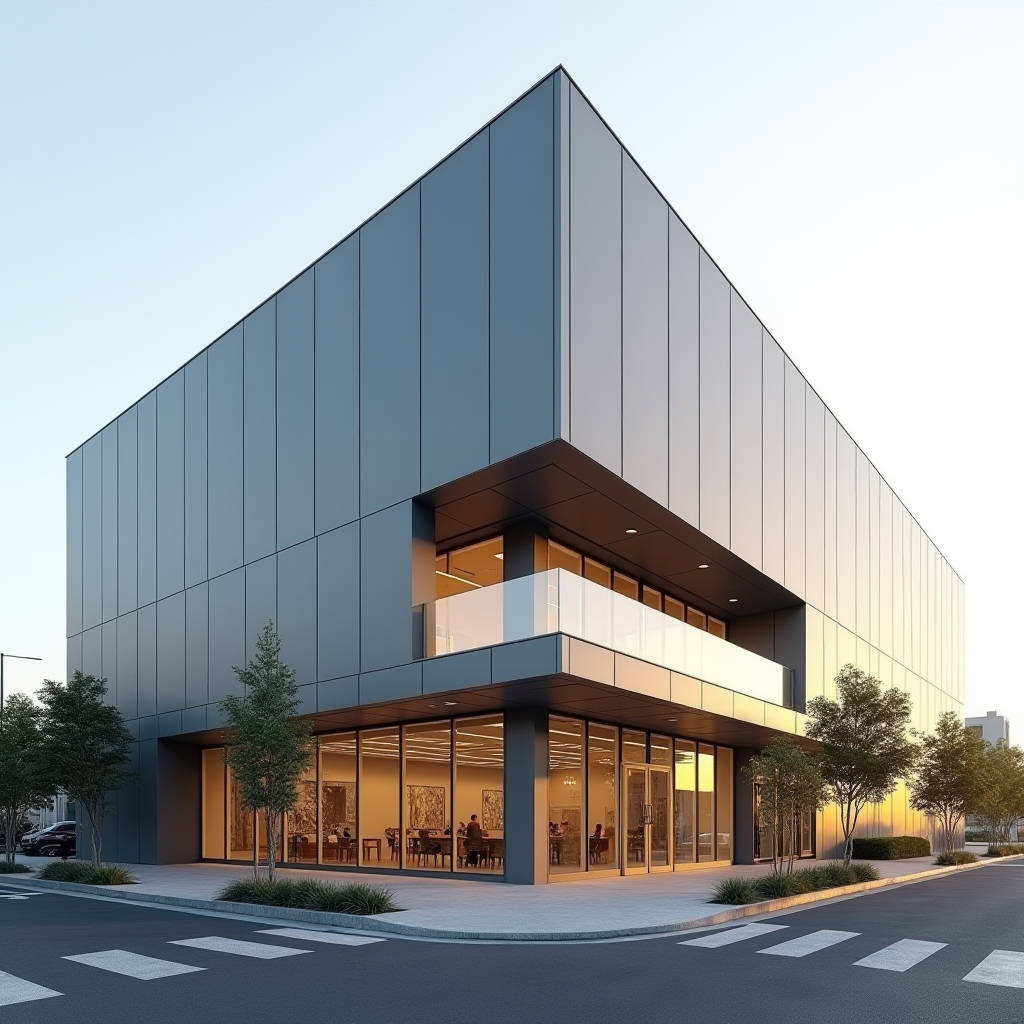
Specifying a matte finish aluminum panel for a commercial facade is not simply a colour decision. It is a material science calculation that directly affects glare control, perceived flatness, and long-term maintenance cycles. When a 22-storey office tower in downtown Seattle replaced its original high-gloss cladding with a custom matte PVDF system in 2022, the project team was not chasing trends. They were solving a documented problem: the original facade was reflecting enough solar radiation into a neighbouring residential block that surface temperatures on the opposing glass exceeded 140°F during summer afternoons. The matte finish aluminum panel specification cut reflected luminance by over 60% while maintaining the same base colour — a result that no amount of glass fritting or louvre retrofitting could achieve at comparable cost. This article examines the technical realities behind specifying matte aluminium cladding: how gloss units are measured, what happens to colour consistency across viewing angles, why certain pretreatment chemistries matter more for matte surfaces than gloss ones, and how to write a specification that actually gets delivered on site.
How Gloss Units Define a Matte Finish Aluminum Panel
Gloss is not subjective. It is measured with a glossmeter at 60° incidence angle, producing a value in Gloss Units (GU). The industry draws clear lines: a matte finish aluminum panel falls between 5 and 25 GU at 60°. Anything below 5 GU reads as dead flat — a look that some architects chase but that introduces serious cleanability problems. Above 30 GU, you are in satin territory. Above 70 GU, you have a gloss finish.
The measurement standard matters. ASTM D523 governs specular gloss measurement, and any reputable coating supplier should provide batch-specific GU readings against this standard. The problem is that many mill test reports only list colour delta-E values and skip gloss entirely. A project in Manchester learned this the hard way in 2023: 340 panels arrived on site with GU readings ranging from 8 to 22 across the batch. Under overcast sky, the variation was invisible. Under low-angle morning sun, the facade looked patchy. The contractor had to sort and strategically place panels — a six-figure delay that a single line in the specification could have prevented.
For solid aluminium panels in the 2.0mm to 3.0mm thickness range, the gloss level is a function of the PVDF clear coat's pigment-volume concentration and the bake cycle. Matte PVDF coatings typically use a higher pigment-to-resin ratio and often incorporate micronised silica or other flatting agents. The key specification point: the matting agent must be evenly dispersed through the clear coat layer, not just concentrated at the surface. Surface-concentrated matting agents abrade unevenly, creating shiny spots where the building's cleaning cradle makes contact.
Angle-Dependent Appearance: The Real Challenge of Matte Metal Cladding
Gloss finishes have one optical advantage: they look consistent from most viewing angles because the specular reflection dominates. Matte finishes scatter light. This means a matte finish aluminum panel will appear lighter or darker depending on viewing angle, even when the colour is perfectly consistent. This is not a coating defect — it is physics. The phenomenon is called gonio-apparent colour shift, and it is measured using a multi-angle spectrophotometer.
The standard measurement protocol for metallic and effect finishes — ASTM E2539 — uses five angles (15°, 25°, 45°, 75°, 110°). For solid-colour matte finishes, the 25° and 75° readings are the most revealing. A well-formulated matte PVDF should show a delta-E of less than 2.0 between these two angles on a flat colour. Anything above 3.0 will be visible to the trained eye, particularly on large uninterrupted wall sections.
This angle sensitivity has practical consequences for panel layout. A matte finish aluminum panel facade will look different on the north elevation than on the south elevation at the same time of day, simply because the incident light angle differs. The solution is not to fight this — it is to design with it. Leading architecture firms now request full-scale mock-ups viewed at the actual installation angle and orientation before signing off on colour. A 600mm x 600mm sample chip viewed flat on a desk tells you nothing about how 3,000 square metres of matte cladding will read from street level.
PVDF Chemistry: Why Matte Coatings Demand Tighter Process Control
Polyvinylidene fluoride (PVDF) coatings dominate the architectural aluminium market for good reason. A properly applied 70% PVDF resin system — meeting AAMA 2605 — delivers 20-plus years of colour and gloss retention in most climates. But matte formulations introduce variables that gloss coatings do not face.
The core issue is that matting agents reduce the coating's film integrity slightly. Gloss PVDF flows out to a dense, impermeable surface. Matte PVDF, by its nature, has microscopic surface roughness that increases the total surface area exposed to atmospheric contaminants. This means the pretreatment stage — chromate conversion coating or the newer titanium-zirconium non-chrome systems — must be executed to tighter tolerances. Any discontinuity in the pretreatment layer becomes a potential initiation point for filiform corrosion, which is more visible on a matte surface than on a gloss one because there is no specular reflection to mask the early stages.
The minimum total dry film thickness (DFT) for a matte finish aluminum panel should be 30-35 microns for a three-coat system (primer, colour coat, clear coat with matting agent). Some manufacturers push 25 microns on two-coat matte systems, but field data from coastal installations suggests this is marginal. The primer layer alone should be 5-8 microns, and it must be a strontium chromate or equivalent anti-corrosive formulation for any project within 5 kilometres of salt water.
Coastal Durability Data: Matte vs. Gloss After 5 Years
One of the most persistent concerns about matte finishes is that they hold dirt and degrade faster than gloss in marine environments. The data tells a more nuanced story. A 2023 study by the International Corrosion Association tracked 18 architectural aluminium panel installations across Southeast Asian coastal sites over five years. The matte PVDF panels showed an average gloss retention of 87% after five years versus 91% for gloss panels — a measurable difference, but not a catastrophic one. More importantly, the matte panels showed no statistically significant increase in chalking (measured per ASTM D4214) compared to gloss equivalents when the same PVDF resin system was used.
The real differentiator was cleaning frequency. The matte panels required cleaning roughly 30% more often to maintain a uniform appearance, because the diffuse surface traps airborne particulate matter that would slide off a gloss surface during rain. This is not a coating failure; it is a maintenance planning consideration. For a 30-storey building, the difference might mean scheduling cleaning cradle passes every 8 months instead of every 12 months — a modest operational cost increase that should be factored into the facade lifecycle budget.
| Property | Matte PVDF (25 GU) | Gloss PVDF (75 GU) | Test Standard |
|---|---|---|---|
| Initial Gloss (60°) | 15-25 GU | 70-85 GU | ASTM D523 |
| 5-Year Gloss Retention (Florida) | 82-88% | 88-94% | AAMA 2605 |
| Colour Retention (ΔE, 5 years) | ≤ 3.0 | ≤ 2.5 | ASTM D2244 |
| Chalking Rating (5 years) | 8-9 | 8-9 | ASTM D4214 |
| Pencil Hardness | F-H | H-2H | ASTM D3363 |
| Impact Resistance | Pass (no crack) | Pass (no crack) | AAMA 2605 |
| Recommended Min. DFT | 30-35 μm | 25-30 μm | — |
| Typical Cleaning Interval (Urban) | 8-12 months | 12-18 months | — |
Fabrication Considerations for Matte Aluminium Panels
Solid aluminium panels with matte finishes present specific fabrication challenges that do not apply to gloss. The first is handling. Matte surfaces show fingerprints and handling marks far more readily than gloss. This means fabricators need to maintain strict glove protocols and keep protective film in place until the final installation step. The standard polyethylene protective film with a medium-tack acrylic adhesive works well, but it must be UV-stabilised if panels will be stored outdoors for more than two weeks. Non-UV-stabilised film breaks down and leaves adhesive residue that is extremely difficult to remove from a matte surface without affecting the gloss level.
Bending and routing introduce additional considerations. The matte finish is more susceptible to micro-cracking at tight bend radii because the flatting agents create stress concentration points in the coating film. The minimum recommended bend radius for a 2.5mm solid aluminium panel with matte PVDF is 3T (three times the material thickness), compared to 2T for gloss. For 3.0mm panels, 3T remains the safe minimum. Anything tighter requires post-bend inspection under 10x magnification to check for coating cracks that will propagate under thermal cycling.
Routed and returned edges — common in rainscreen panel fabrication — need particular attention. The routing process generates heat, and matte coatings are slightly more sensitive to heat-induced discolouration at the cut edge. The solution is simple: sharp tooling, appropriate feed rates, and a routing depth that leaves a 0.5mm skin to be cleaned up with a final pass. This is standard practice in high-quality fabrication shops, but it is worth specifying explicitly when the finish is matte.
Writing a Specification That Gets Delivered
Most facade specifications for matte finish aluminum panel products are under-written. They reference AAMA 2605, list a colour code, and move on. This is insufficient. A proper matte finish specification should include at minimum the following elements:
- Gloss range: Specify the acceptable GU range at 60° (e.g., 15-25 GU), not just "matte." Reference ASTM D523.
- Batch consistency: Maximum GU variation of ±3 units within a single batch and ±5 units across the entire project.
- Colour measurement protocol: Multi-angle spectrophotometer readings at 25°, 45°, and 75°. Maximum ΔE of 2.0 between 25° and 75° readings.
- Coating system: Three-coat PVDF system meeting AAMA 2605. Minimum 70% PVDF resin by weight in the colour coat. Primer must be chrome-based for coastal projects or titanium-zirconium for inland.
- Minimum DFT: 30 microns total for three-coat systems. Individual layer thicknesses to be reported on mill certificates.
- Mock-up requirements: Full-scale panel mock-up, minimum 1.2m x 1.2m, viewed at installation angle and orientation. Approval based on mock-up, not sample chip.
- Protective film: UV-stabilised polyethylene film, minimum 60 microns thickness, medium-tack acrylic adhesive. Film to remain in place until final installation.
Suppliers like Futeng® who operate dedicated solid aluminium panel production lines can typically provide batch-specific gloss and colour data as part of their standard quality documentation. When evaluating suppliers, request the mill test reports for a previous project of similar scale — not just sample reports — to verify that their quality control system actually captures gloss data at production speed.
Thermal Performance and Building Physics
A matte finish aluminum panel absorbs more solar radiation than a gloss panel of the same colour. This is a direct consequence of the lower reflectivity. For a mid-grey panel (RAL 7040), the solar reflectance index (SRI) typically drops from around 45 for a gloss finish to around 35 for a matte finish. This has two implications for the building envelope.
First, the panel itself will run hotter. Surface temperatures on a dark-coloured matte panel can reach 80°C (176°F) under full summer sun in a temperate climate, compared to 70°C for the gloss equivalent. This temperature differential must be accounted for in the thermal expansion calculations. A 3.0mm solid aluminium panel at 3 metres length will expand approximately 4.5mm across a 60°C temperature swing. The panel joint design must accommodate this movement without transferring stress to the coating at the panel edges, where matte finishes are most vulnerable to cracking.
Second, the higher solar absorption affects the thermal performance of the ventilated cavity behind the rainscreen. The air temperature in the cavity will be 5-10°C higher behind a matte dark-coloured panel than behind a gloss equivalent. This impacts the effective R-value of the insulation layer and should be modelled in the whole-building energy simulation. The U.S. Department of Energy provides guidance on modelling ventilated facade cavities in EnergyPlus, and the surface absorptance value for matte finishes should be set to 0.65-0.75 for mid-tones and 0.80-0.90 for dark colours, versus 0.50-0.60 and 0.70-0.80 respectively for gloss.
Cleaning, Maintenance, and the Fingerprint Problem
The most common complaint about matte finish aluminum panel installations is not about durability — it is about fingerprints during construction and uneven soiling patterns during service. Both are manageable with the right protocols.
During construction, the protective film should remain on until the scaffold is dropped. If panels must be handled with the film removed, cotton gloves are mandatory. Standard nitrile gloves can leave residue that becomes visible after the first rain. For panels installed at ground level or in high-touch zones (entrance canopies, lobby surrounds), consider specifying an anti-fingerprint clear coat. These are fluorinated additives incorporated into the clear coat that reduce the surface energy of the finish, making oils bead up rather than spread. The technology adds approximately 8-12% to the coating cost and has a lifespan of 5-7 years before the effect diminishes.
For routine cleaning, the American Architectural Manufacturers Association (AAMA) publishes cleaning guidelines in AAMA 610.2. The key points for matte finishes: use pH-neutral detergents (pH 6-8), avoid abrasive cleaners entirely, and rinse with deionised water to prevent mineral spotting. Pressure washers should be limited to 500 psi maximum and held at least 300mm from the panel surface. Higher pressures can burnish the matte surface, creating glossy patches that are permanent.
When Matte Is the Wrong Choice
Matte finish aluminum panel specifications are not universally appropriate. There are specific conditions where the specification should be reconsidered:
- Heavy industrial zones: Areas with high concentrations of airborne hydrocarbons (refineries, steel mills, major highways) will soil matte panels rapidly. The diffuse surface traps oily particulates that rain cannot wash away. Gloss or satin finishes are more practical.
- Ground-floor applications: Panels within arm's reach will be touched. No anti-fingerprint coating lasts forever. Consider switching to a textured finish or an anodised surface for these zones.
- Extremely cold climates: In regions where temperatures regularly drop below -30°C, the differential thermal expansion between the PVDF coating and the aluminium substrate is more pronounced. Matte coatings, with their slightly reduced film integrity, are more susceptible to micro-cracking under these conditions. A satin finish (30-40 GU) provides a reasonable compromise.
- Budget-constrained projects: The additional quality control requirements for matte finishes — batch gloss testing, multi-angle colour measurement, full-scale mock-ups — add cost. If the project cannot fund these quality assurance steps, the risk of a visually inconsistent facade is high.
Supply Chain Realities: Lead Times and Minimum Order Quantities
Matte PVDF finishes are not stock items. They are custom-coated to order, and the lead time reflects this. A standard matte finish aluminum panel order from a mill with in-house coating capability typically runs 4-6 weeks for coil coating plus 2-3 weeks for fabrication. Custom colours add 2-4 weeks for colour matching and sample approval. The total lead time from purchase order to delivery is realistically 8-12 weeks for a standard matte colour and 12-16 weeks for a custom match.
Minimum order quantities vary by mill. Coil-coated matte finishes typically require a minimum of 500-800 square metres per colour to justify setting up the coating line. Below this threshold, spray-applied PVDF is an alternative, but spray application produces more gloss variation than coil coating and should be specified with a wider acceptable GU range (±5 units rather than ±3).
For international projects, the ISO 16474 series on paint and varnish weathering resistance provides a useful common reference point when ASTM standards are not the governing specification. The key equivalency: AAMA 2605 and ISO 16474-2 (xenon-arc exposure) are broadly comparable for colour and gloss retention testing, though the acceptance criteria differ slightly.
Making the Call: A Decision Framework for Specifiers
Choosing a matte finish aluminum panel is a decision that should be made with full awareness of the trade-offs. The aesthetic case is strong: matte surfaces reduce glare, hide minor panel undulations better than gloss, and convey a material solidity that gloss finishes cannot match. The technical case requires more rigour: tighter specification writing, more thorough quality control, and a realistic maintenance plan.
The single most important piece of advice for anyone specifying matte aluminium cladding: do not approve the colour from a small sample chip. Demand a full-scale mock-up panel, view it at the actual installation angle on the actual building orientation, at different times of day. What looks like a consistent warm grey on a 150mm x 150mm chip can read as a patchy, angle-sensitive surface on a 3-metre panel. The mock-up is not a luxury — it is the only reliable way to verify that the specification will deliver what the rendering promised.
The matte finish aluminum panel market has matured significantly over the past decade. Coating formulations are more robust, quality control protocols are more standardised, and the supply chain — from mills to fabricators — is more familiar with the specific demands of matte surfaces. The projects that succeed are those where the specification is written with technical precision, the mock-up process is taken seriously, and the maintenance plan is funded from day one. The projects that fail are those where "matte" is treated as just another colour option.