Corten Steel Effect Aluminum Facade Engineering Performance and Coating Specification Guide
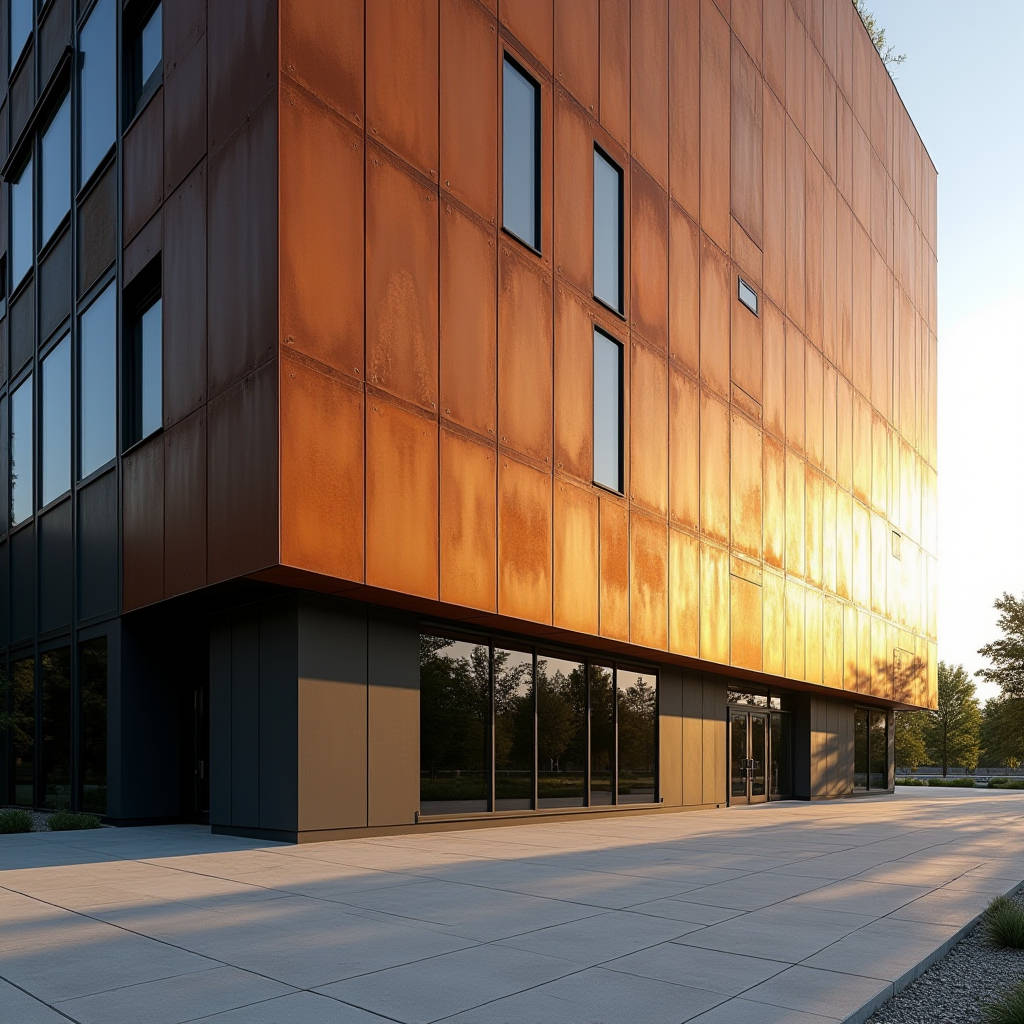
The architectural appetite for weathered steel aesthetics has surged over the past decade, yet the practical realities of specifying genuine Corten steel on large-scale facades often collide with structural weight constraints, runaway corrosion in coastal environments, and staining that mars adjacent surfaces. A Corten Steel Effect Aluminum Facade resolves this tension by delivering the same visceral, oxidized orange-brown patina that designers chase—without the 5.0 kg/m² per millimeter weight penalty, without the uncontrolled rust bleed, and without the decade-long wait for a stable oxide layer. This article examines the technical substrate beneath the aesthetic: how PVDF and FEVE coil coatings replicate the spectral signature of weathering steel on 2.0–3.0mm solid aluminium sheets, what accelerated weathering data reveals about 20-year color stability, and where the engineering boundary lies between a convincing replica and a maintenance liability. If you have been specifying genuine Corten only to watch contractors value-engineer it out, the following sections map the exact performance parameters you need to hold the line on design intent while keeping the structural budget intact.
Why Genuine Corten Steel Creates Problems That Aluminum Solves
Weathering steel—ASTM A588 and A606 Type 4—develops its protective patina through controlled oxidation. The alloying elements (copper, chromium, nickel, phosphorus) form a dense, adherent oxide layer that slows further corrosion once mature. The problem is the timeline. In arid inland climates, that stable patina might take 18 to 36 months to fully develop. In humid coastal zones, the oxide never truly stabilizes; the wet-dry cycling continuously sheds rust particles that stain concrete plazas, glass curtain walls, and paving below. A Corten Steel Effect Aluminum Facade eliminates this entire oxidative cascade because the color lives in the coating, not in the metal substrate.
The weight differential alone rewrites structural calculations. A 3.0mm solid aluminium sheet weighs approximately 8.1 kg/m². A 3.0mm Corten steel sheet weighs 23.5 kg/m²—nearly three times as much. On a 5,000 m² facade, that delta adds roughly 77 metric tons to the supporting steelwork, foundation loads, and bracket sizing. When you factor in seismic design requirements under ASCE 7 or Eurocode 8, the lighter aluminium substrate often eliminates the need for additional stiffening members entirely.
Then there is the staining. Genuine Corten requires a carefully designed drainage strategy. Runoff from unweathered panels carries iron oxide particulates that etch into porous surfaces permanently. The Steel Construction Institute publishes detailed guidance on managing this runoff, recommending sacrificial concrete aprons and dedicated drainage channels. With a coated aluminium panel, there is no runoff chemistry to manage. The facade sheds rainwater like any other architectural metal finish, with zero iron oxide transport.
The Coating Chemistry That Makes the Effect Convincing
Replicating weathered steel on aluminium requires more than a brown paint job. The human eye reads Corten's patina through three visual cues: the base orange-brown hue, the micro-variation in tone across the surface, and the low-gloss, almost chalky reflectance. Achieving all three on a smooth aluminium substrate demands a multi-layer coating system engineered for both aesthetics and durability.
PVDF Multi-Coat Systems: The Industry Baseline
Polyvinylidene fluoride (PVDF) coatings—specifically 70% PVDF resin systems conforming to AAMA 2605—form the default specification for architectural aluminium. For a Corten Steel Effect Aluminum Facade, the coating line applies a primer layer (typically 5–8 microns), a color coat carrying the iron-oxide pigmentation (20–25 microns), and a clear topcoat (12–15 microns). Total dry film thickness lands between 35 and 48 microns. The pigments themselves are ceramic and inorganic—synthetic iron oxides blended with small amounts of chromium oxide and titanium dioxide to tune the hue away from "painted brown" toward the specific spectral reflectance curve of weathered A588 steel.
Futeng® has developed a proprietary pigment dispersion process that introduces controlled micro-variation in the color coat, mimicking the tonal inconsistency of natural patina without compromising batch-to-batch repeatability. This matters because architects reviewing mock-ups will reject panels that look too uniform; the eye expects the slight mottling that genuine oxidation produces.
FEVE Fluoropolymer: The Step-Up Option
Fluoroethylene vinyl ether (FEVE) coatings offer a higher gloss retention ceiling and superior recoatability compared to PVDF, though at a cost premium of roughly 15–20%. For projects in aggressive chemical environments—industrial zones with SO₂ exposure, or coastal sites within 500 meters of breaking surf—FEVE's tighter cross-linked polymer network provides measurable advantages in color retention. Testing per AAMA 2605 typically shows FEVE retaining 90%+ specular gloss after 10 years of South Florida exposure, versus 80–85% for standard PVDF. The decision between the two often comes down to whether the project specification requires a 20-year or 30-year aesthetic warranty.
Accelerated Weathering Data: What 4,000 Hours Tells You
Architects and specifiers need hard numbers, not marketing claims. The table below compiles comparative performance data from QUV-B and Xenon arc accelerated weathering protocols, mapping the degradation pathways that distinguish a quality Corten effect coating from a commodity finish.
| Test Protocol | Standard PVDF (70% Resin) | FEVE Fluoropolymer | Standard Polyester (Reference) |
|---|---|---|---|
| QUV-B 3,000 hrs (ASTM G154) | ΔE < 3.0; gloss retention > 75% | ΔE < 2.0; gloss retention > 85% | ΔE > 8.0; gloss retention < 40% |
| Xenon Arc 4,000 hrs (ISO 11341) | ΔE < 4.0; no chalking | ΔE < 2.5; no chalking | ΔE > 10.0; moderate chalking |
| Salt Spray 3,000 hrs (ASTM B117) | No blistering; < 2mm creep at scribe | No blistering; < 1mm creep at scribe | Blistering rating 4+; > 5mm creep |
| Humidity Resistance 3,000 hrs (ASTM D2247) | No blistering; minimal color shift | No blistering; negligible color shift | Blistering rating 6; significant fade |
| Acid Resistance (10% H₂SO₄, 48 hrs) | Slight gloss reduction; no color change | No visible change | Severe etching and discoloration |
The ΔE values are the critical column. A ΔE below 3.0 is generally imperceptible to the human eye under normal viewing conditions. A ΔE above 5.0 reads as a distinct color shift. The polyester reference row explains why bargain Corten-look panels—often sold through generic cladding distributors without specifying the coating chemistry—fail visibly within 5–7 years. The iron-oxide pigments themselves are stable; it is the resin matrix that degrades, chalking and releasing pigment particles that wash away.
Substrate Integrity: Why Solid Aluminium, Not Composite
The coating is only half the performance story. The substrate underneath determines flatness tolerance, fire performance, and long-term dimensional stability. Solid aluminium sheets—grades 3003, 5005, or 5052 per ASTM B209—bring a coefficient of thermal expansion around 23.8 × 10⁻⁶ m/m/°C. A 3.0mm panel spanning 1,200mm between fixing points will expand roughly 2.8mm across a 100°C temperature swing. This is entirely manageable with standard slotted fixing systems. Aluminium composite panels, by contrast, introduce a polyethylene or mineral-filled core with different thermal behavior, creating a bimetallic bending effect that manifests as visible oil-canning within the first seasonal cycle.
Fire performance is the other non-negotiable. Solid aluminium is non-combustible—classified A1 under EN 13501-1 or meeting the requirements of ASTM E84 Class A when tested as part of an assembled system. For buildings over 18 meters in the UK, or Type I and II construction in the US, this classification is mandatory. Specifying a Corten Steel Effect Aluminum Facade on solid aluminium keeps the fire engineer's report clean without requiring additional cavity barriers or fire stops that composite panels demand.
Fabrication Tolerances and the Corten Look
The industrial aesthetic of Corten steel is often expressed through crisp folds, sharp corners, and large-format panels with minimal visible joints. Solid aluminium achieves this through CNC folding and routing. A 3.0mm 5052-H32 sheet can be folded to a 90° angle with an internal radius equal to the material thickness (3.0mm), producing an edge that reads as sharp and deliberate. Thinner gauges—2.0mm 3003-H14—can be folded to even tighter radii for cassette systems.
Flatness is the specification that separates architectural-grade panels from industrial sheet. The allowable deviation under AAMA 609.1 is 0.4% of the panel dimension. For a 1,500mm × 800mm panel, that means no more than 6mm of deviation from a flat plane. Achieving this on a Corten effect finish adds complexity because the dark, low-gloss surface makes oil-canning more visible than on a light-colored or high-gloss finish. The solution lies in the panel stiffening strategy: folded returns on all four edges, bonded aluminum stiffeners on the rear face for panels exceeding 1.0 m², and careful attention to the fixing system's ability to accommodate thermal movement without constraining the panel.
Installation Systems: Cassette, Rainscreen, and Hook-On
The fixing system for a Corten Steel Effect Aluminum Facade must satisfy two competing demands: it needs to hold panels flat against wind suction while allowing enough thermal movement to prevent buckling. Three systems dominate the market.
Cassette systems use folded tray panels with a rear fixing leg that hooks onto horizontal carrier rails. The panels are typically 400–600mm wide and up to 3,000mm long, giving a strong horizontal rhythm that suits the industrial Corten aesthetic. The joint between cassettes—usually 15–20mm open or with a black EPDM gasket—creates shadow lines that emphasize the panel grid. Wind load resistance depends on the gauge of the folded leg and the spacing of the carrier rails, with typical systems rated for 2.0–3.5 kPa design pressure.
Rainscreen systems position the aluminium panels as the outer leaf of a ventilated cavity. The air gap—minimum 25mm per most building codes, 38mm recommended—provides drainage and pressure equalization. The structural brackets that support the panels are thermally broken to prevent cold bridging, and the entire assembly is designed so that the inner weather barrier does the waterproofing while the aluminium skin does the weathering and the looking.
Hook-on systems use extruded aluminium profiles on the panel rear that engage with matching profiles on the substructure. This approach allows individual panel removal for inspection or replacement without disturbing adjacent panels—a consideration for projects where future access to the cavity is required for building services maintenance.
Cost Engineering: Where the Numbers Land
Comparing the installed cost of genuine Corten steel versus a Corten Steel Effect Aluminum Facade requires accounting for material, substructure, and lifecycle factors. The raw material cost of 3.0mm A588 steel sheet is lower than 3.0mm PVDF-coated aluminium on a per-square-meter basis—roughly $45–$60/m² for steel versus $75–$95/m² for coated aluminium. But the installed cost picture flips once the substructure is included.
A genuine Corten facade at 3.0mm gauge weighing 23.5 kg/m² needs heavier-gauge support rails, larger brackets, and more frequent fixings than an 8.1 kg/m² aluminium panel. The substructure steel tonnage can increase by 30–40% for the same wind load design. When you add the cost of the drainage system required to manage Corten runoff—stainless steel drip edges, sacrificial concrete at grade, and possibly a dedicated runoff collection system—the total installed cost of the aluminium solution often comes in 10–15% lower despite the higher material cost of the panels themselves.
Lifecycle costs tilt further toward aluminium. Genuine Corten in a coastal or industrial environment may require inspection and localized treatment of the oxide layer every 8–12 years. The coated aluminium panel requires cleaning—mild detergent and water, per AAMA 610.1 guidelines—but no recoating within the warranty period. For a 30-year building lifecycle, the maintenance differential can exceed $50/m² in present-value terms.
"The decision between genuine weathering steel and a Corten-effect aluminium facade is fundamentally a question of whether you want the material to perform the aesthetic or the coating to perform it. In most urban and coastal contexts, the coating is the more predictable performer."
Specification Checklist for Architects and Contractors
Writing a specification that gets you a genuine Corten Steel Effect Aluminum Facade—not a generic brown cladding panel—requires precision in the following areas:
- Alloy and temper: Specify 3003-H14, 5005-H32, or 5052-H32 per ASTM B209. Minimum thickness 2.0mm for rainscreen, 2.5mm for cassette systems, 3.0mm for large-format panels exceeding 1.5 m².
- Coating system: AAMA 2605-compliant PVDF, minimum 70% resin, three-coat system. Name the color standard: reference a physical sample of weathered A588 steel aged 24+ months in the project's climate zone, or a defined RAL/Lab value with acceptable ΔE tolerance of ±1.5.
- Flatness: Per AAMA 609.1, maximum deviation 0.4% of panel dimension.
- Fire classification: EN 13501-1 A1 or ASTM E84 Class A as tested in the assembled system configuration.
- Accelerated weathering: Minimum 3,000 hours QUV-B with ΔE < 4.0 and gloss retention > 70%.
- Fabrication: CNC routed and folded; all cut edges to be deburred and touched up with manufacturer-supplied repair coating.
- Mock-up: Require a minimum 3-panel, 6 m² on-site mock-up installed on the actual substructure system, reviewed and approved under natural daylight at multiple angles before production release.
Regional Performance Considerations
The performance of a Corten Steel Effect Aluminum Facade varies by climate zone in ways that specifiers should anticipate. In the Middle East—Dubai, Riyadh, Doha—the combination of UV intensity, airborne sand, and diurnal temperature swings of 20°C+ puts extreme stress on coating systems. PVDF performs well here because its chemical inertness resists the alkaline dust that can etch polyester coatings. The darker Corten color absorbs more solar radiation than a light-colored finish, raising the panel surface temperature by 15–25°C above ambient. This thermal load must be factored into the expansion joint spacing and the fixing system's slip capacity.
In Southeast Asia—Singapore, Kuala Lumpur, Bangkok—the challenge is humidity and industrial pollutants. The warm, moist atmosphere accelerates the corrosion of any exposed aluminium at cut edges or fastener holes. The solution is a chromate-free conversion coating under the primer, applied at 200–300 mg/m², combined with stainless steel fasteners (304 or 316 grade depending on chloride exposure).
In Northern Europe and Scandinavia, the freeze-thaw cycling tests the coating's adhesion at the panel edges. Water that penetrates the coating at a microscopic scratch will freeze, expand, and propagate delamination. The AAMA 2605 specification includes a cyclic corrosion test that simulates this mechanism, but specifiers in these regions should request additional adhesion testing after 50 freeze-thaw cycles per ASTM D2247.
Quality Control: What to Inspect Before Shipment
For procurement managers and contractor teams receiving containers of Corten effect aluminium panels, a systematic incoming inspection protocol prevents costly site disputes. The following checks should be performed on a statistical sampling basis per ANSI/ASQ Z1.4, inspection level II, acceptable quality limit 2.5:
- Color match: Use a calibrated spectrophotometer to measure ΔE against the approved reference sample. Reject panels exceeding ΔE 2.0.
- Coating thickness: Eddy-current gauge per ASTM D7091. Measure five points per panel; all must exceed minimum specified dry film thickness.
- Pencil hardness: Per ASTM D3363, a minimum of HB grade is standard for PVDF; F grade for FEVE.
- Impact resistance: Per ASTM D2794, 40 inch-pounds direct impact with no cracking or delamination.
- Panel dimensions: Length, width, and diagonal tolerance of ±1.5mm for panels up to 1,500mm; ±2.0mm for larger panels.
- Flatness: Place panel on a certified granite surface plate; measure deviation with a feeler gauge at the point of maximum gap.
Futeng® and other established manufacturers provide mill test certificates for the aluminium substrate and batch-specific coating quality reports as standard documentation. For projects requiring third-party verification, the coating can be tested by laboratories accredited to ISO 17025, with reports typically available within 10–15 working days.
When the Corten Effect Makes Engineering Sense
The decision to specify a Corten Steel Effect Aluminum Facade over genuine weathering steel is not a compromise—it is an engineering optimization. The coated aluminium solution delivers the aesthetic that the architect's vision demands while resolving the structural, drainage, and maintenance problems that the general contractor's budget cannot absorb. The key to a successful outcome is specificity: a well-written coating specification, a properly engineered substructure, and a mock-up process that catches color mismatches before production begins. In an industry where value engineering often means stripping away design intent, this approach preserves it—on a substrate that weighs two-thirds less and will not stain the paving.