Terracotta Effect Aluminum Facade Engineering Solid Panels That Outperform Fired Clay
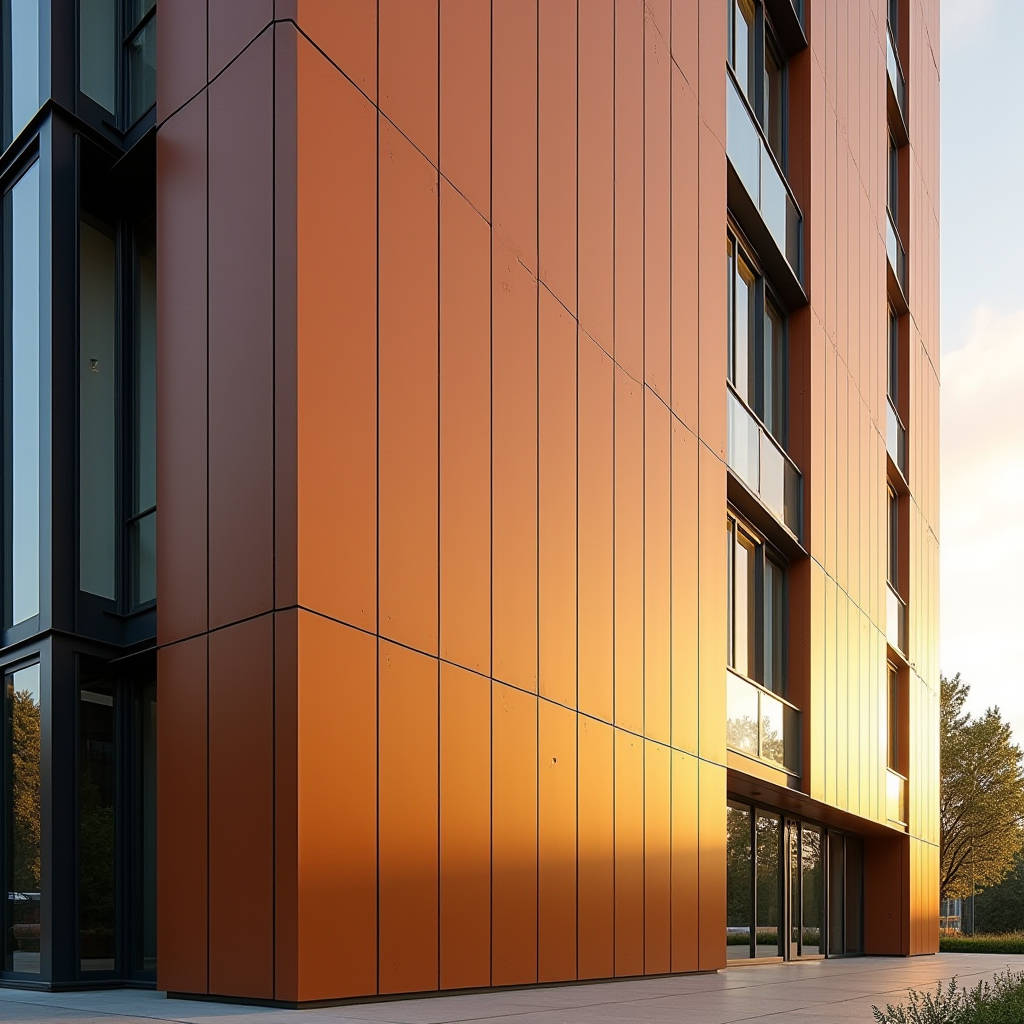
Architects and facade engineers face a persistent tension: the desire for the warm, organic presence of terracotta cladding versus the structural, logistical, and budgetary realities of heavyweight fired clay panels on high-rise envelopes. A Terracotta Effect Aluminum Facade resolves this tension directly. It uses solid aluminium sheets—typically 2.0mm to 3.0mm thick—coated with advanced PVDF or powder systems that replicate the granular texture and fired-earth color of natural terracotta, while delivering the flatness, wind-load resistance, and installation speed that only metal can provide. The result is not a compromise. It is a deliberate material strategy that preserves the architectural language of clay while eliminating the fracture risk, water absorption, and substructure over-engineering that haunt genuine terracotta rainscreens. This article examines the technical substrate behind these facade systems: coating chemistry, solid aluminium metallurgy, drainage-plane physics, and the cost-calendar realities that make the terracotta effect on aluminium a defensible specification choice for mid-rise commercial towers, institutional buildings, and retrofit over-cladding projects alike.
Why the Market Is Moving Away from Fired Terracotta Rainscreens
Fired terracotta has a legitimate architectural pedigree. Extruded clay panels, kiln-fired at 1100°C to 1200°C, offer a matte, light-scattering surface that reads as grounded and human-scaled. But the material carries inherent liabilities that facade consultants increasingly flag during value-engineering reviews. A single extruded terracotta baguette weighing 18–22 kg/m² demands a heavy-gauge aluminium or steel substructure, driving up the total dead load on the primary structure. Water absorption rates of 3–8% by mass mean freeze-thaw cycling in northern climates gradually spalls the surface. Panel lead times from European terracotta extruders routinely stretch to 16–20 weeks, and on-site cutting generates silica dust that triggers occupational health protocols. These factors do not make terracotta a bad material. They make it a material that requires a specific project appetite for risk, time, and cost—an appetite that many commercial developments simply do not have.
Coating Chemistry: How PVDF and Powder Systems Create the Terracotta Illusion
The visual credibility of a Terracotta Effect Aluminum Facade lives or dies in the coating. Two dominant technologies serve this market: 70% PVDF (polyvinylidene fluoride) liquid coatings and super-durable polyester powder coatings. Both can deliver the terracotta look, but their performance profiles diverge in ways that specifiers must understand.
70% PVDF Liquid Coatings
PVDF resin systems—governed by AAMA 2605—use a three-coat or four-coat architecture: a chrome-based or chrome-free conversion coat, a corrosion-inhibiting primer, a color coat carrying ceramic or inorganic pigments, and a clear topcoat. The pigment layer is where the terracotta effect happens. Manufacturers blend iron oxide reds, yellow ochres, and carbon blacks to land on a specific L*a*b* coordinate that matches a reference terracotta sample. Some advanced lines, such as Interpon D Terracotta Effect from AkzoNobel, offer 12 distinct shades within the terracotta spectrum, from burnt sienna to muted earth grey. The clear topcoat—typically 25–30 microns—provides the gloss control. A 25–35% gloss level at 60° mimics the matte, light-diffusing surface of fired clay without the porosity that traps pollutants.
Super-Durable Polyester Powder Coatings
Powder coatings meeting AAMA 2604 standards offer a different value proposition. Applied electrostatically and cured at 180–200°C, these systems achieve 60–80 microns of film thickness in a single pass. The terracotta effect in powder relies on a blend of pigmented base coat and a textured topcoat that introduces a fine orange-peel profile—typically 15–25 microns of surface roughness (Rz). This texture scatters incident light in a way that closely approximates the micro-roughness of kiln-fired clay. The trade-off is chemical resistance: powder systems show greater gloss retention and color fade at the 5-year mark compared to PVDF, particularly in coastal or high-UV environments. For inland projects with moderate exposure, a super-durable powder terracotta finish on solid aluminium can deliver a 15–20 year aesthetic service life at roughly 60–70% of the coating cost of a full PVDF system.
Solid Aluminium Substrate: Why Panel Thickness Determines Everything
The coating gets the attention, but the aluminium substrate determines whether the facade stays flat and quiet. Solid aluminium panels for terracotta-effect cladding are typically specified in 2.0mm, 2.5mm, or 3.0mm thicknesses using alloy 3003-H14 or 5052-H32. The choice of gauge is not arbitrary—it maps directly to panel dimensions, wind loads, and attachment geometry.
| Panel Thickness | Max Recommended Panel Size (mm) | Wind Load Capacity (kPa) | Deflection Under 2.0 kPa (L/360) | Typical Application |
|---|---|---|---|---|
| 2.0mm (3003-H14) | 600 x 1200 | 1.5–2.0 | Acceptable with 4-side support | Spandrel panels, low-rise retail |
| 2.5mm (3003-H14) | 800 x 1600 | 2.0–2.8 | Within limits for 3-side support | Mid-rise office, residential towers |
| 3.0mm (5052-H32) | 1000 x 2000 | 2.8–3.5 | Minimal deflection on 2-side support | High-rise, coastal, high-wind zones |
These figures assume standard tray-folded or cassette-style panels with continuous perimeter engagement. Actual engineering must reference ASCE 7 wind load maps for the specific site, but the table provides a defensible starting point for schematic design. Manufacturers like Futeng® supply solid aluminium panels in all three gauges with factory-applied terracotta PVDF finishes, which means the specifier can dial in the exact thickness-to-cost ratio for each elevation zone rather than defaulting to a single gauge across the entire building.
Rainscreen Physics: Drainage, Ventilation, and the Pressure-Equalized Cavity
A Terracotta Effect Aluminum Facade is almost always deployed as a drained-and-ventilated rainscreen. The aluminium panel forms the outer leaf of a pressure-equalized cavity, typically 38–50mm deep, backed by continuous insulation and a weather-resistive barrier (WRB). The physics are straightforward but demand rigorous detailing. Open joints—typically 8–12mm horizontal and 6–10mm vertical—allow air to enter the cavity, equalizing pressure across the cladding and dramatically reducing the volume of water driven past the outer face. Any water that does penetrate drains down the back of the panel and exits through weep holes at the base of each floor line.
The critical detail is the joint profile. A simple open joint with a black EPDM or dark-colored aluminium reveal behind it creates a shadow line that reads as a traditional terracotta baguette gap. The dark background also masks the aluminium edge, reinforcing the illusion that the panel is a solid clay element. Some systems use a proprietary extruded aluminium carrier with integrated gaskets that snap into the panel return leg, eliminating exposed fasteners and enabling individual panel removal for inspection or replacement—a maintenance advantage that genuine terracotta systems rarely offer without risking panel breakage.
Thermal Performance: The Hidden Advantage of Metal Over Clay
Terracotta has a thermal conductivity of roughly 0.8–1.2 W/m·K. Aluminium, at 160 W/m·K, is a dramatically better conductor. In a rainscreen application, this is a feature, not a bug. The high conductivity of the aluminium outer leaf means it tracks ambient air temperature almost instantly, minimizing thermal lag and reducing the risk of interstitial condensation on the back of the panel during rapid temperature swings. The actual thermal performance of the wall assembly is dominated by the continuous insulation layer behind the cavity—typically mineral wool at 80–120mm thickness—so the cladding material's conductivity is largely irrelevant to the assembly U-value. What matters is that the aluminium panel does not store moisture, does not contribute to freeze-thaw damage, and does not require the 15–20mm expansion gaps that terracotta systems need to accommodate hygroscopic movement.
Color Consistency and Fade Resistance: What the Standards Actually Say
One of the most persistent complaints about natural terracotta is batch-to-batch color variation. Kiln-fired clay panels from the same production run can show Delta E values of 3–5, and panels from different production runs can drift well beyond that. For architects who have specified a precise RAL or custom color, this variability is a defect. PVDF-coated aluminium panels, by contrast, are manufactured to a color tolerance of Delta E ≤ 1.5 under AAMA 2605, measured spectrophotometrically and verified per lot. The pigments are inorganic, the resin system is UV-stable, and the application environment is a controlled factory line, not a kiln whose atmosphere shifts with humidity and fuel quality.
Accelerated weathering data from ASTM G155 (Xenon arc, 5000 hours) shows that a properly formulated PVDF terracotta coating retains over 80% of its original gloss and exhibits a Delta E shift of less than 3.0 after the equivalent of 10 years of Florida exposure. Powder systems meeting AAMA 2604 typically show Delta E shifts of 4–6 under the same conditions. These are not laboratory curiosities—they translate directly to whether a facade still looks like the architect's intent after a decade of service.
Installation Speed and Trade Coordination
Solid aluminium panels with a terracotta finish install faster than any clay-based alternative. A four-person crew can hang 30–40 m² of aluminium rainscreen panels per day using a clip-and-rail system, compared to 15–20 m² per day for extruded terracotta baguettes that require individual bracket alignment and shimming. The aluminium panels arrive on site pre-fabricated to size with folded edges, punched attachment holes, and the terracotta coating fully cured. There is no on-site cutting, no silica dust, and no risk of fracturing a panel during handling. For a 5,000 m² facade, the labor differential alone can represent 3–4 weeks of schedule compression and a six-figure cost saving in trade labor, scaffolding rental, and general conditions overhead.
Cost Comparison: Terracotta-Effect Aluminium vs. Genuine Terracotta Rainscreen
Cost is the conversation that every project eventually has. The table below compares installed costs for a 5,000 m² facade on a 12-story commercial building in a temperate climate zone, using 2024 market data from North American and European subcontractors.
| Cost Element | Terracotta-Effect Aluminium (2.5mm, PVDF) | Genuine Extruded Terracotta Rainscreen |
|---|---|---|
| Cladding material (ex-works) | $85–110/m² | $120–160/m² |
| Aluminium substructure (kg/m²) | 3.5–4.5 kg/m² | 6.0–8.0 kg/m² |
| Substructure cost | $35–50/m² | $55–80/m² |
| Installation labor | $45–65/m² | $70–100/m² |
| Scaffolding/access (duration-adjusted) | $12–18/m² | $20–28/m² |
| Waste factor | 3–5% | 8–15% |
| Total installed cost (range) | $177–243/m² | $265–368/m² |
The 30–35% cost differential is consistent across multiple project types. The gap widens on high-rise projects where the dead-load penalty of terracotta drives up structural steel or concrete costs, and on retrofit projects where the existing structure cannot accommodate the weight of a full terracotta system without strengthening.
Fire Performance: The Non-Combustible Baseline
Solid aluminium is classified as non-combustible per ASTM E136 and EN 13501-1 Class A1. The PVDF or powder coating—applied at a film thickness of 30–80 microns—contributes negligible organic content and does not alter the non-combustible classification of the assembly. This is a critical distinction from aluminium composite panels (ACP) with polyethylene cores, which have been the subject of well-documented fire safety failures. A Terracotta Effect Aluminum Facade using solid aluminium sheets carries none of that fire risk. It passes NFPA 285 multi-story fire propagation testing without requiring fire breaks or intumescent strips at floor lines, provided the cavity insulation is mineral wool and the WRB is properly detailed. For projects above 18 meters in jurisdictions that have tightened cladding regulations post-Grenfell, the solid aluminium option eliminates an entire category of compliance risk.
Specification Language: What to Write in Section 07 42 13
For specifiers writing a performance-based specification, the following language captures the key requirements without naming proprietary products:
Solid aluminium rainscreen panels with terracotta-effect finish. Panel substrate: alloy 3003-H14 or 5052-H32, minimum thickness 2.5mm, flatness tolerance within 0.5% of panel dimension. Finish: 70% PVDF resin-based coating system conforming to AAMA 2605, three-coat minimum, color range to match architect's reference terracotta sample with Delta E ≤ 1.5. Gloss: 25–35% at 60° geometry. Panel attachment: concealed clip-and-rail system with pressure-equalized cavity, 38mm minimum depth, open joints 8–10mm. Provide manufacturer's 20-year film integrity warranty and 15-year color retention warranty.
This language is deliberately generic but technically precise. It allows qualified manufacturers—including Futeng® and other solid aluminium specialists—to bid without locking the project into a single source.
Maintenance and Lifecycle: What Happens After Year 10
A Terracotta Effect Aluminum Facade requires remarkably little active maintenance. Annual inspection of joint seals, weep holes, and panel alignment is sufficient for the first decade. The PVDF surface resists dirt adhesion due to its low surface energy; rainfall provides effective self-cleaning in most urban environments. If cleaning is required, a mild detergent solution applied with a soft brush and low-pressure water rinse restores the original appearance without affecting the coating. Compare this to natural terracotta, where biological growth in the micro-porous surface can require periodic chemical cleaning, and where a single cracked panel demands a color-matched replacement that may no longer be available from the original kiln batch.
At end of service life—typically 30–40 years for the aluminium substrate and 25–30 years for the coating—the panels are fully recyclable. The aluminium can be re-melted with minimal energy input compared to primary smelting, and the PVDF coating burns off cleanly in the recycling furnace. This end-of-life pathway contributes to LEED v4.1 Materials and Resources credits and aligns with the increasing owner demand for circular-economy facade solutions.
Architectural Precedent: Where the Terracotta Effect Is Working
The terracotta-effect aluminium approach is not theoretical. Aliva UK's trompe-l'œil system on an Ivy League university project in the United States demonstrated that a profiled aluminium rainscreen could pass for terracotta even at close viewing distances—the custom profiling and multi-layer coating created a surface that reads as clay from 2 meters away. Across Asia, solid aluminium panels with terracotta PVDF finishes are increasingly specified for mixed-use podiums and transit-oriented developments where the architectural brief calls for a "warm, contextual material" but the structural engineer has capped the cladding dead load at 25 kg/m². These projects prove that the terracotta effect on aluminium is not a value-engineering downgrade. It is a parallel material strategy that delivers the same aesthetic outcome through a different technical pathway.
The decision to specify a Terracotta Effect Aluminum Facade ultimately rests on a clear-eyed assessment of project constraints: dead load budgets, installation schedules, color consistency requirements, maintenance expectations, and total installed cost. Where those constraints point away from kiln-fired clay, solid aluminium with a properly engineered PVDF or powder terracotta coating offers a technically defensible, aesthetically convincing, and commercially rational alternative. The key is to specify the coating system, substrate gauge, and joint detailing with the same rigor that would be applied to any high-performance rainscreen—because the terracotta look is only as good as the engineering behind it.