Marble Effect Aluminum Facade Engineering and Specification for Solid Panel Rainscreen Systems
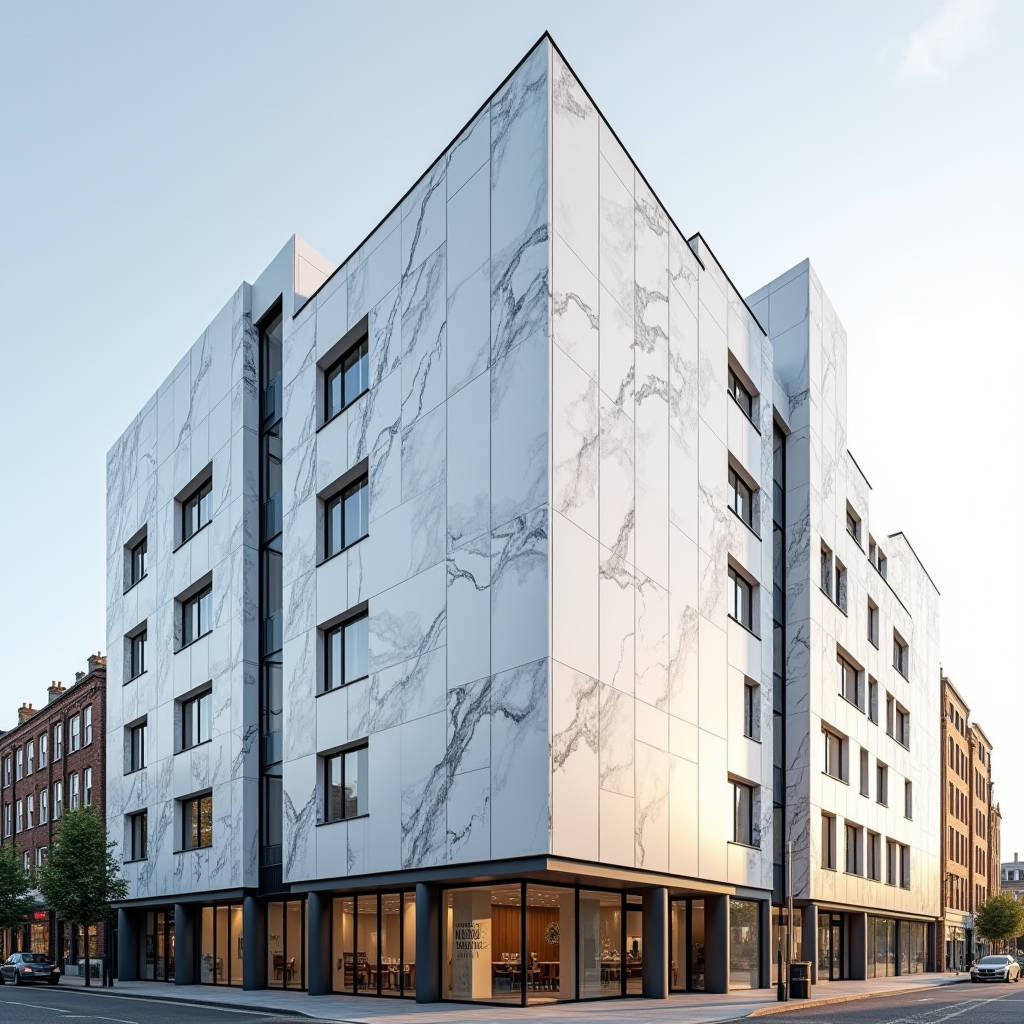
Marble Effect Aluminum Facade systems have steadily gained traction among architects and facade contractors who need the visual weight of natural stone without the structural headaches that come with 40mm-thick marble slabs. The core proposition is straightforward: a 2.5mm or 3.0mm solid aluminium sheet, coil-coated with a PVDF marble-pattern finish and fabricated into interlocking panels, gives you the same veining depth and tonal variation as quarried Carrara or Calacatta marble at roughly one-eighth the weight. What makes this category worth a closer look is not just the aesthetic mimicry — it is the engineering reality that solid aluminium panels can span larger distances between fixing points, handle thermal movement predictably, and meet the same non-combustibility requirements that increasingly govern mid-rise and high-rise envelope design across Europe, the Middle East, and Southeast Asia.
How the Marble Effect Is Actually Produced on Solid Aluminium
Most specifiers assume the marble pattern is a simple digital print sealed under a clear coat. The reality is more nuanced. On solid aluminium sheets — typically 2.0mm, 2.5mm, or 3.0mm thick in grades AA1100 or AA3003 — the marble effect is achieved through one of two industrial processes: high-definition sublimation transfer or multi-pass roller coating with registered grain alignment.
Sublimation transfer works by first applying a polyester or PVDF base coat to the aluminium sheet, then heat-pressing a printed film that embeds the marble pattern into the coating layer at approximately 180–200°C. The pigment penetrates the coating rather than sitting on top, which is why properly executed sublimation does not delaminate under thermal cycling. The alternative — roller coating with registered grain — uses engraved rollers that deposit successive layers of ink in precise registration, building up the veining pattern across the sheet width. This method is more common in high-volume production runs and delivers better consistency across large batches.
In both cases, the decorative layer is protected by a clear PVDF topcoat. For exterior applications, this topcoat must meet AAMA 2605 standards, which means a minimum total dry film thickness of 25–30μm for a two-coat system and 35–40μm for a three-coat system. The clear coat is where the UV resistance lives. Without it, marble-effect panels fade unevenly within 18–24 months — a failure mode that has burned more than a few contractors who chased the lowest bid.
Solid Aluminium vs. Composite Panels: Why the Distinction Matters for Facades
Search for "marble effect aluminium facade" and you will find a flood of ACP (Aluminium Composite Panel) products. Those panels sandwich a polyethylene or mineral-filled core between two thin aluminium skins, typically 0.3–0.5mm each. They are cheaper, lighter, and perfectly adequate for low-rise commercial interiors. But for exterior facades on buildings over 18 metres, the conversation shifts.
Solid aluminium panels — what this article is about — are monolithic sheets of aluminium with no core material. A 2.5mm solid sheet weighs approximately 6.8 kg/m². A typical 4mm ACP with 0.5mm skins weighs around 5.5 kg/m². The weight difference is modest, but the fire performance gap is enormous. Solid aluminium is inherently non-combustible (Euroclass A1 or A2-s1,d0 depending on the specific coating system). ACPs with polyethylene cores are typically Euroclass D or E unless they use a fire-retardant mineral core, which adds cost and still rarely achieves A2.
Beyond fire, there is the question of flatness and deflection. Solid aluminium panels resist oil-canning — the wavy distortion visible under raking light — far better than thin-skinned composites. A 3.0mm solid panel with properly engineered stiffeners can span 1,200mm between fixing points with deflection under L/175 at design wind loads up to 2.5 kPa. A 4mm ACP at the same span will show visible deflection at lower loads, and the thin skin is more prone to impact damage from hail or maintenance lifts.
Engineering Wind Loads and Fixing Systems for Stone-Look Panels
Marble-effect finishes introduce a subtle but real engineering consideration: the pattern must align across panel joints. Natural marble has continuous veining, and one of the quickest ways to make a marble-effect facade look fake is to have veins that stop abruptly at a panel edge and restart at a random offset on the adjacent panel. This is not a material problem — it is a fabrication and installation sequencing problem.
Panel joint alignment requires the fabricator to nest parts on the sheet with the grain direction marked, and the installer must follow a numbered layout drawing. This adds perhaps 3–5% to fabrication time and requires the site team to resist the temptation to grab any panel from the stack. For large projects — say, a 6,000 m² facade on a mixed-use tower — this coordination effort is non-trivial.
On the fixing side, solid aluminium marble-effect panels typically use one of three systems:
- Rainscreen with visible fixings: Panels are riveted or screwed onto aluminium subframes. Fastest to install, but the exposed fastener heads interrupt the stone-like surface. Often specified for industrial and logistics buildings where speed and cost dominate.
- Rainscreen with concealed fixings: Panels use rear-ventilated cassettes with folded returns and hidden brackets. The marble pattern runs uninterrupted across the visible face. This is the dominant system for commercial offices and residential towers.
- Unitised curtain wall integration: Panels are pre-assembled onto stick-system or unitised frames in the factory. The marble effect is aligned and inspected before the unit reaches the site. Highest quality, highest cost, and increasingly common in the Gulf region.
Wind load design for these systems follows the same principles as any solid aluminium rainscreen. The panel's bending capacity is a function of its thickness, alloy temper, and the spacing of its stiffeners. A 3.0mm AA3003-H14 panel with a 600mm stiffener spacing can typically handle serviceability wind loads of 2.0–3.0 kPa, which covers most urban sites up to 80 metres in height under EN 1991-1-4 or ASCE 7. For taller buildings or exposed coastal sites, the panel thickness or stiffener spacing must be adjusted accordingly.
Coating Performance: PVDF, FEVE, and the 20-Year Colour Stability Question
The marble pattern on a solid aluminium facade panel is only as durable as the clear coat that protects it. Three coating chemistries dominate the market, and the differences matter enormously for long-term appearance retention.
| Coating System | Resin Chemistry | Typical DFT (μm) | Colour Retention (ΔE) | Gloss Retention at 10 Years | Applicable Standard |
|---|---|---|---|---|---|
| PVDF (70% Kynar 500®) | Polyvinylidene fluoride | 25–35 (3-coat) | ΔE ≤ 5 after 10 years | ≥ 50% | AAMA 2605 |
| FEVE (Lumiflon®) | Fluoroethylene vinyl ether | 30–40 (3-coat) | ΔE ≤ 3 after 10 years | ≥ 70% | AAMA 2605 / JIS K 5659 |
| PE (Polyester) | Polyester / silicone-modified polyester | 20–25 (2-coat) | ΔE ≥ 10 after 5 years | ≤ 30% | AAMA 2603 |
For exterior marble-effect facades, polyester-based coatings are a false economy. The colour shift and gloss loss become visible on large uninterrupted surfaces within three to five years, and the patchy fading pattern is far more noticeable on a stone-look finish than on a solid colour. PVDF is the minimum acceptable standard for any project with a design life beyond 10 years. FEVE offers measurably better gloss retention and is worth the premium — typically 15–20% over PVDF — for prestige projects where the marble appearance is a defining architectural feature.
The South Florida exposure testing data from AAMA consistently shows that 70% PVDF coatings maintain colour integrity for 20+ years in subtropical conditions. FEVE formulations push that window closer to 30 years. These are not theoretical numbers; they come from real outdoor weathering racks and should inform every specification decision.
Thermal Movement and Panel Joint Design
Aluminium expands and contracts at roughly 2.4 mm per linear metre per 100°C temperature swing. On a 4-metre-long marble-effect panel, that is nearly 10mm of movement between a cold winter night and a sun-soaked summer afternoon. If the joint design does not accommodate this movement, panels will buckle, fasteners will loosen, and the carefully aligned marble pattern will be the least of the owner's worries.
The standard recommendation for solid aluminium rainscreen panels is a minimum joint width of 8–10mm for panels up to 3 metres in length, and 12–15mm for longer panels. The joint should be open (ventilated) or fitted with a compressible gasket, never rigidly sealed with structural silicone across the full joint depth. Open joints also serve the secondary function of pressure equalisation, which reduces the wind load on each individual panel.
For marble-effect panels specifically, the joint colour matters. A dark joint against a white Carrara-look panel creates a strong grid that fights the stone aesthetic. Many architects now specify joint backing in a colour matched to the dominant tone of the marble pattern — light grey for Carrara, warm beige for travertine effects, dark grey for Nero Marquina. This is a small detail that has an outsized impact on the visual unity of the facade.
Cost Structure: Where the Money Goes on a Marble-Effect Solid Aluminium Facade
Procurement managers evaluating marble-effect solid aluminium facades need to understand the cost breakdown beyond the per-square-metre panel price. The following estimates are based on a 5,000 m² rainscreen project with 2.5mm solid aluminium panels, PVDF marble-effect coating, and a concealed-fix aluminium subframe system, priced at 2025 levels for a mid-specification project in a competitive bidding environment.
- Solid aluminium sheet (AA3003-H14, 2.5mm): $12–18/m², depending on alloy premium and mill source. Chinese mills (Chalco, Mingtai) are typically at the lower end; European mills at the higher end.
- Marble-effect PVDF coating (3-coat, 70% Kynar): $18–25/m². The wide range reflects pattern complexity — a simple travertine repeat is cheaper than a high-resolution Calacatta with large-scale veining that requires careful registration.
- Fabrication (cutting, folding, routing, stiffener attachment): $15–22/m². Complexity drives cost. Simple flat panels with folded returns are at the low end; panels with complex geometries, perforations, or integrated window surrounds are at the high end.
- Aluminium subframe and fixings: $25–40/m², heavily dependent on the building's geometry and wind load requirements.
- Installation labour: $35–60/m², varying by region. Gulf markets tend toward the lower end; Western Europe and North America toward the higher end.
All-in, a marble-effect solid aluminium rainscreen facade typically lands between $120 and $180/m² installed. That compares to $250–400/m² for a 30mm natural marble ventilated facade on a similar subframe, and $80–120/m² for a standard solid-colour PVDF aluminium rainscreen. The marble effect adds roughly 20–30% to the panel cost versus a solid colour, a premium that most project teams find justifiable when the alternative is natural stone.
Quality Control: What to Inspect Before Shipment
If you are importing marble-effect aluminium panels — and a large share of global supply comes from fabricators in China, including the Futeng® facility in Jiangsu — there are specific QC checks that go beyond the standard dimensional and coating-thickness inspections.
First, pattern consistency across the batch. The marble pattern is applied to flat sheets before fabrication, and the coating line must maintain consistent colour, veining density, and background tone across the entire production run. Batch-to-batch variation is the single most common complaint. The fix is to require a set of "range panels" — physical samples representing the lightest and darkest acceptable extremes — approved before production begins, and to insist that all panels fall within that range.
Second, coating adhesion on folded edges. When a flat sheet with a marble-effect coating is folded on a press brake, the coating at the bend line is subjected to elongation. A properly formulated PVDF system can handle a 90° bend on a 2.5mm sheet with an inside radius of 1.5× material thickness without cracking. If the coating cracks, moisture ingress at the fold line will cause delamination within a few years. The ASTM D3359 cross-hatch adhesion test, performed on a sample from the same batch, is a non-negotiable QC gate.
Third, flatness. Marble-effect finishes amplify any deviation from flatness because the eye uses the veining pattern as a reference grid. A panel that is technically within the 0.5% of diagonal tolerance can still look wavy if the pattern makes the distortion visible. The practical solution is to specify a tighter flatness tolerance — 0.3% of diagonal — for marble-effect panels, and to inspect under diffuse lighting that simulates the installed conditions.
Regional Market Preferences and Specification Trends
The adoption of marble-effect solid aluminium facades follows distinct regional patterns that reflect local building traditions, regulatory environments, and aesthetic preferences.
In the Middle East — particularly the UAE, Qatar, and Saudi Arabia — marble-effect aluminium has become a go-to material for residential tower podiums and hotel entrance facades. The regional preference is for high-contrast patterns: Calacatta Oro with bold gold veining, or Statuario with dramatic grey-on-white contrast. The architectural language of Gulf cities has long favoured natural stone, and marble-effect aluminium allows developers to maintain that visual language while meeting the fire safety requirements that have tightened considerably since the 2017 UAE Fire and Life Safety Code updates.
In Southeast Asia — Singapore, Malaysia, Thailand — the preference leans toward more subdued patterns: honed travertine effects, warm limestone tones, and low-contrast marble with fine veining. The tropical climate demands coatings that resist fungal growth and can be cleaned with pressure washing without degrading. FEVE-based systems are disproportionately specified here because of their superior gloss retention under high-UV, high-humidity conditions.
In Western Europe, the marble-effect trend intersects with the broader movement toward material honesty. Some architects are uncomfortable with a printed stone pattern on metal, while others embrace it as a legitimate design tool. The key specification driver is the EN 13501-1 fire classification. Solid aluminium panels with A2-s1,d0 classification meet the requirements for buildings above 18 metres, which has opened up the mid-rise residential and commercial office segments that were previously the domain of terracotta and fibre cement.
Installation Sequencing and Site Handling
Marble-effect panels demand more careful site handling than solid-colour panels. The decorative surface is the PVDF clear coat, and while PVDF is tough, it can be scratched by careless stacking or by dragging one panel across another. Scratches on a marble pattern are more visible than on a solid colour because the underlying base coat colour — usually white or beige — contrasts with the printed veining.
Best practice on site includes:
- Storing panels vertically on A-frame racks with protective interleaving between each panel. Horizontal stacking invites debris to settle between panels and grind into the surface under vibration.
- Installing panels in the sequence specified on the layout drawing. The marble pattern alignment depends on this, and a panel installed out of sequence will break the visual continuity of the veining.
- Using suction cups with soft rubber seals for handling. Mechanical clamps that grip the panel edges can crush the folded returns or chip the coating at the grip point.
- Cleaning the installed facade with pH-neutral detergent and soft brushes, never with abrasive pads or acidic cleaners. The PVDF clear coat resists chemical attack well, but repeated abrasive cleaning will micro-scratch the surface and dull the gloss over time.
Specifying Marble-Effect Aluminium for Your Next Project: A Practical Checklist
For architects and facade engineers writing a specification for a marble-effect solid aluminium facade, the following points should be addressed explicitly in the performance specification, not left to the contractor's interpretation:
- Alloy and temper: AA3003-H14 or AA1100-H14. Minimum yield strength 115 MPa for AA3003-H14 per ASTM B209.
- Sheet thickness: 2.5mm minimum for concealed-fix rainscreen; 3.0mm for exposed-fix or large-format panels exceeding 2.0 m² in area.
- Coating system: 70% PVDF (Kynar 500® or equivalent) or FEVE, 3-coat system, minimum 35μm total dry film thickness. Clear topcoat mandatory.
- Pattern approval: Range panels defining acceptable colour and veining variation, approved by the architect before production.
- Flatness: 0.3% of diagonal maximum deviation for marble-effect panels.
- Fire classification: A2-s1,d0 per EN 13501-1, or equivalent classification per local code.
- Wind load design: Calculated per EN 1991-1-4 or ASCE 7, with panel deflection limited to L/175 at serviceability limit state.
- Joint width: Minimum 10mm for panels up to 3m; 12mm for 3–5m panels. Joint backing colour to match dominant marble tone.
- Warranty: Minimum 20-year coating warranty against colour fade (ΔE > 5) and delamination, backed by the coating manufacturer.
Suppliers like Futeng®, with in-house PVDF coating lines and CNC fabrication capacity, can typically meet these requirements in a single-source arrangement, which simplifies the supply chain and avoids the finger-pointing that occurs when the coater and fabricator are separate entities. Whether you choose a single-source or multi-vendor approach, the specification must be clear enough that all bidders are pricing the same technical solution.
The marble-effect solid aluminium facade is not a novelty product. It is a mature, technically validated cladding solution that solves a genuine architectural problem: how to deliver the visual permanence of natural stone on a lightweight, non-combustible, and thermally manageable envelope. The success of any given project depends less on the panel itself — the technology is well-established — and more on the rigour of the specification, the quality of the fabrication, and the discipline of the installation team. Get those three right, and the facade will look as intended for decades.