Marble Finish Aluminum Panel Coating Chemistry and Long Term Facade Durability
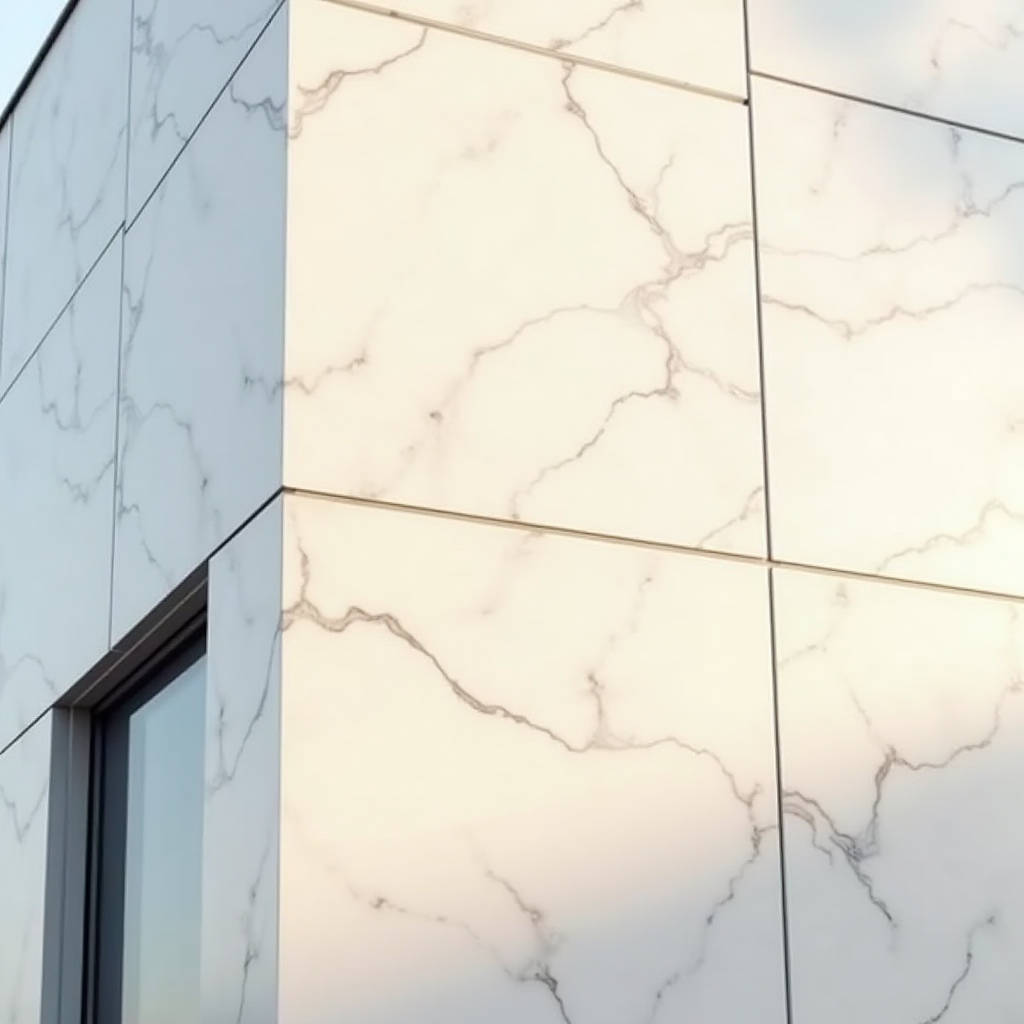
Specifying a Marble Finish Aluminum Panel for a commercial facade means confronting a question that rarely gets asked early enough: how does the printed stone pattern hold up after five years of UV exposure, salt spray, and thermal cycling? Architects and facade consultants spend hours selecting the exact marble vein pattern from a catalog, but the real engineering challenge sits in the coating system that carries that image. A solid aluminum panel with a marble-effect finish is not a single product category. It is an intersection of substrate metallurgy, pretreatment chemistry, PVDF or FEVE resin formulation, and digital printing technology. Getting the aesthetic right on day one is easy. Keeping it legible and color-stable across a 20-year warranty period is where specification discipline matters.
What Actually Sits Under the Marble Pattern
When a contractor orders a Marble Finish Aluminum Panel, the substrate is almost always an AA1100, AA3003, or AA5052 aluminum alloy sheet, typically at 2.0mm, 2.5mm, or 3.0mm thickness for exterior cladding. This is a solid monolithic aluminum sheet, not a composite sandwich. The alloy choice matters for flatness after bending and for corrosion resistance at cut edges. AA3003 offers a good balance of formability and strength for panels that will be brake-pressed into cassettes or trays. AA5052 provides higher tensile strength for large-format panels exceeding 1200mm in width where wind load deflection becomes the governing design constraint.
The marble pattern itself is applied through a multi-layer coating system. A chrome-based or chrome-free conversion coating goes onto the cleaned and etched aluminum surface first, providing the anchor for subsequent layers. Then comes a primer layer, typically 5-8 microns of epoxy or polyester-based material. The marble image is applied via high-resolution digital printing using UV-curable or solvent-based inks. The critical layer is the clear topcoat: a 70% PVDF (polyvinylidene fluoride) resin system sprayed at 25-35 microns dry film thickness, or a FEVE (fluoroethylene vinyl ether) formulation for applications requiring higher gloss retention. This topcoat is what determines whether the marble pattern fades in year three or remains crisp in year fifteen.
PVDF vs. FEVE vs. Polyester: The Coating Decision That Determines Everything
Not all marble-finish aluminum panels use the same clearcoat chemistry. The difference between a specification that performs and one that fails shows up in the resin system. Polyester clearcoats cost less and look fine at installation, but their UV resistance is fundamentally limited. A standard polyester topcoat will lose 50% of its gloss within 3-5 years of south-facing exposure in a subtropical climate. PVDF systems meeting AAMA 2605 requirements maintain over 50% gloss after 10 years of Florida testing. FEVE systems can push that to 15-20 years with minimal color shift.
The marble pattern underneath the clearcoat introduces a second failure mode that does not exist with solid-color PVDF panels. If the digital ink layer is not chemically compatible with the clearcoat resin, interlayer adhesion fails. The clearcoat delaminates from the printed surface, and the marble pattern becomes cloudy or peels. A proper specification should require the coating applicator to provide adhesion test results per ASTM D3359 (cross-hatch) and impact resistance per ASTM D2794, tested on the actual marble-printed panel, not just on a solid-color control sample.
| Coating Parameter | Polyester (SP) | PVDF (70% Kynar) | FEVE (Lumiflon-based) |
|---|---|---|---|
| Clearcoat DFT (microns) | 15-20 | 25-35 | 30-40 |
| Gloss Retention (10yr Florida) | <30% | 50-65% | 70-85% |
| Color Shift ΔE (5yr) | 3.0-5.0 | 1.0-2.5 | 0.5-1.5 |
| Applicable Standard | AAMA 2603 | AAMA 2605 | AAMA 2605 / JIS K 5659 |
| Typical Warranty (Exterior) | 5-10 years | 15-20 years | 20-30 years |
| Cost Index (Relative) | 1.0 | 1.8-2.2 | 2.5-3.0 |
Digital Printing Resolution and Pattern Repeat: The Visual Engineering Nobody Discusses
Natural marble slabs have chaotic, non-repeating veining. A digitally printed Marble Finish Aluminum Panel does not, unless the manufacturer invests in large-format scanning and printing equipment. Low-cost suppliers use a single scanned image of roughly 600mm x 600mm and tile it across the panel surface. The result is a visible repeat pattern that destroys the illusion of natural stone, especially on large facade areas where multiple panels sit side by side.
High-end digital printing lines for solid aluminum panels operate at 720-1440 dpi resolution with print widths up to 1600mm. They use multiple scanned marble master images, randomized by software to avoid obvious repetition across a batch of panels. For a project requiring 500 square meters of marble-finish cladding, the specifier should ask the coating applicator how many unique master images are used and what the maximum repeat distance is. A minimum of four unique scans and a repeat distance exceeding 2400mm is a reasonable specification for a mid-to-high-end commercial project.
Ink chemistry also affects long-term pattern stability. UV-curable inks offer fast production speeds but can be more brittle than solvent-based ceramic-pigment inks. For exterior applications, pigment-based inks with inorganic colorants provide superior fade resistance compared to dye-based inks. The specifier should request accelerated weathering data per ASTM G154 (QUV) or ISO 16474-2 for the specific ink set used on the marble pattern, not just for the clearcoat alone.
Thermal Movement and the Marble Pattern Alignment Problem
Solid aluminum has a coefficient of thermal expansion of approximately 23.6 x 10⁻⁶ /°C. A 3-meter-long panel subjected to a 60°C temperature swing (from -10°C winter night to 50°C summer sun on a dark marble pattern) will expand by roughly 4.25mm. If the panel is fixed with a rigid attachment system, that movement has to go somewhere. Buckling, oil-canning, or fastener pull-through are the typical failure modes.
For marble-finish panels, there is an additional aesthetic concern. When panels are installed with open joints, the marble veining pattern does not need to align across the joint gap. But when the architect specifies a continuous marble appearance across panel joints — a "book-matched" effect — thermal movement makes alignment maintenance extremely difficult. The panels expand and contract independently, and the 10-15mm joint gap breaks the visual continuity. Some projects attempt to minimize this by using a darker grout-colored joint backing that visually recedes, but the specifier should understand that true book-matched marble veining across aluminum panels is a photographic aspiration, not a dimensional reality under thermal cycling.
Salt Spray, Industrial Atmospheres, and Coating Edge Integrity
A Marble Finish Aluminum Panel installed on a coastal resort in Southeast Asia faces a fundamentally different environment than the same panel on an office building in Milan. The ISO 12944 corrosion classification system helps specifiers match the coating system to the environment. C3 (urban/industrial) environments are manageable with standard PVDF. C4 (coastal with moderate salinity) demands thicker clearcoat application and careful edge sealing. C5-M (marine, high salinity) requires FEVE topcoats and possibly anodized edge treatment.
The weak point is always the cut edge. When a solid aluminum panel is cut to size after the marble coating is applied, the raw aluminum edge is exposed. If the panel is installed without edge sealant or if the factory does not apply a touch-up coating to the cut edges, corrosion initiates at the edge and creeps under the coating. For marble-finish panels, this is particularly damaging because the corrosion lifts the printed pattern layer, creating visible blistering that follows the marble veins. The specification should mandate that all cut edges receive a two-part epoxy or polyurethane edge seal within 24 hours of cutting, applied by brush or roller to a minimum dry film thickness of 50 microns.
Flatness Tolerances and the Marble Pattern Optical Distortion
A solid aluminum panel at 2.5mm thickness spanning 1200mm x 2400mm will exhibit some degree of deflection under its own weight and under wind load. Industry standards such as ASTM E330 for wind load testing and AAMA 508 for flatness provide quantitative benchmarks. But the marble pattern introduces a perceptual dimension: even minor oil-canning (waviness in the panel surface) becomes visually amplified by the stone veining. A 2mm deviation from flatness that would be barely noticeable on a solid white panel can look like a distortion in the marble grain on a printed panel.
Specifiers should tighten flatness tolerances for marble-finish panels compared to solid-color panels. A reasonable specification for a marble-finish solid aluminum panel is a maximum deviation of 0.5% of the diagonal dimension, measured per ASTM E1801 or equivalent. This is tighter than the 0.8% commonly accepted for solid-color architectural panels. Achieving this requires careful control of the coil tension during the coating line process and proper stiffener placement on the panel rear face.
Fire Performance: Solid Aluminum Does Not Equal Non-Combustible
A common misunderstanding in facade specification is that a solid aluminum panel is automatically non-combustible. Aluminum itself is classified as A1 (non-combustible) under EN 13501-1, but the coating system changes the classification. A Marble Finish Aluminum Panel with a PVDF or FEVE coating system is typically classified as A2-s1,d0 under EN 13501-1, meaning limited combustibility with minimal smoke production and no flaming droplets. This is acceptable for most building types and heights under current European and Middle Eastern fire codes.
However, the digital printing ink layer and the primer can contribute additional organic content. A specifier should request the full EN 13501-1 classification report for the specific marble-finish coating system, not just for the base aluminum substrate. The report should reference the exact coating build-up: primer type and thickness, ink chemistry, and clearcoat type and thickness. For projects in jurisdictions that have tightened facade fire regulations following the Grenfell Tower fire, this documentation is not optional. It is a prerequisite for building permit approval.
Fabrication Constraints: Bending, Routing, and the Pattern Edge
Solid aluminum panels with marble finishes are typically fabricated into cassette systems, trays, or hook-on panels. The fabrication process — CNC routing, brake pressing, punching for fixings — all occur after the coating is applied. This means the marble pattern must survive the fabrication process without cracking, peeling, or discoloring at the bend lines.
The minimum bend radius for a coated solid aluminum panel depends on the alloy and temper. For AA3003-H14 at 2.5mm thickness, the minimum inside bend radius is approximately 1.5 times the material thickness, or about 3.75mm. Tighter bends risk cracking the coating at the outer radius. For marble-finish panels, coating cracking at the bend line is particularly visible because it interrupts the stone pattern with a sharp line of exposed primer or bare metal. A 90-degree bend on a marble panel should be tested on a sample before production, and the bend radius should be verified with a coating adhesion test on the bent area.
Routing and perforation present another challenge. If the architect specifies perforated marble-finish panels for acoustic performance or decorative effect, the hole edges expose the aluminum substrate. Each hole becomes a potential corrosion initiation point. For perforated marble panels, the specification should require post-perforation edge treatment — either a clear chemical conversion coating applied to each hole edge or a full post-fabrication clearcoat touch-up. This adds cost and lead time but is essential for exterior durability.
Supply Chain Realities: Lead Times, Batch Consistency, and Global Sourcing
Marble Finish Aluminum Panel production involves multiple sequential processes: aluminum coil or sheet procurement, pretreatment, primer application, digital printing, clearcoat application, and quality inspection. Each step introduces potential variability. The marble pattern printed in January may not exactly match the marble pattern printed in June if the digital printer has been recalibrated, if the ink batch has changed, or if the clearcoat applicator has adjusted the spray parameters.
For large projects requiring phased delivery, batch-to-batch color and pattern consistency is a legitimate concern. The specifier should require the manufacturer to produce and retain a master panel for each marble pattern specified, and to match all production panels to within a ΔE of 2.0 (CIE LAB) measured against the master. This tolerance should be written into the purchase specification and verified with a spectrophotometer during incoming quality inspection at the fabrication shop.
Lead times for custom marble-finish solid aluminum panels typically range from 6 to 10 weeks, depending on the coating applicator's production schedule and the complexity of the pattern. Suppliers like Futeng® operate dedicated coating lines with in-house digital printing capability, which can compress lead times for projects requiring rapid turnaround. The specifier should confirm whether the coating applicator has redundant printing capacity — if the primary printer goes down, can production continue on a backup line, or does the project wait?
Cleaning, Maintenance, and the Marble Pattern's Real-World Aging
A Marble Finish Aluminum Panel facade will accumulate atmospheric soiling just like any other building surface. The difference is that dirt on a marble pattern is more visually forgiving than dirt on a solid white or black panel. The natural variation in the stone pattern masks light soiling. However, in environments with heavy particulate pollution, the clearcoat can develop a haze that mutes the marble pattern's contrast.
Cleaning recommendations for PVDF and FEVE-coated marble panels follow the same guidelines as solid-color architectural panels: mild detergent solution, soft brush or sponge, and low-pressure water rinse. Abrasive cleaners, pressure washers exceeding 500 psi, and acidic or alkaline cleaning agents should be avoided. The cleaning frequency depends on the environment: every 6-12 months for urban locations, every 3-6 months for industrial or coastal sites. The specifier should provide the building owner with a maintenance manual that includes cleaning procedures, recommended cleaning agents, and a log template for recording cleaning dates and observations.
After 10-15 years of service, the clearcoat may show micro-cracking or chalking. At this point, the marble pattern can be rejuvenated by applying a new clearcoat layer, provided the original coating is properly prepared by cleaning and light abrasion. This is a significant advantage of solid aluminum panels over composite alternatives: the metal substrate can outlast the coating, and recoating is technically feasible. The specifier should confirm with the coating manufacturer that the original clearcoat chemistry is compatible with recoating products.
Specification Checklist for a Marble Finish Aluminum Panel Project
Writing a specification for a marble-finish solid aluminum cladding system requires covering details that standard master specifications often miss. The following checklist addresses the key technical points discussed in this article:
- Substrate: Solid aluminum sheet, AA3003 or AA5052, H14 temper, 2.0mm / 2.5mm / 3.0mm thickness as required by wind load calculations per ASCE 7 or EN 1991-1-4.
- Pretreatment: Chrome-free conversion coating per ASTM D1730 or EN 12487, minimum coating weight verified by supplier certificate.
- Primer: Epoxy or polyester-based, 5-8 microns DFT, compatible with digital printing ink system.
- Marble Pattern: Digital printing at minimum 720 dpi, minimum four unique master images, maximum repeat distance 2400mm, pigment-based inks for exterior applications.
- Clearcoat: 70% PVDF (Kynar 500 or Hylar 5000) or FEVE (Lumiflon-based), 25-35 microns DFT, meeting AAMA 2605 for color retention and chalk resistance.
- Adhesion: ASTM D3359 cross-hatch test, minimum 4B rating on marble-printed surface, tested after 24-hour water immersion per ASTM D870.
- Weathering: Accelerated weathering per ASTM G154 Cycle 1 or ISO 16474-2, minimum 4000 hours with ΔE less than 3.0.
- Fire Classification: EN 13501-1 A2-s1,d0 for the complete coating system on aluminum substrate, test report referencing exact coating build-up.
- Edge Treatment: All cut edges sealed with two-part epoxy or polyurethane, minimum 50 microns DFT, applied within 24 hours of cutting.
- Flatness: Maximum deviation 0.5% of diagonal dimension, measured per ASTM E1801.
- Batch Consistency: ΔE less than 2.0 (CIE LAB) against retained master panel, verified by spectrophotometer.
Specifying a Marble Finish Aluminum Panel is not about picking a pattern from a swatch book. It is about understanding the coating chemistry, the fabrication sequence, the thermal mechanics, and the environmental exposure that will determine whether the facade looks like natural stone for two decades or starts showing its artificial nature in two years. The difference sits in the details: resin type, ink chemistry, edge sealing, flatness tolerance, and batch control. Architects and facade engineers who write these details into their specifications get the performance they expect. Those who leave the coating system to the contractor's discretion are gambling with the building's long-term appearance.
For further technical reference, consult the American Architectural Manufacturers Association (AAMA) for AAMA 2605 coating performance standards, the ASTM International database for test methods including ASTM D3359, ASTM G154, and ASTM E330, and the International Organization for Standardization (ISO) for ISO 12944 corrosion classification and ISO 16474-2 weathering standards. The Centre for Window and Cladding Technology (CWCT) provides additional guidance on cladding system performance and testing relevant to UK and European projects.