Cassette Aluminum Facade Engineering Joint Design Alloy Selection and Wind Load Performance
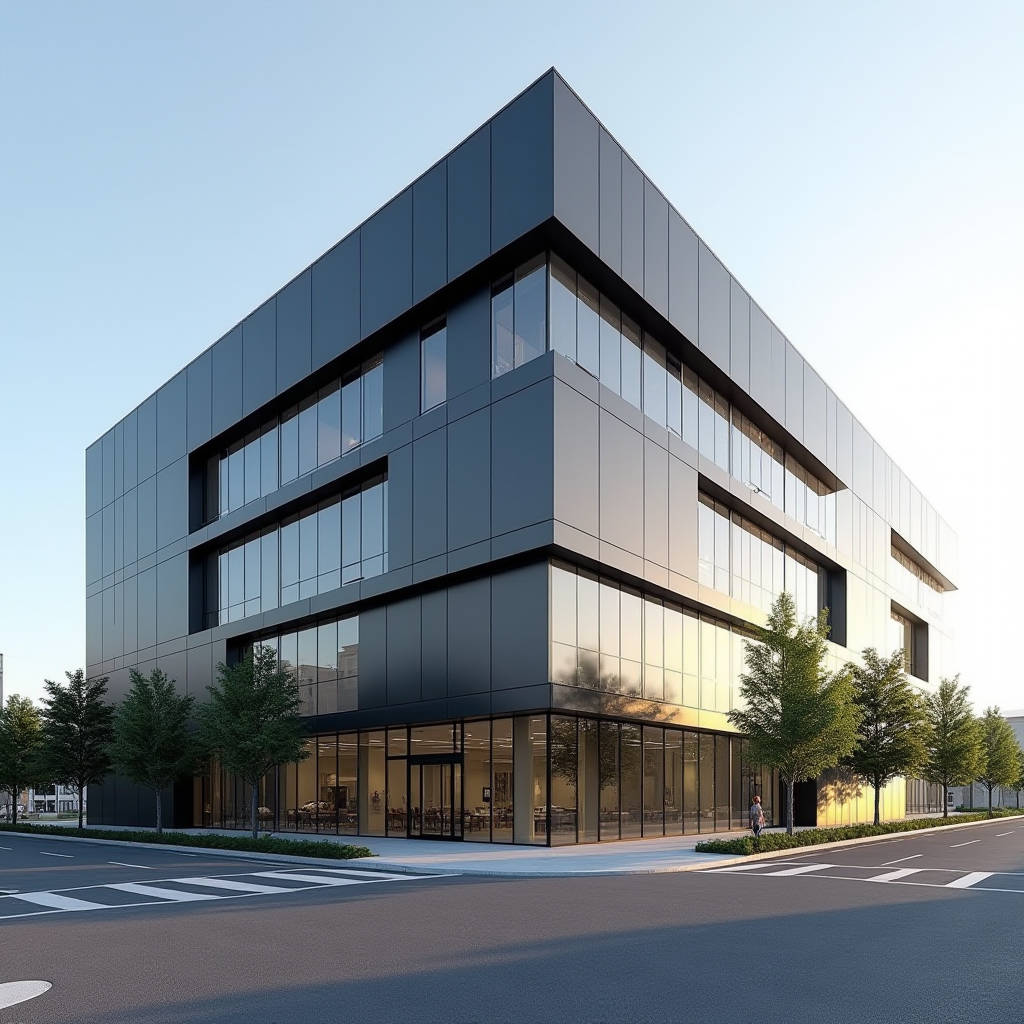
Specifying a Cassette Aluminum Facade for mid-rise and high-rise commercial envelopes demands more than picking a panel profile. The engineering conversation starts with joint design, drainage logic, and the structural interplay between solid aluminum cassettes and the substructure behind them. A cassette system is a drained and ventilated rainscreen where each panel acts as a self-supporting unit with folded returns on all four edges, hung from a carrier grid using discrete fixings. The result is a flat, shadow-line aesthetic without exposed fasteners. But the gap between a visually clean mockup and a facade that performs across 30 years of thermal cycling, wind loading, and driven rain sits squarely in the details: rib height, alloy selection, coating specification, and the difference between a true pressure-equalized cavity and a simple drained joint.
What Defines a Cassette Aluminum Facade System
A cassette panel is fabricated from a single solid aluminum sheet—typically 2.0 mm, 2.5 mm, or 3.0 mm gauge—cut, notched, and brake-pressed to form a shallow tray with folded returns. The returns are the engineered backbone of the system. Standard rib heights range from 50 mm to 200 mm, and the choice directly governs spanning capacity. A 50 mm return on a 2.0 mm panel might span 600 mm between fixing points; push the return to 150 mm in 3.0 mm material, and spans can reach 3 to 5 meters horizontally, depending on wind load and deflection limits.
The cassette hangs on a carrier framework—typically aluminum T-profiles or galvanized steel brackets—via a hook-and-rail or clip arrangement. The fixing is concealed. From the street, the observer sees only the flat face of the panel and a consistent joint shadow. This is the discrete-fix principle that separates a cassette system from face-screwed panel cladding. The panels are non-combustible, meeting EN 13501-1 Class A1 or ASTM E84 Class A requirements when produced from solid 3003 or 5052 aluminum alloy. No polyethylene core, no laminations, no fire propagation risk.
Joint Typology: The Functional Core of Cassette Design
Joints between cassettes are not cosmetic. They manage water, air pressure differential, and thermal movement. Three joint types dominate commercial cassette facade specification:
Open Joint (Drained)
An open joint leaves a gap—typically 10 mm to 20 mm—between adjacent cassettes. The cavity behind the panel is ventilated and drained. Water that penetrates the joint hits the back of the panel or the carrier and drains down the cavity. The joint is simple to fabricate and tolerant of installation tolerances. The trade-off: the dark cavity behind the gap must be managed visually. A black EPDM baffle or dark-colored breather membrane behind the joint prevents the carrier framework from being visible. Open joints work well in moderate climates and on buildings where the aesthetic of a pronounced shadow line is acceptable.
Baffled Joint
A baffled joint incorporates an extruded aluminum or EPDM insert behind the visible gap. The baffle blocks direct water entry while maintaining ventilation. Pressure equalization is partial. The baffle also serves as a visual mask, hiding the substructure. This joint type suits projects where wind-driven rain is a concern but full pressure equalization is not mandated by the specification.
Sealed Joint (SSG Cassette)
Sealed-joint cassette systems use wet silicone perimeter seals combined with multi-layer EPDM gaskets to achieve air and water tightness. The cassette effectively becomes a unitized pressure-equalized module. This is the approach behind systems like the GCW01 cassette facade, where glass lites are structurally bonded to aluminum cassette frames and the entire assembly is hung on a mullion-transom grid. Sealed joints are specified for high-rise towers, hospitals, and laboratories where interior pressure control matters. The cost premium is significant—sealed-joint cassette systems can run 25% to 40% higher than open-joint equivalents—but the performance envelope justifies the investment.
Alloy Selection and Mechanical Properties
Not all solid aluminum behaves the same way on a facade. The alloy choice affects formability, corrosion resistance, and the flatness achievable after brake-pressing. Three alloys dominate the cassette market:
| Alloy | Temper | Yield Strength (MPa) | Typical Gauge Range | Best Application |
|---|---|---|---|---|
| 3003 | H14 | 145 | 2.0 – 3.0 mm | General commercial facades, moderate wind zones |
| 5052 | H32 | 193 | 2.0 – 3.0 mm | Coastal environments, high corrosion resistance |
| 5754 | H22 | 190 | 2.5 – 3.0 mm | High-wind zones, long-span applications |
3003-H14 is the workhorse. It brake-presses cleanly, accepts PVDF coatings well, and costs less than the 5000-series alternatives. 5052-H32 brings magnesium into the alloy, boosting corrosion resistance for coastal and industrial atmospheres. 5754-H22 offers a strength advantage without the stress-corrosion sensitivity of some 6000-series extrudable alloys. For a standard 3.0 mm cassette with 100 mm returns, 5052-H32 can handle design wind pressures exceeding 2.5 kPa at spans up to 1.8 meters, assuming a deflection limit of L/175 as per AAMA 508 guidelines.
Coating Systems and Performance Verification
The coating on a Cassette Aluminum Facade does two jobs: aesthetics and barrier protection. PVDF (polyvinylidene fluoride) remains the industry benchmark for architectural aluminum. A proper PVDF system—applied to a chromate conversion coating on the aluminum substrate—consists of a primer layer and a color coat with a minimum total dry film thickness of 25–30 microns for a two-coat system, or 35–40 microns for a three-coat system with a clear topcoat. The resin content in the color coat must be at least 70% PVDF by weight, per AAMA 2605.
FEVE (fluoroethylene vinyl ether) coatings offer an alternative with comparable weatherability and a wider gloss range, including low-gloss and matte finishes that PVDF struggles to achieve below 25 gloss units. Powder coatings based on polyester or super-durable polyester chemistries are gaining ground for mid-range projects, but their color retention and chalk resistance over 20 years do not match PVDF or FEVE.
AAMA 2605-compliant PVDF coatings carry a 20-year film integrity and color retention warranty as standard from qualified applicators. The key test parameters: 4,000 hours of salt spray (ASTM B117), 10 years of South Florida exposure with a maximum Delta E of 5, and no blistering, cracking, or adhesion loss. For projects in the Middle East or Southeast Asia, where UV and humidity combine aggressively, specifying a three-coat PVDF system with a clear topcoat is standard engineering practice.
Wind Load Engineering and Span Tables
Cassette panel spanning capacity is not a manufacturer's guess. It is calculated from the aluminum alloy's yield strength, the panel geometry, and the design wind pressure derived from the local building code. The governing equation for a simply supported plate under uniform wind pressure is:
w = (σ_y × t²) / (β × b²)
Where w is the uniform pressure capacity, σ_y is the alloy yield strength, t is the panel thickness, β is a bending coefficient dependent on aspect ratio and edge fixity, and b is the shorter span dimension. For a typical cassette with four-edge support and an aspect ratio of 1:1, β is approximately 0.25. For a 2.5 mm 5052-H32 panel spanning 1.2 meters, the calculated capacity is roughly 3.1 kPa—sufficient for most suburban mid-rise conditions.
Real-world span tables incorporate safety factors. A typical manufacturer's table for a 2.0 mm 3003-H14 cassette with 80 mm returns might show:
- Span 800 mm: allowable wind load 2.0 kPa
- Span 1,000 mm: allowable wind load 1.3 kPa
- Span 1,200 mm: allowable wind load 0.9 kPa
Increase the return height to 150 mm and the gauge to 3.0 mm, and the same 1,200 mm span can handle 2.4 kPa. This is why rib height is not a cosmetic detail—it is a structural lever. Specifying a deeper return can eliminate intermediate support members, reducing substructure cost and installation time.
Thermal Movement and Fixing Strategy
Aluminum expands at approximately 0.024 mm per meter per degree Celsius. A 4-meter-long cassette panel facing a 60°C temperature swing from winter night to summer solar gain will move roughly 5.8 mm. The fixing system must accommodate this movement without inducing buckling, fastener loosening, or sealant shear.
Discrete-fix cassette systems address thermal movement through a combination of fixed and sliding points. Each panel typically has two fixed anchors—usually at the top corners—that locate the panel in space. The remaining clips allow longitudinal sliding. The clip design incorporates a nylon or EPDM bush that isolates the aluminum cassette from the aluminum carrier, preventing galvanic contact and reducing noise from thermal expansion and contraction.
Installers must verify that the sliding clips are not overtightened and that the panel can move freely after installation. A common defect is a cassette that is inadvertently fixed at all four corners, which leads to oil-canning in summer and joint sealant failure in winter.
Fire Performance and Non-Combustibility
Post-Grenfell, the global facade industry has undergone a hard reset on fire safety. Solid aluminum cassette panels are inherently non-combustible. A 3.0 mm 5052 aluminum sheet carries an EN 13501-1 classification of A1—no contribution to fire, no smoke, no flaming droplets. This is not a coating claim; it is a material property of solid aluminum.
The cavity behind the cassette must also be fire-engineered. Continuous vertical cavities can act as chimneys. Building codes in the UK (Approved Document B), Australia (NCC C1.12), and the UAE (UAE Fire and Life Safety Code) require cavity barriers at each floor level and at compartment boundaries. The breather membrane behind the cassette must be Class A2-s1,d0 or better. Non-combustible mineral wool insulation in the cavity completes the fire-safe assembly.
For specifiers, the chain of evidence matters. A credible cassette supplier provides a full EN 13501-1 classification report for the panel assembly, not just the aluminum sheet. The report covers the panel, the coating, and any backing materials. Futeng® supplies solid aluminum cassette panels with full A1 classification documentation, traceable to the mill certificate for each batch of aluminum coil.
Installation Sequence and Quality Control
Cassette facade installation follows a logical sequence that, when executed correctly, delivers a flat, rattle-free envelope. The critical steps:
- Substrate survey and bracket setting. Laser survey the structural substrate. Set the carrier brackets to a tolerance of ±2 mm in plane across the entire elevation. Bracket misalignment compounds across the grid and produces visible waviness in the finished facade.
- Carrier rail installation. Vertical T-profiles or horizontal Z-girts are fixed to the brackets. Alignment is verified with a string line or laser. The carrier grid defines the plane of the facade; errors here cannot be corrected later.
- Breather membrane and insulation. A vapor-permeable membrane is installed over the substrate, followed by non-combustible insulation boards mechanically fixed through the membrane.
- Cassette hanging. Panels are lifted into position, engaged on the bottom clips, and rotated into the top clips. The installer checks that each panel sits flush and that the joint width is consistent. Panel-to-panel height tolerance is typically ±1.5 mm.
- Joint treatment. For baffled or sealed joints, EPDM gaskets or silicone seals are applied after the cassettes are in place. Wet silicone must be tooled and protected from rain during curing.
A well-supervised crew can install 30 to 50 square meters of cassette facade per day, depending on panel size, access conditions, and joint complexity. Large-format cassettes—2 meters by 4 meters—accelerate coverage but require mechanical lifting aids and careful handling to avoid edge damage.
Cost Structure and Budgeting Factors
The installed cost of a Cassette Aluminum Facade breaks down into material, fabrication, substructure, and labor. A typical distribution for a mid-rise commercial project in Western Europe or North America:
| Cost Component | Share of Total | Key Variables |
|---|---|---|
| Aluminum sheet (mill finish) | 20 – 25% | Alloy, gauge, LME aluminum price |
| PVDF coating | 8 – 12% | Two-coat vs. three-coat, color, gloss |
| Fabrication (cutting, folding, routing) | 15 – 20% | Panel size, return height, complexity |
| Substructure (carrier grid, brackets, fixings) | 18 – 25% | Span requirements, substrate type |
| Installation labor | 20 – 25% | Site access, panel format, joint type |
| Engineering, freight, contingencies | 5 – 10% | Project location, documentation requirements |
Total installed costs typically range from $280 to $550 per square meter, with sealed-joint unitized cassette systems at the upper end. Bulk procurement of standard-sized panels in a single color can reduce the unit cost by 15% to 20% compared to a project with multiple panel sizes and custom finishes.
Common Failure Modes and How to Prevent Them
Cassette aluminum facades are robust when specified and installed correctly, but certain failure patterns recur across projects. Knowing them helps the specifier write tighter performance requirements:
Oil-canning. Visible waviness or buckling in the flat face of the panel. Causes include insufficient panel thickness for the span, over-constrained fixings that prevent thermal movement, and residual stresses from the coil-coating process. Prevention: specify a minimum 2.5 mm gauge for panels larger than 1 square meter, require stress-relieved material, and ensure the fixing design allows free thermal expansion.
Joint sealant failure. Silicone sealant peeling or cracking within 5 years. Causes include inadequate joint width for the expected movement, sealant applied to contaminated surfaces, and UV degradation of non-silicone sealants. Prevention: specify a minimum joint width of 12 mm for sealed joints, require a two-part structural silicone tested to ASTM C920, and mandate adhesion testing on site.
Galvanic corrosion. White, powdery corrosion product at the interface between aluminum cassettes and steel fixings. Prevention: use stainless steel (A2 or A4 grade) fixings with nylon isolation washers, or specify aluminum carrier components throughout. Avoid carbon steel fasteners in any exterior application.
Water ingress at window interfaces. The junction between cassette panels and window frames is a weak point in many installations. Prevention: detail a continuous EPDM gasket or pre-compressed foam seal at the perimeter of each opening, and include a sub-sill flashing that drains to the exterior.
Sourcing and Supply Chain Considerations
Procurement strategy for a Cassette Aluminum Facade starts with the aluminum coil. The global supply chain for architectural aluminum is concentrated in a handful of rolling mills capable of producing coil in the widths—typically 1,500 mm to 2,000 mm—required for large-format cassettes. Lead times for mill-finish coil range from 8 to 14 weeks, and PVDF coating adds another 3 to 5 weeks, depending on the applicator's schedule.
Fabrication capacity is the next bottleneck. A factory with two CNC brake presses and a powder coating line can produce 800 to 1,200 square meters of cassette panels per week. For a 15,000-square-meter facade, that translates to a 12- to 15-week fabrication window. Coordinating fabrication with the site program is essential; panels delivered too early risk storage damage, while late delivery stalls the cladding contractor.
For projects in Europe, the Middle East, and Asia-Pacific, working with a fabricator that controls both the aluminum sourcing and the coating application simplifies logistics. Futeng® operates an integrated production facility with in-house PVDF coating lines, enabling single-point responsibility for material quality, coating consistency, and delivery scheduling. The factory's weekly output of over 5,000 square meters of solid aluminum cassette panels supports large-scale commercial projects without subcontracting fabrication to third parties.
Specification Checklist for Architects and Engineers
A robust cassette facade specification leaves no ambiguity. The following checklist covers the parameters that should appear in every performance specification:
- Alloy and temper: 3003-H14, 5052-H32, or 5754-H22, with mill certificates to EN 485 or ASTM B209.
- Panel thickness: Minimum 2.0 mm; 2.5 mm or 3.0 mm for large-format panels or high-wind zones.
- Return height: Specified based on span tables and wind load calculations, not arbitrarily.
- Coating: PVDF to AAMA 2605, minimum 70% PVDF resin, 25–30 microns DFT for two-coat, 35–40 microns for three-coat. Color and gloss range defined.
- Fire classification: EN 13501-1 Class A1 or ASTM E84 Class A for the complete panel assembly.
- Fixing system: Discrete fix with concealed clips, fixed and sliding points as per thermal movement calculations, stainless steel or aluminum components.
- Joint type: Open, baffled, or sealed, with joint width specified and tolerances defined.
- Wind load: Design pressure and deflection limit (L/175 or L/240) stated, with span tables provided by the manufacturer.
- Warranty: 20-year coating warranty from a qualified applicator, 5-year workmanship warranty from the fabricator.
Specifying to these parameters ensures that the tender returns are comparable and that the installed facade meets the performance expectations of the design team and the building owner.
The Cassette Aluminum Facade has earned its place in contemporary commercial architecture through a combination of clean aesthetics, fast installation, and verifiable engineering performance. The system's success on any given project depends on the rigor applied to the details: alloy selection matched to the environment, coating specified to the climate, joint design aligned with the performance requirements, and fixing strategy that respects thermal physics. When these elements are coordinated—and when the supply chain is managed from coil to site—the result is a facade that performs quietly for decades, with minimal maintenance and no surprises.