Interactive Aluminum Facade How Solid Panels Respond to Light Heat and Wind Without Electronics
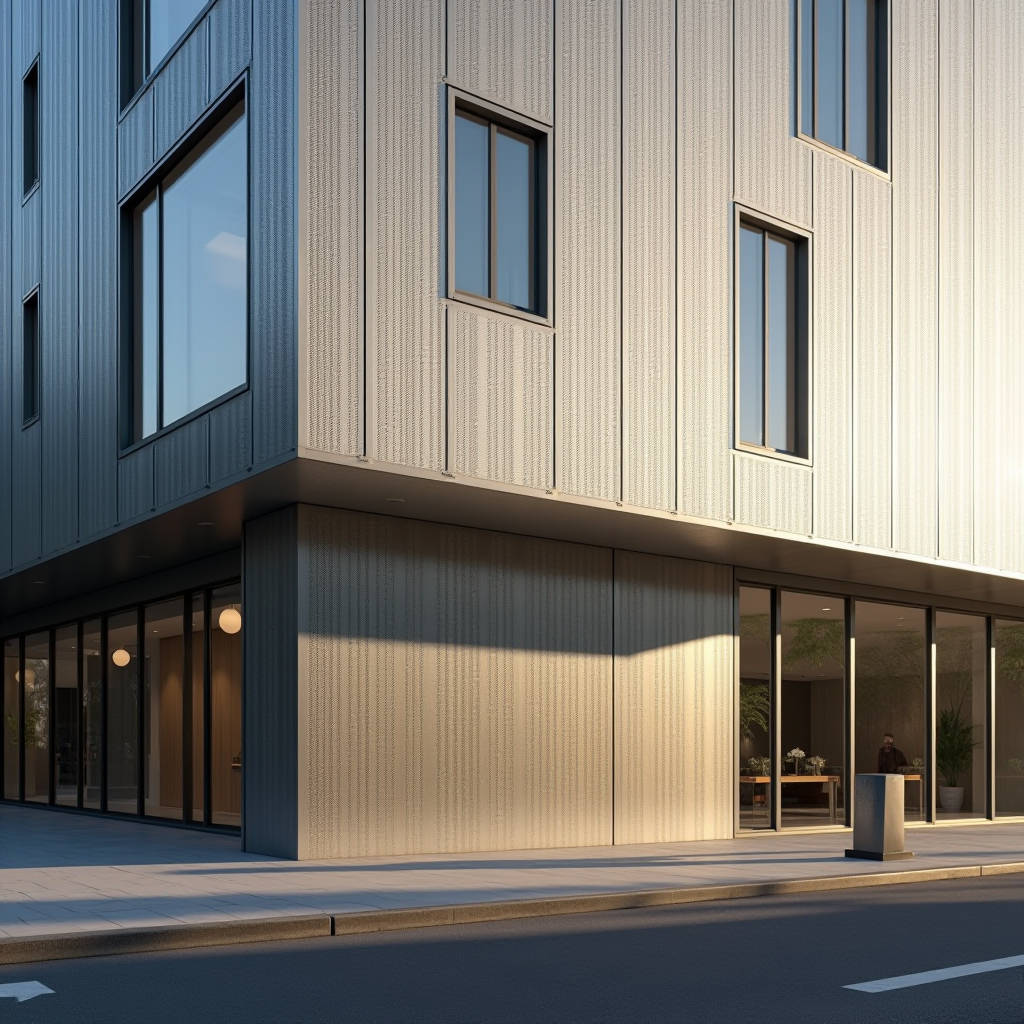
An Interactive Aluminum Facade is not a screen bolted onto a building. It is a load-bearing skin that responds to light, wind pressure, thermal expansion, and human proximity through material properties rather than electronic sensors. The aluminum itself does the work. When a solid 3.0mm AA5052 panel bows outward by 12mm under midday thermal gain and returns flush by evening, that is interaction. When a perforated rainscreen casts shifting shadow patterns across a lobby floor as the sun tracks west, that is interaction. When a brushed anodized surface reads differently at 8:00 AM than it does at 4:00 PM because the angle of incidence changes how the grain catches light, that is interaction. None of these effects require a single wire, microcontroller, or software update. They require precise engineering, tight tolerances, and a deep understanding of how solid aluminum panels behave over decades of exposure.
What "Interactive" Actually Means for Solid Aluminum Cladding
The term interactive aluminum facade gets thrown around in marketing decks to describe anything with LED strips or kinetic louvers. But for general contractors and facade engineers writing performance specifications, the word carries a different weight. It means the facade system changes its physical state in response to environmental inputs without relying on powered actuators. The aluminum panel itself is the mechanism.
Three physical phenomena drive this behavior:
- Thermal deflection — A 2.5mm solid aluminum sheet spanning 1,200mm between rails will expand by approximately 2.8mm per linear meter across a 60°C temperature swing. If the substructure does not accommodate this movement, the panel buckles. If it does, the panel breathes visibly, creating a facade that subtly shifts profile throughout the day.
- Specular reflectance variation — Brushed, embossed, and perforated aluminum surfaces scatter light differently as the sun angle changes. A facade that appears matte silver at noon can read as dark charcoal at dusk. This is not a coating trick; it is geometry.
- Pressure-equalized cavity dynamics — A properly designed rainscreen with solid aluminum panels creates a pressure-equalized cavity behind the cladding. Wind loads compress the cavity air, and the panel flexes within engineered limits. This micro-movement prevents moisture ingress and reduces structural load on the anchoring system.
These are not aesthetic features. They are performance characteristics that must be calculated, specified, and tested against ASTM E330 for wind load and AAMA 501.1 for dynamic water penetration. The "interactive" quality of the facade is a byproduct of getting the engineering right.
Perforation as a Daylight Interaction Tool
Perforated solid aluminum panels represent the most direct form of passive interactivity available to facade designers. By varying hole diameter, spacing, and open-area ratio across a single panel or across adjacent panels, the facade becomes a daylight filter. The interior experience changes continuously as the sun moves, and the exterior appearance shifts from opaque to semi-transparent depending on viewing angle and ambient light levels.
The engineering constraints are non-negotiable. A 2.0mm solid aluminum panel with 40% open area loses roughly 55% of its bending stiffness compared to a solid panel of the same thickness. This means the subframe spacing must tighten, or the panel gauge must increase to 2.5mm or 3.0mm. Perforation patterns also introduce stress concentrations around each hole. Finite element analysis (FEA) should be run on any pattern with non-circular perforations or with edge distances below 1.5x the hole diameter.
From a procurement standpoint, the key specification is the perforation tooling method. CNC turret punching produces clean holes with minimal burring but leaves a slight dimple around each perforation. Laser cutting eliminates the dimple but can create a heat-affected zone that alters the aluminum's temper within 0.5mm of the hole edge. For marine or coastal environments, this microstructural change can become a corrosion initiation point if the panel is not properly pretreated and PVDF-coated after perforation. The correct sequence is: perforate first, then chromate conversion coat, then apply the PVDF system. Skipping pretreatment because "the holes are too small" is a common shortcut that leads to filiform corrosion within 3-5 years.
Surface Texture and the Angle-Dependent Facade
An interactive aluminum facade does not need moving parts to appear dynamic. Surface texture does the work. Three finishing approaches create angle-dependent visual behavior that turns a static building envelope into something that reads differently from every approach angle:
Mechanical brushing produces a linear grain pattern. When sunlight hits the grain perpendicularly, the panel appears bright and reflective. When the light runs parallel to the grain, the same panel appears darker and more matte. This effect is strongest with a clear anodized finish over the brushed surface. The anodic layer (typically 15-20 microns per AAMA 611) is transparent, so the underlying texture remains fully visible.
Embossed or stucco-textured surfaces scatter light omnidirectionally, which reduces glare but also reduces the dramatic angle-dependent shift. The trade-off is practical: embossed panels hide oil-canning and minor impact damage better than flat or brushed panels. For high-traffic ground-level applications where the facade will be touched, leaned on, or struck by bicycles and carts, a 2.5mm embossed panel with PVDF coating offers the best balance of durability and visual consistency.
Micro-perforation combined with a contrasting backing layer creates a third category of interactivity. The facade appears solid from a distance, reveals the backing color at mid-range, and becomes a transparent scrim up close. This three-stage reading is a function of the human visual system's angular resolution, not any powered system. The specification must control hole diameter (typically 0.8mm to 1.5mm), center-to-center spacing, and the color contrast between the panel face and the backing material. A dark backing behind a light-colored perforated panel produces the strongest moiré-free transition effect.
Thermal Movement and the Breathing Facade
Every solid aluminum panel moves. The coefficient of linear thermal expansion for AA5052 is 23.8 × 10⁻⁶ per °C. On a 3-meter panel subjected to a 70°C surface temperature swing (from -10°C winter night to 60°C summer afternoon under direct sun), the panel grows by approximately 5mm. If the fixing system does not allow this movement, the panel will find somewhere to go — usually by buckling outward between fasteners or by tearing at the rivet points.
The interactive aluminum facade that "breathes" is not a design concept. It is what happens when the engineering is correct. The panel is fixed at one point (the dead anchor) and allowed to slide at all other connection points. The sliding connections use slotted holes with nylon or PTFE washers that permit movement while maintaining wind-load resistance. The joint between adjacent panels opens and closes by 2-3mm seasonally, which means the sealant selection must accommodate cyclic movement without losing adhesion. Low-modulus silicones with ±50% movement capability are standard; polyurethane sealants with ±25% movement capability are not appropriate for this application.
For contractors, the practical implication is that panel installation temperature matters. Panels installed at 5°C will be in their contracted state; panels installed at 35°C will be in their expanded state. Joint widths should be calculated based on the expected installation temperature range and the building's geographic location. A panel installed in Dubai in August needs wider joints than the same panel installed in Oslo in March. The math is straightforward, but skipping it leads to panels that either bind against each other in summer or leave unsightly gaps in winter.
Acoustic Interactivity: The Facade as Sound Modifier
An interactive aluminum facade also interacts with sound. Solid aluminum panels reflect sound efficiently, which can create noise problems in dense urban environments. Perforated panels with an acoustic backing — typically a non-woven acoustic fleece or a mineral wool layer behind the perforations — convert the facade into a broadband sound absorber. The system works on the Helmholtz resonator principle: the perforations act as necks, the cavity behind the panel acts as the resonator volume, and the acoustic fleece provides the damping.
The absorption coefficient depends on perforation diameter, open area percentage, cavity depth, and fleece density. A typical configuration — 2.5mm holes at 15% open area, 100mm cavity, 50mm mineral wool backing — achieves a noise reduction coefficient (NRC) of 0.65 to 0.75, which is competitive with purpose-built acoustic panels. This turns the building envelope into a noise mitigation system without adding a separate acoustic treatment layer.
For projects near airports, rail corridors, or major roadways, this dual-function approach can eliminate the cost of interior acoustic ceilings or wall treatments. The facade does both jobs. The specification must reference ASTM C423 for sound absorption testing and ISO 354 for the reverberation room method. The acoustic fleece must be rated for exterior use; standard interior acoustic fabrics will degrade within 18 months when exposed to moisture and UV radiation, even behind a perforated panel.
Coating Systems and Long-Term Visual Stability
The interactive qualities of an aluminum facade — the angle-dependent reflectance, the color shift, the texture reading — are only as durable as the coating that protects the aluminum. A PVDF coating system based on Kynar 500® or Hylar 5000® resin, applied at a minimum 25 microns dry film thickness over a chromate conversion coating, is the industry benchmark for architectural aluminum. The specification should reference AAMA 2605 for superior-performance organic coatings.
The table below compares coating systems relevant to interactive facade applications where visual consistency over time is critical:
| Coating System | Dry Film Thickness | Color Retention (10 Years) | Chalk Resistance | Applicable Standard |
|---|---|---|---|---|
| PVDF 70% (Kynar 500®) | 25-35 µm | ΔE ≤ 5 | Rating 8+ | AAMA 2605 |
| PVDF 50% | 20-25 µm | ΔE ≤ 8 | Rating 6-7 | AAMA 2604 |
| Polyester (SP) | 20-25 µm | ΔE ≤ 12 | Rating 4-5 | AAMA 2603 |
| Clear Anodized (AA20) | 15-20 µm | N/A (natural) | N/A | AAMA 611 |
| FEVE Fluoropolymer | 25-30 µm | ΔE ≤ 5 | Rating 8+ | AAMA 2605 |
For an interactive aluminum facade where the angle-dependent visual effect relies on surface texture rather than color, clear anodized or clear PVDF over a brushed substrate preserves the texture while providing corrosion protection. Colored PVDF coatings can fill in the micro-texture of a brushed surface, reducing the angle-dependent effect. The specifier should request mock-ups with the exact coating system specified before finalizing the finish selection. A 300mm × 300mm sample viewed under a light booth does not predict how a 3-meter panel will read on the building.
Substructure Engineering for Interactive Performance
The aluminum panel is only half the system. The substructure — typically extruded aluminum rails, brackets, and fasteners — determines whether the panel's interactive behavior is controlled or chaotic. A poorly designed substructure fights the panel's natural movement, leading to oil-canning, fastener fatigue, and water ingress. A properly designed substructure works with the panel, allowing thermal movement while maintaining wind-load resistance and drainage.
Key engineering decisions include:
- Rail spacing — For 2.5mm solid aluminum panels, maximum rail spacing is typically 1,200mm for wind zones up to 2.0 kPa. For 3.0mm panels, spacing can extend to 1,500mm. Perforated panels require spacing reductions of 20-30% depending on open area percentage.
- Thermal isolation — Where aluminum substructure penetrates the building's thermal envelope, thermal breaks are required to prevent condensation and heat loss. Polyamide thermal break pads with a thermal conductivity below 0.3 W/m·K are standard.
- Material compatibility — Aluminum substructure in contact with steel building structure requires isolation to prevent galvanic corrosion. Stainless steel fasteners (A2 or A4 grade) are mandatory; zinc-plated carbon steel fasteners will corrode within 2-3 years when in contact with aluminum in exterior applications.
- Drainage and ventilation — The cavity behind the panel must be drained at the base and ventilated at the top. Minimum cavity depth is 25mm, but 38-50mm is recommended for buildings over 30 meters where wind-driven rain is a concern.
For projects requiring an interactive aluminum facade with significant panel movement, the substructure connection points should be designed as sliding joints rather than fixed connections. This adds approximately 8-12% to the substructure cost but eliminates panel buckling and the associated callbacks. The cost-benefit analysis favors sliding joints on any project where panel dimensions exceed 1.5 meters in any direction or where the expected annual temperature range exceeds 40°C.
Procurement and Quality Control: What to Inspect Before Shipment
For procurement managers and general contractors, the interactive performance of an aluminum facade is determined long before the panels arrive on site. It is determined in the factory, during fabrication and finishing. The following inspection points should be part of every pre-shipment quality control protocol:
Panel flatness — Measured with a straight edge and feeler gauge. For panels up to 1,200mm, deviation should not exceed 2mm. For panels 1,200-2,400mm, deviation should not exceed 3mm. Oil-canning (visible waviness under specular light) is not a manufacturing defect per se, but excessive oil-canning indicates insufficient panel gauge for the span or inadequate handling during fabrication.
Coating adhesion — Cross-hatch test per ASTM D3359, Method B. Rating 5B (no detachment) is required. Boiling water adhesion test per AAMA 2605, with no blistering or adhesion loss after 20 minutes immersion.
Perforation accuracy — Hole diameter tolerance ±0.1mm, center-to-center spacing tolerance ±0.5mm cumulative over 10 holes. Edge distance from perforation to panel edge must meet the specified minimum, typically 10mm or 1.5x material thickness, whichever is greater.
Dimensional tolerance — Panel length and width ±1.5mm, diagonal difference ≤3mm for panels up to 2,400mm. Fold angle tolerance ±1° for brake-formed panels.
Suppliers like Futeng®, who operate in-house CNC punching, laser cutting, and PVDF coating lines, can provide full traceability from coil to finished panel. This single-source control reduces the risk of finger-pointing between the fabricator and the coater when coating defects appear. For an interactive aluminum facade where visual consistency is critical, batch-to-batch color matching should be verified with a spectrophotometer, and panels should be sorted by production batch for sequential installation on the building.
Cost Drivers and Budget Benchmarks
An interactive aluminum facade with perforations, custom textures, and high-performance coatings costs more than a standard flat panel rainscreen. Understanding the cost drivers helps procurement teams allocate budget accurately and avoid value-engineering decisions that undermine the interactive performance.
The primary cost drivers are:
- Perforation complexity — A simple 15% open area with 5mm round holes on a 12mm staggered grid adds roughly 18-25% to the panel fabrication cost. Custom patterns with variable hole sizes, non-circular perforations, or open areas above 30% can add 40-60%.
- Surface finishing — Brushed texture adds 10-15% over a standard mill finish. Embossed or stucco texture adds 15-20%. The combination of brushing plus PVDF coating requires careful process control to avoid filling the texture with coating, which can add 5-8% in quality-control labor.
- Panel gauge — Moving from 2.0mm to 2.5mm adds approximately 25% to material cost. Moving from 2.5mm to 3.0mm adds another 20%. The thicker gauge also increases shipping weight and handling costs.
- Substructure complexity — Sliding-joint systems with thermal breaks cost 30-40% more than fixed-clip systems. For high-rise applications where wind loads exceed 3.0 kPa, the substructure engineering and material costs increase non-linearly.
As a rough budget benchmark, a standard 2.5mm solid aluminum rainscreen with PVDF coating and a fixed-clip substructure runs $180-220 per square meter, supplied and installed. An interactive aluminum facade with 20% perforation, brushed texture, PVDF coating, and a sliding-joint thermally broken substructure runs $280-350 per square meter. The premium buys the interactive behavior — the breathing, the light play, the acoustic performance — without adding a single powered component.
Installation Sequencing and On-Site Handling
The interactive qualities of the facade can be compromised by poor installation practices. Panels that are dropped, dragged, or stacked without interleaving will show scratches, edge damage, and oil-canning that destroy the visual consistency the design relies on. The following practices are mandatory for any project where the facade's interactive performance matters:
Panel storage — Store panels vertically on edge in the original crating, with interleaving material between panels. Do not stack panels flat. Do not store panels outdoors without weather protection. Condensation trapped between stacked panels causes water staining and can initiate filiform corrosion on cut edges.
Installation sequence — Install panels from the bottom up, completing each horizontal row before moving to the next. This prevents water from running behind partially installed panels and staining the insulation or air barrier. For perforated panels with a directional pattern, verify orientation before fastening. A panel installed upside down or rotated 90° will break the pattern continuity.
Fastener torque — Over-torqued fasteners dimple the panel face and restrict thermal movement. Under-torqued fasteners allow panel flutter under wind load. The correct torque value depends on the fastener type and the panel gauge, but a typical specification is 8-10 N·m for M6 stainless steel fasteners into aluminum rails. Torque should be verified with a calibrated torque wrench on the first 10 panels and spot-checked every 50 panels thereafter.
Joint alignment — Horizontal and vertical joints should be straight within 3mm over any 6-meter run. Joint width variation should not exceed ±1.5mm from the specified dimension. These tolerances are tighter than standard rainscreen specifications because the interactive facade's visual effect depends on consistent joint lines.
The general contractor should budget for a facade consultant or the panel supplier's technical representative to be on site for the first week of installation. The cost of this supervision — typically $2,000-4,000 — is negligible compared to the cost of removing and replacing 50 panels that were installed incorrectly.
Long-Term Performance: What to Expect After 10, 20, and 30 Years
The interactive aluminum facade is a long-term investment. Unlike powered kinetic systems that require maintenance contracts, software updates, and component replacements, a passive interactive facade based on solid aluminum panels should perform for 30-50 years with minimal intervention. But "minimal" does not mean "zero."
At 10 years: PVDF-coated panels should show no visible chalking, color change within ΔE 5, and no loss of coating adhesion. Anodized panels may show slight dulling of the surface, particularly in marine or industrial environments. Joint sealants should be inspected and any cracked or debonded sealant replaced. This is a $5-8 per linear meter maintenance item.
At 20 years: PVDF coating should still be intact, though some gloss reduction is normal. Fasteners should be spot-checked for corrosion; stainless steel fasteners in non-marine environments should show no significant degradation. The cavity behind the panels should be inspected for debris accumulation, insect nests, or signs of water staining on the insulation.
At 30 years: The aluminum substrate itself should be structurally sound. AA5052 and AA3003 alloys do not suffer from age-related embrittlement. The PVDF coating may be approaching the end of its aesthetic service life, but the panels will still be functional. A full recoating is possible but rarely cost-effective compared to panel replacement. Anodized panels in coastal environments may show pitting; this is cosmetic unless the pitting depth exceeds 0.5mm.
The key to long-term performance is the initial specification. A facade built with 2.0mm panels where 3.0mm was needed will oil-can within the first year. A facade with polyester coating where PVDF was specified will chalk within 5 years. A facade with zinc-plated fasteners where stainless steel was required will bleed rust stains within 3 years. The interactive aluminum facade that still performs after 30 years is the one where no one took shortcuts in year zero.
The industry has spent decades chasing interactivity through electronics — LED matrices, motorized louvers, responsive shading systems. Those systems have their place, but they come with maintenance liabilities, energy consumption, and obsolescence timelines that solid aluminum panels simply do not have. A well-engineered perforated aluminum rainscreen with a brushed PVDF finish will still be doing its job — filtering daylight, shifting with the sun, breathing with the temperature — long after the building's BMS has been upgraded three times. That is the argument for passive interactivity. It is not a compromise. It is a different category of performance, one that rewards precision in fabrication and discipline in installation over the long term.