Folded Aluminum Panel Engineering for Rainscreen Facades Tolerance Stack and Procurement Logic
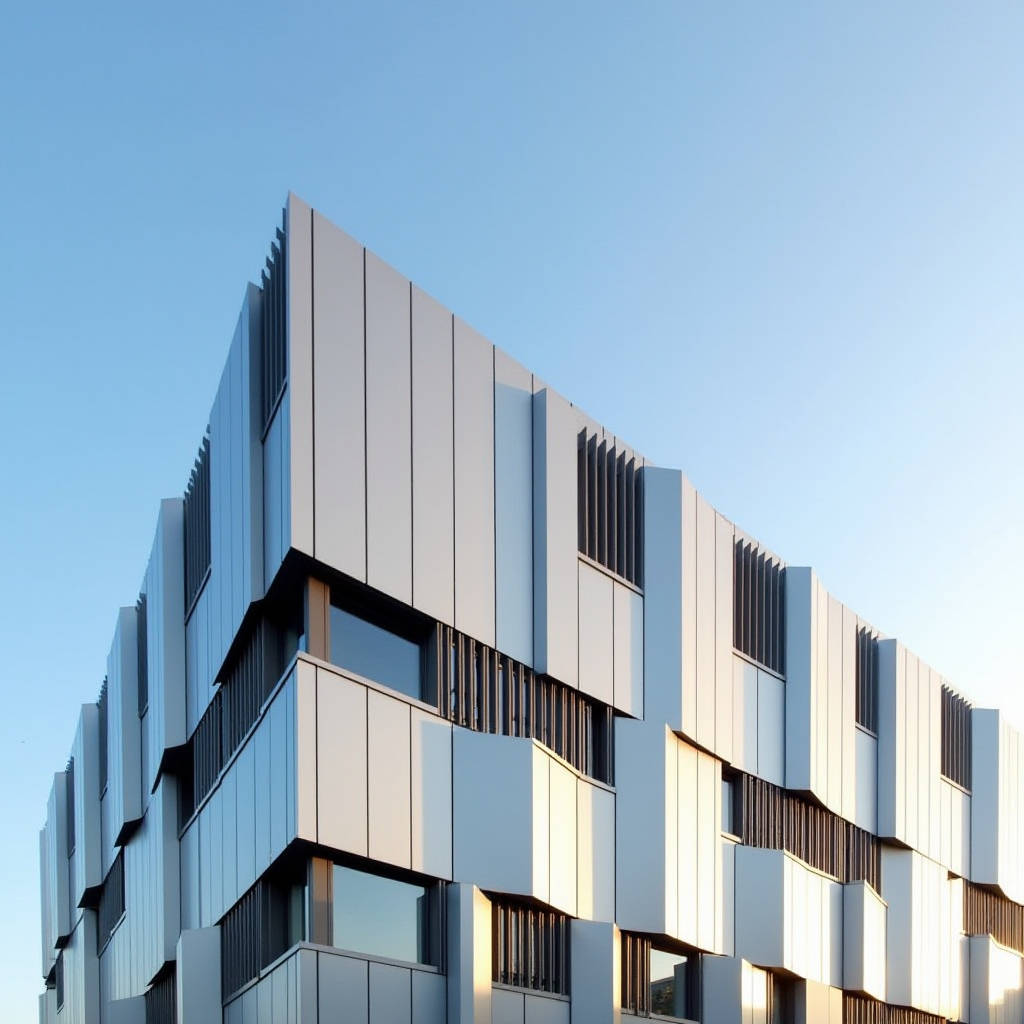
When a folded aluminum panel arrives on site, the first thing a cladding contractor checks is not the spec sheet. It is the edge. Run a finger along the brake line. Look at the radius consistency across 200 identical pieces. That one detail tells you whether the fabricator understood the assignment or just bent metal until the angle looked close enough. Folded aluminum panel systems have quietly become the default choice for rainscreen façades, column covers, soffit liners, and parapet caps across commercial projects in North America, the Middle East, and Southeast Asia. The reason is not fashion. It is geometry. A single sheet of solid 5052 or 3003 aluminum, CNC-routed to precise fold lines, then brake-formed into a three-dimensional cassette, eliminates the need for welded corners, riveted returns, and the thermal movement headaches those joints introduce. This article focuses on the engineering logic behind fold geometry, the tolerance stack that separates a watertight envelope from a callback nightmare, and the procurement decisions that determine whether your folded aluminum panel package arrives on time or six weeks late.
What Actually Happens at the Fold Line
A folded aluminum panel starts as a flat sheet, typically 2.0 mm to 3.0 mm thick for architectural exterior applications. The sheet goes onto a CNC router fitted with a V-groove bit. The machine cuts a channel along the bend line, leaving a residual material thickness at the root—usually 0.3 mm to 0.5 mm depending on the alloy and the specified bend radius. This residual web is what allows the sheet to be folded by hand or hydraulic brake without fracturing. If the groove is too deep, the panel cracks at the fold. Too shallow, and the bend radius is sloppy, the corner bulges, and the cassette will not sit flush against the subframe. The math is straightforward but unforgiving: for a 90-degree fold on 2.5 mm 3003-H14 aluminum, the groove depth should leave approximately 0.4 mm of material. The resulting outer bend radius lands around 1.5 mm to 2.0 mm, which is tight enough to read as a crisp corner from 10 meters away but not so sharp that the PVDF coating micro-cracks under thermal cycling.
The alloy choice matters here more than most specifiers realize. 3003 aluminum offers excellent formability and is the workhorse for folded aluminum panel fabrication. 5052, with its higher magnesium content, provides better corrosion resistance and tensile strength but requires more careful groove depth control because it work-hardens faster. For projects within 10 kilometers of a coastline, 5052 is the minimum recommendation per ASTM B209. Some fabricators, including Futeng®, run both alloys through dedicated CNC lines to avoid cross-contamination of swarf and to maintain separate bend parameter libraries for each material.
Why Folded Geometry Beats Welded Corners on Rainscreens
Traditional solid aluminum panel fabrication involves cutting individual face, return, and flange pieces, then TIG-welding them together at the corners. The welds get ground flush, the panel goes through surface prep, and then it receives the architectural coating. This method works. It also introduces three problems that folded aluminum panel geometry solves at the source.
First, thermal expansion. A 3-meter-long aluminum panel subjected to a 60°C temperature swing will expand and contract roughly 4.2 mm over its length. Welded corners are rigid points. Repeated cycling concentrates stress at the heat-affected zone adjacent to the weld, where the grain structure has been altered. Over 10 to 15 years, this can manifest as micro-cracking in the coating at the corners. A folded aluminum panel, by contrast, has no weld. The entire perimeter is continuous parent metal. The fold line itself acts as a stress-relief feature, allowing the panel to breathe without concentrating strain at any single point.
Second, fabrication time. A welded panel requires skilled labor, weld inspection, grinding, and often a second round of surface finishing. A folded aluminum panel moves from router to brake to coating line in a fraction of the time. For a project requiring 2,000 identical cassettes, the cumulative schedule difference can be four to six weeks. This is not a small number when liquidated damages are running at $2,500 a day.
Third, flatness. Welding introduces heat distortion. Even with careful fixturing, a large welded panel will show some oil-canning. Folded panels, being mechanically formed without heat input, exhibit superior flatness across the face. This matters enormously on high-gloss PVDF finishes where even minor undulations catch the light and become visible from the street.
The Tolerance Chain Nobody Discusses Until It Fails
A folded aluminum panel rainscreen system involves at least four independent tolerance sources: the primary structure, the subframe brackets, the vertical and horizontal rails, and the panel itself. If each layer is specified at ±3 mm, the cumulative stack can easily exceed ±12 mm at the panel face. At that point, gaskets lose compression, joints open up, and the pressure-equalized cavity stops being pressure-equalized.
Responsible fabricators hold folded aluminum panel dimensions to ±1.0 mm on face dimensions and ±0.5 mm on fold return heights. The routing process, being CNC-controlled, is inherently precise. The variable is the brake-forming operation. A hydraulic press brake with CNC back-gauge control can hold ±0.5 degrees on bend angle. A manual brake operated by a technician who "knows the machine" cannot. The difference between the two approaches becomes visible when 50 panels are installed side by side and the joint lines either run true or wander.
For specifiers, the practical takeaway is this: the subframe system should be designed with at least ±5 mm of three-dimensional adjustability, and the panel supplier should provide a dimensional inspection report for each batch, not just a certificate of conformance. The relevant standard for dimensional tolerances on aluminum sheet is ASTM B209, but that covers the sheet before fabrication. The finished panel tolerances should be explicitly stated in the project specification and cross-referenced to the rainscreen system manufacturer's installation manual.
Coating Considerations for Folded Panels
The coating on a folded aluminum panel has to do something that coatings on flat sheet do not: survive the fold. When a flat sheet is routed and folded after coating, the PVDF or FEVE layer at the bend line stretches. The elongation capacity of the coating system becomes a critical parameter. Most architectural PVDF coatings, applied per AAMA 2605, can tolerate elongation of 15% to 25% without cracking. A 90-degree fold on a 0.4 mm residual web produces surface elongation in the range of 8% to 12%, well within the safe zone. But if the residual web is thinner—say 0.2 mm—the elongation jumps and the coating can fail.
There are two process sequences in the industry. Post-coating fabrication means the flat sheet is coated first, then routed and folded. This is the most common approach for folded aluminum panel production because it ensures full coating coverage on the face and returns. The alternative is pre-coating fabrication, where the panel is formed first and then coated. This eliminates any risk of coating damage at the fold but makes it harder to achieve uniform coverage inside the return legs. The choice depends on the coating type and the fold geometry. For panels with deep returns exceeding 50 mm, post-coating fabrication is generally preferred because the electrostatic spray process struggles to reach into deep, narrow cavities.
The following table summarizes the key performance differences between the two dominant coating systems used on folded aluminum panel projects:
| Property | PVDF (Kynar 500® / Hylar 5000®) | FEVE (Lumiflon®-based) |
|---|---|---|
| Applicable Standard | AAMA 2605 | AAMA 2605 |
| Minimum Dry Film Thickness | 30-35 microns (2-coat); 40-45 microns (3-coat) | 30-35 microns (2-coat); 40-45 microns (3-coat) |
| Elongation at Break | 15-25% | 20-35% |
| Gloss Retention (10 years, Florida) | ≥50% at 60° gloss | ≥70% at 60° gloss |
| Color Range | Excellent; limited bright colors | Excellent; wider bright color gamut |
| Chalk Resistance (10 years) | Rating 8 minimum | Rating 8 minimum |
| Fold Line Performance | Good; requires ≥0.35 mm residual web | Better; more forgiving at tight radii |
| Relative Cost Index | 1.0 (baseline) | 1.15-1.30 |
Wind Load Performance and Span Capability
A folded aluminum panel derives its structural stiffness not from the material thickness alone but from the folded geometry. The returns act as stiffening ribs. A 2.5 mm thick flat sheet spanning 600 mm between supports will deflect noticeably under 2.0 kPa wind load. The same sheet, folded into a cassette with 38 mm returns on all four sides, can span 1,200 mm at the same deflection limit of L/175. The fold transforms the panel from a membrane into a shallow shell.
Design wind loads should be calculated per ASCE 7 for the specific project location, accounting for exposure category, building height, and local topographic effects. The panel supplier should provide span tables derived from physical testing or validated finite element analysis, not from rule-of-thumb extrapolation. For a typical folded aluminum panel rainscreen in a suburban office park (Exposure B, 15-meter building height, basic wind speed 45 m/s), the design pressure on corner zones can reach 2.8 kPa. A well-designed cassette with 50 mm returns in 3.0 mm 5052-H32 will handle this comfortably at 900 mm span.
The connection between the folded aluminum panel and the subframe is the next link in the load path. Most systems use a hook-and-rail arrangement where the top return of the panel engages a horizontal carrier rail, and the bottom return is secured with a clip or fastener that resists wind uplift. The clip material should be stainless steel (grade 304 minimum, 316 within 5 km of salt water) to avoid galvanic corrosion with the aluminum panel. The number and spacing of clips should be calculated based on the panel's tributary area and the design wind pressure, with a safety factor of at least 2.0 on the clip's published allowable load.
Procurement Logic: What Determines Lead Time and Cost
Folded aluminum panel procurement is not a commodity purchase. The lead time and price per square meter are driven by five variables that the specifier controls, often without realizing it.
The first is alloy and thickness. 5052 costs roughly 8% to 12% more than 3003 at the mill level. 3.0 mm sheet costs proportionally more than 2.0 mm. These are straightforward material cost drivers.
The second is fold complexity. A simple four-sided cassette with 90-degree returns is the baseline. Add a fifth fold for a shadow gap, a sixth for a drip edge, or a double-fold for a concealed perimeter, and the fabrication time per panel increases. Each additional fold requires a separate routing pass and a separate brake-forming operation. The cost adder is not linear; a panel with eight folds can cost 40% more to fabricate than a four-fold panel of the same face dimensions.
The third is coating specification. A three-coat PVDF metallic finish costs more than a two-coat solid color. FEVE adds another premium. Custom colors requiring color matching to a submitted sample add lead time for lab formulation and approval. The standard lead time for stock PVDF colors is two to three weeks for coating. Custom matches can extend this to five or six weeks.
The fourth is perforation. Many folded aluminum panel projects incorporate perforated panels for acoustic absorption or ventilated zones behind the rainscreen. Perforation is done on the flat sheet before folding. The perforation pattern, open area percentage, and hole diameter all affect the routing and folding sequence. Panels with high open area (above 30%) require careful handling during folding because the perforations reduce the panel's stiffness and can lead to distortion along the fold line if the brake pressure is not adjusted.
The fifth is quantity and repetition. A project with 50 panels of 50 unique sizes is a completely different manufacturing proposition than one with 2,500 panels of five repeating sizes. The former requires individual programming for each panel, which drives up engineering time and reduces the efficiency of batch processing. The latter allows the fabricator to optimize the nesting of parts on sheet stock, run dedicated brake setups, and achieve higher throughput. The unit price difference between these two scenarios can be 25% to 35%.
For project managers and procurement leads, the lesson is to engage the folded aluminum panel supplier during the design development phase, not after the construction documents are issued. A fabricator like Futeng® can review the panel schedule, identify opportunities to rationalize sizes without compromising the architectural intent, and flag details that will drive disproportionate cost. This early involvement typically reduces the panel package cost by 10% to 15% and shortens lead time by two to three weeks.
Installation Sequence and Quality Control Gates
The best folded aluminum panel in the world will look terrible if installed without attention to the subframe alignment and the joint tolerances. The installation sequence matters. The subframe should be surveyed and adjusted before any panels are hung. The survey should confirm that the rail positions are within ±2 mm of the design grid in both the horizontal and vertical planes. Laser scanning or total station survey is the preferred method. String lines and spirit levels are not adequate for a 30-meter elevation.
Once the subframe is signed off, the installation should proceed from a fixed reference point—typically the center of the elevation or a defined corner—and work outward. This prevents the accumulation of dimensional errors across the façade. Each panel should be checked for plumb and level as it is hung, and the joint width should be verified with a go/no-go gauge. The standard joint width for folded aluminum panel rainscreens is 20 mm, with a tolerance of ±2 mm. Joints narrower than 18 mm risk trapping debris and preventing drainage. Joints wider than 22 mm reduce the visual crispness of the façade and can expose the subframe behind the open joint.
The pressure-equalized cavity behind the panel relies on the open joints to allow air pressure to equalize between the cavity and the exterior. This prevents water from being driven through the joints by pressure differential. The cavity depth should be a minimum of 38 mm, and the air barrier behind the cavity must be continuous and properly sealed. Any breach in the air barrier—around windows, at floor lines, at parapets—compromises the pressure equalization and can lead to water ingress. This is not a panel problem; it is a building envelope coordination problem. But it is the panel installer who will get the first call when water appears on the interior.
A folded aluminum panel system is only as good as the air barrier behind it. The panel sheds the bulk of the water. The cavity manages pressure. The air barrier is the last line of defense. All three must work together.
Quality Indicators to Check Before Signing Off
When a folded aluminum panel shipment arrives, a few targeted checks can prevent months of dispute later. First, pull a random sample of panels—at least 5% of the shipment, or 10 panels, whichever is greater—and measure the face dimensions with a calibrated tape. Check against the approved shop drawings. The tolerance should be ±1.0 mm. Second, check the fold return heights at all four corners of each sampled panel. The return height should be consistent within ±0.5 mm. A panel with a 38 mm return on one side and a 36 mm return on the other will not sit flush on the rail. Third, inspect the coating at the fold lines under magnification. Look for hairline cracks, color change, or loss of gloss. A 10x loupe is sufficient. Fourth, check the flatness of the panel face by laying a straightedge across the diagonal. The gap between the straightedge and the panel face should not exceed 0.5% of the diagonal length. For a 1,500 mm diagonal panel, that means a maximum gap of 7.5 mm.
These checks should be documented in a receiving inspection report. Any non-conforming panels should be photographed, tagged, and set aside for the supplier's review. The contract should specify the acceptance criteria and the remedy for non-conforming product—whether replacement, repair, or credit. The relevant industry standard for aluminum sheet flatness is The Aluminum Association's flatness tolerances for sheet and plate, but these apply to mill product, not fabricated panels. The fabricated panel flatness criteria should be agreed upon between the specifier and the fabricator before production begins.
When Folded Aluminum Panels Make Sense—and When They Do Not
Folded aluminum panel systems are not the universal solution for every building envelope. They excel on projects where the panel dimensions are repetitive, the fold geometry is relatively simple, and the architectural expression relies on crisp edges and uniform joint lines. They are less suitable for projects with highly complex, non-repeating geometries—doubly curved surfaces, for instance, are better served by stretch-formed or die-formed panels. They are also less economical for very small quantities of unique panels, where the programming and setup time per panel dominates the fabrication cost.
For the majority of commercial rainscreen applications—office buildings, hospitals, university buildings, parking structures, industrial façades—a folded aluminum panel system offers the optimal balance of cost, performance, and schedule reliability. The key is to understand the engineering behind the fold, specify the tolerances explicitly, engage the fabricator early, and enforce quality control at the receiving stage. When these conditions are met, a folded aluminum panel rainscreen will deliver decades of service with minimal maintenance, and the crisp geometry will hold its visual integrity long after the project has been handed over.