Stamped Aluminum Panel Engineering How Alloy Grain Structure and Tooling Affect Facade Flatness
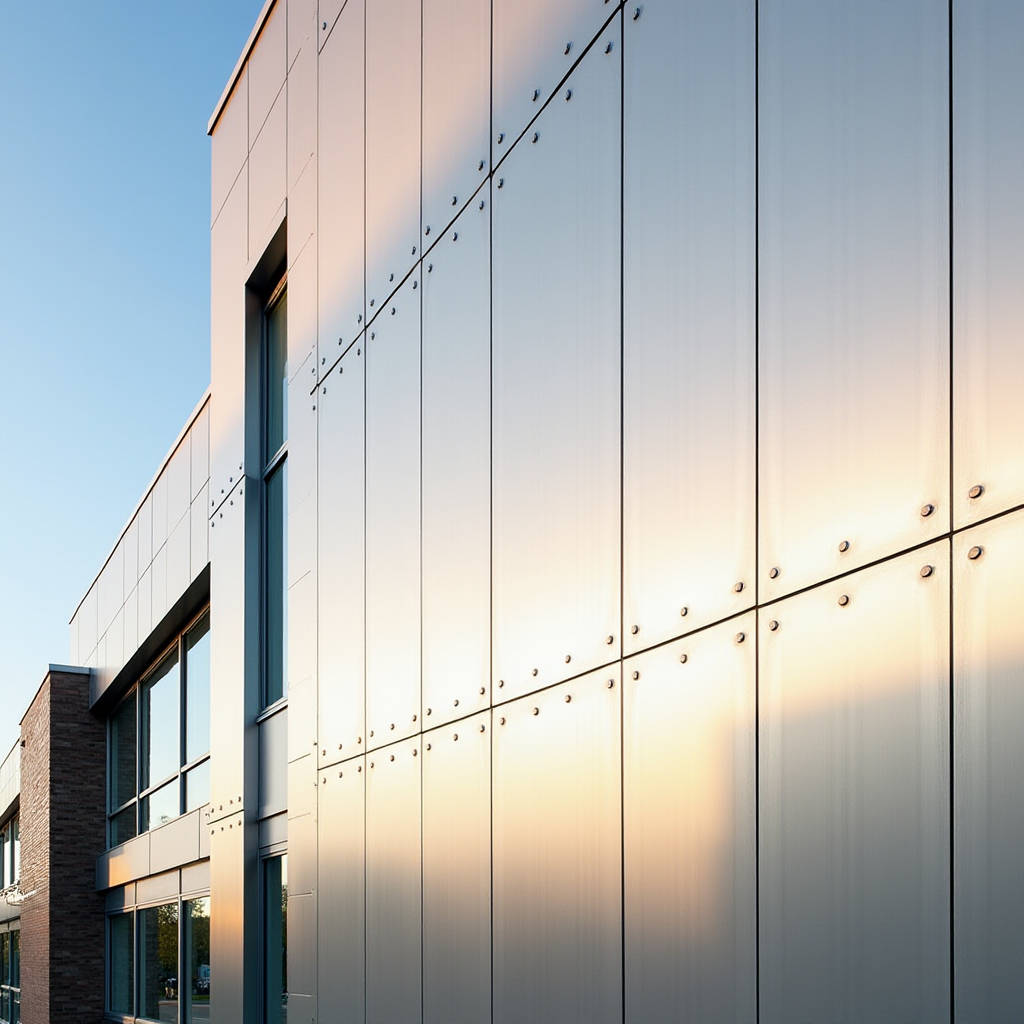
The decision to specify a stamped aluminum panel on a rainscreen facade often comes down to a single engineering question that gets surprisingly little attention during the design phase: how does the stamping process itself alter the alloy's grain structure, and what does that mean for long-term flatness tolerance across a 3,000-square-meter elevation? Most spec writers treat stamped aluminum panel products as interchangeable with flat sheet stock, but the cold-working deformation that creates ribs, returns, and stiffening geometries permanently changes the material's internal stress state. A panel that measures dead-flat at the fabricator's facility can develop oil-canning distortion six months after installation if the stamping parameters were not dialed in for the specific alloy and temper being used. This article examines the metallurgical and fabrication variables that determine whether a stamped aluminum panel will hold its intended geometry through thermal cycling, wind loading, and decades of UV exposure.
What Actually Happens to Aluminum During the Stamping Operation
When a hydraulic or mechanical press drives a die set into a blank of 3003-H14 or 5052-H32 aluminum at forces ranging from 200 to 1,500 tons depending on panel size, the material undergoes plastic deformation that is anything but uniform. The metal directly under the die radii experiences the highest strain, while the flat field areas between stamped features may see almost no deformation at all. This differential strain creates residual stress gradients across the panel surface.
The critical variable is the strain rate. Aluminum alloys exhibit strain-rate sensitivity, meaning the flow stress required to continue deformation changes depending on how fast the punch is moving. A slow hydraulic press cycle at roughly 15-25 mm/second produces a different residual stress pattern than a faster mechanical press running at 50-100 mm/second. For a stamped aluminum panel intended for exterior cladding, where flatness is a visual and functional requirement, the slower cycle generally produces more predictable springback behavior and lower locked-in stress.
Springback — the elastic recovery that occurs when the press opens and the panel partially returns toward its original shape — is the single biggest headache in stamped aluminum panel production. The amount of springback varies with alloy, temper, bend radius-to-thickness ratio, and the angle of the formed feature. A 90-degree return leg stamped into 2.5mm 5052-H32 might spring back 2 to 4 degrees, while the same feature in 3003-H14 might spring back 1 to 3 degrees. Tooling must be cut with overbend compensation to account for this, and the compensation values are rarely published — they live in the tribal knowledge of experienced tool-and-die makers.
Alloy Selection: Why 5052 and 3003 Dominate Architectural Stamping
Walk through any major curtain wall project and the stamped aluminum panel you encounter will almost certainly be fabricated from one of two alloys: 3003 or 5052. These are not accidental choices. They reflect decades of iterative learning about which aluminum grades can survive the stamping process without cracking, while still delivering the corrosion resistance and strength required for building envelope service.
3003-H14 is a manganese-alloyed grade with moderate strength — tensile around 150-170 MPa — and excellent formability. It can handle tight bend radii down to 1t (one times material thickness) without fracturing, which makes it the go-to choice for panels with complex stamped geometries, deep draws, or intricate perforation patterns. The trade-off is lower yield strength compared to 5052, which means a 3003 stamped aluminum panel may require thicker gauge or additional stiffening ribs to meet the same wind-load deflection criteria.
5052-H32 is magnesium-alloyed, delivering higher tensile strength in the 210-260 MPa range and significantly better resistance to salt-spray corrosion. For coastal projects or anywhere within 5 kilometers of breaking surf, 5052 is the conservative engineering choice. However, 5052 work-hardens more aggressively than 3003 during stamping, which means tooling must be designed with larger bend radii — typically 1.5t to 2t minimum — and the risk of edge cracking during severe forming operations is higher. The magnesium content that gives 5052 its corrosion advantage also makes it more prone to Lüders bands (stretcher-strain markings) on the panel surface if the stamping parameters are not optimized.
| Property | 3003-H14 | 5052-H32 | Relevance to Stamped Aluminum Panel |
|---|---|---|---|
| Tensile Strength (MPa) | 150–170 | 210–260 | Higher strength allows thinner gauge for same wind load |
| Yield Strength (MPa) | ≥120 | ≥160 | Determines elastic deflection under negative wind pressure |
| Elongation (%) | 8–20 | 7–18 | Higher elongation = better formability for deep stamping |
| Minimum Bend Radius | 1t | 1.5t–2t | Critical for return leg and stiffener rib geometry |
| Corrosion Resistance | Good (general atmosphere) | Excellent (marine/industrial) | 5052 preferred within 5 km of coastline |
| Work-Hardening Rate | Moderate | High | Affects springback compensation and tooling design |
| Typical Gauge Range (mm) | 2.0–3.0 | 2.0–3.0 | Standard for architectural cladding per AAMA 508 |
The Tooling Investment Nobody Talks About
Stamped aluminum panel production is a tooling-intensive business. Unlike laser-cut flat panels that can be nested and programmed with minimal upfront investment, a stamped panel requires a dedicated die set — and that die set represents a fixed cost that must be amortized across the project's square meterage. Understanding this cost structure is essential for anyone evaluating whether stamping is the right fabrication method for a given facade design.
A single progressive or compound die for a typical architectural panel — say, 600mm x 1,200mm with stamped stiffening ribs, return legs, and mounting slots — can cost between $8,000 and $35,000 depending on complexity, number of stations, and whether the die is designed for a mechanical or hydraulic press. For a project requiring 2,000 panels, that tooling cost amortizes to $4 to $17.50 per panel, which is often economically viable. For a project requiring only 200 panels, the per-panel tooling burden jumps to $40 to $175, at which point alternative fabrication methods like CNC folding or routing may make more sense.
The die material choice matters too. Tool steel (D2 or A2) dies are standard for production runs exceeding 5,000 hits. For shorter runs, some fabricators use cast-iron or even aluminum-bronze dies to reduce upfront cost, but these wear faster and can produce dimensional drift over the course of a run. On a large facade project where panel-to-panel joint consistency is held to ±1.5mm, die wear is not a theoretical concern — it is a quality-control variable that must be monitored with in-process dimensional checks.
Futeng® has observed across its project portfolio that the break-even point where stamping becomes more cost-effective than CNC folding plus welding typically falls around 500 to 800 identical panels. Below that threshold, the tooling cost dominates. Above it, the speed advantage of stamping — cycle times of 15 to 30 seconds per panel versus several minutes for multi-step folding and welding — drives unit cost down significantly.
Flatness Tolerance and the Oil-Canning Problem
Oil-canning is the bane of every facade engineer who has ever specified a stamped aluminum panel. It is the visible waviness or buckling that appears on an otherwise flat panel surface, caused by elastic buckling of the panel field under compressive residual stress. The phenomenon gets its name from the way an old-fashioned oil can's bottom would pop in and out when pressed — the same snap-through buckling behavior can occur on a building facade when the sun hits the panel and thermal expansion creates compressive stress.
The stamping process introduces residual stress that can either suppress or amplify oil-canning, depending on how the tooling is engineered. A well-designed stamping die will intentionally stretch the panel field slightly — typically 0.5% to 1.5% strain — to put the surface into a state of uniform tensile stress. This tensile pre-stress acts like a drumhead, keeping the panel flat even as thermal cycling tries to buckle it. A poorly designed die that simply bends the edges without stretching the field leaves the panel surface in a neutral or slightly compressive state, making it far more susceptible to oil-canning.
The industry standard for flatness on a stamped aluminum panel is typically ±0.8% of the panel's diagonal dimension, measured with a straightedge and feeler gauge per ASTM E1803 or the project-specific AAMA 508 requirements. For a panel with a 1,500mm diagonal, that translates to ±1.2mm maximum deviation. Achieving this consistently requires not just good tooling design but also careful control of incoming material flatness — the coil or sheet stock should meet half-standard flatness tolerances per ASTM B209 before it ever enters the press.
PVDF Coating After Stamping: Sequencing Matters
One of the most consequential process decisions in stamped aluminum panel production is whether to coat before or after stamping. Each approach has engineering implications that ripple through the project's cost, schedule, and performance.
Post-stamp coating — where the panel is formed, cleaned, pretreated, and then sprayed with a 70% PVDF architectural coating system per AAMA 2605 — is the dominant approach for high-end architectural work. The coating is applied to the fully formed geometry, which means the film thickness (typically 30-40 microns total dry film thickness across primer, color coat, and clear coat) is uniform across all surfaces including return legs and stiffener rib interiors. This uniformity is critical for corrosion protection, especially on 5052 panels in coastal environments where any thin spot in the coating becomes a potential initiation site for filiform corrosion.
The downside of post-stamp coating is that the panel must be handled and racked after forming, which adds labor and creates opportunities for handling damage. The formed geometry also makes it harder to achieve perfectly uniform spray coverage in deep recesses, though experienced coaters manage this with careful rack positioning and spray gun angle adjustment.
Pre-paint coil stock — where the aluminum is coated in coil form before blanking and stamping — offers significant cost and throughput advantages. The coil coating process applies PVDF or high-durability polyester at line speeds of 30-60 meters per minute with extremely consistent film thickness. However, the stamping operation then deforms the coated metal, which can create micro-cracks in the coating at sharp bend radii. For this reason, pre-painted stock used for stamped aluminum panel applications typically requires a minimum bend radius of 2.5t to 3t to avoid coating fracture, and the coating formulation itself may need to be modified with more flexible resin chemistry — a specification detail that is easy to overlook.
Wind Load Performance of Stamped Versus Flat Panels
A stamped aluminum panel with integral stiffening ribs behaves fundamentally differently under wind load than a flat panel of the same gauge. The ribs act as beam stiffeners, breaking the panel field into smaller sub-panels and changing the boundary conditions from simply supported edges to something closer to fixed-edge conditions along the rib lines. This can increase the allowable span by 30% to 60% for a given deflection limit, or conversely allow a reduction in material thickness while maintaining the same deflection performance.
The engineering challenge is that the stiffening ribs are formed by the same stamping operation that creates the panel perimeter geometry, and the rib depth is limited by the formability of the alloy. A 3003-H14 panel can typically accommodate rib depths up to about 15mm without cracking, while 5052-H32 may be limited to 10-12mm depending on the rib profile radius. Deeper ribs provide more stiffness but push the material closer to its forming limit.
For a typical 2.5mm-thick 5052-H32 stamped aluminum panel measuring 1,200mm x 2,400mm with two stamped longitudinal ribs, the allowable wind load for a deflection limit of L/60 (a common facade criterion) can be estimated using standard plate bending equations modified for the ribbed geometry. The ribs effectively reduce the unsupported width from 1,200mm to approximately 400mm, which — since bending stress is proportional to the square of the span — reduces the maximum bending moment by a factor of roughly 9. This is why stamped panels can often meet wind load requirements at 2.0mm gauge where flat panels of the same dimensions would require 3.0mm.
Quality Control: What to Inspect Before the Panels Leave the Factory
Specifying a stamped aluminum panel is one thing. Verifying that what arrives on site matches the specification is another. A systematic incoming inspection protocol, ideally conducted at the fabricator's facility before crating and shipping, catches problems that become exponentially more expensive to fix after installation.
The inspection checklist should include: dimensional verification of overall length, width, and diagonal (within ±1.5mm per AAMA 508); flatness measurement using a calibrated straightedge and feeler gauge across the panel field and along all edges; coating thickness measurement using a calibrated eddy-current gauge, with a minimum of five readings per face and acceptance criteria per AAMA 2605; visual inspection for coating defects including orange peel, color variation, and edge pull-back; and a sampling of return leg angles to verify that springback compensation is holding within tolerance.
For projects where oil-canning is a specific concern — and it should be on any project with large, relatively flat panel fields — a thermal cycling test is worth considering. This involves placing a sample panel in a fixture that allows it to expand and contract freely, then cycling it between -20°C and +80°C (or the project-specific temperature range) for 10 to 20 cycles and measuring flatness before and after. Panels that develop oil-canning during thermal cycling will almost certainly develop it on the building. The standard reference for this type of testing is ASTM E2264, which covers thermal cycling of wall panels.
Supply Chain Realities: Lead Times and Minimum Order Quantities
The global supply chain for stamped aluminum panel products has tightened considerably over the past several years. Mill lead times for 5052 and 3003 coil stock from major producers have extended to 8-14 weeks in some markets, and the specialized tool steel grades used for stamping dies have seen similar pressure. A project team that assumes a 12-week lead time from order to delivery may be in for an unpleasant surprise if the die needs to be cut from scratch and the alloy is not in inventory at the service center.
Realistic lead times for a stamped aluminum panel package break down roughly as follows: die design and engineering, 2-4 weeks; die fabrication and tryout, 4-8 weeks; material procurement, 4-12 weeks depending on alloy and gauge; production stamping, 2-4 weeks for a typical 2,000-5,000 panel run; coating and curing, 1-2 weeks; and final QC, crating, and shipping, 1-3 weeks depending on destination. In an ideal scenario with material in stock and an existing die that can be modified rather than built from scratch, the total lead time might compress to 8-10 weeks. A new die plus mill-order material pushes the timeline to 16-22 weeks.
Minimum order quantities vary by fabricator but typically range from 200 to 500 panels for a custom stamped aluminum panel program. Below that threshold, the per-unit cost escalates sharply because the fixed costs of die engineering and press setup cannot be spread across enough units. For smaller projects or phased installations, it may be more economical to fabricate a larger batch in one production run and warehouse the excess, rather than setting up the press twice.
Installation Considerations That Affect Panel Design
The way a stamped aluminum panel attaches to its substructure directly influences how the panel should be engineered. The two dominant attachment methods — exposed fastener and concealed clip — impose different constraints on the stamping geometry.
Exposed fastener systems, where screws or rivets pass through the panel face into aluminum or steel sub-framing, are the simpler and less expensive option. The panel must be stamped with fastener holes or slots, and the area around each fastener needs to be reinforced — typically by stamping a slight embossment or by ensuring the fastener passes through a doubled material thickness at a return leg. The critical design parameter is the coefficient of thermal expansion mismatch between the aluminum panel (approximately 23 x 10⁻⁶/°C) and the supporting structure. A 3-meter-long panel subjected to a 60°C temperature swing will expand by roughly 4.1mm, and if the fastener holes do not provide adequate clearance for this movement, the panel will buckle.
Concealed clip systems, where the panel is supported by extruded aluminum clips that engage stamped slots or returns on the panel back, eliminate visible fasteners but require more precise stamping. The clip engagement slots must be positioned within ±0.5mm of their nominal location for the system to install smoothly, and the stamped returns that engage the clips must be perpendicular to the panel face within 1 degree. These tolerances are achievable with well-maintained stamping tooling but become progressively harder to hold as the die wears.
The Centre for Window and Cladding Technology (CWCT) publishes detailed guidance on attachment design and movement accommodation that is worth consulting during the shop-drawing phase, particularly for projects in the UK and Middle East markets where CWCT standards are commonly referenced.
Making the Right Call for Your Project
Stamped aluminum panel fabrication is not a one-size-fits-all proposition. The decision to stamp rather than fold, rout, or extrude should be driven by a clear-eyed assessment of the project's geometry, volume, performance requirements, and budget. Stamping excels when the panel design includes integrated stiffening features, when the production volume exceeds roughly 500 units, and when the dimensional consistency of a dedicated die set justifies the upfront tooling investment. It is less appropriate for small runs, for designs that are likely to change during the shop-drawing phase, or for panels with features that push the alloy beyond its forming limits.
The engineering variables — alloy selection, die design, springback compensation, coating sequence, and attachment geometry — are interconnected in ways that reward early collaboration between the architect, the facade engineer, and the fabricator. A specification that simply calls for "stamped aluminum panel, 2.5mm, PVDF finish" leaves too many critical decisions to chance. The projects that achieve the best results are those where the stamping process is considered not as a procurement afterthought but as a design input that shapes the panel geometry from the earliest schematic phase.
For project teams evaluating stamped aluminum panel options, the key takeaway is this: invest time in understanding the tooling strategy, the alloy and temper selection, and the quality control protocol before the die steel is cut. Once the tooling exists, changes become expensive. The panels that perform best over a 30-year building life are the ones where someone asked the right metallurgical and fabrication questions at the right time.