CNC Carved Aluminum Facade Engineering Guide Alloy Selection Depth and Coating Decisions
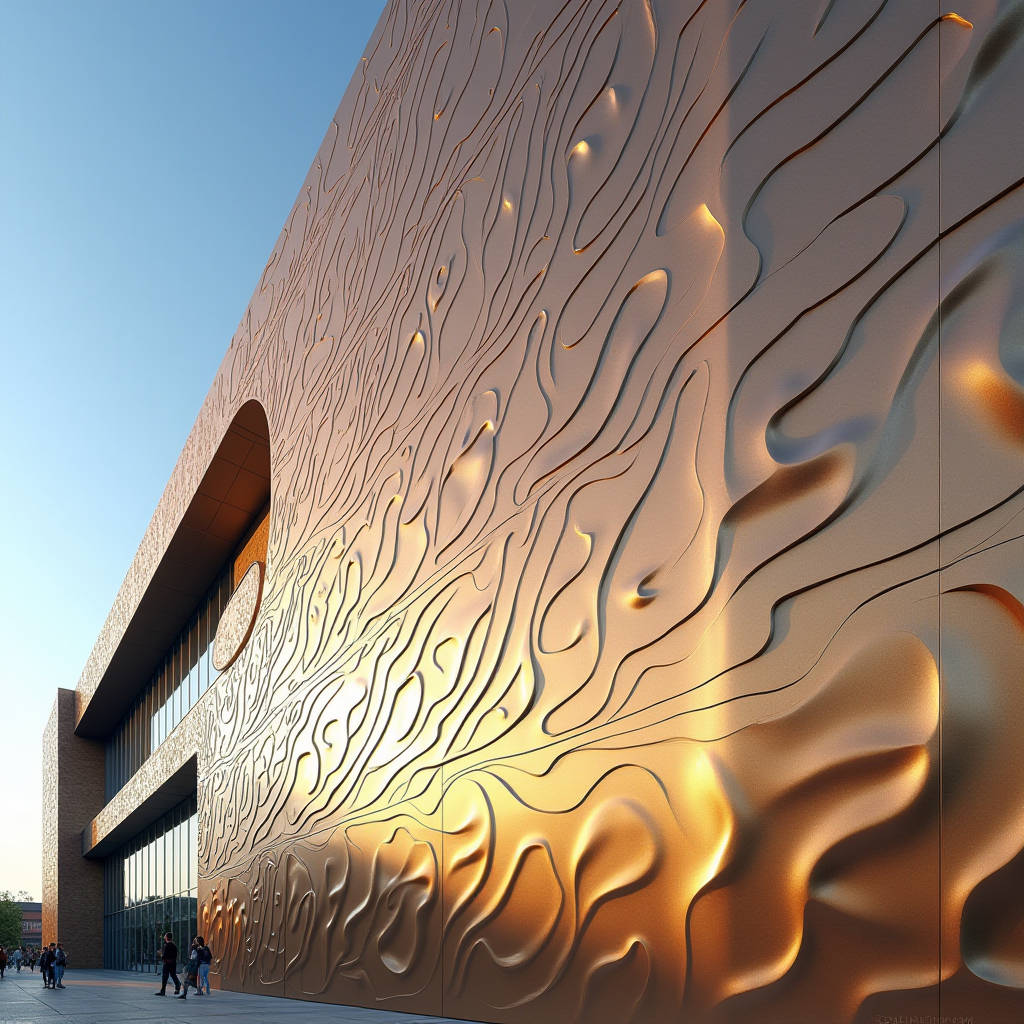
Specifying a CNC Carved Aluminum Facade means committing to a particular kind of visual language — one where shadow, depth, and precision-cut geometry replace the flatness of conventional rainscreen panels. The technology behind CNC routing on solid aluminum sheets has matured to the point where 3D relief depths of 8mm to 15mm are achievable on 5052 alloy plates, but the jump from a compelling CAD file to a facade that performs under thermal cycling, wind suction, and decades of UV exposure is where most project teams encounter friction. This article walks through the engineering decisions that determine whether a carved aluminum facade system delivers on its architectural promise without becoming a long-term liability on the maintenance log.
What Separates CNC Carved Aluminum From Perforated or Stamped Panels
It is easy to conflate CNC carving with perforating or stamping, but the three processes produce fundamentally different products. Perforated panels are punched through — light passes, air moves, and the structural behavior of the sheet changes because material is removed entirely. Stamped panels rely on a male-female die set that presses a pattern into the sheet; the depth is limited by the formability of the alloy and the tonnage of the press, typically maxing out around 3mm to 5mm of relief on aluminum.
A CNC Carved Aluminum Facade panel, by contrast, is machined from a solid aluminum blank using a rotating end mill that removes material along a programmed toolpath. The sheet is never pierced unless the design calls for it. The back face remains intact, which means the panel retains its full weather-barrier function. Depths of 10mm, 12mm, even 15mm are achievable on plate stock starting at 15mm thickness, with the carved recesses revealing the raw metallic grain of the alloy — a finish that powder coating or PVDF can then seal. This is subtractive manufacturing applied to architectural cladding, and it opens up geometries that neither perforating nor stamping can touch: undercut profiles, variable-depth gradients, and continuous flowing patterns that shift as the sun moves across the facade.
Alloy Selection: Why 5052 and 6061-T6 Dominate the Conversation
Not every aluminum alloy machines well, and not every machinable alloy belongs on a building exterior. The two grades that consistently appear in CNC Carved Aluminum Facade specifications are 5052-H32 and 6061-T6, and they serve different priorities.
5052-H32 is a magnesium-alloyed grade with excellent corrosion resistance in marine and industrial atmospheres. It machines cleanly — chips break rather than gumming up the cutter — and it accepts PVDF and polyester powder coatings with predictable adhesion. Its tensile strength sits around 210-260 MPa, which is sufficient for most rainscreen applications where the panel is not carrying structural loads beyond its own weight and wind pressure. For carved panels in the 2.5mm to 4.0mm thickness range, 5052 is the workhorse.
6061-T6 is a heat-treated, precipitation-hardened alloy with tensile strength in the 290-310 MPa range. It machines with exceptional crispness, holding sharp edges and fine details that softer alloys can lose during tool deflection. The trade-off is cost — 6061-T6 plate is typically 20-30% more expensive than 5052, and the machining time increases because the harder material requires slower feed rates. Where 6061-T6 earns its place is on panels with very fine filigree, deep relief carving where edge definition matters, or projects in high-wind zones where the additional stiffness reduces the need for intermediate framing. For a 15mm-thick carved panel spanning 1,200mm between girts, the difference in deflection between 5052 and 6061-T6 can be 30% or more under the same wind load.
Suppliers like Futeng® typically stock both grades in plate form and can advise on the cost-performance crossover point based on the specific carving geometry and project location.
Carving Depth, Wall Thickness, and the Structural Integrity Trade-Off
Every millimeter of depth carved into a solid aluminum panel removes material that was contributing to the panel's bending stiffness. The relationship is not linear — stiffness drops with the cube of the remaining thickness — so a design that carves 10mm deep into a 15mm plate leaves only 5mm of continuous material at the thinnest cross-section. That residual thickness must be verified against the project's wind load calculations.
The table below provides a practical reference for common CNC carving depth configurations and their corresponding engineering checks:
| Plate Thickness (mm) | Max Carve Depth (mm) | Residual Thickness (mm) | Typical Max Span (mm) | Wind Load Capacity (kPa) | Recommended Alloy |
|---|---|---|---|---|---|
| 3.0 | 1.5 | 1.5 | 600 | 1.5 - 2.0 | 5052-H32 |
| 5.0 | 3.0 | 2.0 | 800 | 2.0 - 2.8 | 5052-H32 |
| 10.0 | 6.0 | 4.0 | 1,000 | 2.5 - 3.5 | 5052-H32 / 6061-T6 |
| 15.0 | 10.0 | 5.0 | 1,200 | 3.0 - 4.5 | 6061-T6 |
| 20.0 | 14.0 | 6.0 | 1,500 | 4.0 - 5.5 | 6061-T6 |
These figures are indicative and assume a simply supported panel with uniform wind pressure per ASCE 7-22. Every project requires its own structural analysis, but the pattern is clear: doubling the plate thickness does not double the allowable carve depth if you want to maintain the same span. The residual thickness is the governing parameter, and it should never drop below 1.5mm on a rainscreen panel that faces direct wind exposure.
Coating Systems for Machined Surfaces: Why the Recesses Matter
A carved aluminum panel presents a coating challenge that flat panels do not. The CNC tool leaves a machined surface inside every recess — microscopic tool marks, a slightly different surface energy than the mill-finished face, and geometry that makes it harder for electrostatic spray equipment to achieve uniform coverage. If the coating system is not specified with these recesses in mind, the carved areas become the first points of coating failure.
PVDF fluoropolymer coatings — typically Kynar 500® or Hylar 5000® resin-based systems — remain the benchmark for exterior aluminum facades. Applied as a three-coat system (primer, color coat, clear coat) with a total dry film thickness of 30-35 microns, PVDF delivers the UV resistance and chalk resistance that architectural specifications demand. The AAMA 2605 standard governs high-performance PVDF coatings and requires 10-year South Florida exposure testing with minimal color fade (ΔE ≤ 5.0). For a CNC Carved Aluminum Facade, specifying AAMA 2605-compliant PVDF is the baseline for any project where the facade is expected to look consistent for a decade or more.
Polyester powder coating — applied electrostatically and oven-cured — offers a thicker film build (60-80 microns) at a lower cost. The heavier coating can partially fill fine tool marks, which is an advantage for carved panels with intricate detailing. However, polyester resins chalk and fade faster than PVDF under UV exposure, particularly in latitudes below 30°. For carved facades in the Middle East, Southeast Asia, or the American Southwest, PVDF is the safer specification.
One detail that is often overlooked: the inside corners of CNC-carved recesses are the hardest places for any coating to build adequate thickness. Faraday cage effects during electrostatic spraying can starve these areas. A quality-controlled fabricator will run coating thickness measurements specifically inside the carved recesses, not just on the flat fields, and will adjust spray parameters — or switch to a manual touch-up pass — to ensure the recessed areas meet the specified minimum dry film thickness.
Toolpath Strategy and Its Impact on Per-Unit Cost
The machining time for a CNC Carved Aluminum Facade panel is not a fixed number; it is a function of toolpath strategy, and small decisions in CAM programming can swing the per-panel cost by 30% or more. Three variables dominate:
Stepover distance. This is the lateral offset between adjacent passes of the ball-end mill. A 0.2mm stepover produces a near-polished surface that may not need secondary finishing, but it quadruples the machining time compared to a 0.8mm stepover that leaves visible tool marks. For exterior facades viewed from 10 meters or more, a 0.5mm to 0.6mm stepover is usually the sweet spot — the tool marks read as a consistent matte texture rather than a defect.
Roughing vs. finishing passes. A smart toolpath uses a larger-diameter end mill (6mm to 10mm) for bulk material removal at high feed rates, then switches to a smaller ball-end mill (3mm to 4mm) for the final surface pass. Skipping the roughing pass and going straight to the finishing tool saves programming time but burns through expensive small-diameter cutters and adds hours to the cycle time.
3-axis vs. 5-axis machining. Most carved aluminum panels can be produced on a 3-axis CNC router, which keeps the tool perpendicular to the sheet. Undercut geometries — where the carving reaches sideways beneath an overhanging feature — require a 5-axis machine that can tilt the tool. 5-axis machining adds roughly 40-60% to the machining cost and should be reserved for design features that genuinely need it.
For a typical 1,200mm × 2,400mm panel with a medium-complexity carved pattern at 6mm depth, machining time on a 3-axis router with a proper roughing/finishing strategy runs between 45 and 90 minutes. At shop rates of $80-$120 per machine-hour, the machining cost per panel lands in the $60-$180 range before material, coating, and handling.
Fixing and Framing: How Carved Panels Change the Substructure
Solid aluminum panels with deep carving are heavier than their flat counterparts. A 15mm-thick 5052 panel weighs approximately 40.5 kg/m² before any carving; after 10mm of material removal across 40% of the surface area, the weight drops to roughly 30 kg/m². That is still substantially heavier than a 3mm solid aluminum rainscreen panel at 8.1 kg/m², and the supporting substructure must be designed accordingly.
The fixing method also interacts with the carved geometry. Panels with deep relief carving have varying thickness across their surface, which means the fixing points — typically along the panel perimeter or at intermediate stiffener locations — must be located in the full-thickness zones. A fixing located in a 5mm-thick carved zone will have lower pull-through resistance than one in the 15mm-thick perimeter. The Aluminum Association publishes design guidelines for mechanically fastened aluminum connections that should inform fixing spacing and edge distances.
Three fixing systems are commonly used with CNC Carved Aluminum Facade panels:
- Concealed clip systems — aluminum extrusions engage a routed slot in the panel edge, providing a clean face with no visible fasteners. Best suited for panels up to 10mm thickness where the edge slot does not compromise the panel's bending capacity.
- Exposed mechanical fasteners — stainless steel screws with EPDM washers through pre-drilled holes. The most economical option and the easiest to replace individual panels, but the fastener heads interrupt the carved pattern.
- Structural adhesive bonding — two-part epoxy or polyurethane adhesives bond the panel to a subframe. Allows for a completely clean face but requires careful surface preparation of the machined aluminum and limits future panel replacement options.
Thermal Movement and Joint Design
Aluminum expands and contracts at roughly 0.024 mm per meter per degree Celsius. A 3-meter-tall carved panel subjected to a 60°C temperature swing between a winter night and a summer afternoon will move approximately 4.3mm. If the joint between adjacent panels is too tight, the panels will bind, buckle, or transfer load into the substructure in ways the engineer did not intend.
For CNC Carved Aluminum Facade panels, the joint width should be calculated based on the maximum expected temperature range at the project location, not a generic 10mm default. The AAMA and ASTM provide thermal movement calculation methodologies. As a rule of thumb, joint widths below 8mm are risky on panels longer than 2 meters, and carved panels with interlocking edge details need additional clearance because the carved geometry can reduce the effective joint width at certain points.
Open joints — where the gap between panels is left unsealed — are common in rainscreen systems and work well with carved panels because the shadow lines created by the carving complement the open-joint aesthetic. However, open joints expose the substructure and the back face of the panel to wind-driven rain, so the backup wall waterproofing and the panel's rear coating must be specified accordingly. A shop-applied wash coat on the panel back face, typically a thin polyester or epoxy layer, prevents corrosion of the machined aluminum from condensation that forms behind the panel.
Quality Control: What to Inspect Before the Panels Leave the Factory
A CNC Carved Aluminum Facade is a made-to-order product, and the window for catching defects is before the panels are crated and shipped. The following inspection points should be part of every factory acceptance test:
- Dimensional tolerance. Overall panel dimensions should be within ±1.0mm, and the carved pattern should be checked against the approved shop drawing at a minimum of five measurement points per panel. CNC routers are repeatable, but tool wear can cause gradual dimensional drift across a production run.
- Carve depth consistency. Using a depth micrometer, measure the carve depth at multiple locations. Variation should not exceed ±0.2mm from the specified depth. Deeper-than-specified carving reduces the residual thickness and may compromise structural performance.
- Coating thickness in recesses. An eddy-current thickness gauge with a probe small enough to access the carved recesses is essential. The SSPC and coating manufacturers publish minimum thickness requirements; for PVDF, no single measurement should fall below 25 microns total dry film thickness.
- Surface defect check. Look for chatter marks (periodic waviness from tool vibration), burrs on edges, and gouges from chip recutting. Chatter marks indicate a rigidity problem in the machine setup or an overly aggressive feed rate and should trigger a toolpath or fixturing review.
- Flatness. A carved panel with asymmetric material removal may warp due to residual stress release. Check flatness on a granite surface plate; deviations beyond 0.5% of the diagonal dimension warrant investigation.
Lead Times, Packaging, and the Logistics of Heavy Carved Panels
CNC Carved Aluminum Facade panels occupy a different position on the project schedule than standard flat panels. The carving process adds 2-4 weeks to the fabrication timeline depending on complexity and quantity. A typical production sequence runs: plate cutting (1-3 days), CNC carving (5-15 days depending on panel count and machine availability), edge detailing and fixing preparation (2-3 days), coating (3-5 days including curing), and quality control with packaging (2-3 days). Total lead time from approved shop drawings to ex-works delivery is typically 4-7 weeks.
Packaging carved panels requires more care than flat panels. The carved face must be protected from contact with adjacent panels during shipping. Standard practice is to apply a peelable PVC film to the face, then interleave panels with foam or corrugated spacers. Panels are crated vertically on A-frames or horizontally in custom timber crates with foam-lined supports that cradle the panels at their full-thickness edges. For ocean freight, the crates should be lined with VCI (vapor corrosion inhibitor) paper to prevent condensation-related corrosion during transit.
Weight is a logistics cost driver. A 20-foot container can hold roughly 1,200 m² of 3mm flat aluminum panels but only 300-400 m² of 15mm carved panels. Freight cost per square meter is proportionally higher, and this should be factored into the project budget at the specification stage, not discovered when the shipping invoice arrives.
When a CNC Carved Aluminum Facade Makes Engineering Sense
Carved aluminum facades are not a universal solution. They are heavier, more expensive, and slower to produce than flat or perforated alternatives. The projects where they justify their cost are those where the facade is the primary architectural statement — museum exteriors, cultural centers, corporate headquarters, luxury retail — and where the carved geometry delivers a visual effect that cannot be replicated by other means. The interplay of light and shadow across a deeply carved surface changes throughout the day in ways that a printed or painted graphic never will.
The engineering path to a successful installation runs through alloy selection matched to the carving depth, a coating system specified for the recessed geometry, a substructure designed for the actual panel weight, and a quality control program that catches problems before the panels are hanging on the building. When those pieces are in place, a CNC Carved Aluminum Facade can perform for 30 years or more with minimal intervention — a properly coated 5052 or 6061-T6 panel in a non-marine environment will see corrosion rates below 0.025mm per year, and the PVDF finish will hold its color within ΔE 5.0 for well over a decade.
For project teams evaluating this technology, the single most important step is to engage the fabricator early — during design development, not during tender — so that the carving geometry, fixing strategy, and coating specification are developed together rather than patched together after the fact. The difference between a facade that looks exactly like the rendering and one that disappoints is almost always in the engineering details that were discussed before the first aluminum plate was loaded onto the CNC bed.