Embossed Aluminum Panel Engineering How Pattern Geometry Affects Flatness Wind Load and Coating Performance
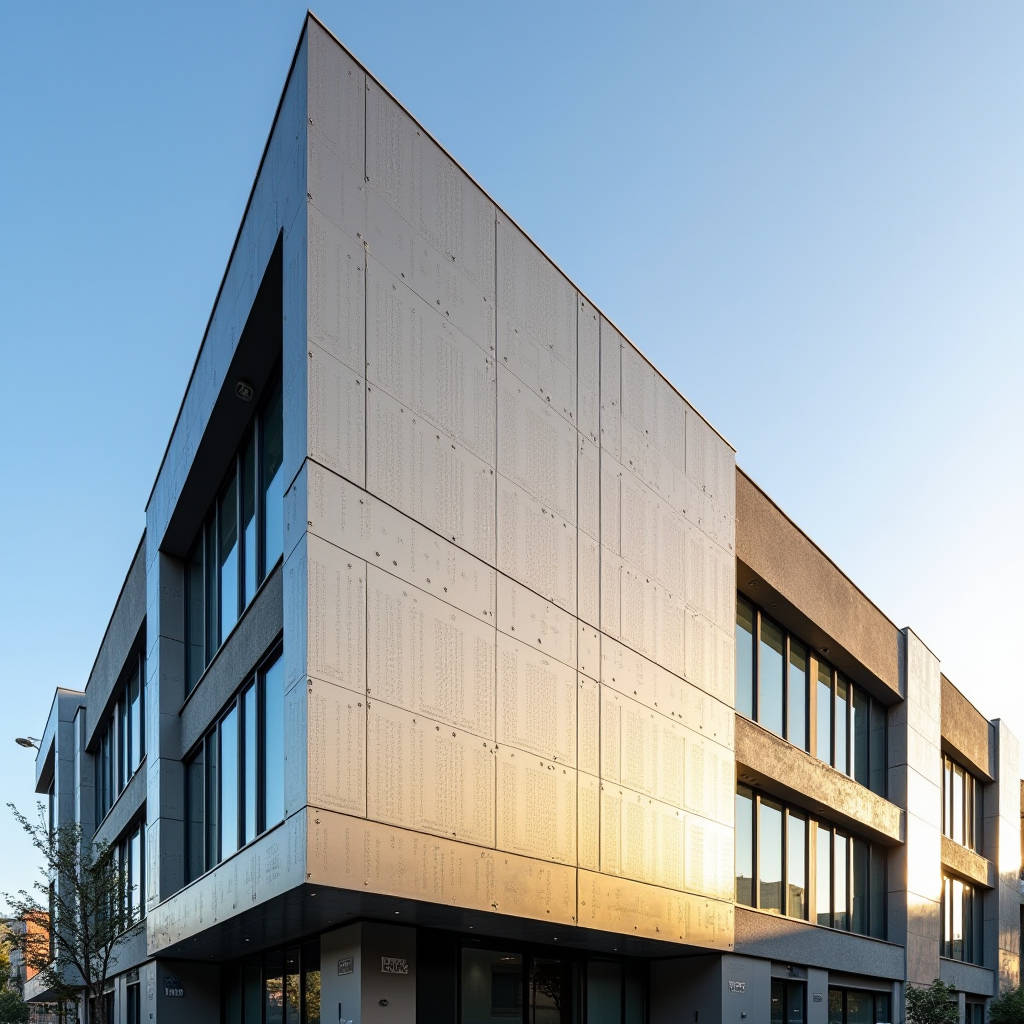
When a façade consultant specifies an embossed aluminum panel, the conversation rarely stays on appearance for long. Within minutes, the structural engineer asks about spanning capacity, the quantity surveyor pulls up metal gauge tables, and the installer wants to know whether the pattern alters the fastener layout. This is the reality of working with textured solid aluminium cladding — a product category where the embossed surface is not merely decorative but directly influences flatness, wind load resistance, and long-term panel stability. Understanding how that raised pattern interacts with a 2.5mm or 3.0mm 5052-H32 aluminium sheet is the difference between a façade that looks sharp on day one and one that still reads flat after a decade of thermal cycling.
What Defines an Embossed Aluminum Panel in Solid Cladding Terms
An embossed aluminum panel begins as a solid aluminium alloy sheet — typically 5052, 3003, or 6061-T6 depending on the project's structural requirements — that passes through a set of hardened steel rollers engraved with a negative of the desired pattern. The process applies controlled pressure, permanently deforming the metal into a raised relief. This is not a film, not a laminate, and not a coating. The texture is integral to the metal itself.
For building envelope applications, the most common starting thicknesses are 2.0mm, 2.5mm, and 3.0mm. The embossing process slightly reduces the effective bending stiffness along one axis while marginally increasing it along the other, depending on pattern geometry. This anisotropic behavior means that panel orientation during installation matters. A stucco pattern running horizontally will perform differently under negative wind load than the same panel rotated 90 degrees. Structural engineers who treat embossed sheet as isotropic — identical in all directions — are making an assumption that does not hold up under full-scale testing.
The alloy choice matters enormously. 5052-H32 offers the best balance of formability and corrosion resistance for marine and coastal projects. 3003-H14 provides adequate strength for interior applications at a lower cost. 6061-T6, while harder to emboss with deep patterns, delivers the highest yield strength for spans exceeding 1,200mm. Each alloy-embossment combination produces a distinct set of mechanical properties that should be verified against ASTM B209 / B209M tolerances before fabrication begins.
Pattern Geometry and Its Direct Impact on Panel Flatness
Panel flatness is the silent obsession of every curtain wall contractor. An embossed aluminum panel with visible oil-canning — that wavy distortion visible under raking light — will trigger a rejection faster than a color mismatch. The relationship between embossment pattern and flatness is not intuitive, and it trips up even experienced specifiers.
A deep, aggressive embossment — think heavy stucco or large diamond plate — introduces more cold work into the metal surface. This cold work creates residual stresses that can release unpredictably during fabrication, particularly when the panel is routed, folded, or welded at the edges. The result is a panel that leaves the factory flat but develops subtle waves after installation as ambient temperature cycles relieve those locked-in stresses.
Shallow embossed patterns, such as fine leather grain or light stucco, introduce less cold work and tend to produce flatter panels. However, they also provide less visual depth, which can disappoint architects who selected the texture specifically for its shadow-casting properties. The engineering compromise often involves specifying a medium-depth embossment on a 2.5mm or 3.0mm substrate, where the additional metal thickness provides enough stiffness to resist the stress-relief distortion.
Flatness tolerances for embossed solid aluminium panels should reference AAMA 611-20, which specifies a maximum deviation of 0.4% of the panel's diagonal dimension for high-performance architectural applications. On a 1,500mm x 3,000mm panel, that translates to roughly 13.5mm of permissible deviation — a number that sounds generous until you see it under a low-angle morning sun.
Coating Compatibility: PVDF Over Embossed Surfaces
Applying a PVDF coating system to an embossed aluminum panel introduces challenges that do not exist with flat sheet. The raised and recessed areas of the pattern receive different coating thicknesses during spray application, particularly in the valleys where electrostatic wrap-around is weaker. A coating specification that reads "minimum 30 microns DFT" on a flat panel may deliver only 22-25 microns in the recessed areas of a deep embossment.
This matters because the thinnest coating point becomes the failure point. AAMA 2605, the standard for high-performance architectural coatings, requires a minimum total dry film thickness of 30 microns (1.2 mils) measured at any point on the panel surface. For embossed panels, this means the spray parameters — gun distance, voltage, fluid flow rate — must be calibrated specifically for the pattern geometry, not copied from the flat sheet settings.
Three-coat PVDF systems (primer + color coat + clear coat) typically achieve 35-45 microns DFT on flat surfaces. On embossed surfaces, specifiers should request cross-sectional coating thickness measurements from sample panels, taken at both peaks and valleys, before approving production. The data often reveals that a 4-coat system (primer + barrier + color + clear) is necessary to achieve the minimum 30 microns in recessed areas, adding approximately 15-20% to the coating cost but eliminating the risk of premature chalking or fading in the pattern valleys.
| Coating System | Layers | Typical DFT (Flat) | DFT in Embossed Valleys | AAMA Standard | Recommended Pattern Depth |
|---|---|---|---|---|---|
| PVDF 70% (2-Coat) | Primer + Color | 25-30 μm | 18-22 μm | AAMA 2604 | Shallow only (<0.5mm) |
| PVDF 70% (3-Coat) | Primer + Color + Clear | 35-45 μm | 28-35 μm | AAMA 2605 | Medium (0.5-1.0mm) |
| PVDF 70% (4-Coat) | Primer + Barrier + Color + Clear | 50-60 μm | 40-48 μm | AAMA 2605 | Deep (>1.0mm) |
| FEVE Fluoropolymer (3-Coat) | Primer + Color + Clear | 35-40 μm | 30-35 μm | AAMA 2605 | Medium (0.5-1.0mm) |
| Polyester (2-Coat) | Primer + Color | 20-25 μm | 15-18 μm | AAMA 2603 | Shallow only (<0.5mm) |
Wind Load Performance: Why Pattern Orientation Is a Structural Variable
A flat 3.0mm solid aluminium panel spanning 1,200mm between girts behaves predictably. Its bending stiffness is uniform across both axes, and wind load calculations follow straightforward beam theory. An embossed aluminum panel of the same thickness and span does not behave the same way, and the difference is measurable.
The embossing process effectively creates a series of miniature stiffening ribs. When the pattern runs parallel to the span direction, those ribs contribute to bending resistance and can increase the panel's allowable span by 5-8% compared to flat sheet. When the pattern runs perpendicular to the span, the ribs provide negligible structural benefit and may actually reduce the effective section modulus because the metal thickness at the pattern valleys is marginally thinner than the nominal gauge.
For a typical commercial façade in a Region II wind zone (basic wind speed 45 m/s, 3-second gust), a 2.5mm 5052-H32 embossed aluminum panel with stucco pattern running parallel to the span can typically handle a 1,000mm girt spacing at a deflection limit of L/60. The same panel with the pattern perpendicular may need to reduce spacing to 900mm to meet the same deflection criterion. These are not theoretical numbers — they come from full-scale ASTM E330 uniform load testing conducted on fabricated panel assemblies.
Fabricators who supply embossed panels for high-wind projects — including coastal installations where corrosion resistance is equally critical — should provide project-specific span tables rather than generic flat-sheet data. Suppliers such as Futeng® maintain in-house testing data for their embossed product lines across multiple pattern types and alloy grades, which allows engineers to specify with confidence rather than applying conservative fudge factors that inflate the substructure cost.
Fabrication Constraints: Routing, Folding, and Welding Embossed Sheet
The moment an embossed aluminum panel moves from flat stock to a fabricated cassettes, the pattern becomes a complication. Routing a V-groove for a folded edge on embossed sheet requires the CNC operator to set the tool depth relative to the peak of the pattern, not the valley. If the depth is set to the valley, the router bit will cut too deep at the peaks and may penetrate the face of the panel. If set to the peak, the valley areas may not cut deeply enough for a clean fold line.
The standard solution is to use a spring-loaded router foot that follows the surface contour, maintaining a consistent cut depth relative to the local surface. This works adequately for shallow patterns but becomes unreliable on deep embossments where the foot cannot track rapid elevation changes. For heavy stucco or deep diamond plate, many fabricators switch to laser cutting for the fold relief, accepting the higher cost in exchange for consistent groove geometry.
Welding presents a different challenge. The embossed surface near the weld zone will flatten during the welding process as the heat-affected zone expands and contracts. This flattening can extend 15-25mm from the weld line, creating a visible smooth band around the panel perimeter that contrasts with the textured field. The only reliable mitigation is to design the panel system so that welds occur in areas hidden by the framing or covered by a perimeter extrusion. Where exposed welds are unavoidable, the flattened zone must be mechanically re-textured using a hand embossing tool matched to the pattern — a labor-intensive process that adds cost and should be priced into the fabrication estimate from the start.
Corrosion Behavior in Coastal and Industrial Environments
An embossed aluminum panel in a coastal environment faces two distinct corrosion mechanisms that flat panels experience differently. First, the increased surface area of the embossed pattern — typically 10-18% greater than the projected flat area — provides more metal surface for chloride deposition. Second, the pattern valleys can trap salt-laden moisture, extending the time-of-wetness compared to a flat surface where water sheets off more efficiently.
5052-H32 alloy with its 2.2-2.8% magnesium content provides the best marine corrosion resistance among the common architectural aluminium grades. When combined with a properly applied PVDF coating system, 5052 embossed panels have demonstrated excellent performance in installations within 500 meters of breaking surf, provided that the panel edges are properly sealed and the coating is intact.
For industrial environments with elevated sulfur dioxide or acidic precipitation, the coating specification should include an epoxy primer with enhanced chemical resistance. The AAMA 2605 standard includes specific chemical resistance tests, but project specifications for heavy industrial sites should additionally require a 3,000-hour neutral salt spray test per ASTM B117 with no blistering or loss of adhesion on scribed embossed samples.
Thermal Movement and the Embossed Pattern
Aluminium expands at approximately 2.4mm per meter per 100°C of temperature change. On a 3-meter panel experiencing a 60°C surface temperature swing between a winter night and a summer afternoon, that translates to roughly 4.3mm of movement. The embossed pattern does not change the coefficient of thermal expansion, but it does change how the panel accommodates that movement.
The corrugated geometry of an embossed pattern acts as a series of expansion bellows, providing a degree of in-plane compliance that flat sheet lacks. This means that an embossed aluminum panel can often tolerate slightly tighter attachment tolerances than a flat panel of the same dimensions before buckling becomes visible. However, this benefit is modest — perhaps 10-15% reduction in the required movement joint width — and should not be used to justify eliminating properly engineered expansion provisions.
The more practical thermal consideration is the differential expansion between the aluminium panel and its steel or aluminium substructure. Steel girts expand at roughly half the rate of aluminium. On a façade with 6-meter continuous aluminium panels attached to steel framing, the differential movement can exceed 7mm. The panel attachment system — typically a combination of fixed points and sliding clips — must accommodate this movement without transferring stress to the panel corners, where embossed patterns can develop stress cracks if over-constrained.
Common Embossed Patterns and Their Engineering Profiles
Not all embossed patterns are created equal for architectural cladding. The pattern that works beautifully on a refrigerator liner may be a nightmare on a 30-story tower. Here is how the major pattern families perform in building envelope applications.
Stucco Embossed
The most widely specified embossed aluminum panel pattern for building exteriors. Stucco embossing produces a non-directional, pebble-like texture with a typical relief depth of 0.3-0.8mm. The non-directional nature means it performs consistently regardless of panel orientation — a significant advantage for complex façades with mixed vertical and horizontal panel layouts. Stucco pattern provides moderate improvement in dent resistance compared to flat sheet, which matters during handling and installation on congested job sites.
Diamond Plate / Tread Plate
Characterized by raised diamond or linear tread shapes with relief depths of 1.0-2.5mm. These patterns were originally developed for industrial flooring and truck beds, but architects increasingly specify them for feature walls and soffit panels where the aggressive texture creates dramatic shadow lines. The deep pattern presents all the fabrication challenges discussed earlier — coating thickness variation, routing complexity, and weld-zone flattening. Diamond plate panels should be specified in 3.0mm minimum thickness for exterior applications, as the deep embossment reduces the effective metal thickness at the valley bottoms to approximately 2.3-2.5mm.
Leather Grain / Linen
Fine, shallow patterns (0.1-0.3mm relief) that provide a subtle texture without the fabrication complications of deeper embossments. These patterns are popular for interior wall panels and exterior soffits where the viewing distance is close. The shallow relief means that coating thickness variation is negligible, and standard flat-sheet fabrication parameters generally apply. However, the subtle texture is easily obscured by heavy PVDF coatings, so the coating specification should limit total DFT to 45 microns maximum.
Custom Embossed Patterns
For landmark projects, custom embossing rollers can be manufactured to produce project-specific patterns — corporate logos, abstract geometries, or textures that mimic natural materials like wood grain or stone. The roller cost (typically $15,000-40,000 USD depending on width and complexity) is amortized across the project's panel quantity. Custom patterns require a full engineering evaluation, including sample fabrication and ASTM E330 testing, before production approval. Minimum order quantities for custom embossed aluminium panels typically start at 1,500-2,000 square meters to justify the roller investment.
Specification Language That Prevents Substitution Problems
One of the most persistent problems in embossed aluminum panel procurement is unauthorized substitution. A contractor bids the project with a 3.0mm 5052-H32 stucco embossed panel, then submits a shop drawing proposing 2.5mm 3003-H14 with a lighter embossment pattern, claiming it is "equivalent." The specification language must close this door.
Recommended Specification Clause: "Embossed aluminum panels shall be fabricated from solid aluminium alloy sheet conforming to ASTM B209/B209M. Alloy shall be 5052-H32 [or 3003-H14, as specified] with a nominal thickness of [2.0/2.5/3.0] mm. Embossed pattern shall be [Stucco/Diamond/Leather Grain/Custom] with a relief depth of [0.3-0.8/1.0-2.5/0.1-0.3] mm. Coating shall be a 70% PVDF resin system conforming to AAMA 2605, applied at a minimum dry film thickness of 30 microns measured at any point on the embossed surface. Contractor shall submit sample panels 300mm x 300mm demonstrating the specified alloy, thickness, embossment pattern, and coating for approval prior to fabrication. Substitution of alloy, thickness, or pattern relief depth shall not be permitted without re-engineering of the panel span and attachment system."
This language ties the embossment to the structural design, making it clear that the pattern is not merely an aesthetic choice. The requirement for sample panels with the actual embossment — not a flat color chip — prevents the common situation where the approved finish sample bears no resemblance to the textured production panels.
Cost Drivers That Procurement Managers Should Understand
The premium for an embossed aluminum panel over a flat PVDF-coated panel of the same alloy and thickness typically ranges from 8-18%, depending on four primary factors. First, the embossing process itself adds a processing step with associated equipment amortization and scrap. Second, the deeper the pattern, the higher the scrap rate during fabrication, as routing and folding errors increase. Third, coating consumption increases because the textured surface has greater area than the projected flat dimensions. Fourth, packaging and handling costs rise because embossed panels cannot be stacked as tightly as flat panels without risking pattern damage.
For budget estimation purposes, a 2.5mm 5052-H32 stucco embossed panel with 3-coat PVDF coating typically falls in the range of $85-120 USD per square meter (ex-works, 2024 pricing), compared to $72-100 for the equivalent flat panel. The range reflects order quantity, pattern complexity, and coating color. Custom colors and deep embossments push toward the upper end. These figures assume a minimum order of 500 square meters; smaller quantities incur setup charges that can add 20-30% to the unit price.
Freight costs also deserve attention. Embossed panels, particularly those with deep patterns, require thicker interleaving material and more careful crating. A 20-foot container that holds 1,800 square meters of flat panels may only accommodate 1,500-1,600 square meters of embossed panels due to the increased packaging volume. This difference in packing density should be factored into the logistics budget, particularly for projects in remote locations where container costs represent a significant portion of the total landed cost.
Installation: What the Site Team Needs to Know Before the Panels Arrive
The installation crew that has spent years handling flat aluminium panels will encounter several surprises with embossed material. The first is handling damage. The raised pattern is vulnerable to scuffing and flattening if panels are dragged across each other or across rough surfaces. Site storage should include dedicated stillage racks with padded dividers, and panels should be lifted — not slid — during handling.
The second surprise is fastener seating. On a flat panel, a rivet or screw head seats cleanly against the metal surface. On an embossed panel, the fastener may land on a peak, in a valley, or on a slope, resulting in inconsistent clamping force. The solution is to specify fasteners with a neoprene or EPDM washer that conforms to the surface texture, and to require installers to check fastener torque with a calibrated wrench rather than relying on feel. The ASTM E1512 standard for anchor testing provides a useful framework for verifying fastener performance on textured surfaces.
The third issue is pattern alignment across panel joints. On a large façade, the embossed pattern will inevitably shift slightly from panel to panel due to the random nature of the stucco texture or the tolerance stack-up in the embossing process. Attempting to match patterns across joints is futile and will lead to rejected panels. The specification should explicitly state that pattern continuity across panel joints is not required, and the architect should be made aware of this limitation before approving the material.
Cleaning and maintenance also differ. Embossed surfaces trap dirt and pollution more readily than flat panels, particularly in the pattern valleys. The Aluminum Association recommends cleaning architectural aluminium at least annually in most environments and every six months in coastal or industrial locations. For embossed panels, the cleaning frequency should be increased by approximately 25% to prevent the buildup of contaminants that can etch the coating over time. Pressure washing should be limited to 500 psi maximum and applied at a 45-degree angle to avoid driving water behind the panel joints.
When Embossed Aluminum Panels Are the Right Specification
An embossed aluminum panel makes the most engineering sense when the project requires both the structural integrity of solid aluminium cladding and a textured surface that cannot be achieved through coating alone. The pattern hides minor surface imperfections that would be glaringly obvious on a flat panel — a practical advantage on large, uninterrupted façades where the eye naturally seeks out deviations. The texture also reduces the visual impact of dirt accumulation between cleaning cycles, extending the acceptable maintenance interval.
However, embossed panels are not the right choice for every project. If the façade design includes extensive perforation, the embossed pattern will complicate the punching process and may create burrs that require secondary finishing. If the panels are to be anodized rather than painted, the embossed surface will exhibit different anodizing response at peaks and valleys due to variations in current density during the electrochemical process. And if the project budget is extremely tight, the 8-18% cost premium for embossing may be difficult to justify against the aesthetic benefit.
The decision ultimately rests on a clear-eyed assessment of the pattern's contribution to the building's architectural intent, weighed against the fabrication, coating, and installation complexities it introduces. When that assessment favors embossing, the specification must be detailed enough to ensure that the panels delivered to the site match the panels the design team envisioned — in alloy, in thickness, in pattern depth, and in coating integrity. Getting those details right requires collaboration between the architect, the structural engineer, the fabricator, and the installer from the earliest stages of the project. Anything less invites disappointment on installation day.