Industrial Metal Cladding Fire Classification Standards EN 13501 ASTM E84 NFPA 285 Compared
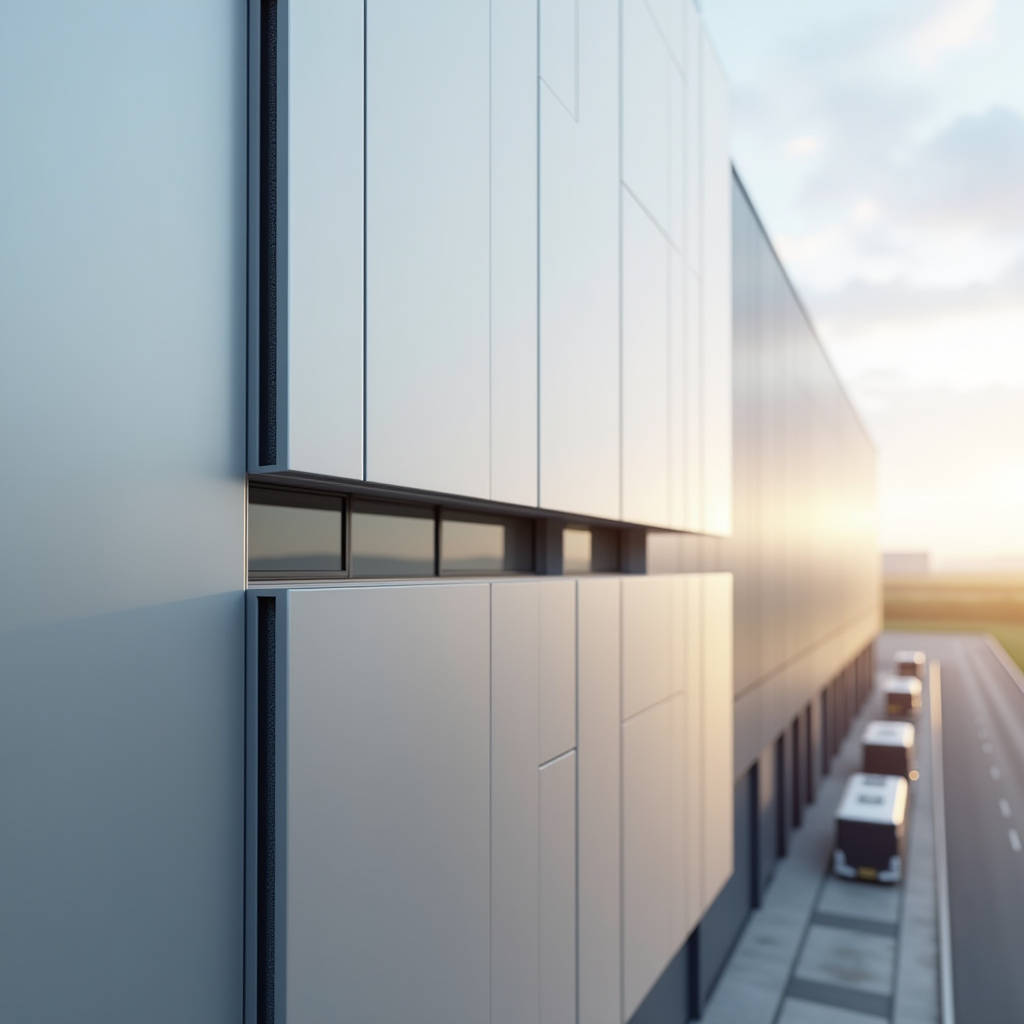
When a project specification lands on your desk calling for industrial metal cladding, the conversation rarely stays at the surface level for long. Someone in the supply chain is going to ask about fire performance. Not the generic "non-combustible" checkbox on a data sheet, but the actual reaction-to-fire classification that determines whether a facade system gets approved or rejected by the local authority having jurisdiction. Solid aluminium cladding panels sit in a unique position here. Unlike composite products that have dominated headlines for all the wrong reasons since 2017, solid aluminium carries no polyethylene core, no mineral fill that varies by batch, and no ambiguity about what happens when temperatures climb past 600°C. But the regulatory landscape is fragmented. A project in Dubai follows different rules than one in Melbourne or Manchester. This article unpacks the fire classification frameworks that matter for industrial metal cladding, the test standards behind them, and what procurement teams should verify before signing off on a panel specification.
Why Fire Classification Drives Industrial Metal Cladding Decisions
Insurance underwriters have changed the game. Since the Grenfell Tower fire and the subsequent regulatory overhaul across multiple jurisdictions, the burden of proof for facade fire safety has shifted from the manufacturer to the specifier. For industrial metal cladding on factories, logistics centres, data centres, and processing plants, the stakes are high even when the building is not occupied by sleeping residents. A warehouse fire that spreads via the envelope can destroy inventory worth tens of millions before the first fire truck arrives. Insurers now routinely ask for EN 13501-1 classification reports, ASTM E84 flame spread indices, or AS 1530.1 combustibility test results before quoting a premium. The panel material itself is only part of the equation. The full system — including insulation, vapour barriers, sub-frame, and fixing method — must be evaluated as an assembly. Solid aluminium (grades 3003, 5052, or 5754 in thicknesses of 2.0 mm to 3.0 mm) achieves an A1 or A2-s1,d0 rating under EN 13501-1 when tested as a standalone material, because aluminium alloys contain no organic compounds that contribute to flame propagation. But the moment you introduce a polyethylene vapour barrier or a combustible insulation layer behind the panel, the system classification can drop. This is where many project teams get caught off guard.
Field Note: On a 2023 data centre project in Frankfurt, the specification called for A2-s1,d0 system-level classification. The solid aluminium panels from Futeng® passed without issue, but the originally specified PIR insulation with a facing foil dropped the assembly to B-s1,d0. The fix was switching to mineral wool insulation with a non-combustible facing. The panel material was never the problem — the insulation was. Always request system-level test reports, not just material certificates.
Breaking Down EN 13501-1: The European Benchmark
For any project governed by EU building codes or specifications that reference European standards, EN 13501-1 is the document that matters. It classifies construction products into seven Euroclasses: A1, A2, B, C, D, E, and F. For industrial metal cladding, the target is almost always A1 or A2-s1,d0. The "s1" refers to smoke production (s1 being the lowest, meaning little to no smoke). The "d0" refers to flaming droplets and particles (d0 meaning none). These suffixes matter enormously. A panel that achieves A2-s2,d1 is not equivalent to one rated A2-s1,d0, and a building control officer will catch the difference. The test methodology behind EN 13501-1 involves several component tests. The single burning item (SBI) test per EN 13823 is the primary one for A2 through D classifications. It measures heat release rate, smoke production, and flaming droplets over a 20-minute exposure period. For A1 classification, the product must also pass the EN ISO 1182 non-combustibility test (furnace test at 750°C) and the EN ISO 1716 calorific value test, which measures the gross heat of combustion. Solid aluminium panels, when tested without any organic coating, achieve A1. With a PVDF or powder coating, the organic content of the paint layer (typically 70-100 microns dry film thickness for PVDF systems) can push the classification to A2-s1,d0, which is still fully compliant for high-rise and sensitive applications under most European regulations.
What the EN 13501-1 Report Must Include
Procurement teams should not accept a one-page certificate. A legitimate EN 13501-1 classification report runs 15 to 40 pages and includes the following elements: the notified body's accreditation number, the test laboratory's identification, the product's full commercial name and description, the exact composition and mounting method used during testing, the test standards applied, the classification achieved with all suffixes, and the field of application. The field of application section is critical. It defines the scope within which the classification remains valid — for example, whether the classification applies to the panel in horizontal orientation, vertical orientation, with specific joint details, and with or without an air gap. A classification obtained for a panel mounted directly to a concrete substrate does not automatically apply to the same panel installed on a ventilated rainscreen with a 50 mm cavity. If the test report does not match the installation condition on your project, the classification is not transferable.
ASTM E84 and NFPA 285: The North American Framework
Projects in the United States, Canada, and markets that follow IBC (International Building Code) requirements operate under a different set of rules. The key standard for surface burning characteristics is ASTM E84, also known as the Steiner tunnel test. It measures flame spread index (FSI) and smoke developed index (SDI). For industrial metal cladding on exterior walls of buildings over 40 feet (12.2 metres) in height, the IBC requires compliance with NFPA 285, which is a full-scale multi-storey fire test that evaluates the entire exterior wall assembly. This is where things get expensive. An NFPA 285 test can cost upwards of USD 80,000 and takes months to schedule. Many cladding manufacturers have not tested their systems to NFPA 285 because the cost is prohibitive. For project teams, this means the pool of pre-qualified systems is smaller than the marketing brochures suggest. Solid aluminium panels, when combined with the right insulation and weather barrier, have a track record of passing NFPA 285. The key variables are the insulation type (mineral wool passes consistently; foam plastics require additional engineering), the presence of a ventilated cavity, and the detailing at floor lines and window openings.
| Standard | Region | What It Measures | Key Classification | Test Scale |
|---|---|---|---|---|
| EN 13501-1 | EU, UK, Middle East, parts of Asia | Reaction to fire: combustibility, smoke, flaming droplets | A1, A2-s1,d0 through F | Component and system (SBI, furnace, bomb calorimeter) |
| ASTM E84 | USA, Canada, markets referencing IBC | Surface burning: flame spread index, smoke developed index | Class A (FSI ≤25, SDI ≤450), B, C | Small-scale tunnel (7.6 m specimen) |
| NFPA 285 | USA, Canada (IBC-mandated for buildings >40 ft) | Full exterior wall assembly fire propagation | Pass/Fail | Full-scale two-storey test rig |
| AS 1530.1 / AS 1530.3 | Australia, New Zealand | Combustibility (Part 1), early fire hazard (Part 3) | Deemed non-combustible / combustible | Furnace test (Part 1), various (Part 3) |
| BS 476 Parts 6 & 7 | UK (legacy, still referenced in some specs) | Fire propagation index, surface spread of flame | Class 0, Class 1 through 4 | Small to medium scale |
Australian and Middle Eastern Requirements: AS 1530.1 and Civil Defence Codes
Australia applies the National Construction Code (NCC), which references AS 1530.1 for combustibility and AS 1530.3 for early fire hazard properties. For industrial metal cladding on buildings of Type A or Type B construction (typically those over three storeys or with specific occupancy types), the NCC requires external walls to be non-combustible. AS 1530.1 is a furnace test conducted at 750°C for 30 minutes. The material must not flame, and the temperature rise in the furnace must not exceed specified limits. Solid aluminium panels pass this test, but the test report must be issued by a NATA-accredited laboratory. In the Middle East, particularly the UAE, the Civil Defence fire code has become one of the most stringent in the world post-2017. Dubai Civil Defence requires full system-level fire testing for facade assemblies on buildings over 15 metres. The test protocol is based on BS 8414 (the UK large-scale facade test) with additional requirements for smoke and toxicity. Solid aluminium panels from Futeng® have been supplied into multiple GCC projects where the specification required A2-s1,d0 classification backed by EN 13501-1 reports from EU-notified bodies, which the UAE Civil Defence accepts under their equivalency framework.
Coating Chemistry and Fire: Why PVDF Matters
The fire performance of industrial metal cladding is not solely about the metal substrate. The coating system contributes organic content that can affect the Euroclass. A standard PVDF coating (70% Kynar 500® or Hylar 5000® resin, 30% acrylic) applied at 25-35 microns dry film thickness contains approximately 0.5-0.8 grams of organic material per square metre of panel surface. This is negligible in terms of fire load. A powder coating applied at 60-80 microns contains more organic material — typically 2-3 grams per square metre — but still falls well within the thresholds for A2-s1,d0 classification. The threshold for A2 classification under EN 13501-1 is a gross heat of combustion (PCS) of no more than 3.0 MJ/kg for the homogeneous product, or no more than 4.0 MJ/m² for non-homogeneous products. A 2.5 mm solid aluminium panel with PVDF coating has a PCS well below 1.0 MJ/kg, putting it comfortably in A2 territory. The exceptions arise when panels are specified with thick intumescent coatings, heavy PE-based protective films that are not removed before installation, or laminated acoustic pads on the rear face. These additions can push the organic content past the threshold and should be disclosed to the fire engineer during the specification phase.
Pro Tip: When ordering solid aluminium panels for a project with fire classification requirements, specify in the purchase order that the factory must provide the EN 13501-1 or ASTM E84 report that corresponds to the exact coating system being supplied. If you change the coating colour from a standard RAL to a custom metallic or a textured finish, the organic content may change slightly. A reputable supplier will have tested multiple coating variants and can provide the relevant documentation. If they cannot, you are taking on the liability yourself.
System-Level Thinking: The Panel Is Only One Component
No building control officer approves a panel in isolation. They approve the wall assembly. The industrial metal cladding panel, the sub-frame (aluminium or galvanised steel), the insulation layer, the vapour barrier, the cavity (ventilated or unventilated), the fixing brackets, and the fire stops at floor lines all contribute to the fire performance of the completed wall. This is why the concept of "system classification" is so important. Under EN 13501-1, a system can be classified as a whole based on testing of the complete build-up. Alternatively, the classification can be derived from the "extended application" rules defined in EN 15715 and EN 15254-series standards, which allow certain substitutions without retesting. The most common mistake in industrial projects is assuming that because the panel is A2-s1,d0, the wall is A2-s1,d0. The insulation layer is usually the weak link. Polyisocyanurate (PIR) foam insulation, widely used in industrial buildings for its thermal performance, typically achieves Euroclass B-s1,d0 or C-s1,d0. If the specification requires A2-s1,d0 for the wall assembly, PIR will not comply. Mineral wool (stone wool) with a melting point above 1,000°C is the standard solution. It achieves A1 or A2-s1,d0 depending on the binder content. The trade-off is thermal conductivity: mineral wool has a lambda value of approximately 0.034-0.040 W/m·K, while PIR achieves 0.022-0.028 W/m·K. This means a thicker insulation layer is required to achieve the same U-value, which affects the cladding system's build-up depth and the fixing bracket design.
Fixing Brackets and Thermal Bridging
The fixing brackets that connect the cladding rails to the building structure create point thermal bridges. In a fire scenario, these brackets conduct heat from the cavity into the structural frame. Stainless steel brackets conduct less heat than aluminium brackets due to lower thermal conductivity (approximately 15 W/m·K for stainless steel versus 160 W/m·K for aluminium). However, aluminium brackets are lighter, easier to fabricate, and compatible with the aluminium cladding rails and panels, avoiding galvanic corrosion. The fire engineer's report should address the bracket material and its impact on the assembly's fire resistance. For projects where the cavity fire spread risk is a concern, horizontal fire barriers (cavity barriers) made of intumescent material or mineral wool are installed at each floor level and at vertical intervals not exceeding 10 metres. These barriers are designed to expand and seal the cavity when exposed to heat, preventing the chimney effect that can accelerate fire spread in ventilated rainscreen cavities.
Documentation: What to Demand from Your Panel Supplier
Before accepting a shipment of industrial metal cladding panels, the procurement team should have the following fire-related documents on file: the EN 13501-1 classification report (or ASTM E84 test report, or AS 1530.1 report, as applicable to the project jurisdiction), the test laboratory's accreditation certificate, the manufacturer's Declaration of Performance (DoP) per EU Regulation 305/2011 if the project is in the EU, the factory production control (FPC) certificate confirming that the manufactured panels match the tested samples, and the installation manual specifying the approved fixing method and system components. The DoP is a legally binding document under the Construction Products Regulation (CPR) in the EU. It must state the product's declared performance for reaction to fire, and the manufacturer is liable for the accuracy of that declaration. If a panel is supplied without a DoP where one is required, the specifier and contractor may be assuming liability that should rest with the manufacturer. For projects outside the EU, equivalent documentation requirements apply under local regulations. In the UAE, for example, the supplier must provide a Civil Defence registration certificate and a laboratory test report from an ISO 17025-accredited facility. In Australia, a CodeMark certificate or a report from a NATA-accredited laboratory is required for evidence of suitability under the NCC.
Cost Implications of Fire Classification Requirements
Fire compliance adds cost at multiple points in the supply chain. The testing itself is expensive, and manufacturers amortise these costs across their product range. A panel system that has been tested to NFPA 285 or EN 13501-1 at system level will typically carry a 10-15% price premium over an untested equivalent. The insulation upgrade from PIR to mineral wool adds approximately USD 8-15 per square metre of wall area, depending on thickness and density. The fixing system may need to be upgraded to accommodate thicker insulation and heavier panels. And the documentation — the DoP, the test reports, the FPC certificate — requires a manufacturer with a quality management system certified to ISO 9001, which not all low-cost suppliers maintain. The total cost uplift for a fully compliant A2-s1,d0 industrial metal cladding system, compared to a basic untested system, is typically in the range of 20-30%. This is not a place to cut corners. The liability for non-compliance — including potential building closure, cladding replacement, and insurance invalidation — dwarfs the upfront cost difference.
For procurement managers evaluating solid aluminium cladding panels from suppliers like Futeng®, the key question is not "Do your panels comply?" but rather "Can you provide the system-level classification report that matches our project's installation condition?" The answer to that question separates suppliers who understand fire engineering from those who are simply moving metal.
Fire classification for industrial metal cladding is ultimately a chain of evidence. The panel material, the coating, the insulation, the brackets, the cavity barriers, and the installation method must all align with the tested configuration. Solid aluminium panels in 2.0 mm to 3.0 mm thicknesses with PVDF or powder coating provide a reliable substrate that achieves A2-s1,d0 or better under EN 13501-1 and Class A under ASTM E84. The challenge is not the panel — it is making sure everything behind it is equally well-documented. For further reference, consult the BS EN 13501-1 standard, the NFPA 285 standard, and the ASTM E84 standard. The ISO 1182:2020 non-combustibility test and the AAMA 2605 coating specification for PVDF provide additional technical benchmarks that underpin the fire performance of solid aluminium cladding systems.