Corrosion Resistant Panel Specification for Marine and Industrial Building Facades
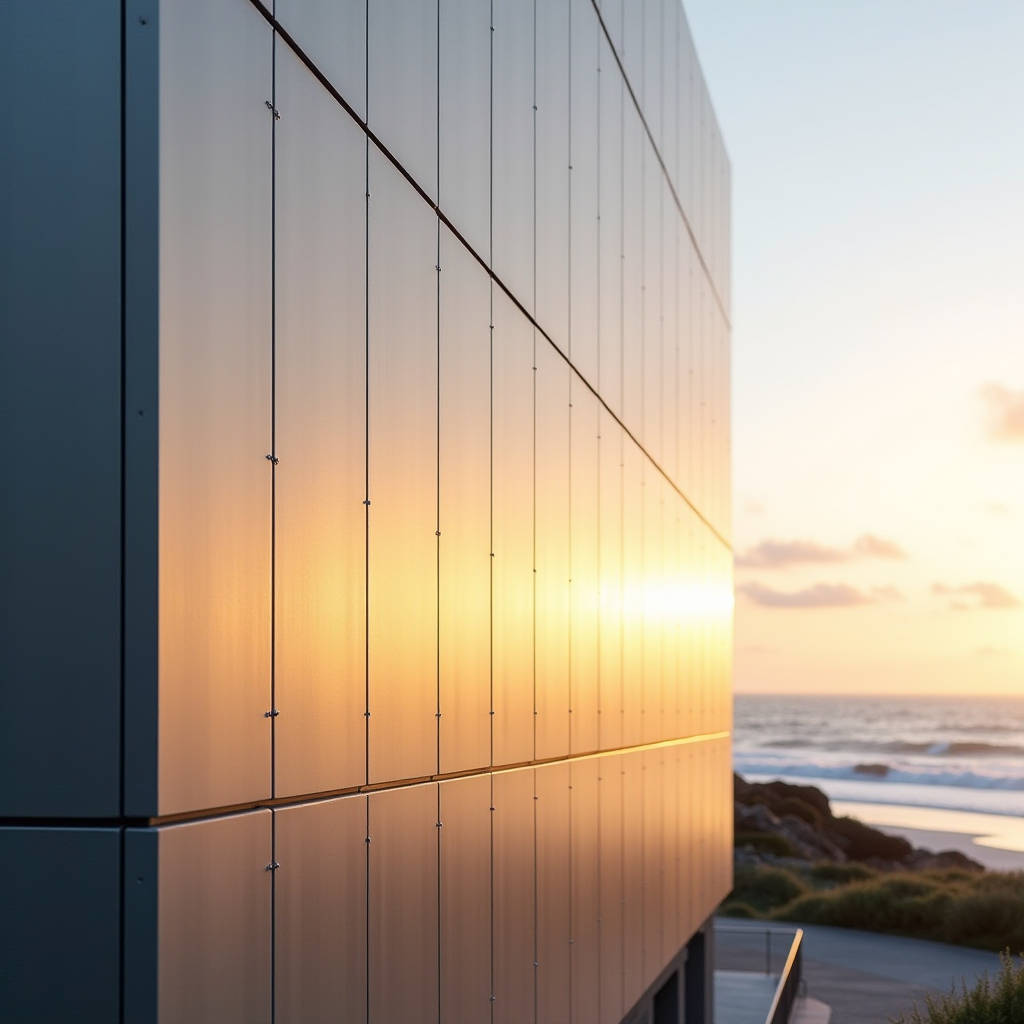
When a project lands on your desk that sits within 500 metres of breaking surf, or downwind of a chemical processing zone, the first specification question is rarely about aesthetics. It is about whether the facade will still be intact five years later. A corrosion resistant panel in these contexts is not a value-add. It is a binary requirement. Yet the procurement process often collapses into a single checkbox: "Aluminium — check." That oversimplification has cost contractors millions in remedial work across coastal developments, wastewater treatment plants, and industrial cold storage facilities. The real question is not whether aluminium resists corrosion. It is whether the specific alloy, coating system, and joint geometry you specify can survive the specific microclimate the building will face for 30 years.
Mapping the Microclimate Before You Specify
Corrosion is local. Two buildings separated by a kilometre can experience vastly different degradation rates depending on wind direction, proximity to chlorides, and the presence of industrial SO₂. A 2023 field study across 14 coastal sites in Southeast Asia found that aluminium panels on buildings facing prevailing onshore winds exhibited pitting depths 2.7 times greater than those on leeward elevations within the same development. The implication for specification is uncomfortable: you cannot apply a uniform panel specification across all four facades and expect uniform performance.
The ISO 9223 corrosion classification framework provides a starting point. A C3 environment (urban/industrial) demands different coating thicknesses than a C5-M (marine) environment. But the standard is a blunt instrument. What matters on the ground is the combination of airborne salinity, time-of-wetness, and temperature cycling. A corrosion resistant panel specified for a C4 environment in Dubai performs differently than one in the same C4 classification in Singapore, because the Dubai panel dries every night while the Singapore panel stays wet for 18 hours a day.
Field Note: On a 2021 mixed-use project in Dammam, Saudi Arabia, the east-facing aluminium panels showed coating blistering after 14 months despite a PVDF system rated for 20 years. Investigation revealed that the building's HVAC condensate drains discharged mist onto the east facade during prevailing shamal winds, creating a continuous wet microclimate that the original specification never anticipated. The fix required replacing 340 panels and rerouting eight condensate lines. Cost: $127,000. Lesson: walk the site with the mechanical engineer before finalising the facade spec.
Alloy Selection: 3003, 5052, or 6061?
Most architectural aluminium cladding uses 3003-H14 alloy. It forms well, welds acceptably, and costs less than marine-grade alternatives. But in aggressive environments, the alloy selection matters almost as much as the coating. The 5xxx series alloys (5052, 5754) contain magnesium, which improves resistance to saltwater attack. The 6xxx series (6061, 6063) offers higher strength but lower corrosion resistance in marine exposure compared to 5xxx.
The following table summarises the practical differences for architectural cladding applications:
| Alloy | Temper | Corrosion Rating (Marine) | Yield Strength (MPa) | Typical Cladding Use | Relative Cost |
|---|---|---|---|---|---|
| 3003 | H14 | Moderate | 145 | Standard facades, inland | 1.0x |
| 5052 | H32 | High | 193 | Coastal, chemical plants | 1.3x |
| 5754 | H22 | High | 185 | Marine infrastructure | 1.4x |
| 6061 | T6 | Moderate-Low | 276 | Structural, stiffeners | 1.2x |
| 1100 | H14 | Moderate | 110 | Interior, decorative | 0.9x |
For a project within 2 km of open ocean, 5052-H32 should be the baseline. The cost premium over 3003 — roughly 25-30% on raw material — is negligible compared to the cost of a single scaffold erection for remedial work. Some manufacturers, including Futeng®, stock 5052 coil specifically for coastal projects, reducing lead times that historically plagued marine-grade orders.
Coating Systems: PVDF, FEVE, and the Anodising Alternative
Coating is where the corrosion resistant panel specification becomes genuinely technical. The industry default is PVDF (polyvinylidene fluoride), typically a 70/30 Kynar 500® or Hylar 5000® resin system applied at 25-35 microns dry film thickness over a chromate conversion coating. This system works. Decades of Florida exposure testing confirm colour retention and corrosion resistance exceeding 20 years for properly applied PVDF.
But the default has limits. In environments with combined UV and chemical exposure — think fertiliser plants, paper mills, or airports with jet fuel particulates — standard PVDF can degrade faster than published data suggests. FEVE (fluoroethylene vinyl ether) coatings offer an alternative. They cure at ambient temperatures, making them suitable for field touch-up, and their gloss retention in accelerated QUV-B testing exceeds PVDF by approximately 12-15% after 5,000 hours.
Anodised finishes deserve a separate discussion. A corrosion resistant panel with a 20-micron anodic layer (AA20 per AAMA 611) provides exceptional hardness and corrosion resistance. The anodic layer is aluminium oxide — essentially sapphire — chemically bonded to the substrate. It cannot peel or delaminate. The trade-off is colour consistency: anodising batch-to-batch variation runs 2-3 Delta E units, compared to 0.5-1.0 for PVDF. For large facades where colour uniformity matters, this is a genuine constraint.
| Coating Type | Thickness (μm) | Salt Spray (ASTM B117) | QUV-B 5000h Gloss Retention | Field Repair | Best Application |
|---|---|---|---|---|---|
| PVDF (70/30) | 25-35 | 4,000+ hrs | 70-75% | Difficult | General architectural |
| FEVE | 30-40 | 5,000+ hrs | 85-90% | Possible | Chemical/industrial |
| Anodised (AA20) | 20 | 3,000+ hrs | N/A (no organic) | Impossible | Coastal, high-abrasion |
| Polyester (SP) | 20-25 | 1,000 hrs | 40-50% | Easy | Interior, low-exposure |
| PVDF (50/50) | 25-30 | 2,500 hrs | 55-65% | Difficult | Budget architectural |
One specification trap: requesting "PVDF coating" without specifying the resin ratio. A 50/50 PVDF/acrylic blend costs less but performs significantly worse than 70/30. The AAMA 2605 standard requires 70/30. If your specification references AAMA 2605, the resin ratio is enforced. If it only says "PVDF," the contractor can legally supply the cheaper blend.
Joint Design: Where Water Sits, Corrosion Starts
The most carefully specified corrosion resistant panel will fail at the joints if the drainage geometry is wrong. Water that sits in a horizontal joint for six hours after rain will eventually penetrate any sealant. The design principle is simple but frequently ignored: every joint must either drain or remain dry by geometry. There is no middle ground.
Open-joint systems, common in ventilated rainscreen facades, accept that water will enter the cavity. The panel itself becomes a rain screen, and the real waterproofing sits on the backup wall. In these systems, the panel edge must be coated — not just the face. Uncoated edges on an open-joint corrosion resistant panel expose the aluminium substrate to cavity condensation, which can be more corrosive than external rain because it carries dissolved salts from the building materials.
For sealed-joint systems, the sealant selection matters enormously. Silicone sealants dominate because they accommodate movement well. But neutral-cure silicones are mandatory for PVDF-coated panels. Acetoxy-cure silicones release acetic acid during curing, which etches the coating and creates micro-pores that become corrosion initiation sites. The cost difference between neutral and acetoxy silicone is about $0.80 per linear metre. The cost of replacing etched panels is several hundred times that.
Galvanic Corrosion: The Hidden Accelerator
When a corrosion resistant panel is mounted on a steel substructure, galvanic corrosion becomes a design consideration, not a theoretical footnote. Aluminium is anodic to steel, zinc, and copper. In the presence of an electrolyte — rainwater, condensation, or even high humidity — the aluminium sacrifices itself to protect the more noble metal.
The fix is isolation. EPDM or PVC gaskets between the panel and the steel substructure break the electrical circuit. Stainless steel fasteners (304 or 316 grade) reduce the galvanic potential difference. On one coastal project in Oman, the specification team used galvanised steel screws to secure aluminium panels. Within 18 months, the screw holes in the panels had enlarged to three times their original diameter, and 22% of panels required replacement. The fastener cost saving was $1,200. The remedial work cost $84,000.
Pro Tip: When specifying fasteners for a marine-environment corrosion resistant panel installation, 316 stainless is the minimum. 304 will pit in chloride-rich air. The price difference between 304 and 316 fasteners on a 5,000 m² facade is roughly $2,400. If you are working on a project within 5 km of saltwater, do not let the QS value-engineer this line item. Document the substitution risk in writing.
Packaging and Logistics: Corrosion Protection Doesn't Stop at the Factory Gate
A panel that leaves the factory with perfect coating integrity can arrive on site with corrosion already initiated. The journey from a Chinese manufacturing hub like Foshan to a project site in Jeddah or Rotterdam involves 4-6 weeks of maritime exposure. Container sweat — condensation caused by temperature cycling inside shipping containers — is a real and underappreciated threat.
Proper packaging for a corrosion resistant panel shipment includes: VCI (volatile corrosion inhibitor) paper between panels, desiccant packs inside the crate, and a polyethylene wrap that is not fully sealed — allowing some vapour transmission to prevent trapped moisture. Panels should be crated at a slight angle (3-5 degrees) to prevent water pooling on faces if condensation occurs. These details cost perhaps $0.40 per panel. They prevent claims that run into five figures.
On arrival, the site storage protocol matters. Panels stored directly on the ground, even on timber dunnage, will wick moisture from soil and concrete. A proper storage specification requires: covered storage with ventilation, panels elevated at least 150 mm above ground, and the original VCI packaging left intact until installation. For projects in humid climates, a dehumidified storage container is not excessive. It is insurance.
Fabrication Details That Affect Corrosion Performance
The corrosion resistance of a finished panel depends as much on fabrication as on material selection. Routing, bending, and punching operations create stress concentrations and expose raw aluminium edges. If these edges are not properly treated — either by coating or by the natural formation of a passive oxide layer under controlled conditions — they become preferential corrosion sites.
Three fabrication practices that degrade corrosion performance:
- Excessive bending radii. Tight bends (less than 2t for 3003 alloy) create micro-cracks in the coating at the bend line. These cracks are invisible to the naked eye but provide pathways for moisture to reach the substrate.
- Inadequate edge treatment. Routed edges on a corrosion resistant panel should receive a touch-up coating, ideally a two-part epoxy primer followed by colour-matched PVDF. Single-component acrylic touch-up pens, common on many sites, provide inadequate protection.
- Contaminated tooling. Cutting tools previously used on steel will embed iron particles into aluminium edges. These particles create galvanic micro-cells that initiate pitting corrosion within weeks. Dedicated aluminium tooling is not a luxury; it is a quality control requirement.
Testing and Verification: What to Ask For
Specifying a corrosion resistant panel without specifying verification testing is like writing a contract without penalties. The following tests should be in your RFQ or specification document:
- AAMA 2605 (for PVDF): Covers coating adhesion, impact resistance, chemical resistance, and accelerated weathering. The full standard includes 10 separate test methods.
- ASTM B117 (salt spray): A minimum of 4,000 hours for marine-grade panels. Request test reports, not just a certificate of compliance.
- ISO 9227: The international equivalent of B117, with slightly different test parameters. Useful when working with manufacturers outside North America.
- AAMA 611 (for anodised finishes): Specifies anodic coating thickness, seal quality, and abrasion resistance.
- ASTM D3359 (cross-hatch adhesion): A simple but revealing test. If the coating peels at the cross-hatch, the pretreatment was inadequate.
Requesting third-party test reports from an ISO 17025-accredited laboratory adds credibility. Manufacturer self-certified reports are common but should be verified for critical projects. The cost of independent testing on a batch of panels is typically $800-1,500 — a rounding error on most facade budgets.
Cost Realities Across the Service Life
Procurement teams often evaluate corrosion resistant panel options on installed cost per square metre. This is the wrong metric. The right metric is 30-year cost of ownership, which includes: initial installation, scheduled maintenance (cleaning, inspection), recoating or replacement of failed panels, and the consequential costs of water ingress if panels fail.
A PVDF-coated 5052 panel at $85/m² installed versus a polyester-coated 3003 panel at $62/m² installed looks like a $23/m² premium. Over 5,000 m², that is $115,000. But if the polyester system requires recoating at year 12 — involving scaffold, labour, and downtime — the cost differential evaporates. A single recoating cycle on a mid-rise building typically runs $40-60/m². The polyester system ends up costing more over the building's life, without accounting for the disruption and reputational damage of premature failure.
For projects in C4 and C5 environments, the specification should mandate a minimum 70/30 PVDF on 5052 alloy with chromate pretreatment. Any value engineering proposal that reduces these specifications should be accompanied by a written warranty from the value engineer, not the manufacturer. This shifts the risk where it belongs and usually kills the VE proposal before it gains traction.
Supplier Evaluation Beyond the Datasheet
Every manufacturer's datasheet claims corrosion resistance. The difference between a reliable supplier and a claims-management exercise emerges in three areas: pretreatment consistency, coating application control, and after-sales technical support.
Pretreatment is the invisible step. A seven-stage chromate conversion coating line — clean, rinse, etch, rinse, chromate, rinse, dry — costs money to operate and maintain. Manufacturers that skip stages or extend bath life to save costs produce panels that look identical but fail years earlier. Ask for pretreatment line audit reports. Ask about bath chemistry monitoring frequency. If the sales engineer cannot answer these questions, the factory probably does not want you to know the answers.
Coating application control means consistent dry film thickness across the panel face and edges. A minimum of 25 microns DFT for PVDF is standard. But the standard is meaningless if the coating is 30 microns in the centre and 12 microns at the edges. Request DFT measurement maps for sample panels. A competent manufacturer will provide them without hesitation.
Futeng® operates a dedicated architectural aluminium line with automated pretreatment and electrostatic PVDF application. For projects requiring a corrosion resistant panel with documented quality control, manufacturers with ISO 9001 and ISO 14001 certifications and in-house testing capability reduce the burden of third-party verification. The key is not the brand name but the documented process.
Making the Specification Stick
The best specification is worthless if it is not enforced during construction. Three practical steps to ensure the corrosion resistant panel you specified is the panel that gets installed:
- Require batch-specific test reports for the panels delivered to site, not just the generic product certification. Match batch numbers on the reports to the packaging labels.
- Conduct random adhesion testing on site using ASTM D3359 Method B. One test per 500 m² of installed panels provides a statistically meaningful sample without being burdensome.
- Photograph the substrate and fasteners before panels are installed. If a galvanic corrosion issue emerges later, these photographs will tell you whether the specified isolation was actually installed.
The specification of a corrosion resistant panel is ultimately a risk management exercise. The technical decisions — alloy, coating, joint design, fastener isolation, packaging — are individually straightforward. The difficulty is that each decision sits in a different subcontractor's scope: the facade engineer specifies the panel, the structural engineer specifies the substructure, the mechanical engineer designs the drainage, and the logistics team handles the shipping. The general contractor or project manager is the only party with visibility across all these decisions. If that person does not understand the interdependence of these choices, the corrosion risk is not managed. It is simply deferred.