Aluminum Facade Engineering Color Control From PVDF Chemistry to Jobsite Spectrophotometry
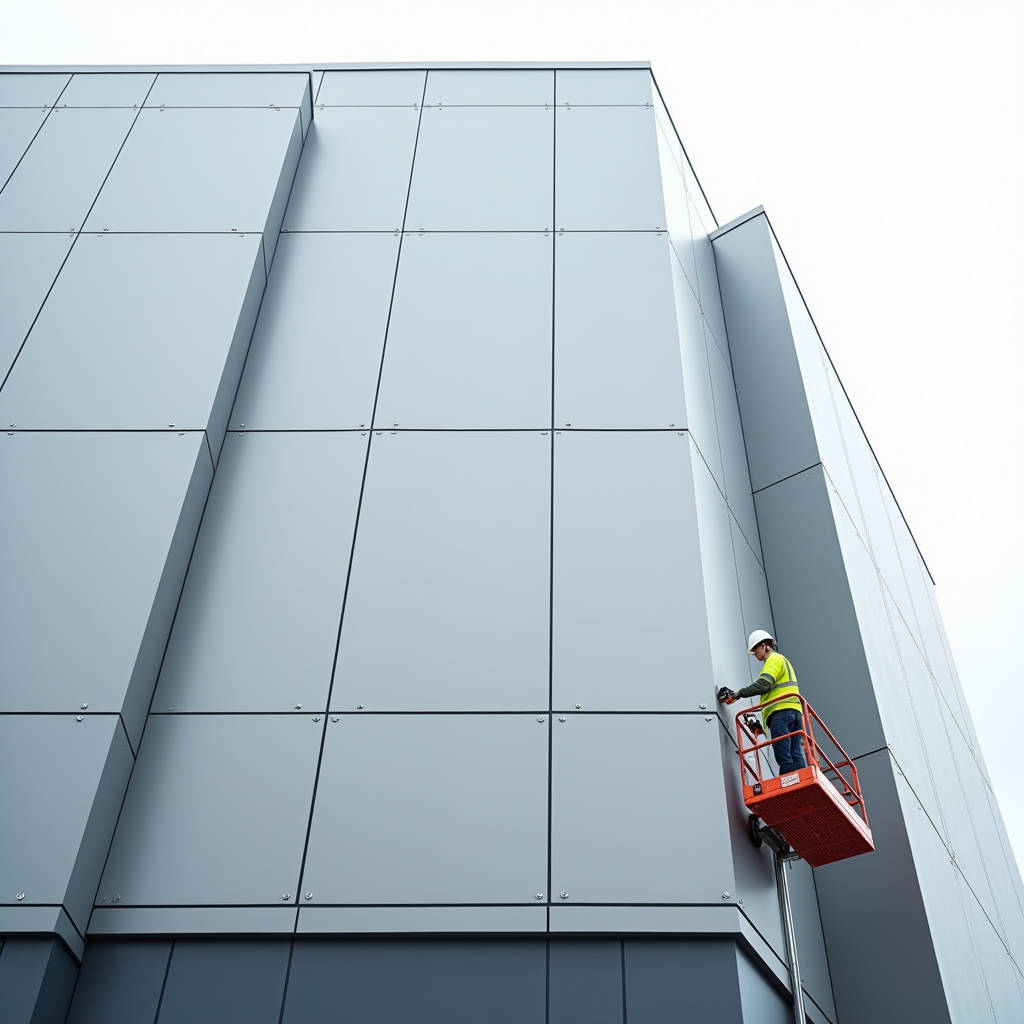
When a curtain wall contractor in Singapore receives a shipment of 3.0mm solid aluminium panels from a fabricator in Guangdong, the first thing their QA team checks is not the PVDF gloss level or the panel flatness. They pull out a spectrophotometer and measure the Delta E against the approved control sample. A reading above 2.0 on a single panel means rejection. A reading above 1.5 across the batch means the entire facade will look inconsistent under the equatorial sun. This is the reality of aluminum facade engineering at the color-critical interface — where architectural intent collides with industrial coating chemistry, and where specifications written in a design office in London must hold up on a jobsite in Dubai.
Color consistency across solid aluminium cladding panels is not a decorative afterthought. It is a structural specification problem. The human eye can detect color differences as small as Delta E 1.0 under diffuse daylight. When a 40-story tower has 8,000 panels spanning north-facing shade and south-facing direct sun, even panels coated in the same batch can read differently depending on viewing angle, gloss level, and metallic flake orientation. This article examines the engineering controls — from resin chemistry to application parameters to jobsite sequencing — that determine whether a facade reads as one uniform surface or a patchwork of near-misses.
The Delta E Problem: Why "Same Color" Is Not a Binary Condition
Architects specify RAL, Pantone, or custom matched colors. Fabricators order coil or spray coatings. Installers bolt panels onto substructures. Somewhere in that chain, the assumption that "color" is a fixed property breaks down. In aluminum facade engineering, color is a system output — not a material input.
The industry standard for color difference measurement is CIE Lab (Commission Internationale de l'Eclairage L*a*b*), codified in ISO 11664-4. The Delta E (ΔE) value quantifies the Euclidean distance between two color points in three-dimensional space: L* (lightness), a* (green-red axis), and b* (blue-yellow axis). A ΔE of 0 means mathematically identical. A ΔE of 1.0 is perceptible to a trained observer under controlled lighting. A ΔE of 2.0 is visible to an untrained observer under daylight.
Here is the problem most project specifications overlook: the same PVDF coating formulation, applied to the same 3003-H14 aluminium substrate, at the same 35-micron dry film thickness, can produce ΔE variations of 0.8 to 1.5 between panels coated in the morning versus the afternoon. Ambient humidity shifts. Line speed fluctuates. Oven temperature gradients drift. The metallic flakes in mica-based coatings orient differently depending on spray gun distance and electrostatic charge. None of these variables appear on a typical architectural specification sheet — but they all show up on the finished wall.
Field Note: On a 2022 mixed-use project in Kuala Lumpur, the contractor rejected 23% of delivered solid aluminium panels because the metallic silver coating showed visible banding when installed. Root cause analysis traced the problem to inconsistent spray gun pressure during the mica clear coat pass. The fabricator had to recalibrate all six guns to maintain 2.8 bar ± 0.1 bar and re-coat the entire batch. The lesson: color consistency auditing starts at the coating line, not at the receiving dock.
PVDF Chemistry: Why Kynar 500 Matters for Color Stability
The overwhelming majority of architectural aluminium cladding uses PVDF (polyvinylidene fluoride) coatings based on Kynar 500 resin or equivalent 70% PVDF formulations. The chemistry matters because PVDF is not just a pigment carrier — it is the primary barrier against UV degradation, acid rain etching, and chalking.
A properly formulated 70% PVDF coating, applied at 30-40 microns dry film thickness over a chrome-based conversion coating, will exhibit Delta E shift of less than 5.0 after 10 years of South Florida exposure (per AAMA 2605-20). By contrast, a 50% PVDF or polyester-based coating might show ΔE shifts of 8-15 over the same period. The difference between "the building still looks like the rendering" and "the building looks tired" comes down to that 20% resin gap.
But resin quality alone does not guarantee batch-to-batch consistency. The pigments themselves — particularly inorganic pigments used in earth tones, terracottas, and warm greys — have their own thermal stability profiles. Iron oxide pigments can shift toward red at elevated curing temperatures. Titanium dioxide in whites and light colors can yellow if the peak metal temperature exceeds 250°C during the cure cycle. These are not coating failures; they are process control failures that manifest as color problems.
| Coating Type | Resin System | DFT (microns) | ΔE After 5 Years Florida | Typical Color Stability | Relevant Standard |
|---|---|---|---|---|---|
| PVDF (70%) | Kynar 500 / Hylar 5000 | 30-40 | ≤ 3.0 | Excellent — minimal fade | AAMA 2605 |
| PVDF (50%) | Blended resin system | 25-35 | 4.0 - 8.0 | Moderate — noticeable fade | AAMA 2604 |
| FEVE Fluoropolymer | Fluoroethylene vinyl ether | 30-40 | ≤ 3.5 | Very good — high gloss retention | AAMA 2605 |
| Polyester (SMP) | Silicone-modified polyester | 20-30 | 8.0 - 15.0 | Poor — significant chalking | AAMA 2603 |
For projects requiring metallic or mica finishes, the coating system becomes a three-layer stack: primer (5-8 microns), color coat (15-20 microns), and clear coat (15-20 microns). The clear coat carries the PVDF protection. The color coat carries the pigment and metallic flake. The flake orientation — which determines whether the panel reads as bright or dull at a given angle — is locked in during the flash-off period between color coat and clear coat application. If that interval varies by more than 30 seconds across a production run, the metallic "flop" will differ panel to panel.
Gloss, Texture, and the Angle-Dependent Facade
Color is not just hue. Gloss units (GU), measured at 60° per ASTM D523, directly affect perceived color. A dark grey panel at 30 GU reads as a different color than the same dark grey at 45 GU — even with identical pigment loading. This is why aluminum facade engineering specifications must define gloss tolerance bands, not just color tolerance bands.
The standard architectural gloss range for PVDF solid aluminium panels is 25-35 GU at 60° (medium gloss). A tolerance of ±5 GU is typical. But on large facades with long sightlines, even a ±3 GU variation between adjacent panels can create visible "shimmer" zones where the building appears to have stripes. This is particularly acute on south-facing elevations in the northern hemisphere, where low-angle winter sun rakes across the facade and amplifies gloss differences.
Texture introduces another variable. A PVDF coating over a 0.5mm mechanical brush finish on the aluminium substrate will scatter light differently than the same coating over a mill finish. The brush direction must be consistent across all panels — typically horizontal — and the abrasive grit size (often 80-120 grit) must be controlled. If the brushing station uses worn belts on one shift and fresh belts on the next, the resulting surface roughness (Ra) can vary by 0.2-0.4 microns, enough to shift the apparent color by ΔE 0.5-1.0.
Pro Tip: When specifying metallic or mica PVDF coatings for solid aluminium panels above 2.5mm thickness, require the fabricator to produce a "range board" showing the acceptable light-to-dark variation under three lighting conditions: diffuse overcast, direct sunlight at 45°, and artificial light at 4000K. Have the architect sign off on the range board before production begins. This single document has resolved more color disputes than any contract clause.
Batch Control: The Mathematics of a Uniform Facade
A single coil of pre-painted aluminium yields approximately 300-400 square meters of finished panels, depending on panel size and nesting efficiency. A mid-rise commercial building with 8,000 square meters of cladding will require 20-25 coils. If those coils come from different coating runs — even from the same paint manufacturer — the ΔE between coil 1 and coil 20 can exceed 1.5.
The solution is not to demand that all coils come from one batch. That is often logistically impossible. The engineering solution is to implement a batch-mapping protocol:
- All coils are measured with a spectrophotometer upon receipt and assigned a ΔE value relative to the master standard.
- Panels are fabricated and labeled by coil number.
- A facade map is generated, assigning panels from the same coil or adjacent ΔE coils to contiguous zones on the building.
- Transition zones — where one coil group meets another — are placed at architectural breaks: vertical expansion joints, floor lines, or shadow gaps.
This approach treats color variation as an inevitable manufacturing reality and manages it through distribution logic rather than attempting to eliminate it entirely. It is the same principle used in stone cladding, where natural color variation is managed through "blending" diagrams. Solid aluminium panels deserve the same rigor.
Fabricators like Futeng® have invested in spectrophotometer-linked production tracking systems that embed color data into each panel's QR-code label, allowing the installation team to verify the correct panel placement against the facade map using a tablet on-site. This closes the loop between factory QC and field installation — a connection that remains broken on too many projects.
On-Site Verification: The QA Protocol That Catches Problems Before Installation
The receiving inspection at the jobsite is the last line of defense against a mismatched facade. The protocol should be defined in the project's quality assurance plan (QAP) and should include:
- Sample size: AQL (Acceptable Quality Limit) of 2.5% per batch, per ISO 2859-1, with a minimum of 5 panels per batch.
- Measurement conditions: D65 illuminant (simulated daylight), 10° observer angle, specular component included (SCI) for solid colors, specular component excluded (SCE) for metallic finishes.
- Acceptance criteria: ΔE ≤ 2.0 for individual panels vs. approved control sample; ΔE ≤ 1.0 between any two panels within the same visual field (defined as panels visible simultaneously from a single vantage point at 20 meters distance).
- Gloss tolerance: ±5 GU from specified value at 60° geometry.
The spectrophotometer itself must be calibrated daily against a white tile standard traceable to NIST. A device that has not been calibrated in six months can drift by ΔE 0.5-1.0 — enough to pass bad panels or fail good ones. This seems obvious, but on a recent audit of five active facade projects in Southeast Asia, three sites had spectrophotometers with expired calibration certificates.
For projects in coastal or high-humidity environments, the QA protocol should also include a 24-hour "settling period" after panel unpacking before color measurement. Solid aluminium panels shipped in sealed crates from a temperate factory to a tropical jobsite can develop condensation on the coated surface. That moisture film shifts the refractive index at the coating-air interface and can alter spectrophotometer readings by ΔE 0.3-0.5 — enough to trigger false rejections.
Weathering, Aging, and the Moving Target of Color
All architectural coatings weather. PVDF coatings weather slowly and predictably, but they weather nonetheless. The initial 6-12 months after installation represent the most dynamic period: residual solvents from the coating process fully evaporate, the PVDF resin matrix undergoes final cross-linking under UV exposure, and surface gloss stabilizes.
A panel measured at ΔE 0.8 relative to the standard on day one might measure ΔE 0.3 after six months of natural weathering. This is not a defect — it is the coating reaching its stable state. Smart specifications account for this by allowing a 12-month "weathering-in" period before final color acceptance on the completed facade.
The reference standard for accelerated weathering is ASTM G154 (xenon arc) or ASTM G155 (fluorescent UV). AAMA 2605 requires 4,000 hours of xenon arc exposure with ΔE ≤ 5.0 for color change and gloss retention ≥ 50%. But accelerated weathering is a screening tool, not a predictor. South Florida exposure at 5° south-facing remains the gold standard for real-world correlation. Any coating supplier claiming "20-year color warranty" without 10+ years of actual Florida exposure data is selling marketing, not engineering.
Specifying Color for International Projects: A Practical Checklist
When writing a color specification for solid aluminium cladding on an international project — where the architect is in one country, the fabricator in another, and the jobsite in a third — the following elements should be explicit in the specification document:
- Color space and tolerance: Specify CIE Lab ΔE per ISO 11664-4, with explicit tolerance values for individual panels (ΔE ≤ 2.0) and batch uniformity (ΔE ≤ 1.0).
- Gloss range: Define 60° gloss units and tolerance band (±5 GU).
- Control sample protocol: Require three identical control samples — one for the architect, one for the fabricator, one for the contractor — all signed and dated by all parties.
- Measurement standard: Specify D65 illuminant, 10° observer, and whether SCI or SCE geometry applies.
- Range board for metallics: Mandatory for any coating containing metallic or mica pigments.
- Batch mapping requirement: Require the fabricator to submit a coil-to-facade mapping diagram before production.
- Weathering-in clause: Allow 12 months of natural weathering before final color acceptance, with a maximum ΔE shift of 2.0 during that period.
These seven items transform color from a subjective aesthetic judgment into an objective engineering parameter. They cost nothing to include in a specification but can save hundreds of thousands in re-coating, re-fabrication, and schedule delay costs.
The discipline of aluminum facade engineering extends far beyond structural calculations and wind load tables. It reaches into the chemistry of fluoropolymer resins, the physics of spectrophotometry, and the logistics of batch tracking across continents. A facade that reads as one uniform surface — whether in RAL 7016 Anthracite Grey or a custom champagne metallic — is the product of engineering decisions made months before the first panel arrives on site. The spectrophotometer is as essential a tool as the torque wrench. Use it accordingly.