Solid Aluminium Front Cladding Panels and the Oil Canning Challenge
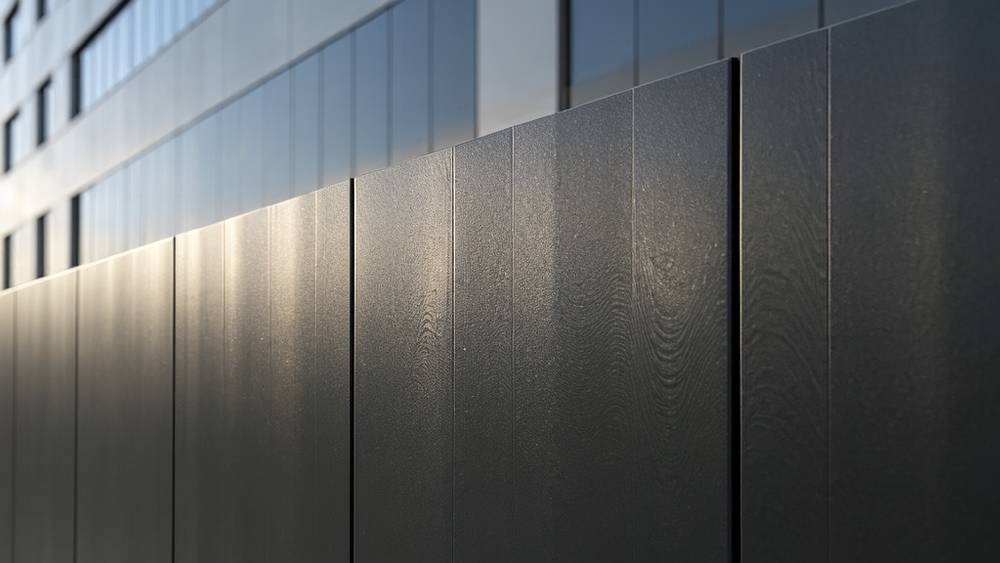
Every facade contractor who has worked with solid aluminium panels knows the moment. You step back to inspect a freshly installed front cladding elevation under morning light, and there it is — a subtle but unmistakable wave distortion across what should be a dead-flat surface. The spec called for a 3 mm aluminium sheet. The submittal was approved. The fixing system was installed per the shop drawings. Yet the panel reads like a funhouse mirror. This is oil canning, and in the world of front cladding, it remains the single most persistent quality complaint that separates premium architectural metalwork from a punch-list nightmare.
Oil canning — also referred to as elastic buckling or stress wrinkling — is not a material defect. It is a visual phenomenon where a flat metal panel exhibits visible waviness or distortion under certain lighting conditions. The term originates from the sound and movement of an old-fashioned oil can bottom being pressed. In solid aluminium front cladding panels, the effect is purely aesthetic, but in high-end commercial facades, aesthetics are everything. This article unpacks why oil canning happens in solid aluminium panels, how different alloy tempers and thicknesses influence the risk, what shop-level and site-level controls actually work, and how to write a specification that protects both the contractor and the client from a dispute that can run into six figures.
What Oil Canning Actually Is — And What It Is Not
A critical distinction needs to be made before any technical discussion: oil canning is elastic deformation, not plastic deformation. The panel is not permanently bent, creased, or structurally compromised. If you remove the panel from its mounting system and lay it on a flat table, the waviness largely disappears. This is why measuring oil canning is so difficult — there is no permanent set to gauge with a straightedge. The distortion only becomes visible when the panel is restrained in a framing system and subjected to the residual stresses locked into the metal during manufacturing.
The American Architectural Manufacturers Association (AAMA) has addressed this in technical documents, and ASTM has relevant flatness tolerances under ASTM B209 for aluminium sheet. However, neither provides a definitive pass/fail criterion for oil canning on installed front cladding panels. The industry generally accepts that some degree of oil canning is inherent to flat sheet metal products. The question is not whether it exists, but whether it is visible under "normal viewing conditions" — a phrase that has launched a thousand legal debates.
Oil canning is not a structural failure. It is an optical condition caused by residual stress manifesting as elastic buckling when the panel is restrained. The panel remains fully capable of performing its weather barrier and load-bearing functions.
The Metallurgical Root: Why Aluminium Alloys Want to Move
To understand why solid aluminium front cladding panels oil-can, you need to look at what happens before the panel ever reaches a job site. Aluminium sheet — typically alloy 3003, 5005, or 5052 for architectural applications — is produced through a rolling process that introduces compressive residual stresses into the material. When the sheet is then cut, routed, folded, or perforated at the fabricator's shop, these locked-in stresses redistribute unevenly. The panel relaxes in some areas and tightens in others.
Alloy selection plays a decisive role. 3003-H14 is the most common architectural alloy due to its formability and cost profile, but it carries a higher oil-canning risk than 5005-H14 or 5052-H32. The magnesium content in 5xxx-series alloys provides greater stiffness and better stress distribution. A 3 mm 5052-H32 panel will generally exhibit less oil canning than a 3 mm 3003-H14 panel of identical dimensions — but at a material cost increase of approximately 12-18% depending on market conditions.
Temper designation matters equally. H14 (strain-hardened, half-hard) is the architectural default. Going to H32 or H34 tempers in 5xxx alloys can improve flatness stability, but fabricators must account for reduced formability when specifying tighter bend radii for complex panel geometries.
Panel Geometry: Width-to-Thickness Ratios That Trigger Trouble
Oil canning risk is not random. It follows predictable patterns tied to panel dimensions. The critical metric is the width-to-thickness ratio of the unsupported flat area of the panel. For solid aluminium front cladding, a useful rule of thumb has emerged from decades of field observation:
| Panel Thickness | Maximum Recommended Flat Width | Width-to-Thickness Ratio | Oil Canning Risk Level |
|---|---|---|---|
| 2.0 mm | 500 mm | 250:1 | High — visible under most lighting |
| 2.5 mm | 700 mm | 280:1 | Moderate — visible under oblique light |
| 3.0 mm | 1,000 mm | 333:1 | Low — generally acceptable |
| 3.0 mm (5052-H32) | 1,200 mm | 400:1 | Very low — premium specification |
These figures assume panels are fabricated with fully captured edges — meaning all four edges are brake-formed with return legs that provide stiffness. A flat panel with no edge returns, regardless of thickness, will almost certainly oil-can. The return leg depth should be a minimum of 20 mm for panels under 1 m width and 25 mm for larger panels. This edge stiffening transforms the panel from a simple membrane into a shallow tray with significantly improved geometric stability.
Large-format panels exceeding 1.2 m in any dimension require additional stiffening strategies. Fabricators typically bond aluminium stiffener profiles to the rear face using structural adhesive — either a two-part epoxy or a VHB (Very High Bond) tape system. The stiffener grid pattern should break the unsupported flat area into rectangles with aspect ratios no greater than 3:1. A 1.5 m × 2.0 m panel, for instance, should have stiffeners spaced to create sub-panels no larger than 600 mm × 900 mm.
Fabrication Processes That Amplify or Suppress Oil Canning
The journey from aluminium coil to finished front cladding panel involves multiple operations, each of which can introduce or relieve stress. Understanding this sequence is essential for anyone writing a specification or reviewing shop drawings.
Shearing and Blanking
When a large aluminium sheet is sheared into smaller blanks, the cut edge undergoes localized plastic deformation. Guillotine shearing introduces edge stresses that can propagate into the panel body. Laser cutting and waterjet cutting produce lower edge stress but are slower and more expensive. For critical flatness applications — such as rainscreen panels on a high-end corporate headquarters — specifying laser-cut blanks adds approximately 8-12% to fabrication cost but measurably reduces post-fabrication distortion.
Routing and Perforating
CNC routing removes material and redistributes stress paths through the remaining metal. Panels with large cutouts for windows, louvers, or architectural features are particularly susceptible to oil canning around the openings. The rule here is straightforward: any opening greater than 150 mm in its smallest dimension requires a perimeter stiffener or a folded return on the cut edge. Perforated panels — increasingly popular for ventilated front cladding systems — actually carry lower oil-canning risk because the perforation pattern provides stress relief pathways. The perforation process itself releases residual rolling stresses, and the resulting panel often lies flatter than a solid panel of identical dimensions.
Bending and Forming
Press brake forming introduces the most concentrated stress of any fabrication step. The bend line experiences plastic deformation while the adjacent flat areas remain elastic. This differential creates a stress gradient that seeks equilibrium after the panel is released from the brake. Fabricators who understand this will sequence their bends to balance stresses — forming opposite edges in immediate succession rather than working sequentially around the perimeter. Simple practice, significant results.
Installation: The Site Factor That Gets Blamed on the Factory
Here is an uncomfortable truth that every facade consultant learns eventually: a significant proportion of oil canning complaints originate not in the factory but on the scaffold. The relationship between the panel and its supporting subframe is the final determinant of whether residual stresses will manifest as visible distortion.
The most common installation-induced cause of oil canning is over-constrained fixing. When a solid aluminium front cladding panel is rigidly fixed at all four corners — or worse, continuously along all edges — it loses the ability to accommodate thermal movement and stress relaxation. The panel becomes a captive diaphragm. Aluminium expands at approximately 2.4 mm per linear metre over a 50°C temperature swing. A 2 m panel that wants to grow by 4.8 mm but is prevented from doing so will buckle elastically. The solution is a properly engineered fixing system that provides restraint in one plane while allowing movement in the perpendicular plane.
Three fixing strategies dominate the market:
- Fixed-point plus sliding-point system: One corner of the panel is rigidly fixed in all directions. The opposite corner on the same edge is fixed in the vertical direction but free to slide horizontally. The remaining two corners are restrained only against wind load (outward movement). This is the gold standard for panels over 1 m width.
- Cassette hook-on system: Panels hang on horizontal carrier rails with interlocking vertical joints. Movement accommodation is built into the system geometry. Cassette systems generally exhibit lower oil-canning rates than face-fixed systems.
- Face-fixed with slotted holes: Screws through slotted holes allow differential movement. Requires careful setting out and quality control — a slot aligned in the wrong direction defeats the purpose.
Substrate flatness is the other installation variable. If the supporting steel or aluminium subframe is out of plane by more than 3 mm over a 3 m straightedge, the panel will be forced to conform to that irregularity when fixed. The resulting distortion is often misdiagnosed as oil canning. In reality, it is simply the panel following the substrate. The AAMA TIR-A9 technical information report provides guidance on framing tolerances relevant to this condition.
Coating, Colour, and the Optical Amplifier Effect
Paint does not cause oil canning, but it absolutely amplifies its visibility. The gloss level and colour of the PVDF or FEVE coating on architectural aluminium panels determine how readily the human eye detects surface distortion.
Dark colours — charcoal, black, deep bronze, navy — are merciless. A panel with a 30% gloss level in RAL 7021 (Black Grey) will reveal oil canning that is completely invisible on the same panel in RAL 9010 (Pure White) at 25% gloss. This is simple optics: dark, specular surfaces reflect light directionally, and any deviation from flatness changes the reflection angle enough to be perceived by the eye. Light, matte surfaces scatter light diffusely, masking minor surface variations.
This creates a specification dilemma. The architect wants a dark, monolithic rainscreen. The contractor knows dark panels will show every wave. The sensible middle ground is a three-part agreement:
- Establish a viewing distance standard. Industry practice for front cladding evaluation is 6 metres minimum viewing distance under diffuse (overcast or indirect) lighting conditions.
- Produce a physical mock-up — at least two full panels including a joint — and have all parties sign off under the agreed viewing conditions.
- Specify a 25-30% gloss maximum for dark colours. This modest reduction in specularity yields disproportionate improvement in oil-canning tolerance.
Manufacturers such as Futeng® have developed proprietary stress-relief processes during the fabrication stage specifically for dark-colour, large-format panels destined for high-visibility elevations. These processes — involving controlled thermal cycling and post-forming flattening — add cost but can mean the difference between a facade that photographs beautifully and one that requires replacement.
Specification Language: Writing Enforceable Oil-Canning Tolerances
The weakest link in most front cladding specifications is the oil-canning clause. Typical language reads something like: "Panels shall be free from oil canning and other surface distortions." This is unenforceable. "Free from" is an absolute standard that cannot be met by any flat sheet metal product. A better specification acknowledges reality while establishing measurable criteria.
A technically defensible oil-canning specification for solid aluminium panels should include:
- Viewing conditions: 6 m minimum distance, diffuse lighting, elevation viewed from a position no more than 45 degrees from perpendicular.
- Acceptance standard: Reference to ASTM B209 flatness tolerances for the aluminium sheet prior to fabrication, plus a project-specific mock-up as the installed benchmark.
- Alloy and temper mandate: Specify 5005-H14 or 5052-H32 for panels exceeding 600 mm in the shorter dimension, with 3003-H14 permitted only for smaller panels.
- Stiffener requirement: Define the maximum unsupported flat area — 0.36 m² (600 mm × 600 mm) is a conservative default — and require bonded stiffeners for any area exceeding this.
- Mock-up protocol: Require a minimum two-panel mock-up incorporating a vertical and horizontal joint, approved by the architect before production release.
- Remediation limits: State that no more than 5% of installed panels may be rejected for oil canning, subject to the agreed viewing conditions.
The AAMA provides technical resources through its Technical Information Reports, and the Metal Construction Association (MCA) has published a white paper on oil canning in metal wall panels that remains one of the most-cited industry references.
When Oil Canning Appears Mid-Project: Practical Remediation
Despite every precaution, oil canning sometimes appears after installation. The sun hits the facade at the wrong angle on a February morning, and the client's representative emails photographs. What then?
Remediation options exist, but they range from modestly effective to expensive. The least invasive approach is adjusting the fixing system. Loosening over-constrained fasteners and re-torquing to the correct specification can relieve enough stress to reduce visible distortion. For cassette systems, adjusting the engagement of the panel on its carrier rail — often by inserting thin shim plates — can alter the restraint conditions enough to shift the buckling mode.
For panels where adjustment fails, rear-face stiffener retrofitting is possible but requires access to the cavity — straightforward for open-joint rainscreens, difficult for sealed-joint systems. Bonded aluminium stiffeners applied from the rear can break the unsupported span into smaller sub-panels, reducing the amplitude of any wave. This work is delicate; the adhesive must be applied without staining the visible face, and the stiffener must be held in precise position during curing.
Panel replacement is the last resort and should trigger a root-cause investigation before simply remaking the same panel the same way. Was the original panel over-constrained? Was the alloy temper as specified? Was the stiffener pattern adequate? A replacement panel fabricated without addressing these questions will exhibit the same problem. This is where working with an experienced aluminium panel fabricator pays dividends — the technical team can analyze the specific failure mode and adjust the fabrication approach accordingly.
Cost Implications: What Oil-Canning Mitigation Adds to the Budget
Oil-canning control is not free. Every intervention — thicker material, higher-grade alloy, additional stiffeners, stress-relief processing, laser cutting, mock-up construction — adds cost to the front cladding package. The following table represents approximate cost impacts for a typical commercial rainscreen project, based on a 1,000 m² facade area with 3 mm aluminium panels:
| Mitigation Measure | Cost Impact (per m²) | Oil-Canning Risk Reduction | Best Applied When |
|---|---|---|---|
| Upgrade 3003-H14 to 5005-H14 | +$12–18/m² | Moderate (20-30%) | Mid-size panels, mid-range colours |
| Upgrade 3003-H14 to 5052-H32 | +$18–25/m² | High (35-45%) | Large panels, dark colours |
| Rear-face stiffener grid (bonded) | +$25–40/m² | High (40-50%) | Any panel over 1 m² |
| Laser cutting vs. guillotine shearing | +$8–12/m² | Low-Moderate (10-15%) | Critical flatness requirements |
| Full-scale mock-up (2 panels) | $3,000–6,000 lump sum | N/A (verification only) | All projects over $500k facade value |
| Thermal stress-relief processing | +$10–15/m² | Moderate-High (25-35%) | Dark colours, high-spec projects |
For a 1,000 m² facade, the difference between a basic specification (3003-H14, no stiffeners, guillotine-cut) and a premium oil-canning-resistant specification (5052-H32, full stiffener grid, laser-cut, stress-relieved) is approximately $55,000–92,000. In the context of a multi-million-dollar commercial facade project, this incremental cost is modest compared to the potential cost of panel replacement, project delays, and reputational damage if oil canning leads to rejection at handover.
The Mock-Up: Your Insurance Policy Against Disputes
If there is one recommendation to take from this analysis, it is this: build a mock-up. A physical, full-scale, on-site mock-up — viewed under the agreed conditions and signed off by the architect, client representative, and contractor — is the single most effective tool for managing oil-canning expectations on a front cladding project.
A proper mock-up should include at least two full panels with a vertical joint and one horizontal joint. It should be oriented to receive similar lighting to the finished facade. It should be built on the actual subframe system specified for the project. And it should be photographed extensively, with those photographs appended to the contract documents as the installed quality benchmark.
The mock-up serves three functions: it validates the specification, it educates all parties on what is achievable with flat sheet metal, and it provides an irrefutable reference point if disputes arise later. A signed-off mock-up panel with minor oil canning that the architect accepted effectively defines the acceptance threshold for the entire project.
Oil canning in solid aluminium front cladding panels is not a defect to be eliminated — it is a natural behaviour of thin-gauge metal that must be managed through intelligent material selection, thoughtful fabrication, correct installation, and realistic aesthetic expectations. The contractors who understand this distinction are the ones whose projects close out cleanly. The ones who promise perfectly flat panels regardless of conditions are the ones still on site six months after practical completion, replacing panels at their own cost.