Modern Facade Materials Comparing AAMA 2605 and 2604 PVDF Standards
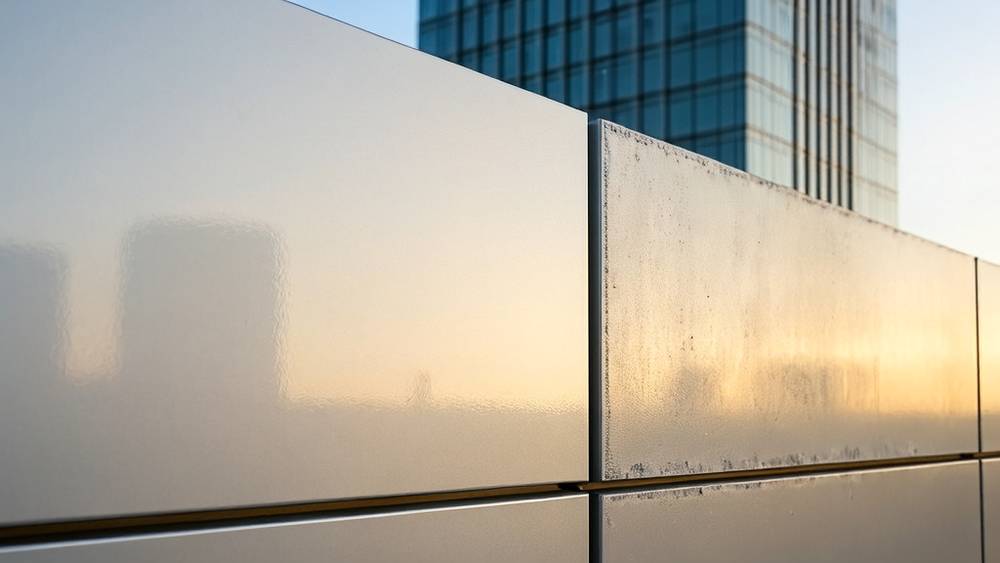
When architects and building owners search for modern facade materials, the conversation nearly always circles back to aluminium. Lightweight, fully recyclable, and capable of spanning large areas without intermediate support, solid aluminium cladding panels have become the default skin for everything from corporate headquarters to airport terminals. But choosing "aluminium" is not the end of the decision. The real question—the one that separates facades that look pristine after 15 years from those that chalk, fade, and leak—is which PVDF coating system sits on top of that aluminium. Two standards dominate the specification landscape: AAMA 2605 and AAMA 2604. Superficially they appear similar. In practice, the gap between them determines whether a facade in a coastal or high-UV environment holds its color and gloss, or becomes a maintenance liability well before the building loan is paid off. This article examines that gap through the lens of real project conditions—salt spray, industrial fallout, and relentless UV exposure—and explains what the 70% PVDF resin threshold actually means for owners who intend to hold their assets long-term.
The Two Standards That Define Exterior Aluminium Coating Performance
AAMA 2605 and AAMA 2604 are both published by the Fenestration and Glazing Industry Alliance (FGIA), the North American body that sets the technical benchmarks for architectural coatings on aluminium. Despite their adjacent numbering, they describe fundamentally different coating systems.
AAMA 2605, titled "Voluntary Specification for High Performance Organic Coatings on Architectural Extrusions and Panels," mandates a minimum of 70% PVDF (polyvinylidene fluoride) resin by weight in the coating's pigment-free portion. The remaining 30% consists of acrylic resins and pigments. PVDF is the component responsible for the coating's extraordinary resistance to ultraviolet radiation, chemical attack, and moisture. At 70%, the carbon-fluorine bonds in the PVDF polymer chain create a molecular shield that does not break down under conditions that would degrade polyester or lower-grade fluoropolymer blends within three to five years.
AAMA 2604, by contrast, governs "High Performance Organic Coatings" with a lower minimum PVDF content—typically 50% in practice, though the standard itself specifies performance criteria rather than a strict resin percentage. The difference matters because every percentage point below 70% reduces the coating's ability to resist photodegradation. In accelerated weathering chambers running ASTM G154 Cycle 1 (UVA-340 lamps at 0.89 W/m²/nm irradiance, 60°C black panel temperature, 8-hour UV with 4-hour condensation at 50°C), AAMA 2605 coatings are tested to 4,000 hours with a maximum color change of 5 Delta E units and gloss retention above 50%. AAMA 2604 coatings are typically qualified at 1,000 to 2,000 hours under the same or similar protocols, and permitted color shift is wider.
70% PVDF: What the Number Actually Means in Molecular Terms
The 70% threshold is not arbitrary. PVDF resin—chemically (-CH₂-CF₂-)n—contains alternating carbon-fluorine and carbon-hydrogen bonds along the polymer backbone. The C-F bond dissociation energy is approximately 485 kJ/mol, versus roughly 350 kJ/mol for the C-O bonds found in polyester and acrylic resins. Ultraviolet photons in the 290-400 nm range carry energy between 300 and 410 kJ/mol. Polyester C-O bonds sit squarely in the crosshairs; PVDF C-F bonds do not.
Below 70% PVDF, the acrylic component—which provides adhesion and pigment wetting—begins to form a continuous pathway through the film. UV photons find these acrylic domains and initiate chain scission. The result is chalking: pigment particles lose their resin binder and sit loosely on the surface, producing a white, dusty residue that wipes off on a fingertip. Gloss drops because the coating surface roughens at the micron scale. Color fades because the exposed pigments degrade without protective resin encapsulation.
Coating applicators in China, including those supplying the Middle East and Southeast Asian markets, use Kynar 500® (Arkema) or Hylar 5000® (Solvay) PVDF resins almost exclusively for AAMA 2605 work. These resins are supplied as granules and milled with ceramic-bead dispersers into a base that meets the 70% threshold after the acrylic modifier and pigments are factored in. Any plant claiming AAMA 2605 compliance without specifying the resin brand and lot traceability should raise immediate red flags during factory audit.
When AAMA 2604 Is Enough—And When It Is Not
AAMA 2604 coatings have legitimate applications. Interior aluminium panels, soffits under deep overhangs, surfaces in temperate climates with low UV index, and budget-driven projects with planned recoating cycles of 8-12 years can all use AAMA 2604 successfully. The standard still requires good adhesion, some flexibility, and basic corrosion resistance under ASTM B117 salt spray (typically 1,000-1,500 hours).
The problems start when AAMA 2604 is specified for projects that actually need AAMA 2605. Three scenarios recur across our project history:
Scenario 1: Coastal High-Rise Within 3 km of Salt Water
A 28-storey residential tower in Penang, Malaysia specified AAMA 2604 silver metallic panels for its east-facing elevation. Within six years, panels on the upper floors showed gloss loss exceeding 60% and visible chalking. Salt-laden wind, combined with equatorial UV (annual UV index averaging 11-12), had effectively aged the coating at roughly triple the rate seen in temperate inland sites. The owner ultimately paid for full recladding—at roughly 2.8 times the original panel cost—because the PVDF content was insufficient to withstand the combined chloride-UV degradation mechanism. Chloride ions penetrate micro-cracks formed by UV-induced acrylic degradation, reach the aluminium substrate, and initiate filiform corrosion that propagates under the coating.
Scenario 2: Industrial Zone with Sulfur Dioxide Exposure
Aluminium panels on a logistics center near Map Ta Phut, Thailand—one of Southeast Asia's largest petrochemical zones—were coated with an AAMA 2604 system. Ambient SO₂ levels in the area frequently exceed 100 µg/m³. Sulfur dioxide dissolves in atmospheric moisture to form sulfurous and eventually sulfuric acid micro-droplets on the panel surface. AAMA 2604 coatings, with their higher acrylic content, are more susceptible to acid etching than PVDF-rich AAMA 2605 films. After four years, the panels displayed visible etching rings where acid droplets had concentrated and dried. The owner switched to AAMA 2605 for the second-phase expansion.
Scenario 3: High-Altitude UV in Bogotá or Quito
Cities above 2,500 meters elevation experience UV radiation roughly 20-30% more intense than sea-level locations due to thinner atmospheric ozone. AAMA 2604 coatings on aluminium cladding in these environments can chalk within five years. AAMA 2605's 4,000-hour accelerated weathering benchmark translates to a projected 20-25 year service life at sea level under ASTM G154 correlation models; at altitude, that still yields 15-18 years, which often aligns with the building's first major facade maintenance cycle.
Coating Architecture: 2-Coat, 3-Coat, and 4-Coat Systems
Specifying AAMA 2605 is necessary but not sufficient. The coating architecture—the number and function of individual layers—determines how the PVDF topcoat performs over decades. The table below summarizes the standard configurations used on solid aluminium cladding panels.
| System | Layers | Total DFT (microns) | Best Application | Typical AAMA Standard |
|---|---|---|---|---|
| 2-Coat | Primer + PVDF Color Topcoat | 25-35 | Interior, sheltered soffits | 2604 or 2605 (basic) |
| 3-Coat | Primer + PVDF Color Coat + PVDF Clear | 35-45 | Standard exterior, inland commercial | 2605 |
| 4-Coat | Primer + Barrier + PVDF Color + PVDF Clear | 45-60 | Coastal, industrial, high-UV, metallic/pearl | 2605 (premium) |
The 4-coat system merits particular attention for metallic and mica finishes. Metallic aluminium flake pigments are vulnerable to oxidation if moisture penetrates the clear coat. A dedicated barrier coat between the primer and color coat—typically an epoxy or modified acrylic layer—provides a second line of defense. For projects within 500 meters of breaking surf, where salt spray is continuous rather than occasional, the 4-coat AAMA 2605 system with minimum 55 microns total dry film thickness is the only configuration we recommend without reservation.
Manufacturers like Futeng® who operate their own PVDF coating lines can control film thickness uniformity to within ±5 microns across a 1,500 mm wide panel. This matters because thin spots in the clear coat become initiation points for corrosion. When auditing a supplier, request cross-sectional microscope images at panel edges and center—the edge-to-center DFT delta should not exceed 15%.
Testing Beyond the Standard: What AAMA 2605 Does Not Require
AAMA 2605 sets minimum performance thresholds, but project-specific conditions often demand supplementary testing. The standard does not require:
- Cyclic corrosion testing (CCT): ASTM G85 Annex A5 (Prohesion) cycles between salt fog, dry-off, and humidity. This better simulates atmospheric corrosion than continuous B117 salt spray. For coastal projects, specify 2,000 hours CCT with less than 2 mm scribe creep.
- Filiform corrosion resistance: Covered by EN 3665 for the European market, this test evaluates the coating's ability to resist thread-like corrosion under the film. Relevant for buildings within 1 km of salt water.
- Acid rain resistance: No standard AAMA test replicates the cyclic wet-dry acid deposition seen in industrial zones. Custom protocols using pH 3.5 sulfuric/nitric acid solution in 24-hour cycles can identify vulnerable formulations.
- Miami 5-year real-time exposure: Accelerated weathering correlates imperfectly with reality. South Florida exposure at 45° south-facing angle remains the gold standard for validating lab data. Coatings that pass AAMA 2605 accelerated testing should also show Delta E below 5 after 5 years in Miami.
These supplementary tests add cost—roughly $1,500-3,000 per panel system—but the cost of a single recladding project, measured in millions for a mid-rise building, dwarfs the testing investment by three orders of magnitude.
PVDF Coating Quality Indicators During Factory Inspection
For procurement managers and facade consultants conducting factory audits, the following checks separate coating operations that consistently deliver AAMA 2605 quality from those that pass one qualification panel and then quietly reduce PVDF content in production:
- Resin lot traceability: Request the Kynar 500® or Hylar 5000® lot certificates for the specific production batch. Cross-check the lot number against the resin supplier's shipment records. Legitimate coaters maintain full chain-of-custody documentation.
- DFT measurement protocol: The coater should use eddy-current DFT gauges (e.g., Elcometer 456 or DeFelsko PosiTector 6000) calibrated on the actual aluminium substrate, not on steel calibration foils. Measurements should be taken at minimum 5 points per square meter on large panels, with all readings recorded—not just the ones that pass.
- Oven temperature profiling: PVDF coatings require a peak metal temperature (PMT) of 232-249°C to properly fuse. Running a temperature probe through the curing oven on a production panel confirms whether the PMT is actually achieved at the panel center, not just at the oven thermocouple. Under-cured PVDF fails gloss retention testing within 500 hours of QUV.
- Quarantine and retest rate: Ask the coater what percentage of production batches are quarantined for retesting. A rate of 2-5% suggests real quality control; a rate of 0% suggests either extraordinary capability (unlikely) or no genuine testing program.
- MEK rub test on-site: A quick field check: methyl ethyl ketone (MEK) double rubs on a cured panel. AAMA 2605 coatings should withstand 100+ double rubs without breakthrough to the substrate. Fewer than 50 double rubs indicates under-cure or low PVDF content.
The Gap Between AAMA 2605 and 2604 in Real Numbers
To make the performance difference concrete, the table below compares the two standards across the metrics that most directly affect facade appearance and maintenance cost over a building's service life.
| Performance Parameter | AAMA 2604 | AAMA 2605 | Practical Implication |
|---|---|---|---|
| Minimum PVDF resin content | ~50% (performance-specified) | ≥70% by weight | Determines UV and chemical resistance ceiling |
| Accelerated weathering (ASTM G154) | 1,000-2,000 hrs | 4,000 hrs minimum | ~4x longer qualified service in UV exposure |
| Maximum color change (Delta E) | ≤5 after testing | ≤5 after 4,000 hrs | Equal numerical limit, unequal test duration |
| Gloss retention (60° meter) | ≥30% after testing | ≥50% after 4,000 hrs | 2605 panels stay visually acceptable far longer |
| Salt spray resistance (ASTM B117) | 1,000-1,500 hrs | 4,000 hrs | Critical for coastal and de-icing salt exposure |
| Humidity resistance (ASTM D4585) | 1,000-1,500 hrs | 4,000 hrs | Tropical climates demand the higher threshold |
| Typical cost premium over 2604 | Baseline | +15 to 25% | Incremental cost vs. recladding risk evaluation |
| Expected service life (temperate inland) | 10-15 years to first maintenance | 20-25+ years | Lifecycle cost favors 2605 for long-hold assets |
The 15-25% cost premium for AAMA 2605 translates to roughly $8-15 per square meter of finished panel area, depending on color (metallics and bright colors require thicker clear coats) and factory location. Against a total installed facade cost of $300-600/m² for solid aluminium rainscreen systems, the coating premium represents roughly 2-5% of total installed cost. Set against the cost of scaffold erection, panel removal, and replacement—which can exceed $200/m² for high-rise access alone—the economic case for AAMA 2605 on any building intended to stand for more than 15 years becomes clear.
Color Stability and the Metallic Challenge
Not all AAMA 2605 coatings perform identically. The color formulation interacts with the PVDF resin system in ways that affect long-term stability. Three color families warrant extra scrutiny:
Bright reds and oranges: These colors rely on organic pigments (diketopyrrolopyrrole, quinacridone) that are inherently more UV-sensitive than inorganic alternatives. Even within AAMA 2605, specifying an additional clear coat thickness—40 microns instead of the standard 25—improves UV screening for the pigment layer beneath. Expect Delta E values of 3-4 after 4,000 hours versus below 2 for inorganic grays and beiges.
Metallics and micas: Aluminium flake pigments in metallic coatings are thin platelets that orient parallel to the panel surface during application. If the clear coat erodes, these flakes oxidize from silver to gray-white, causing a "fading" that is actually substrate change, not pigment degradation. The 4-coat system with barrier coat is essential here.
Dark blues and charcoal blacks: These colors absorb more solar radiation, raising the panel surface temperature. A black panel in Riyadh can reach 85°C in summer sun. While PVDF is thermally stable to 250°C+, the acrylic modifier softens above 60°C, and the thermal cycling between day (hot) and night (cooler) creates micro-stresses at the pigment-binder interface. Dark AAMA 2605 coatings benefit from thicker total film builds—50 microns minimum—to distribute these stresses.
Specifying Correctly: What Goes on the Drawing
A specification that reads simply "PVDF coating to AAMA 2605" leaves too much room for interpretation. The following language, adapted from multiple successful project specifications, closes the common loopholes:
"Factory-applied fluoropolymer coating system meeting AAMA 2605-20 requirements. PVDF resin content shall be minimum 70% by weight in the pigment-free portion, using Kynar 500® or Hylar 5000® resin. Coating system: chrome-free pretreatment, epoxy primer (5-8 microns), barrier coat where specified, PVDF color coat (20-25 microns), PVDF clear coat (20-25 microns). Total DFT: 45-55 microns for 3-coat, 55-65 microns for 4-coat metallic. Cure: peak metal temperature 232-249°C verified by oven profiling. Color: [specify RAL/BS/Pantone reference with gloss level at 60° meter]. Quality: each production batch shall have retained samples subjected to 4,000-hour ASTM G154 Cycle 1 testing with Delta E ≤5 and gloss retention ≥50%. Manufacturer to provide resin lot certificates and DFT measurement records for each panel."
This level of detail in the specification does three things: it signals to the contractor that the client understands coating technology, it gives the facade consultant clear pass/fail criteria during factory inspection, and it provides legal recourse if substituted materials fail to meet the stated requirements.
For teams sourcing solid aluminium cladding from overseas manufacturers, particularly from China where the majority of global PVDF coating capacity for architectural aluminium now resides, factory audit is non-negotiable. A desktop review of certificates is insufficient. The audit must include witnessing the coating line in operation, pulling random panels for DFT measurement, and reviewing the resin procurement records that link specific production batches to specific resin lots. Companies like Futeng® that maintain in-house PVDF coating lines rather than outsourcing to third-party applicators generally offer tighter quality control because the panel fabrication and coating processes sit under one roof with unified responsibility.
The choice between AAMA 2605 and AAMA 2604 is ultimately a choice about when—not whether—the first major facade intervention occurs. For buildings where the owner intends to hold the asset for 20 years or more, where the site is within 3 km of salt water or heavy industry, or where the architectural design relies on uniform color and gloss across large uninterrupted surfaces, AAMA 2605 with a properly specified 3-coat or 4-coat system is the only selection that aligns with the investment horizon. The incremental coating cost, amortized over a 25-year service life, works out to less than $0.50 per square meter per year—a figure that makes the alternative look less like a saving and more like deferred spending at a much higher rate.