2.5 mm 3 mm or 4 mm Solid Aluminium Panel Wall Cladding Load Cost and Flatness Tradeoffs
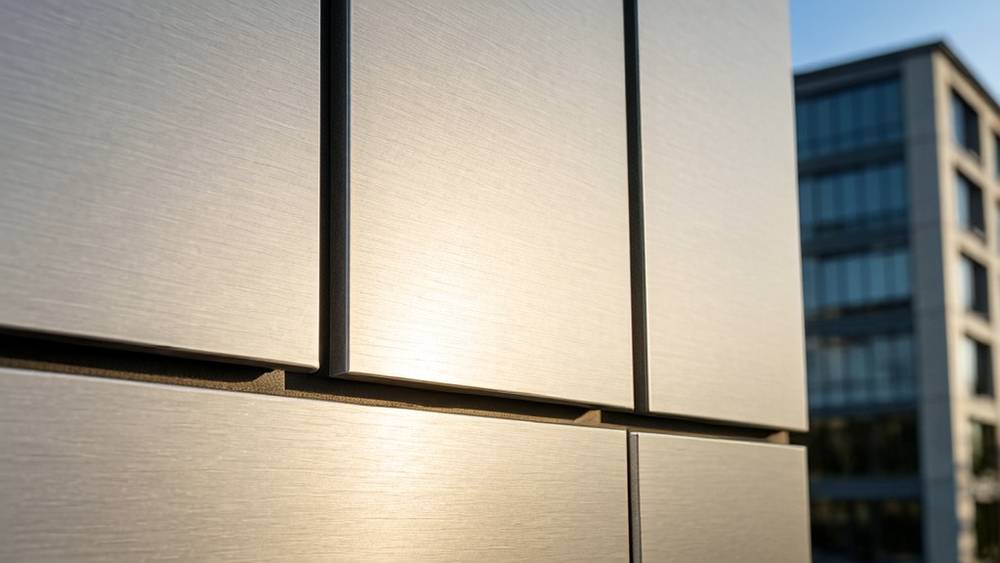
When a facade consultant specifies 4 mm solid aluminium panels for a high-rise in downtown Chicago, the immediate question from the cost estimator is not about aesthetics. It is about dead load. At 10.8 kg per square metre, a 4 mm solid aluminium sheet adds roughly 35% more weight to the curtain wall substructure than a 3 mm panel at 8.1 kg/m². Over 20,000 square metres of panel wall cladding, that difference compounds into tonnes of additional steel, larger brackets, and potentially revised anchor embedments. This article examines what actually changes across the structural system when solid aluminium panel thickness steps from 2.5 mm to 3 mm to 4 mm – and where the line between necessary robustness and avoidable overspecification sits.
Why Panel Thickness Is the First Domino in Facade Engineering
Solid aluminium panels used in panel wall cladding systems are specified by thickness for two reasons that often pull in opposite directions. The structural engineer wants enough cross-sectional stiffness to resist wind deflection under service loads. The QS wants the lightest gauge that meets code. The architect wants flatness – no oil canning, no visible ripples across a 1.2 m wide module on a sunny afternoon.
Thickness is where these three interests collide. A 2.5 mm panel weighs 6.75 kg/m². A 3 mm panel weighs 8.1 kg/m². A 4 mm panel weighs 10.8 kg/m². These numbers look small on a datasheet. Multiplied across a facade area of 15,000 m², the 4 mm option adds 60,750 kg of dead load compared to 2.5 mm – roughly the weight of 40 mid-size cars hanging off the building structure permanently.
This dead load cascades through every component: aluminium extruded sub-frames, galvanised steel brackets, anchor bolts cast into concrete slabs, and the primary building frame itself. The structural implication is not linear. A 35% increase in cladding weight can trigger disproportionate increases in bracket sizing because bracket selection jumps in discrete increments. A bracket rated for 8 kN might handle 3 mm panels across a given zone but require upsizing to a 12 kN bracket for 4 mm panels.
Wind Load Deflection: Where 3 mm Becomes the Practical Floor
Most international facade specifications reference deflection limits of L/175 or L/180 for panel wall cladding under wind load, where L is the span between fixing points. For a typical 1.2 m wide panel spanning 600 mm between horizontal support rails, the allowable deflection at service wind load is approximately 3.4 mm.
A 2.5 mm solid aluminium panel of alloy 3003-H14, simply supported on four edges with a 600 mm span, under a design wind pressure of 1.5 kPa (roughly corresponding to a basic wind speed of 45 m/s in Exposure Category B), will deflect approximately 4.2 mm. That exceeds the L/175 limit. The same panel in 3 mm deflects about 2.8 mm – comfortably within limits. The 4 mm panel deflects around 1.6 mm.
The takeaway is not that thicker is always better. It is that 3 mm represents a practical threshold for most commercial mid-rise and high-rise applications where wind pressures fall between 1.0 and 2.5 kPa. Below 3 mm, the engineer must either reduce panel dimensions, add intermediate stiffeners, or accept a higher risk of visible deflection under peak gusts. Above 3 mm, the gains in deflection performance diminish while the weight penalty accelerates.
Oil Canning: The Visual Defect That No Structural Calculation Predicts
Oil canning – the waviness or rippling visible on flat metal panels under certain lighting conditions – is the most persistent quality complaint in panel wall cladding projects. It has no structural acceptance criteria in ASTM or EN standards. It does not appear in finite element models. Yet it generates more post-installation disputes than any other single issue.
Thicker panels resist oil canning better. The relationship is governed by panel bending stiffness, which is proportional to the cube of thickness. A 4 mm panel is approximately 2.37 times stiffer in bending than a 3 mm panel of the same alloy and temper. This means that under thermal stress or residual stresses from the rolling process, a 4 mm panel will exhibit significantly less distortion.
However, thickness alone does not eliminate oil canning. The alloy temper matters. 3003-H14 is the standard architectural grade, but specifying 5005-H34 or 5052-H32 can improve flatness at a given thickness because these alloys have different stress-relief characteristics after coil coating and blanking. Panel aspect ratio is equally critical – long, narrow panels (aspect ratio above 4:1) are inherently more prone to oil canning than square panels, regardless of thickness.
The AAMA 508 standard provides a test method for evaluating oil canning severity using a straightedge and feeler gauge, categorising panels into five severity levels. Specifiers should reference AAMA 508 in their performance specification rather than simply increasing thickness as a blunt instrument against oil canning.
Alloy Selection: 3003 vs 5005 vs 5052 at Different Gauges
Solid aluminium panels for panel wall cladding are predominantly supplied in three alloys. Each behaves differently at a given thickness, and the alloy choice should inform – or be informed by – the thickness decision.
| Alloy & Temper | Tensile Strength (MPa) | Yield Strength (MPa) | Typical Thickness Range | Best Application |
|---|---|---|---|---|
| 3003-H14 | 150-200 | 145 | 2.0 - 4.0 mm | General architectural facades, moderate wind zones |
| 5005-H34 | 160-210 | 140 | 2.5 - 4.0 mm | High-flatness requirements, anodised finishes |
| 5052-H32 | 215-265 | 160 | 2.0 - 4.0 mm | Coastal zones, high wind loads, curved panels |
For a given thickness, 5052-H32 provides approximately 10-15% higher yield strength than 3003-H14. This means a 3 mm 5052 panel can often match the deflection performance of a 3.5 mm 3003 panel, saving roughly 1.35 kg/m² while maintaining structural equivalence. The trade-off is cost – 5052 typically carries a 12-18% premium over 3003 in sheet form.
5005-H34 occupies a middle ground. It is the preferred alloy when panels will be anodised rather than PVDF-coated, because its magnesium content (0.8-1.2%) produces a more uniform anodic layer than the manganese-based 3003. For projects in the Middle East where anodised solid aluminium is common on luxury residential towers, 5005 at 3 mm is a specification that balances flatness, weight, and finish quality.
Thermal Movement: Why Thicker Panels Need Smarter Fixing Details
A common misconception is that thicker panels, being stiffer, can be fixed more rigidly. The opposite is true. Aluminium expands at approximately 23.4 × 10⁻⁶ per °C. A 4 m long panel subjected to a 60°C temperature swing (from -10°C overnight to 50°C under direct solar radiation) will expand by approximately 5.6 mm. A thicker panel generates higher thermal stress at restrained fixing points because its greater cross-sectional area resists elastic deformation.
The fixing system must accommodate this movement regardless of panel thickness. However, the consequences of inadequate movement provision are more severe with 4 mm panels than with 2.5 mm panels. The thicker panel will transmit higher forces into fixings, potentially causing fastener tear-out around rivet holes or visible buckling between fixed points.
Best practice for panel wall cladding in solid aluminium is to designate one fixing point per panel as the fixed anchor (typically the top-centre or top-corner) and allow all other fixings to slide via slotted holes or proprietary sliding clips. The slot length should be calculated based on the panel dimension parallel to the slot, the expected temperature range, and a safety factor of 1.5. For a 3 m panel in Riyadh, where surface temperatures can reach 80°C, the required slot length at the bottom fixing is approximately 8 mm.
Cost Implications Across the Supply Chain
The decision to move from 3 mm to 4 mm solid aluminium triggers cost changes far beyond the raw material upcharge. The following table breaks down the cascading cost factors for a hypothetical 10,000 m² facade project in a temperate climate zone.
| Cost Element | 3 mm Panel (Baseline) | 4 mm Panel | Delta | Driver |
|---|---|---|---|---|
| Raw aluminium sheet | Base: $28/m² | $37/m² | +32% | 33% more kg of Al per m² |
| CNC routing & fabrication | Base: $15/m² | $17/m² | +13% | Slower feed rates, more tool wear |
| PVDF coating (3-coat) | Base: $12/m² | $12/m² | 0% | Surface area unchanged |
| Sub-frame extrusions | Base: $18/m² | $22/m² | +22% | Larger profiles for higher dead load |
| Steel brackets & anchors | Base: $10/m² | $14/m² | +40% | Upsizing due to load bracket increments |
| Freight (factory to site) | Base: $4/m² | $5.3/m² | +33% | Weight-based shipping |
| Installation labour | Base: $35/m² | $38/m² | +9% | Heavier panels slow handling |
| Total installed cost | $122/m² | $145.3/m² | +19% |
The 19% installed cost premium for 4 mm over 3 mm is significant at scale. On a 10,000 m² project, that is $233,000 in additional facade cost. The question the project team must answer is whether the incremental benefit – slightly lower deflection, marginally better oil canning resistance – justifies that premium for the specific building height, exposure, and architectural expectations.
When 2.5 mm Is Enough: Low-Rise and Soffit Applications
Not every project needs 3 mm or 4 mm panels. For single-storey commercial buildings, interior feature walls, and soffit linings where wind loads are negligible and viewing distances are short, 2.5 mm solid aluminium is a legitimate and cost-effective choice for panel wall cladding.
Soffit applications are particularly suited to 2.5 mm because gravity works in the installer's favour – panels lie flat on the sub-frame rather than hanging from it. Wind uplift on soffits is typically lower than wind pressure on windward walls. The primary load is self-weight, which at 6.75 kg/m² imposes minimal demand on fixings. The cost saving on soffit cladding alone, which may cover 3,000-5,000 m² on a podium building, can be $60,000-$100,000 compared to using 3 mm throughout.
The caveat is panel size. 2.5 mm panels should be kept to maximum dimensions of approximately 1,000 mm × 1,500 mm unless intermediate stiffeners are bonded to the rear face. Beyond these dimensions, the risk of handling damage during transport and installation increases markedly. Fabricators like Futeng® typically recommend 2.5 mm only for panels where both dimensions are under 1.5 m and the panel is not subject to direct pedestrian impact.
Fire Performance: Panel Thickness and Reaction-to-Fire Classification
Solid aluminium panels are inherently non-combustible. They achieve Euroclass A1 or A2-s1,d0 under EN 13501-1, depending on the coating system applied. This is a fundamental distinction from aluminium composite panels, where the polyethylene core can drive a B or C classification.
Panel thickness does not alter the reaction-to-fire classification of solid aluminium. A 2.5 mm, 3 mm, and 4 mm panel with the same PVDF coating will all achieve A2-s1,d0. The relevant variable is not aluminium thickness but coating thickness and composition. PVDF coatings with organic content above a certain threshold can degrade the classification from A1 to A2.
What thickness does influence is fire resistance – the ability of the cladding system to maintain structural integrity during a fire. A 4 mm panel will resist burn-through and loss of structural stability for longer than a 2.5 mm panel, simply because there is more metal to heat and melt. However, solid aluminium panels are not relied upon for fire resistance in building code compliance. That function belongs to the backup wall, fire stops, and cavity barriers behind the rainscreen.
Fabrication Constraints: What Your Supplier Can Actually Bend
Panel thickness directly affects what is achievable in fabrication. The minimum bend radius for 3003-H14 aluminium is approximately 1t for a 90-degree bend, meaning a 3 mm panel can be bent to a 3 mm inside radius. In practice, architectural panel fabricators use V-die bending with die openings of 6-8 times material thickness. A 4 mm panel requires a die opening of 24-32 mm, compared to 18-24 mm for 3 mm.
This has consequences for corner detailing. A 4 mm panel cannot achieve as crisp an external corner as a 2.5 mm panel. Where architects specify sharp, minimalist corners on panel wall cladding, 3 mm is typically the thickest gauge that still delivers a visually acceptable 2-3 mm corner radius. At 4 mm, the corner radius is typically 4-5 mm, which reads as noticeably softer.
For panels requiring complex routing – perforations, integrated stiffener ribs, or edge returns – 3 mm is the sweet spot. It provides enough material thickness for routed grooves to have structural integrity while remaining within the capacity of standard CNC routers without requiring slowed feed rates that extend production times and increase cost.
Transport and Handling: The Hidden Risk in Thicker Panels
A 4 mm solid aluminium panel measuring 1.5 m × 3.0 m weighs 48.6 kg. A 3 mm equivalent weighs 36.5 kg. The 4 mm panel exceeds the 45 kg safe single-person lift limit under many occupational health jurisdictions, meaning it requires a two-person lift or mechanical handling on site. This slows installation, increases labour cost, and introduces handling risks.
Panels in transit are vulnerable to flexural damage if not adequately supported. A stack of 4 mm panels is heavier and transmits more force through the bottom panels when the truck hits a pothole. Protective interleaving and rigid stillage frames become more critical. Shipping damage claims on panel wall cladding projects correlate with panel thickness – the industry's claims data shows a higher incidence of edge damage and surface abrasion on 4 mm panels than on 3 mm, primarily due to the combination of greater mass and the same standard packaging practices.
Specification Guidance: Matching Thickness to Project Conditions
No single thickness is correct for all projects. The specification should flow from a matrix of wind load, panel dimensions, architectural flatness expectations, and budget. The following decision framework reflects current practice among facade consultants in North America, Europe, and the Middle East.
- Wind pressure below 1.0 kPa, panel dimensions under 1.0 m × 1.5 m: 2.5 mm solid aluminium (3003-H14) is structurally adequate and cost-optimal. Suitable for low-rise, sheltered locations, and interior applications.
- Wind pressure 1.0-2.0 kPa, panel dimensions 1.0-1.5 m × 1.5-2.5 m: 3 mm solid aluminium (3003-H14 or 5005-H34) is the default specification. Covers the majority of mid-rise commercial buildings in temperate climates.
- Wind pressure 2.0-3.0 kPa, panel dimensions above 1.5 m × 3.0 m: 3 mm 5052-H32 or 4 mm 3003-H14, with the alloy choice driven by budget vs. weight trade-off.
- Coastal or high-corrosion environment (C4/C5 per ISO 12944): 3 mm minimum in 5052-H32 or 5754-H32, paired with marine-grade PVDF or FEVE coating. Thickness here is driven as much by corrosion allowance as by structural demand.
- Architectural flatness critical (museum, flagship retail, luxury lobby): 4 mm 5005-H34, with AAMA 508 Level 1 or 2 specified as the oil canning acceptance criterion.
These are starting points. Each project's structural engineer must verify deflection, connection capacity, and thermal movement for the specific geometry and loading conditions. The AAMA and ASTM standards referenced throughout this article – particularly ASTM E330 for structural performance and AAMA 508 for oil canning – should form the basis of the performance specification.
The conversation about panel thickness belongs early in the design development phase, not during value engineering when the sub-frame has already been designed around a lighter gauge assumption. A late switch from 3 mm to 4 mm can unravel months of structural coordination. A late switch from 4 mm to 3 mm, driven by cost pressure, can result in a facade that meets the letter of the deflection code but disappoints every time the sun hits it at a low angle. The specifier who understands the structural, aesthetic, and commercial interplay of solid aluminium panel thickness is the one who delivers a panel wall cladding system that performs in all three dimensions.