A2 Fire Rated Bond Aluminium Composite Panel EN 13501-1 Verification for High-Rise Facades
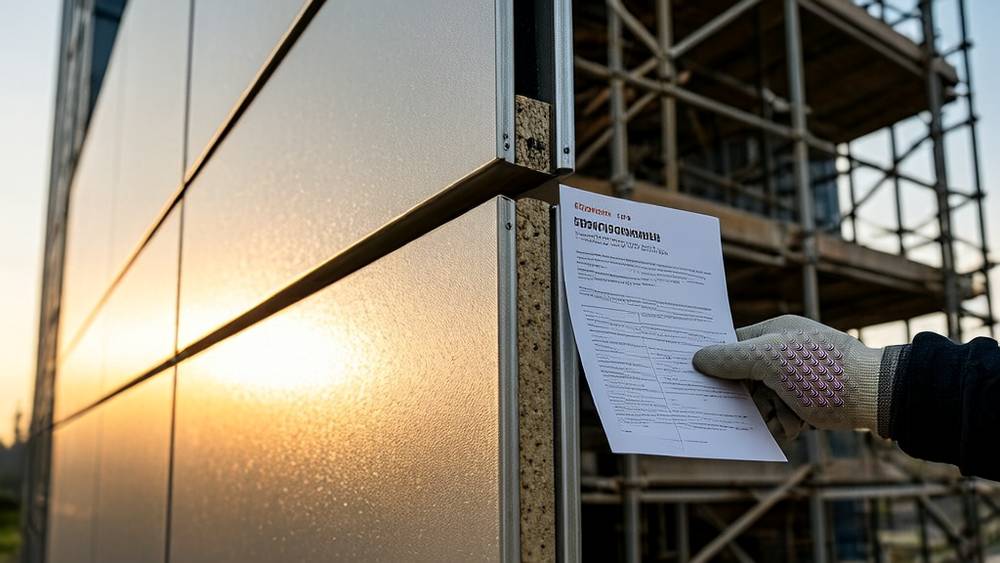
Specifying a bond aluminium composite panel system for a high-rise facade means confronting one question before all others: how does the assembly perform when fire conditions push temperatures past 660°C, the point at which aluminium begins to lose structural integrity? The 2017 Grenfell Tower fire rewrote global procurement checklists overnight. Since then, fire-rated core classifications have become the single most scrutinised line item in project specifications across the Middle East, Europe, Southeast Asia, and increasingly North America. Yet confusion persists. Terms like "FR," "A2," and "non-combustible" get thrown around interchangeably on tender documents, often without the specifier understanding which test standard backs each claim. This article unpacks what actually separates an A2-rated bond aluminium composite panel from a standard FR product, how EN 13501-1 and ASTM E84 map against each other, and what procurement teams should verify before signing off on a facade package.
Why Fire Core Classification Now Dominates Facade Procurement
Before 2017, fire performance for a bond aluminium composite panel was often treated as a secondary checkbox. The primary conversation revolved around flatness tolerances, PVDF colour consistency, and panel dimensions. That hierarchy has inverted. Building codes across the Gulf Cooperation Council countries now mandate non-combustible cladding on structures exceeding 15 metres. The UK's Approved Document B effectively prohibits combustible materials in the external walls of relevant buildings over 18 metres. Australia's National Construction Code introduced similar restrictions following the Lacrosse building fire in Melbourne.
The practical result: a bond aluminium composite panel that carries an A2-s1,d0 classification under EN 13501-1 can be specified on virtually any project globally. An FR-rated panel carrying only a B-s1,d0 or lower classification faces an increasingly narrow band of permissible applications, typically limited to low-rise commercial, signage, or interior work where local codes allow. For procurement managers, this means the upfront material cost difference, roughly 35-50% more for A2-grade panels, must be weighed against the risk of a specification rejection during technical submittal review.
The Core Is the Product: Mineral-Filled vs FR Polymeric Cores
What separates an A2 bond aluminium composite panel from an FR panel is not the aluminium skins. Both use 0.5 mm alloy sheets, typically 3003, 3005, or 5005 series, coil-coated with PVDF or FEVE systems. The distinction lives entirely in the core material.
Standard FR panels use a polyethylene core loaded with mineral fillers, typically aluminium trihydroxide or magnesium hydroxide, at 60-70% by mass. When exposed to flame, the filler releases water vapour through an endothermic reaction, absorbing heat and slowing combustion. But the polyethylene matrix still burns. Under EN 13501-1 testing, these panels typically achieve B-s1,d0 or C-s1,d0 classifications, meaning limited combustibility but not non-combustibility.
A2-rated panels eliminate the polyethylene entirely. The core becomes a mineral-dominated compound where the polymer binder functions solely as a processing aid, typically below 5-8% of total core mass. ALUCOBOND A2, manufactured by 3A Composites, uses a mineral-filled core with less than 10% organic content. Buildbond from Alubuild employs a non-combustible thermoplastic and mineral material blend. Alcobond's A2 range, produced in Dubai, achieves the classification through a proprietary mineral formulation tested to EN 13501-1 parameters. The fire test result for these panels is unambiguous: they do not contribute to flame spread or produce burning droplets under the Single Burning Item test.
EN 13501-1 vs ASTM E84: Reading Across Two Testing Regimes
One of the most frequent mistakes in international procurement is assuming equivalency between European and North American fire classifications. They measure fundamentally different things.
EN 13501-1 classifies construction products into seven Euroclasses: A1, A2, B, C, D, E, and F. The classification for a bond aluminium composite panel derives from multiple test methods: the EN ISO 1182 non-combustibility furnace test, EN ISO 1716 bomb calorimeter for gross heat of combustion, and EN 13823 Single Burning Item test for flame spread and smoke production. The suffix designations s1, s2, s3 cover smoke emission, while d0, d1, d2 cover flaming droplet production.
ASTM E84, the North American Steiner tunnel test, generates two indices: Flame Spread Index and Smoke Developed Index. A Class A rating requires FSI ≤ 25 and SDI ≤ 450. The critical gap: ASTM E84 does not measure heat of combustion or material composition directly. A panel can achieve Class A by incorporating enough fire retardant into a combustible core to slow flame propagation along the tunnel's horizontal surface, while the same panel might fail EN 13501-1's more demanding single burning item and calorimetric tests.
The following table summarises the key distinctions that procurement teams should understand when evaluating fire test data:
| Parameter | EN 13501-1 (Europe/Middle East/Asia) | ASTM E84 (North America) | What It Means for Procurement |
|---|---|---|---|
| Core test method | EN 13823 SBI + EN ISO 1182 + EN ISO 1716 | ASTM E84 Steiner Tunnel | EN tests material composition; ASTM tests surface flame spread only |
| Key metric | Euroclass A1-F, smoke (s1-s3), droplets (d0-d2) | Flame Spread Index (0-200+), Smoke Developed Index | A2-s1,d0 has no direct ASTM equivalent; Class A ≠ A2 |
| Non-combustible threshold | A2-s1,d0 minimum (mineral core required) | No regulatory definition tied to E84 alone | Projects requiring non-combustible must reference EN or ISO 1182 |
| Gross heat of combustion | EN ISO 1716: ≤3 MJ/kg for A2 | Not measured | This is the definitive differentiator; FR cores typically exceed 15 MJ/kg |
| Flaming droplets | d0 = no droplets within 600s | Not systematically measured | Critical for vertical facades where molten polymer can spread fire downward |
| Typical ACP classification | FR: B-s1,d0 or C-s1,d0; A2: A2-s1,d0 | FR: Class A; A2: Class A (but compositionally different) | Request both EN and ASTM reports when specifying across jurisdictions |
What "A2" Actually Requires: The 3 MJ/kg Threshold
To earn an A2 classification under EN 13501-1, a bond aluminium composite panel must clear a specific set of hurdles. The EN ISO 1716 bomb calorimeter test measures gross heat of combustion. For an A2 product, the core material must not exceed 3.0 MJ/kg. By comparison, a standard FR polyethylene core typically measures 15-25 MJ/kg. A pure polyethylene core without fire retardant can reach 43-46 MJ/kg.
The EN ISO 1182 furnace test runs at 750°C for 30 minutes. The sample mass loss must not exceed 50%, and the sustained flaming time after exposure must be under 20 seconds. A mineral-filled A2 core will typically lose under 30% mass in this test, with zero sustained flaming. The aluminium skins will melt at 660°C, but the mineral core remains dimensionally stable, preventing the panel from collapsing into the fire zone.
For specifiers, the practical implication is clear: when a project's fire strategy requires non-combustible cladding, only panels with independently verified A2-s1,d0 or A1 classification will satisfy the authority having jurisdiction. Request the full classification report, not just a certificate summary. Verify that the testing laboratory holds ISO 17025 accreditation. Check that the tested panel construction, including coating type and thickness, matches the product being supplied.
Manufacturing Capacity and Global Supply Chains
The shift toward A2-rated bond aluminium composite panel products has reshaped manufacturing geography. Production of mineral-filled A2 cores requires dedicated compounding lines separate from FR polyethylene extrusion. This capital investment, often exceeding USD 5 million for a single line, creates a meaningful barrier to entry.
Alubond, operating from facilities in the UAE, Oman, Serbia, India, and Turkey, claims a combined manufacturing and processing capacity of 25 million square metres annually across its ACP and MCM range. Alcobond, manufactured in Dubai, exports A2 and FR panels to over 20 countries. 3A Composites produces ALUCOBOND A2 in Germany and the United States. Buildbond, from Alubuild, uses 5005, 3005, 3105, and 5754 alloy cover sheets with its non-combustible thermoplastic and mineral core.
For procurement managers, the supply chain question is not simply who makes the product, but who can deliver it on time with consistent quality across multiple batches. A single high-rise tower can consume 15,000 to 30,000 square metres of cladding. Lead times for A2 panels from European mills can extend to 14-18 weeks during peak construction seasons. Regional manufacturers in the Gulf and Asia often offer shorter lead times of 6-10 weeks, though specifiers should verify that the fire test certification aligns with the project's jurisdiction. Brands like Futeng® have developed manufacturing protocols that maintain batch-to-batch consistency on mineral core density and coating adhesion, parameters that directly affect both fire performance and long-term facade durability.
Three Questions Every Procurement Team Should Ask
Based on a decade of reviewing technical submittals for commercial facade projects, the following three questions separate a properly vetted bond aluminium composite panel specification from one that carries undisclosed risk:
1. "Show me the EN ISO 1716 bomb calorimeter result for this specific product, not a generic product in the range." Manufacturers sometimes certify one core formulation but offer multiple. The 3 MJ/kg threshold for A2 is absolute. A result of 3.2 MJ/kg means the product is not A2, regardless of what the marketing literature says. Ask for the test report number and verify it against the notified body's database.
2. "Which notified body issued the classification report, and does it cover the full panel assembly?" A2 classification must come from an EU notified body or equivalent accredited laboratory recognised by the local authority. Reports covering only the core material, without the aluminium skins and coating, are incomplete. The panel's fire behaviour changes when the aluminium reflects heat back into the core during the SBI test.
3. "What is the organic content of the core by mass, and how do you control it batch to batch?" This question often reveals more than the classification report alone. A2 cores should maintain organic content below 10%, ideally below 8%. Manufacturers with robust quality systems can provide statistical process control data showing core density and organic content across production batches. If the answer is vague, the product may sit on the borderline of the A2 threshold, where minor production variations could push a batch into B classification territory.
Installation Does Not Change the Core, But It Can Compromise the System
An A2 bond aluminium composite panel is only one component in a facade assembly. The fire classification of the complete system depends equally on the framing, insulation, fixings, and perimeter fire stopping. A panel achieving A2-s1,d0 can be undermined by combustible insulation behind it, or by a cassette fixing system that creates an uninterrupted vertical cavity, effectively turning the rainscreen into a chimney.
The relevant system-level fire test for rainscreen facades is BS 8414 in the UK, or NFPA 285 in North America. BS 8414 tests a full-scale facade mockup with the complete assembly. Passing this test requires coordination between the panel supplier, the framing system manufacturer, and the insulation provider. No single component guarantees system-level compliance.
Specifiers should require that the panel manufacturer provides a system compatibility statement confirming that the bond aluminium composite panel has been tested as part of a specific rainscreen system achieving the required fire classification. This statement should reference the test report number and the exact configuration tested, including cavity width, insulation type and thickness, and fixing method.
Fire classifications apply to products and systems as tested. Any deviation from the tested configuration, including a change in insulation or cavity dimension, requires re-evaluation. This principle is embedded in EN 13501-1 and the associated extended application standards.
Cost, Code Compliance, and the Long View
The price differential between an FR and an A2 bond aluminium composite panel has narrowed over the past five years, driven by production scale and competition. Where A2 panels once commanded a 60-80% premium over FR equivalents, the gap today sits closer to 35-50% depending on volume, colour, and lead time. For a 20,000-square-metre facade, this translates to an additional USD 200,000-400,000 on the cladding line item.
Set against the total project cost of a high-rise, this is a modest sum. The alternative, specifying an FR panel and having it rejected at the building control stage, carries costs that extend far beyond material substitution. Programme delays, redesign fees, and in the worst case, remediation of installed panels, can multiply the initial saving many times over.
The direction of building codes is unambiguous. The International Building Code's 2024 edition is expected to tighten restrictions on combustible materials in external wall assemblies for buildings over 12 metres. The Gulf region's civil defence authorities continue to raise the bar on facade fire performance, with the UAE Fire and Life Safety Code now referencing EN 13501-1 classifications directly. Specifying an A2-rated bond aluminium composite panel today is not just about compliance with current codes; it is about anticipating where codes will be when the project reaches practical completion two or three years from now.
The fire core debate within the aluminium composite panel industry has moved beyond whether non-combustible products are necessary. The evidence from facade fire incidents across multiple continents has settled that question. The conversation now centres on verification: how to confirm that the A2 classification on paper reflects the product on the truck. The three questions outlined above, combined with a clear understanding of what EN ISO 1716 and EN 13823 actually measure, give procurement teams the tools to make that determination with confidence.