42 mm Thermal Movement Why Aluminum Privacy Screen Fastener Choice Dictates Panel Flatness
When a project team specifies an aluminum privacy screen, the conversation almost always starts with pattern, color, and percentage of openness. That makes sense at the schematic design stage. But once fabrication drawings land on the desk of a curtain wall contractor or a cladding subcontractor, the discussion shifts to something far less visible: the fastening method. Exposed fasteners versus concealed clip systems represent two fundamentally different engineering philosophies, and the choice between them cascades into everything from panel flatness tolerances to long-term maintenance liabilities. Getting this decision wrong on a 200-linear-meter balcony screen or a multi-story parking garage facade means callbacks, oil canning complaints, and fasteners that telegraph through the powder coat within 18 months. This article examines the structural, thermal, and aesthetic trade-offs between these two attachment approaches for solid aluminum privacy screen systems, drawing on real fabrication constraints and specifier expectations across commercial and institutional projects.
Why Fastener Selection Dictates Panel Engineering Before Pattern Design
Most architects approach an aluminum privacy screen as a visual element first. They select perforation ratios, slat spacing, or laser-cut motifs based on sightline studies and renderings. The contractor receiving those drawings immediately asks a different question: how does each panel attach to its subframe? The answer determines whether the screen can be installed from the front or must be accessed from behind, whether thermal movement can occur independently at each connection point, and whether the panel edges will remain flat after three summers of solar cycling.
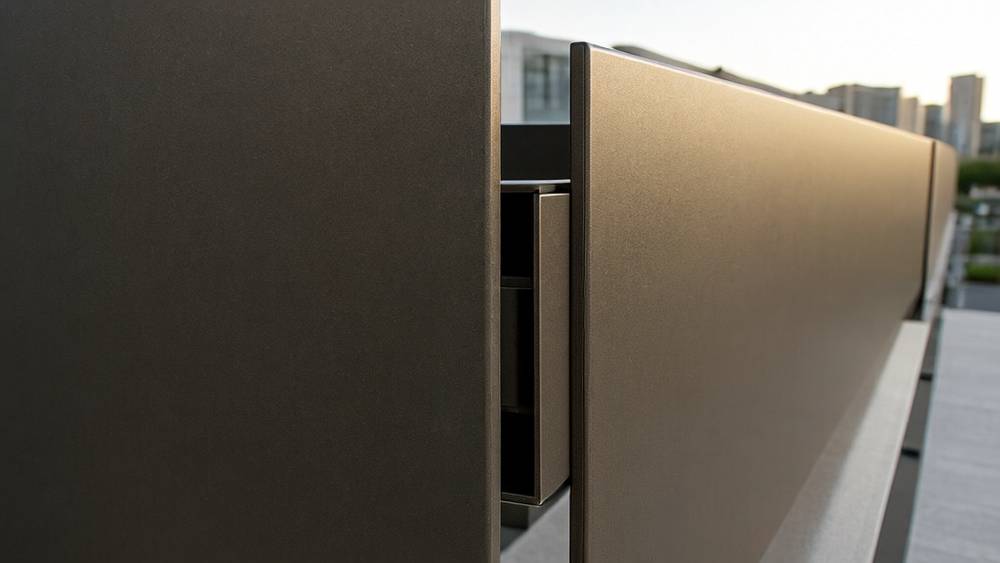
Exposed fastener systems use stainless steel screws with finished heads that pass through pre-drilled holes in the aluminum privacy screen panel and thread into steel or aluminum sub-girts. The fastener head sits proud of the panel face or in a countersunk recess. Concealed clip systems use interlocking aluminum extrusions—a male clip shop-attached to the back of the panel and a female receiver field-attached to the subframe. The panel snaps or hooks into place with zero visible fasteners from the exterior.
The structural implications diverge immediately. An exposed fastener creates a fixed point. A concealed clip, properly engineered, creates a sliding connection that accommodates differential thermal expansion between the aluminum privacy screen panel and its steel substrate. On a 3-meter-tall panel subjected to a 60°C surface temperature swing, the difference between restrained and unrestrained expansion is approximately 4.2 mm. That number comes from straightforward math: 6061-T6 aluminum expands at 23.4 × 10⁻⁶ per °C. Over 3,000 mm with a 60°C delta, the panel wants to grow by 4.2 mm. If fasteners restrain that movement, stress concentrates at each connection. If clips allow it, the panel breathes.
Exposed Fastener Systems: When Direct Fixing Makes Engineering Sense
Exposed fasteners remain the dominant method for aluminum privacy screen installations in North American commercial work, and not simply because they cost less upfront. There are legitimate engineering contexts where a positive mechanical lock at each connection point provides advantages that no clip system can replicate.
Wind Load Transfer and Positive Connection
A stainless steel TEK screw or structural rivet through a solid aluminum panel into a steel tube creates a demonstrable load path. The connection can be calculated, tested, and verified. For aluminum privacy screen panels installed on high-rise balconies where wind suction pressures exceed 2.0 kPa, the certainty of a screwed connection often satisfies the reviewing structural engineer faster than a clip system requiring manufacturer-specific test data.
The trade-off appears in panel flatness. Every fastener creates a local stress riser. When the aluminum privacy screen panel expands under solar gain but cannot move because screws hold it rigidly at six or eight points, the panel compensates by bowing between fasteners. This is the primary cause of oil canning in screwed aluminum panels—a waviness that becomes painfully visible under low-angle morning or late afternoon light. Specifiers who demand perfectly flat panels but also require exposed fasteners are asking for mutually exclusive outcomes unless they accept thicker material, typically 3.0 mm minimum for panels over 1,200 mm in any dimension.
Thickness Requirements for Screwed Panels
Panel gauge selection ties directly to fastening method. An aluminum privacy screen panel held by screws at 600 mm centers needs sufficient bending stiffness to resist wind loads between connection points without permanent deformation. The industry rule of thumb, validated by countless shop drawing reviews, is straightforward:
- 2.0 mm solid aluminum: suitable for screw-fixed panels up to 600 mm × 1,200 mm with supports on all four edges
- 2.5 mm solid aluminum: suitable for screw-fixed panels up to 900 mm × 1,800 mm, recommended where flatness tolerance is ±2 mm over 1,000 mm
- 3.0 mm solid aluminum: minimum for exposed fastener panels exceeding 1,200 mm in the short dimension, or any panel where the specifier demands zero visible oil canning under raking light
These numbers assume 5052-H32 or 6061-T6 alloy, which are the two most common tempers specified for architectural aluminum privacy screen applications. 5052 offers superior formability for bent panel edges. 6061 provides higher yield strength for flat panels that must span longer distances between fasteners.
Concealed Clip Systems: The Engineering Behind the Clean Face
Concealed clip technology migrated from rainscreen cladding into the aluminum privacy screen market roughly a decade ago, driven by specifiers who wanted the same flush aesthetic on decorative screens that they were achieving on building facades. The mechanical principle is deceptively simple but requires more sophisticated extrusion design and tighter fabrication tolerances than exposed fastener work.
How Aluminum Clip Systems Manage Thermal Movement
A properly designed concealed clip system for aluminum privacy screen panels consists of two interlocking profiles extruded from 6063-T6 aluminum. The panel-side clip (male) is fastened to the back of the screen panel using stainless steel blind rivets or structural adhesive during shop fabrication. The substrate-side receiver (female) bolts to the steel or aluminum subframe in the field. When the panel is offered up, the male clip engages the female receiver with an audible click or a gravity-assisted hook, depending on the system.
The critical engineering detail is the slip plane. Unlike a screw that clamps the panel rigidly to the substrate, a concealed clip allows the panel to float in one or two axes. Most systems fix the panel at one "dead" clip (typically center or bottom center) and allow all other clips to slide. This accommodates the 4.2 mm of thermal movement calculated earlier without introducing stress into the panel face.
The cost of this engineering sophistication is a thicker build-up from the structural face to the panel face. A typical concealed clip system adds 25 mm to 40 mm of depth behind the aluminum privacy screen, compared to 3 mm to 6 mm for a direct screw connection. On projects where the screen mounts to an existing wall with limited clearance—retrofit parking garage screens, for instance—this depth penalty can rule out concealed clips entirely.
Tolerance Stacking and Fabrication Precision
Concealed clip systems demand tighter shop tolerances than exposed fastener work. The male and female extrusions must engage across the full width of each panel, typically 600 mm to 1,200 mm. If the panel is fabricated 2 mm out of square, the clips will not align with their receivers. If the subframe is installed with ±5 mm variation in plane, some clips will engage while others hover 3 mm short of their receivers—a condition that field crews discover only after the panel is lifted into position.
Experienced aluminum privacy screen fabricators account for this by building adjustability into the receiver side. Slotted holes, shim packs, and laser-scanned as-built surveys of the substrate all become part of the quality control workflow. These steps add labor cost but eliminate the field modifications that erode margin on clip-system projects.
Comparative Cost Analysis: Not Just Material, But Labor and Callback Risk
The upfront material cost comparison between exposed fastener and concealed clip aluminum privacy screen systems tells only part of the story. A more useful analysis for the procurement manager or estimator examines total installed cost, including the subframe, fasteners, field labor, and the probabilistic cost of post-installation remediation.
| Cost Element | Exposed Fastener System (2.5 mm 5052-H32) | Concealed Clip System (2.5 mm 5052-H32) |
|---|---|---|
| Panel fabrication (material + cutting + bending + powder coat) | $85–$110 per m² | $90–$120 per m² |
| Clip extrusions and shop attachment | Not applicable | $35–$55 per m² |
| Stainless steel fasteners (TEK screws or rivets) | $4–$8 per m² | $2–$4 per m² (receiver-to-subframe only) |
| Subframe (aluminum tube or steel angle, 600 mm grid) | $30–$50 per m² | $35–$55 per m² (tighter tolerance required) |
| Field installation labor | $40–$65 per m² | $55–$80 per m² (clip engagement verification) |
| Estimated total installed cost | $159–$233 per m² | $217–$314 per m² |
| Callback risk (oil canning, fastener corrosion, panel distortion) | Moderate to high, especially on south-facing elevations | Low, provided shop fabrication QC is maintained |
These figures represent mid-range commercial pricing for aluminum privacy screen systems on projects of 200 m² or larger in North American markets as of 2025. Smaller projects, custom patterns, and coastal-zone coating requirements (AAMA 2605 rather than AAMA 2604) push costs toward the higher end of each range.
The callback risk row deserves particular attention from project managers. A concealed clip system that costs $60 per m² more upfront but eliminates the need to replace oil-canned panels two years after substantial completion may deliver lower total cost of ownership. Conversely, an exposed fastener system on a north-facing elevation in a mild climate may perform perfectly adequately for the design life of the building, making the clip premium unjustifiable.
Coating Integrity at Fastener Penetrations: The Corrosion Variable
Every hole drilled through a powder-coated or PVDF-finished aluminum privacy screen panel creates a breach in the coating system. The quality of that breach—whether it is a clean cylindrical hole or a ragged puncture with micro-cracks radiating into the coating—determines whether corrosion initiates at the fastener within the first wet-dry cycle.
Exposed fastener systems concentrate this risk at every screw location. A quality fabricator will pre-drill holes to diameter before coating, then apply a touch-up pen or two-part repair coating to the hole ID after installation. The reality on many job sites is that installers drive self-drilling TEK screws through finished panels without pre-drilling, tearing the coating and embedding metal shavings between the screw head and the panel face. Within 12 to 24 months, filiform corrosion creeps outward from the fastener head, visible as white tendrils under the powder coat on dark-colored aluminum privacy screen panels.
Concealed clip systems eliminate fastener penetrations through the visible face of the panel entirely. Shop-applied clips are riveted to the back surface, which is not visible after installation. The field-installed receivers bolt to the subframe, not to the panel. The panel face remains an unbroken coating membrane. For aluminum privacy screen installations within 5 km of saltwater coastlines, this single advantage often tips the engineering decision toward concealed clips regardless of cost, because the alternative is a documented pattern of fastener-driven coating failures in marine environments.
The coating specification itself interacts with the fastening decision. AAMA 2605-compliant PVDF coatings (minimum 30 microns total dry film thickness, 70% PVDF resin in the color coat) provide superior barrier protection compared to AAMA 2604-compliant polyester powder coats, but neither specification can compensate for a breached coating at a fastener hole. The relevant standard for evaluating coating performance at fabricated edges and penetrations is AAMA 2605-20, which includes specific requirements for salt spray resistance (4,000 hours minimum) and humidity resistance (4,000 hours minimum) on fabricated test specimens—not just flat panels.
Installation Sequencing and Access: The Field Logistics Nobody Models in BIM
The choice between exposed fasteners and concealed clips determines whether an aluminum privacy screen can be installed from the exterior or requires access to both sides. This seems obvious on paper but creates real logistical consequences that estimators often miss.
Exposed fastener systems install from the front. The installer positions the panel against the subframe, checks alignment, and drives screws from the visible side. This works on existing building retrofits, on occupied balconies where access to the rear is impossible, and on screens mounted close to property lines. One trade, one side, one sequence.
Concealed clip systems typically require installers to set the receiver clips on the subframe first, then offer up the panel and engage the clips. On a typical aluminum privacy screen installation where the subframe is already mounted to the building structure, this means the panel must approach the subframe from the front and then slide or snap into engagement. If the panel is large—say 1,200 mm × 3,000 mm—two installers with suction cups can manage the engagement from one side. But if the clip design requires a downward hooking motion and the panel is installed overhead (soffit screen), the sequence becomes physically awkward and may require a third installer or a temporary support bracket.
For multi-story aluminum privacy screen installations, concealed clip systems introduce a sequencing constraint: panels on level 3 cannot be installed until the subframe and receivers on level 3 are complete, which may require scaffolding or swing-stage access that was demobilized after the subframe was installed. Exposed fastener panels can go up in a single mobilization—subframe, panel, fasteners, done. The general contractor who understands this sequencing difference can structure the schedule and access costs accordingly, rather than discovering the constraint when the cladding sub asks for a scaffold extension.
When to Use Each System: A Decision Framework for Specifiers and Contractors
No single fastening method suits every aluminum privacy screen project. The decision matrix below synthesizes the engineering, cost, and logistical factors discussed above into a practical selection guide.
Choose Exposed Fasteners When:
- The aluminum privacy screen mounts to an existing structure with limited rear access
- Panel dimensions are modest (under 900 mm × 1,800 mm) and 2.5 mm or 3.0 mm material can be specified
- The elevation faces north or is shaded, minimizing solar-driven thermal cycling
- The project budget cannot absorb the 30% to 40% premium for concealed clip systems
- The specifier accepts that fasteners will be visible and selects fastener finishes (powder-coated heads, color-matched washers) as a deliberate design element rather than a compromise
- Panels must be individually removable for access to building services behind the screen
Choose Concealed Clips When:
- The aluminum privacy screen is a high-visibility architectural feature where fastener heads would undermine the design intent
- The installation is within 5 km of a marine coastline, where fastener penetrations carry elevated corrosion risk
- Panel dimensions exceed 1,200 mm in either direction and thermal movement must be accommodated
- The specifier demands a flatness tolerance tighter than ±2 mm over 1,000 mm under raking light conditions
- The building owner has experienced oil canning failures on previous projects and is unwilling to accept the risk
- The project schedule and access plan can accommodate the two-stage installation sequence
Quality Assurance: Shop Drawings, Mock-Ups, and the First Panel Inspection
Regardless of which fastening method a project team selects, the quality assurance protocol should include three specific checkpoints that catch the majority of aluminum privacy screen installation defects before they propagate across the entire elevation.
Shop drawing review: The fabricator's shop drawings must indicate every fastener or clip location, the panel joint dimension (typically 6 mm to 10 mm for thermal movement), and the dead-clip/fixed-point location for concealed clip systems. A drawing that shows panels butted tight with no joint dimension is a red flag that thermal movement has not been considered.
On-site mock-up: A minimum two-panel-by-two-panel mock-up, installed on the actual subframe by the actual installation crew, reveals tolerance issues that shop drawings cannot. For concealed clip systems, the mock-up should remain in place for at least 48 hours and be inspected under morning and afternoon light conditions. For exposed fastener systems, a sample fastener installation through a finished panel, sectioned and examined for coating damage at the hole, provides objective data on whether pre-drilling is necessary.
First panel inspection: After the first 10% of panels are installed, the project architect or cladding consultant should inspect panel flatness, joint alignment, and fastener or clip engagement. Any systemic issues—misaligned receivers, over-driven fasteners, panels that bow between clips—will be evident at this stage and can be corrected before the remaining 90% of panels are in place.
Futeng® has supplied solid aluminum privacy screen panels to projects specifying both exposed fastener and concealed clip systems across Southeast Asia and the Middle East. The consistent feedback from contractors on those projects reinforces a simple principle: the fastening method must be locked in before pattern design begins, not retrofitted after the shop drawing phase. Panels engineered for concealed clips have different edge details, different stiffener layouts, and different coating requirements at attachment points compared to panels designed for exposed fasteners. Changing the fastening method mid-stream means re-engineering the panel, and that re-engineering cost always exceeds the cost of making the right decision at the schematic design stage.
The aluminum privacy screen market continues to expand as architects specify decorative screening for parking structures, balcony enclosures, mechanical equipment screens, and facade over-cladding. Within that growing market, the exposed-versus-concealed fastening decision remains the single most consequential engineering choice—more impactful than perforation pattern, more impactful than coating chemistry, and more directly linked to long-term owner satisfaction. Project teams that treat this decision as an early-stage engineering question rather than a last-minute procurement detail will deliver aluminum privacy screen installations that look as clean on day 1,825 as they did on day one.