How Solid Aluminum Wall Cladding Panel Oil Canning Escapes ASTM E330 and What Stops It
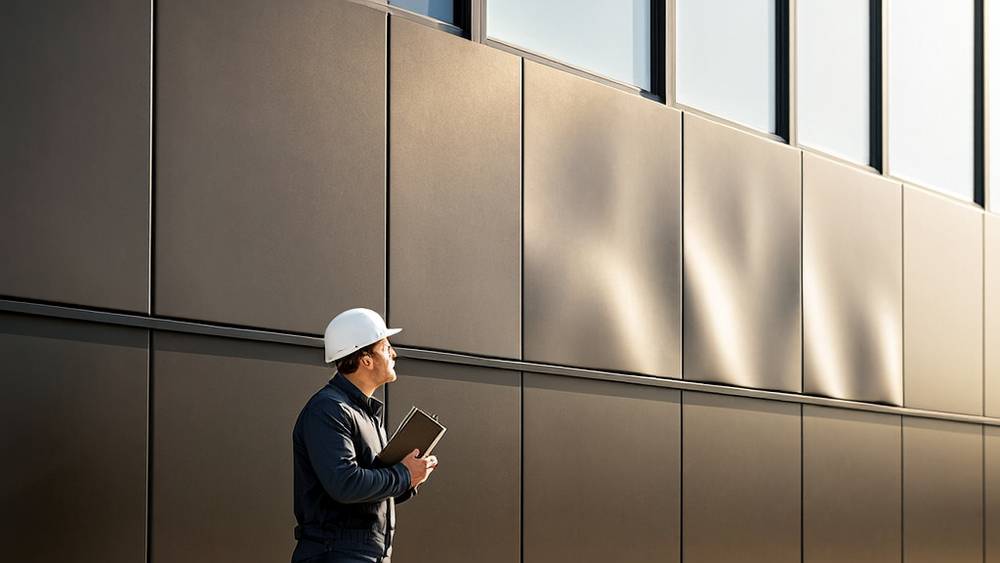
When a building envelope consultant signs off on a rainscreen facade, the assumption is that every aluminum wall cladding panel on that elevation will sit flat, reflect light evenly, and hold its line across a 3-meter span. But six months after handover, the morning sun hits the south elevation and reveals a rippled, distorted surface that was invisible under overcast installation conditions. This is oil canning, and it remains the single most litigated visual defect in solid aluminium cladding. Unlike structural failure, oil canning does not breach the warranty on material integrity. The metal is intact. The fasteners are sound. Yet the owner sees a wavy facade and demands remediation, and the contractor is caught between a fabricator who says "the panel meets flatness tolerances" and an architect who says "this is not what the mock-up showed."
This article does not attempt to cover every aspect of aluminium cladding specification. Instead, it focuses on one narrow, costly problem: how to predict, prevent, and respond to oil canning in a solid aluminum wall cladding panel. The discussion is built around ASTM E330/E330M structural load testing, the practical limits of allowable flatness deviation per AAMA 609.1, and the manufacturing decisions that separate a panel that stays optically flat from one that distorts the first time the temperature climbs 20°C. For project stakeholders specifying rainscreen systems, understanding these variables before the shop drawing phase can mean the difference between a facade that photographs well at practical completion and one that photographs poorly every morning for the next 30 years.
What Oil Canning Actually Is in a Solid Aluminium Panel
Oil canning describes a visible waviness or buckling across the flat plane of a metal panel. The name comes from the way an old steel oil can would pop in and out when pressed. In a solid aluminum wall cladding panel, the distortion typically appears as a regular pattern of shallow ripples spanning between stiffener attachment points or along unsupported edges. The amplitude is usually less than 2 mm, measured from peak to trough, but because the panels are often installed with narrow shadow gaps that create crisp, straight lines as visual reference, even a 1 mm deviation becomes optically obvious under glancing light.
The root mechanism is elastic buckling induced by residual stress. When aluminium sheet is rolled at the mill, cold-worked during fabrication (routing, folding, perforating), and then thermally cycled on a building facade, internal stresses that were locked into the material during production can release unevenly. The panel seeks a lower-energy equilibrium state, and that state often involves a slight out-of-plane deformation. The phenomenon is not unique to aluminium; it affects steel, zinc, and copper cladding as well. But aluminium's relatively high coefficient of thermal expansion (approximately 23.6 × 10⁻⁶ /°C for 3003-H14 alloy commonly used in solid cladding) means a 50°C surface temperature swing, easily achievable on a dark-colored facade in a continental climate, produces enough thermal strain to trigger buckling in panels that were fabricated near the limit of acceptable internal stress.
Crucially, oil canning is classified as an aesthetic defect, not a structural one. ASTM E330, which governs structural performance of exterior windows, curtain walls, and cladding under uniform static air pressure, does not define pass/fail criteria for visual flatness. A panel can pass every structural load test and still exhibit oil canning. This regulatory gap is what makes the problem so contentious: the contractor points to the test report, the architect points to the facade, and neither document resolves the other.
The Flatness Standards That Do and Do Not Apply
Specifiers looking for a hard number to insert into a performance specification often reach for AAMA 609.1, "Voluntary Specification for Flatness Tolerances of Architectural Aluminum Panels." This document defines allowable deviation from a true plane based on panel dimension and measurement method. For a 1200 mm × 2400 mm solid aluminum wall cladding panel measured with a straightedge placed diagonally, the typical allowable out-of-flatness under AAMA 609.1 is in the range of 0.4% to 0.5% of the diagonal length. For that panel size, the diagonal is approximately 2683 mm, yielding an allowable deviation of roughly 10.7 to 13.4 mm.
That number surprises many architects. A 10 mm wave across a rainscreen panel is visibly obvious, and no project team would accept it. What this reveals is that AAMA 609.1 sets a manufacturing tolerance for the panel as it leaves the fabricator's facility, measured under controlled conditions with the panel lying unrestrained on a flat surface. It does not predict installed appearance under thermal load, and it does not account for the stiffener layout, the restraint conditions at the panel edges, or the cumulative effect of adjacent panels reflecting light in different planes.
For this reason, experienced facade engineers supplement AAMA 609.1 with project-specific mock-up evaluation criteria. A common practice is to require that no oil canning be visible when the installed mock-up is viewed from a distance of 6 meters at an angle of incidence of 45 degrees or less, under both diffuse overcast and direct sunlight conditions. This is a visual standard, not a dimensional one, and it puts the burden of proof on the fabricator and installer to demonstrate that their system performs rather than merely meeting a table of numbers.
| Standard / Criteria | What It Governs | Relevance to Oil Canning | Typical Allowable Deviation (1200×2400 mm Panel) |
|---|---|---|---|
| AAMA 609.1 | Manufacturing flatness of panel as delivered | Baseline quality control; does not predict installed behavior | 10.7–13.4 mm (diagonal measurement) |
| ASTM E330 | Structural performance under uniform static air pressure | Confirms panel does not fail structurally; no flatness pass/fail | N/A for visual flatness |
| EN 13166 (reference for thermal insulation) | Not directly applicable to panel flatness | Referenced in rainscreen system design for dew-point analysis | N/A |
| Project-Specific Mock-Up Visual Criteria | Installed appearance under defined viewing conditions | Most practically useful; requires documented agreement pre-fabrication | No visible waviness at 6 m, 45° incidence |
Panel Geometry and the Stiffener Decision
The single largest manufacturing variable that determines whether a solid aluminum wall cladding panel will oil can is the stiffener layout. Stiffeners are aluminium extrusions or formed profiles bonded or mechanically attached to the rear face of the panel. Their job is to increase the panel's bending stiffness and break up the unsupported span into smaller rectangles that resist buckling.
The relationship between stiffener spacing and oil canning resistance is not linear. Reducing stiffener spacing from 600 mm to 400 mm roughly doubles the critical buckling load, but it also adds fabrication cost, panel weight, and thermal bridging through the stiffener attachment points. A panel with 3 mm thickness and stiffeners at 500 mm centers may perform identically to a 2.5 mm panel with stiffeners at 350 mm centers, depending on alloy temper and the method of stiffener attachment.
Two attachment methods dominate: structural silicone bonding and mechanical clip systems. Silicone-bonded stiffeners create a continuous shear connection that distributes stress smoothly and tends to produce a panel with fewer local stress concentrations. The trade-off is cure time and the need for controlled shop conditions. Mechanical clip stiffeners allow faster production but introduce point loads at each clip location, which can become initiation points for oil canning if the clip spacing is too coarse or the panel is under residual compressive stress from the forming process.
For panels exceeding 1500 mm in the long dimension, Futeng® and other manufacturers with dedicated stiffener engineering capability typically recommend a finite element analysis (FEA) of the panel assembly under combined thermal and wind loads rather than relying on span-to-thickness rules of thumb. The FEA output identifies stress concentrations around stiffener terminations and fold lines that simple span tables miss. A panel that passes a uniform-load span table can still buckle at 40% of the predicted load if the stiffener does not extend close enough to a folded return edge.
Alloy Selection and the Temper Question
Most solid aluminium cladding panels are produced from 3003 or 5052 alloy sheet. The choice between them involves a trade-off between formability, corrosion resistance, and the residual stress profile after fabrication.
Alloy 3003-H14 is the workhorse of the architectural cladding industry. It offers good formability for routing and folding operations, excellent corrosion resistance in most atmospheric environments, and a moderate yield strength of approximately 145 MPa. Its relatively low yield strength means it can be cold-worked into complex panel geometries without excessive springback. However, that same low yield strength also means the material enters the plastic deformation regime at lower stress levels, making it more susceptible to permanent set when thermally cycled under restraint.
Alloy 5052-H32 has a higher magnesium content and a yield strength around 193 MPa. It resists oil canning better than 3003 because it stays elastic under higher stress. The downside is that 5052 is harder on tooling, more prone to cracking at tight fold radii, and typically 10-15% more expensive per kilogram. For large flat panels with minimal folding, 5052 is often the technically superior choice. For panels with complex return legs, perforation patterns, or deep drawn features, 3003 may be the only practical option, and the specifier should compensate with a denser stiffener grid.
A third option, less common but worth mentioning, is 5005-H14 or H34, which splits the difference in strength and formability and is frequently used for anodized finishes where alloy chemistry affects color consistency. The key point for the specifier is that alloy and temper should be specified explicitly in the panel performance specification. A fabricator quoting "aluminium sheet" without an alloy designation is likely defaulting to whatever is cheapest and most available, and the resulting panels may oil can even if they meet thickness and flatness tolerances on the shop floor.
Thermal Movement and Restraint: The Hidden Driver
A solid aluminum wall cladding panel installed on a rainscreen system is not free-floating. It is mechanically restrained at each fixing point, typically by a rivet, screw, or clip engaging a folded return leg or a rear stiffener rail. As the panel heats up, it wants to expand. If the restraint system prevents free expansion, compressive stress builds in the plane of the panel. When that compressive stress exceeds the critical buckling stress for the panel geometry, the panel buckles out of plane. The deformation is elastic (it may disappear when the panel cools), but if the stress cycles are repeated daily over years, the material can accumulate plastic strain and develop permanent oil canning.
The standard calculation for unrestrained thermal expansion is straightforward: ΔL = α × L × ΔT. For a 3000 mm long 3003 aluminium panel undergoing a 60°C temperature rise, the expected expansion is approximately 4.25 mm. If the fixing system does not accommodate this movement, the panel experiences a compressive strain of roughly 0.14%, which translates to a compressive stress of around 97 MPa in 3003-H14, well within the range where buckling can initiate.
Fixing systems address this through slotted holes, sliding clips, or flexible connections that allow the panel to expand and contract without building up compressive force. The most common approach in rainscreen design is to fix the panel rigidly at one point (the "fixed point") and allow all other connections to slide in the plane of the panel. The sliding connections must be detailed so that they do not bind under the panel's self-weight or under wind suction loads that pull the panel away from the substructure. Binding at a sliding connection effectively turns it into a fixed point, and the panel now has two fixed points, which can double the compressive stress in the segment between them.
Installers who over-torque fasteners at sliding connections are a common root cause of oil canning that was not predicted by the shop drawings. A panel designed with one fixed point and seven sliding points can behave as if it has eight fixed points if every screw is driven tight against the panel. The specification should include installation torque limits or, better, use fixing systems with built-in stand-off that prevent over-compression regardless of installer technique.
Fabrication-Induced Stress: What Happens Before the Panel Leaves the Factory
Oil canning is often blamed on site conditions or thermal cycling, but the seeds of the problem are frequently sown during fabrication. Every operation performed on a flat aluminium sheet introduces residual stress: uncoiling, leveling, shearing, routing, folding, welding of stiffener brackets, and even the mechanical attachment of stiffeners.
Routing V-grooves for folded corners removes material asymmetrically from one face of the sheet, creating a stress imbalance that can bow the panel even before it is installed. The depth of the V-groove relative to the sheet thickness is critical. A groove that leaves a remaining web of 0.3 mm in a 2.5 mm sheet is standard for achieving a tight fold radius, but if the groove depth varies along its length due to tool wear or machine calibration drift, the fold line will have inconsistent stiffness, and the panel may twist.
Welding stiffener brackets to the rear face introduces localized heat that can anneal the H14 temper in the heat-affected zone, creating soft spots that yield under thermal load. For this reason, many high-end fabricators avoid welding on visible-grade panels and use structural adhesive bonding or mechanical clinching instead. When welding is unavoidable, the specification should require post-weld stress relief (typically a low-temperature thermal cycle around 230°C for 3003 alloy) followed by re-flattening, though this adds cost and lead time.
The leveling process itself can be a source of problems. Roller leveling, in which the sheet is passed through a series of offset rollers to flatten it, leaves a characteristic residual stress pattern through the sheet thickness: the surface layers are in compression, the core is in tension. This stress profile is stable as long as the sheet remains flat, but if subsequent operations remove material from one face (routing, engraving, heavy sanding for a brushed finish), the stress balance is disrupted and the panel bows toward the face that lost material.
Testing Protocols That Go Beyond the Standard Report
A standard ASTM E330 test report tells the specifier that a panel assembly can withstand a specified design pressure without permanent deformation exceeding 0.2% of span. That is a structural pass/fail. It says nothing about oil canning at service temperatures.
To evaluate oil canning risk, the project team should consider a supplementary thermal cycling test. A representative panel assembly is mounted on a section of substructure identical to the project design, instrumented with dial indicators or digital image correlation targets, and cycled through a temperature range that represents the expected facade surface temperature extremes for the project location. A common protocol is 20 cycles from -20°C to +80°C, with flatness measured before cycling and after every 5 cycles. Panels that develop progressive oil canning (worsening with each cycle) are likely to be problematic in service, even if they meet the initial flatness specification.
This type of testing is not standardized in a single ASTM or EN document that covers all the relevant variables, so the specifier must write a project-specific test protocol. The cost, typically $3,000 to $8,000 for a single panel assembly including test chamber time and reporting, is small relative to the cost of replacing 500 panels on a completed building. The test should be performed during the shop drawing and mock-up phase, before production quantities are fabricated.
Some manufacturers, including Futeng®, maintain in-house thermal cycling capability and can provide historical data from previous projects with similar panel geometries and finishes, which allows specifiers to benchmark expected performance without commissioning a new test for every project.
Finish Selection and Its Influence on Oil Canning
The coating system on a solid aluminum wall cladding panel affects oil canning in two ways: through its solar absorptance, which determines the panel's peak service temperature, and through its thickness and stiffness, which marginally affects the panel's bending behavior.
Dark colors with high solar absorptance (0.70 or above) produce surface temperatures 20-30°C higher than light colors under the same solar irradiance. A dark bronze PVDF panel in Phoenix, Arizona, can reach 85°C on a summer afternoon, while a light silver panel on the same building might peak at 60°C. All else being equal, the dark panel experiences roughly 50% more thermal strain and is correspondingly more prone to oil canning. This does not mean dark colors should be avoided, but it does mean the stiffener layout and fixing system designed for a light-colored panel may be inadequate for the same panel in a dark color.
PVDF (polyvinylidene fluoride) coatings, typically applied at 25-35 microns dry film thickness for a two-coat system, add negligible bending stiffness to the panel. FEVE (fluoroethylene vinyl ether) coatings are applied at similar thicknesses and have similar mechanical properties. The coating is not a structural element. Specifiers sometimes ask whether a thicker coating helps resist oil canning; the answer is no, the effect is too small to matter. What does matter is that the coating is applied uniformly and cured correctly. Uneven cure can introduce residual stress in the coating layer that, while small, adds to the total stress budget of the panel assembly.
Anodized finishes present a different set of considerations. The anodizing process involves immersion in an acid bath and application of electrical current, which can generate heat and alter the residual stress state of the aluminium substrate. Panels that were flat before anodizing can emerge from the process with a slight bow. Reputable anodizers for architectural work control bath temperature and racking to minimize this effect, but the specifier should require post-anodizing flatness inspection rather than assuming the pre-anodizing flatness is preserved.
When Oil Canning Appears Anyway: Assessment and Remediation
Despite careful specification, some panels on a completed facade may exhibit oil canning. The first step is not to replace panels but to assess the severity against the agreed visual criteria. If the mock-up evaluation criteria (viewing distance, lighting conditions, angle of incidence) were documented in the contract, the assessment is straightforward: does the installed facade meet the standard that the mock-up met? If no criteria were agreed, the parties are left negotiating subjective judgments, which rarely ends well for the contractor.
If oil canning is confirmed to exceed the agreed threshold, remediation options depend on the cause. Panels that oil can due to inadequate stiffener spacing may need additional stiffeners retrofitted from the rear, which is feasible on a rainscreen system if the cavity is accessible. Panels that oil can due to restraint binding can sometimes be corrected by loosening and re-torquing fasteners at sliding connections. Panels that oil can due to inherent residual stress from fabrication generally cannot be corrected in situ and must be replaced.
Replacement panels should be fabricated with the lessons learned from the failure: revised stiffener layout, different alloy or temper, improved quality control on V-groove depth and leveling, and possibly a thermal cycling test before production. The cost of replacement is typically borne by the fabricator if the panels do not meet the specified flatness criteria, or by the contractor if the specification was silent on flatness and the panels meet all stated requirements. This is why a well-drafted performance specification with explicit flatness criteria and a documented mock-up evaluation protocol is the cheapest insurance against oil canning disputes.
For projects currently in design, the practical takeaway is this: an aluminum wall cladding panel specification that addresses only alloy, thickness, finish, and structural load capacity is incomplete. Oil canning is not covered by any of those parameters. It must be addressed directly, through stiffener design, fixing system detailing, fabrication quality control, and pre-production testing that simulates the thermal environment the panels will actually experience. The industry has the tools to prevent most oil canning. What remains is the will to specify for it, and the budget to verify it before the panels go on the truck.