Aluminum Cladding Coatings Compared Using AAMA 2605 Test Data
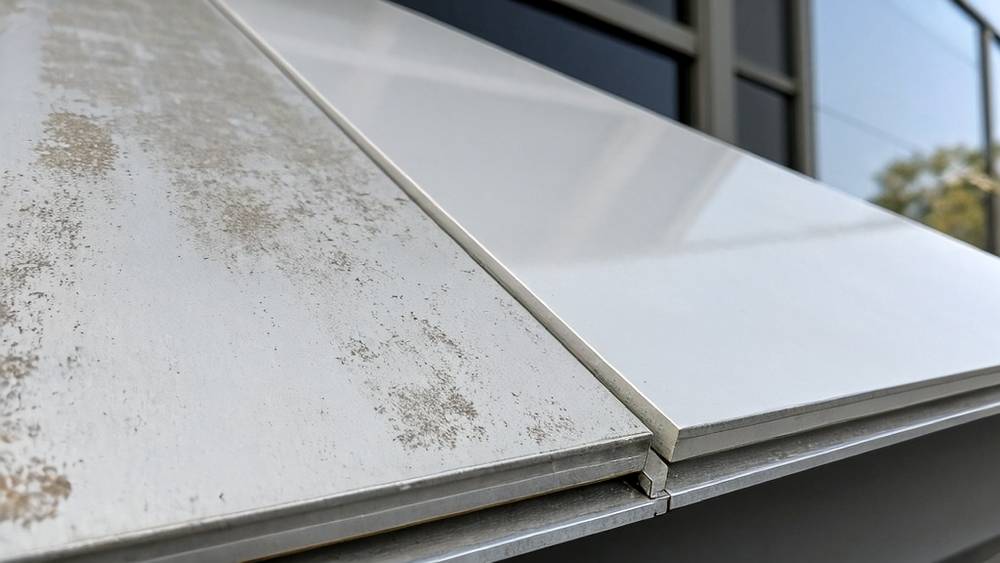
Aluminum solid cladding panels arrive on site looking pristine, but within two years some facades develop a chalky surface that rubs off on your hand. Other buildings keep their original sheen for a decade and beyond. The difference rarely comes down to the aluminum itself. It sits in the coating chemistry, the application process, and a handful of specification decisions that get made long before panels reach the job site.
For general contractors and facade engineers managing multi-million dollar building envelopes, coating degradation on solid aluminum panels is not just cosmetic. Chalking, fading, and delamination trigger warranty claims, occupant complaints, and in coastal or industrial environments, can accelerate substrate corrosion that compromises the panel itself. This article examines the four dominant coating systems for solid aluminum cladding — PVDF fluoropolymer, FEVE fluoropolymer, polyester powder, and anodized finishes — through the lens of real-world performance data, accelerated weathering benchmarks, and application-specific economics.
Why Aluminum Panel Coatings Fail Earlier Than Expected
The aluminum substrate is not the weak link. Solid aluminum sheets in 2.0 mm, 2.5 mm, and 3.0 mm thicknesses carry inherent corrosion resistance from their natural oxide layer. Coating failure almost always traces to three root causes: ultraviolet (UV) radiation breaking down the resin binder, moisture ingress at the coating-substrate interface, and airborne chlorides or industrial acids attacking the film from the outside.
UV energy — specifically in the 290 to 400 nanometer range — is the primary degradation driver. When UV photons strike the coating surface, they break polymer chains in the resin system. This is the mechanism behind chalking: pigment particles lose their binder and sit loose on the surface. ASTM D4214 outlines standard test methods for evaluating this chalking, but specifiers who rely solely on manufacturer datasheets without understanding the underlying resin chemistry often select coatings that cannot meet project lifecycle requirements.
Futeng® has observed in project post-mortems that coating failures cluster in three scenarios: south-facing elevations in subtropical climates (UV overload), panels within 500 meters of breaking surf (chloride attack), and installations where sealant joints failed and allowed water to pond behind the coating film. Each scenario demands a different coating solution, yet many project specifications apply the same finish system across all elevations and exposure conditions.
PVDF Fluoropolymer The 70 Percent Standard With Measurable Limits
Polyvinylidene fluoride (PVDF) coatings dominate the architectural aluminum market, specified on roughly 70% of commercial curtain wall and cladding projects in North America. The resin system typically contains 70% PVDF resin and 30% acrylic resin — a ratio codified in AAMA 2605, the highest performance category for architectural coatings on aluminum.
The 70/30 ratio matters. The PVDF component provides UV resistance; the acrylic component provides pigment wetting and film formation. When manufacturers reduce PVDF content below 70% to cut costs, the coating loses UV durability. A 50/50 blend might look identical at installation but can show measurable gloss reduction within 3 to 5 years on exposed elevations.
AAMA 2605 sets specific performance thresholds: color retention of 5 Delta E units maximum after 10 years Florida exposure, chalk resistance of No. 8 rating (minimum) after 10 years, and gloss retention of 50% minimum after 10 years. These are not theoretical numbers. Florida exposure testing per AAMA 2605 places panels at 45 degrees south-facing in subtropical conditions that deliver roughly 280 kilojoules per square meter of UV annually — roughly double what a vertical facade receives in temperate climates.
For specifiers, the practical takeaway is that AAMA 2605-compliant PVDF on solid aluminum panels delivers a conservative 20-year service life on vertical applications in most climate zones. Coastal installations within 1,000 meters of saltwater should specify AAMA 2605 with an additional salt spray resistance test per ASTM B117, targeting 4,000 hours minimum with no blistering or creepage beyond 2 mm at the scribe.
FEVE Fluoropolymer When PVDF Meets Its Match
Fluoroethylene vinyl ether (FEVE) resins represent the second generation of fluoropolymer coating technology. Unlike PVDF, which requires thermal baking at 230-250°C to form a film, FEVE coatings cure at ambient temperatures. This chemical difference opens application possibilities that PVDF cannot match — including field-applied touch-up and repair with true fluoropolymer chemistry rather than inferior acrylic patch materials.
The performance comparison between PVDF and FEVE generates ongoing debate among specification writers. Independent weathering data from the Japanese Industrial Standards JIS K 5600-7-7 and equivalent ISO 16474-2 protocols suggest that FEVE coatings can match or exceed AAMA 2605 requirements. Some FEVE formulations demonstrate gloss retention above 70% after 4,000 hours of QUV-B accelerated weathering, compared to 50-65% for standard 70% PVDF systems under identical test conditions.
Where FEVE earns its cost premium — typically 15-25% above PVDF — is in chemical resistance. Industrial environments with airborne sulfur dioxide, nitrogen oxides, or hydrochloric acid fumes attack the acrylic component in PVDF coatings. FEVE's fully fluorinated backbone resists these chemicals more effectively. For solid aluminum cladding on pharmaceutical plants, wastewater treatment facilities, or chemical processing buildings, FEVE coatings on 3.0 mm aluminum panels can extend recoating intervals from 15 years to 25 years or more.
The specification language for FEVE should reference AAMA 2605 as a minimum baseline but add project-specific requirements: minimum 50% fluoropolymer resin content by weight (verified by test report), gloss retention above 70% after 3,000 hours accelerated weathering per ASTM G154 Cycle 1, and adhesion above 5B per ASTM D3359 after 2,000 hours salt spray.
Polyester Powder Coatings The Cost Performance Tradeoff
Super durable polyester powder coatings occupy the middle ground between premium fluoropolymers and economy finishes. Formulated with TGIC-free or Primid-based crosslinkers, these systems meet AAMA 2604 standards — the intermediate performance tier requiring 5-year Florida exposure with 5 Delta E color retention and gloss retention above 30%.
The economics are compelling for the right applications. Polyester powder coating on solid aluminum panels typically costs 30-40% less than PVDF liquid coating per square meter. Application is a single-coat electrostatic spray process with oven cure at 180-200°C, eliminating the primer-plus-topcoat steps required for PVDF liquid systems. Production throughput is higher, and the powder overspray can be reclaimed and reused, reducing material waste to under 5%.
However, the performance ceiling is real. AAMA 2604-grade polyester powder on aluminum will show measurable color shift and gloss loss within 8 to 12 years on exposed facades in high-UV regions. The failure mode is progressive: first gloss reduction, then chalking at a rating of 6 or lower per ASTM D4214, and eventually film erosion that exposes the aluminum substrate at sharp edges and corners.
For solid aluminum cladding specifiers, polyester powder is the appropriate choice for interior applications (column covers, lobby panels, elevator cladding), sheltered exterior applications (soffits, recessed entries), and projects with planned recoating cycles under 15 years. It is not appropriate for exposed curtain wall panels on buildings designed for 30-year minimum service life without recoating.
Anodized Finishes The Oxide Layer Approach
Anodizing is not a coating in the conventional sense. It is an electrochemical process that thickens the natural aluminum oxide layer from nanometers to microns. Architectural anodizing per AAMA 611 typically builds an oxide film 15 to 25 microns thick (AA-M10C22A31 through AA-M10C22A44 classifications).
The advantages are unique among aluminum finishing options. Anodized surfaces are harder than any organic coating — typically 250 to 400 Vickers hardness versus under 50 for PVDF films — making them resistant to scratching during handling and installation. The metallic appearance cannot be replicated by paint, which matters for architects specifying a true metal aesthetic. And because the finish is integral to the aluminum surface, there is no coating-substrate interface where delamination can initiate.
The limitations are equally specific. Anodized aluminum is available in a restricted color range: clear (silver), champagne, light bronze, medium bronze, dark bronze, and black. Bright colors and whites are impossible. Color consistency between batches is a persistent challenge because the anodizing response varies with aluminum alloy chemistry. AA 5005 and AA 6061 alloys anodize differently, and even heat-to-heat variations within the same alloy can produce visible shade differences on adjacent panels.
Sealing quality determines long-term performance. Poorly sealed anodic pores absorb contaminants — fingerprints, atmospheric dirt, acid rain — that cause staining and corrosion pitting. Specifiers should require a minimum seal quality of 200 mg/ft² weight loss in the modified stain test per ASTM B136. For coastal applications, anodized aluminum needs regular cleaning with pH-neutral detergent to remove salt deposits. Without maintenance, chloride pitting can penetrate 15-micron anodic films within 5 to 8 years in marine exposure.
Coating Selection by Exposure Zone A Decision Framework
No single coating system is optimal for every condition. The rational approach matches coating chemistry to the degradation mechanisms dominant at each building elevation and geographic location.
The table below synthesizes accelerated weathering data, field performance records, and cost benchmarks across the four coating systems for solid aluminum cladding panels.
| Performance Parameter | PVDF (AAMA 2605) | FEVE (AAMA 2605+) | Super Durable Polyester (AAMA 2604) | Anodized (AAMA 611) |
|---|---|---|---|---|
| Typical film thickness | 25-35 microns (2-coat) | 30-40 microns (2-coat) | 60-80 microns (single coat) | 15-25 microns (oxide layer) |
| UV resistance (years to Delta E > 5) | 15-20 years vertical | 20-25+ years vertical | 8-12 years vertical | No organic binder to degrade |
| Chalk resistance (ASTM D4214) | Rating 8+ after 10 yrs | Rating 8+ after 10 yrs | Rating 6 after 5 yrs | N/A (no organic film) |
| Salt spray (ASTM B117) | 3,000-4,000 hrs | 4,000+ hrs | 1,000-1,500 hrs | 1,500 hrs (sealed) |
| Chemical resistance | Moderate (acrylic component vulnerable) | High (fully fluorinated) | Low-Moderate | Low (acid attack) |
| Color range | Unlimited (liquid tinting) | Unlimited (liquid tinting) | Wide (powder pigmentation) | Bronze/black/silver only |
| Relative cost per m² | 100% (baseline) | 115-125% | 60-70% | 80-95% |
| Field repairability | Limited (acrylic touch-up) | Good (ambient-cure FEVE) | Good (powder repair kits) | Poor (cannot field anodize) |
| Recommended max coastal distance | 1,000 m (with barrier coat) | 500 m (with barrier coat) | Not recommended < 5 km | 1,500 m (with maintenance) |
| Typical service life (vertical facade) | 20-25 years | 25-30+ years | 10-15 years | 20-30 years (maintained) |
This data draws on testing protocols established in AAMA 2605, AAMA 2604, AAMA 611, ASTM B117, and ASTM D4214. Manufacturers including Futeng® can provide project-specific test reports that validate these performance thresholds for their solid aluminum panel systems.
Specification Pitfalls That Compromise Coating Performance
Even the best coating chemistry fails when specification details are overlooked. Three recurring issues surface in facade failure investigations.
First: specifying a coating performance standard without specifying the substrate. AAMA 2605 applies to aluminum — but the standard's weathering tests are performed on chromate-pretreated aluminum. If the pretreatment step is omitted or substituted with a lower-cost process, the coating will not achieve AAMA 2605 durability regardless of the topcoat quality. The specification should explicitly require chromate conversion coating per ASTM D1730 Type A or B, or an approved non-chrome alternative with equivalent performance documentation.
Second: ignoring edge coverage. Coating thickness naturally thins at panel edges, corners, and fold lines. This is where corrosion initiates on solid aluminum cladding. AAMA 2605 requires a minimum of 0.8 mils (20 microns) dry film thickness on edges and cutouts. Specifiers should add a quality assurance check: random DFT measurements on fabricated panel edges using a Type 2 electronic gauge per ASTM D7091, with acceptance criteria of 0.8 mils minimum at 90% of measured points.
Third: failing to align coating selection with sealant chemistry. Neutral-cure silicone sealants are compatible with fluoropolymer and polyester coatings. Acetoxy-cure silicones release acetic acid during curing that can etch anodized aluminum surfaces and attack polyester resins. The specification should explicitly require neutral-cure sealants per ASTM C920 Type S, Grade NS, Class 25 when used adjacent to coated or anodized solid aluminum panels.
Accelerated Testing What QUV and Xenon Arc Actually Predict
Accelerated weathering tests correlate imperfectly with real-world performance, but they remain the best available tool for comparing coating systems on a reasonable timeline. Understanding what these tests can and cannot predict prevents both over-specification (wasted cost) and under-specification (premature failure).
QUV-B testing per ASTM G154 Cycle 1 uses fluorescent UV lamps with peak emission at 313 nanometers — shorter wavelengths than natural sunlight, which cuts off around 295 nanometers at earth's surface. This makes QUV-B useful for comparing relative UV resistance between coating formulations but poor at predicting absolute service life. A coating that passes 4,000 hours QUV-B may still fail at 8 years in Florida if its degradation mechanism involves moisture or thermal cycling rather than pure UV.
Xenon arc testing per ASTM G155 with daylight filters provides a better spectral match to natural sunlight. Combined with a condensation cycle, it simulates both UV degradation and moisture effects. For solid aluminum cladding coatings, 2,000 hours of xenon arc testing with spray correlates roughly with 5 years of Florida exposure at 45 degrees south.
For projects requiring validated 30-year coating performance, specifiers should request both accelerated test data and natural exposure data from at least one benchmark site — South Florida (subtropical), Arizona (arid UV), or Kure Beach, North Carolina (marine). Manufacturers with multi-decade product histories, such as Futeng®, maintain exposure racks at these sites and can provide real-time weathering data for their standard coating formulations.
Making the Final Coating Decision
Coating selection for solid aluminum cladding reduces to three questions that every specifier should answer before issuing a purchase order. What is the dominant degradation mechanism at this building's location — UV, chloride, industrial chemical, or mechanical abrasion? What is the required service life before first recoating — 15 years, 25 years, or 30-plus? And what is the project's tolerance for color shift and gloss reduction over that period?
For most commercial buildings in temperate inland locations, AAMA 2605 PVDF on 2.5 mm or 3.0 mm solid aluminum panels represents the rational baseline. For coastal and industrial sites, upgrading to FEVE chemistry or adding a high-performance barrier coat to PVDF is a measured investment that avoids premature failure. For interior and sheltered applications where UV exposure is minimal, AAMA 2604 polyester powder delivers adequate performance at substantially lower cost. And for architects who demand a true metallic aesthetic and can accept a limited color palette, anodized aluminum per AAMA 611 remains a technically sound option provided the maintenance regime is established from day one.
The common thread across all these scenarios is that coating performance is a system property — not a material property. The aluminum substrate, pretreatment chemistry, primer layer, color coat, and clear coat (if used) must all be selected as an integrated system and validated by test data specific to that system. Shortcuts at any layer cascade into failures that cost far more to remediate than the initial specification premium.
For solid aluminum cladding to perform across a 30-year building lifecycle, the coating decision deserves the same engineering rigor applied to structural connections, thermal movement calculations, and wind load analysis. The data exists. The standards are published. The testing is available. The gap between a 10-year facade and a 30-year facade comes down to whether that rigor is applied.