Aluminum Coating Adhesion Test Methods Standards and Acceptance Criteria for Solid Aluminium Cladding
When a 2.5mm solid aluminium cladding panel arrives on site, the first question a quality engineer should ask is not about color consistency or panel flatness. It is whether the coating will still be bonded to the metal five years later. The Aluminum Coating Adhesion Test answers that question directly, and for anyone managing a facade project in coastal, high-humidity, or extreme-temperature environments, the answer matters more than the spec sheet. This test is not a formality buried in a mill certificate. It is the single most reliable indicator of whether a PVDF or powder-coated aluminium panel will survive thermal cycling, salt spray, and decades of UV exposure without delamination. Getting it wrong means peeling finishes, corroded substrates, and a warranty claim that no one wants to field.
Why Adhesion Testing Matters for Solid Aluminium Cladding
Solid aluminium panels—typically 2.0mm, 2.5mm, or 3.0mm thick—rely on a coating system that serves two purposes: aesthetics and barrier protection. The coating is not decorative in the way interior wall paint is. It is a functional layer that prevents moisture, chlorides, and industrial pollutants from reaching the raw aluminium substrate. When adhesion fails, that barrier is gone, even if the coating looks intact from a distance.
The failure mode is rarely dramatic. It starts as micro-blisters near fastener penetrations. Then edge creep appears at panel perimeters. Within two to three years, coating delamination spreads across the panel face. The aluminium underneath begins to oxidize, and what was a cosmetic issue becomes a structural one. For general contractors and facade consultants, the cost of replacing a single failed panel on a 40-story tower far exceeds the cost of proper adhesion verification during fabrication.
Futeng® has observed this pattern across projects in Southeast Asia and the Middle East, where humidity and salt-laden air accelerate coating degradation. Panels that pass an adhesion test at the factory consistently outperform those that are shipped with only a visual inspection report. The correlation is not anecdotal—it is documented in warranty claim data across multiple suppliers.
What the Aluminum Coating Adhesion Test Actually Measures
Adhesion is not a single property. It is the result of three interacting factors: the mechanical key created by surface profiling, the chemical bond between the pretreatment layer and the coating, and the internal cohesion of the coating film itself. A proper Aluminum Coating Adhesion Test distinguishes between these failure modes, and the distinction matters for root cause analysis.
When a coating pulls away cleanly from the aluminium substrate, that is an adhesive failure. It means the pretreatment or surface preparation was insufficient. The aluminium surface may have been contaminated with rolling oils, or the chromate conversion coating may have been applied too thinly. When the failure occurs within the coating layer itself, that is a cohesive failure. It points to a problem with the coating formulation, curing temperature, or film thickness. When the glue used in a pull-off test fails instead of the coating, the test is invalid and must be repeated.
Understanding this distinction is critical because the corrective action is completely different. Adhesive failure demands a review of the pretreatment line. Cohesive failure demands a review of the coating cure cycle. Confusing the two leads to repeated failures and wasted production time.
Test Methods: Knife, Tape, and Pull-Off Compared
Three primary methods dominate the aluminium cladding industry. Each has a specific application, and none is universally superior.
Knife Test (ASTM D6677)
The knife test is the simplest and most widely used qualitative method. A sharp blade is used to scribe an "X" through the coating down to the substrate. The tester then attempts to lift the coating at the intersection of the scribe using the knife tip. If the coating flakes or peels away from the scribe line, adhesion is considered poor. If it remains firmly bonded with only minor chipping along the cut, adhesion is acceptable.
This method is fast, requires no specialized equipment, and can be performed on site. However, it is operator-dependent. The angle of the knife, the sharpness of the blade, and the pressure applied all influence the result. For this reason, the knife test is best used as a screening tool rather than a final acceptance criterion for high-specification projects.
Cross-Hatch Tape Test (ASTM D3359)
The cross-hatch test introduces more standardization. A multi-blade cutter creates a lattice pattern of 6 or 11 parallel cuts, spaced 1mm, 2mm, or 3mm apart depending on coating thickness. A pressure-sensitive tape is applied over the lattice and then removed sharply. The result is rated on a scale from 0B (greater than 65% removal) to 5B (no removal).
For PVDF-coated solid aluminium panels with a typical dry film thickness of 25-35 microns, the 1mm spacing is appropriate. The test is reproducible enough for quality control purposes, but it has limitations. It is best suited for coatings under 125 microns. Above that thickness, the tape cannot reliably distinguish between strong and weak adhesion. It also does not provide a numerical value, making it difficult to track trends over time.
Pull-Off Test (ASTM D4541, ISO 4624)
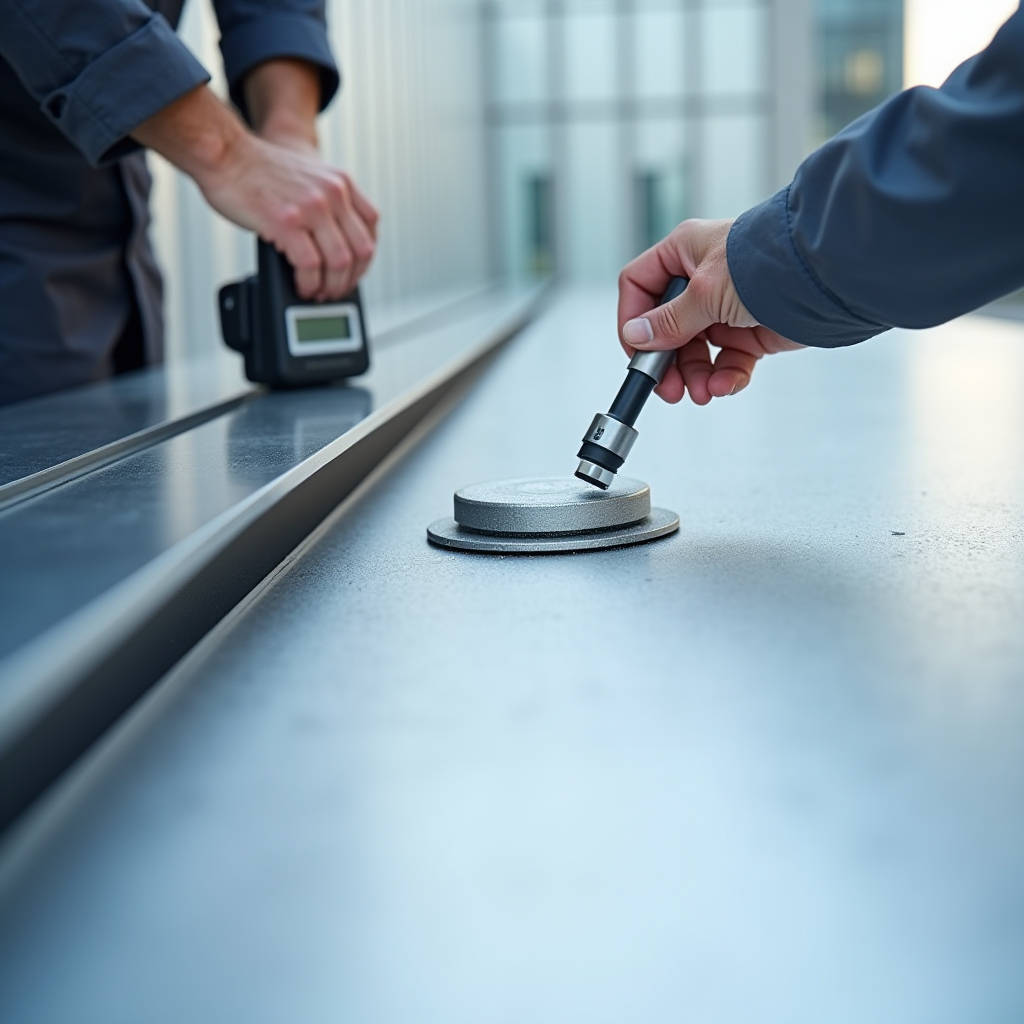
The pull-off test is the gold standard for quantitative adhesion measurement. A loading fixture—a metal dolly—is glued to the coating surface. After the adhesive cures, a portable pull-off tester applies tensile force perpendicular to the surface until the coating detaches. The result is expressed in megapascals (MPa) or pounds per square inch (psi).
For architectural aluminium cladding, a pull-off value of 5 MPa (725 psi) or higher is generally considered acceptable for PVDF systems, though project specifications may demand higher thresholds. The test also records the failure mode, which is essential for the diagnostic reasons discussed above. Modern pull-off testers from manufacturers like DeFelsko and Elcometer store data digitally, allowing fabricators to build a statistical process control database.
The limitation of the pull-off test is practical. It requires a clean, flat surface for dolly attachment. The adhesive must cure fully—typically 24 hours for epoxy—before testing. It is destructive, leaving a circular mark on the panel. For production-line testing, this means dedicating sample panels rather than testing finished goods.
| Test Method | Standard | Output | Best Application | Limitations |
|---|---|---|---|---|
| Knife Test | ASTM D6677 | Pass/Fail (qualitative) | On-site quick checks | Operator-dependent, no numerical data |
| Cross-Hatch Tape | ASTM D3359 | 0B to 5B rating | QC for coatings <125μm | Not suitable for thick coatings, subjective rating |
| Pull-Off | ASTM D4541 / ISO 4624 | MPa or psi (quantitative) | Final acceptance, failure analysis | Destructive, requires adhesive cure time |
| Bend Test | ASTM D522 | Pass/Fail (visual cracking) | Formability assessment | Not a direct adhesion measure |
Surface Preparation: The Root Cause of Most Failures
The greatest single cause of coating adhesion failure on aluminium is poor surface preparation. This is not a matter of opinion—it is the consistent finding across decades of failure investigations documented by coating manufacturers and independent testing laboratories. Aluminium forms a natural oxide layer within minutes of exposure to air. That oxide layer is weakly bonded and must be removed before coating.
The pretreatment process for architectural aluminium typically involves multiple stages: alkaline degreasing to remove oils and shop contaminants, acid etching to remove the oxide layer and create a uniform surface profile, and a chromate or chrome-free conversion coating that provides both corrosion resistance and a chemical anchor for the organic topcoat. Each stage must be controlled for chemical concentration, temperature, and dwell time.
When a panel fails an Aluminum Coating Adhesion Test, the first place to look is the pretreatment bath records. A degreasing bath that has exceeded its contamination limit will leave a residue on the aluminium surface. A conversion coating bath with incorrect pH will produce a powdery, non-adherent layer. These are process control problems, not coating problems. The adhesion test is the detector; the pretreatment line is where the correction happens.
Research published in the Surface and Coatings Technology journal has demonstrated that aluminium alloys treated with a titanium-zirconium conversion coating system can achieve adhesion performance comparable to traditional hexavalent chromate systems, though the process window is narrower. This is relevant for projects specifying chrome-free pretreatment due to environmental regulations.
PVDF vs. Powder Coating: Adhesion Behavior Differences
The two dominant coating systems for solid aluminium cladding—PVDF (polyvinylidene fluoride) liquid coatings and polyester-based powder coatings—behave differently in adhesion testing. Understanding these differences helps in specifying the right test method and interpreting results correctly.
PVDF coatings, typically applied at 25-35 microns dry film thickness as a two-coat or three-coat system, rely heavily on the primer layer for adhesion. The primer is formulated with specific resins that bond to the conversion coating and provide a compatible surface for the PVDF topcoat. When a PVDF system fails an adhesion test, the failure is almost always at the primer-to-substrate interface, not between primer and topcoat. This points directly to pretreatment issues.
Powder coatings, applied at 60-80 microns, achieve adhesion through a combination of mechanical interlock and chemical bonding during the melt-and-flow curing process. The thicker film can mask minor surface preparation deficiencies that would cause a thinner PVDF coating to fail. However, powder coatings are more susceptible to under-cure adhesion failure. If the substrate does not reach the required peak metal temperature for the specified dwell time, the powder particles do not fully cross-link, and inter-coat adhesion suffers.
The American Architectural Manufacturers Association (AAMA) publishes separate specifications for each system. AAMA 2605 covers high-performance PVDF coatings and requires adhesion testing per ASTM D3359 with a minimum rating of 4B. AAMA 2604 covers powder coatings with similar adhesion requirements but different weathering performance criteria.
Environmental Factors That Accelerate Adhesion Loss
Adhesion is not a static property. A coating that passes a pull-off test at the factory can lose adhesion over time if the coating system is not matched to the environmental exposure. Three factors dominate: moisture, temperature cycling, and UV radiation.
Moisture is the most aggressive. Water molecules are small enough to permeate most organic coatings, and when they reach the coating-substrate interface, they can displace the chemical bonds that create adhesion. This process, called cathodic delamination, is accelerated in the presence of salts. Coastal projects demand coating systems with proven resistance to filiform corrosion and under-film creep.
Temperature cycling creates mechanical stress at the coating-substrate interface due to the difference in thermal expansion coefficients between aluminium (approximately 23 × 10⁻⁶ /°C) and organic coatings (typically 50-100 × 10⁻⁶ /°C). Over thousands of cycles—a dark-colored panel can reach 80°C in direct sun and cool to ambient temperature overnight—this differential movement can fatigue the adhesive bond. Panels installed on south-facing elevations in hot climates are at highest risk.
UV radiation primarily affects the coating itself rather than the bond, but the degradation products can migrate to the interface and weaken adhesion. This is why accelerated weathering tests like ASTM G154 (QUV) and ASTM G155 (xenon arc) are often specified alongside adhesion tests in project quality plans.
Specifying Adhesion Testing in Project Quality Plans
For architects and facade consultants writing specifications, the language around adhesion testing should be precise. A vague requirement for "good adhesion" is unenforceable. A properly written specification includes the test method, the acceptance criteria, the sampling frequency, and the failure mode documentation requirements.
A typical specification clause for a PVDF-coated solid aluminium panel might read: "Adhesion shall be tested in accordance with ASTM D4541 using a Type V pull-off tester. Minimum acceptable pull-off strength is 5 MPa. Failure mode shall be recorded photographically. Cohesive failure within the coating or adhesive failure at the substrate shall be reported. Adhesive failure at the substrate exceeding 20% of the dolly area shall be cause for rejection. Testing frequency: one panel per 100 panels produced, or one per color per batch, whichever is more frequent."
This level of detail eliminates ambiguity and gives the fabricator clear targets. It also provides the general contractor with objective criteria for accepting or rejecting material at the site. The ISO 4624 standard provides additional guidance on test apparatus calibration and result interpretation that can be referenced in specifications.
On-Site Verification: What You Can and Cannot Do
Site conditions are not laboratory conditions. Temperature, humidity, and surface contamination all affect adhesion test results. A pull-off test performed on a cold panel at 5°C will give different results than the same test performed at 23°C. The adhesive used to attach the dolly may not cure properly in high humidity. Dust and dirt on the panel surface will reduce the measured adhesion value.
For on-site verification, the cross-hatch tape test is the most practical option. It requires minimal equipment, can be performed in under five minutes per location, and provides immediate results. The limitation is that it is qualitative, and borderline results are difficult to interpret. If a panel tests at 3B on site, the question becomes whether the coating was under-performing at the factory or whether site conditions affected the result.
The best practice is to perform adhesion testing at the fabricator's facility before shipment, with the results documented in the mill certificate. On-site testing should be reserved for panels that show visual signs of coating distress or for random audit purposes. The ASTM D3359 standard includes guidance on environmental conditions for testing that should be followed as closely as site conditions permit.
Common Misinterpretations of Adhesion Test Results
One of the most frequent mistakes in the industry is treating the pull-off value as the only meaningful output. A panel that pulls off at 7 MPa with 100% adhesive failure at the substrate is in worse condition than a panel that pulls off at 5 MPa with 100% cohesive failure within the coating. The first panel has a pretreatment problem that will lead to progressive delamination. The second panel has a coating that is well-bonded, and the lower value simply reflects the internal strength of that particular coating formulation.
Another misinterpretation involves comparing adhesion values across different coating systems. A polyester powder coating may routinely achieve 8-10 MPa pull-off values, while a PVDF system may test at 5-7 MPa. This does not mean the powder coating is "better." It means the coating materials have different cohesive strengths. The relevant comparison is always against the specification requirement for that specific coating system, not against other systems.
Finally, a single adhesion test result is a snapshot. Trends matter more than individual values. A fabricator whose pull-off values are consistently 6-7 MPa with one data point at 4.5 MPa should investigate the outlier, but the overall process is likely in control. A fabricator whose values are trending downward from 7 to 5 to 4 MPa over three production batches has a systematic problem that needs immediate attention.
Integrating Adhesion Testing into a Broader Quality Assurance Program
Adhesion testing does not exist in isolation. It is one element of a comprehensive coating quality assurance program that should include film thickness measurement, color and gloss verification, impact resistance testing, and accelerated weathering exposure. For high-specification projects, the coating applicator should maintain a statistical process control chart for adhesion values, with upper and lower control limits established from historical data.
The Powder Coating Institute and various coating manufacturers publish recommended quality control frequencies that can serve as a starting point. A typical program for architectural aluminium might include adhesion testing at the start of each production shift, after any line stoppage, and after any change in pretreatment chemicals. Full physical property testing, including adhesion, impact, and flexibility, should be performed on retained samples from each production batch.
For procurement managers and specifiers, the existence of a documented quality program at the fabricator is more important than any single test result. A supplier who can show six months of adhesion test data with stable values and documented corrective actions for any deviations is a supplier who understands their process. That level of transparency is worth more than a brochure full of technical claims.
Solid aluminium cladding panels represent a significant investment in a building's exterior envelope. The coating system is what protects that investment. The Aluminum Coating Adhesion Test is the tool that verifies the protection is real, not assumed. For projects where facade performance is non-negotiable, specifying and verifying adhesion is not optional—it is the difference between a facade that ages gracefully and one that becomes a liability.