How Aluminum Extrusion Pressing Controls Flatness and Durability in Solid Aluminium Cladding Panels
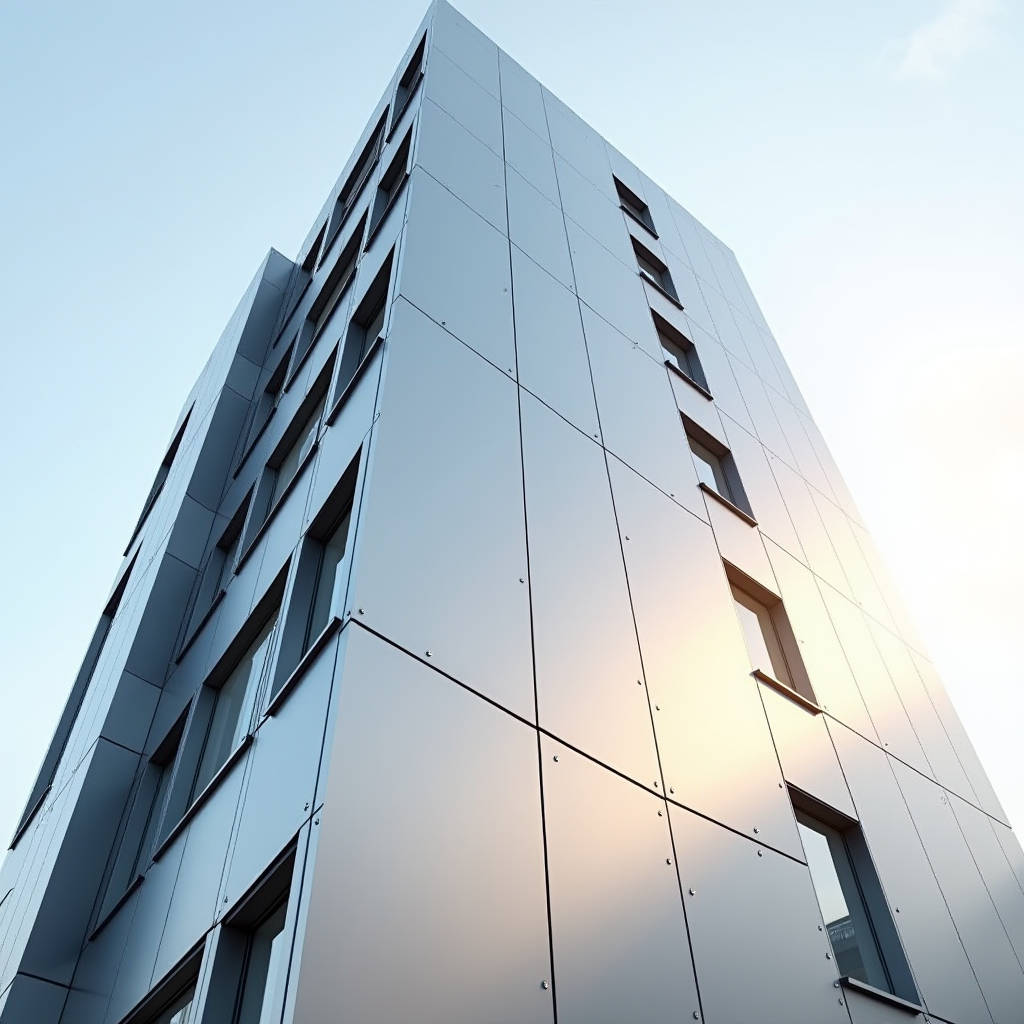
Aluminum Extrusion Pressing is the industrial backbone behind every solid aluminium cladding panel that ends up on a high-rise facade. When a procurement manager in Dubai or a facade engineer in Singapore specifies 3.0mm solid aluminium sheets for a 40-story tower, they are not just buying metal — they are buying the output of a precisely controlled extrusion press line that turned a 600°C billet into a flat, stress-relieved plate ready for PVDF coating. The connection between the press and the panel is direct and unforgiving: a poorly managed extrusion run produces plates with residual stress gradients that reveal themselves as oil-canning six months after installation. Understanding what happens inside that press — the ram speed, the quench rate, the die design — is not academic. It is the difference between a facade that stays flat and one that waves in the afternoon sun.
What Aluminum Extrusion Pressing Actually Means for Solid Cladding Plates
Most industry literature on Aluminum Extrusion Pressing focuses on profiles — window frames, curtain wall mullions, T-slot structural members. Solid aluminium cladding panels occupy a different category. They are flat plates, typically 2.0mm to 3.0mm thick, produced in widths up to 1,500mm. The press must deliver a uniform cross-section with minimal thickness variation across the entire width, and that is harder than it sounds. A 1,500mm-wide flat die presents flow distribution challenges that a narrow profile die never faces. The aluminium must exit every point along the die opening at the same velocity. If the center flows faster than the edges, the resulting plate carries locked-in compressive stresses that will buckle under thermal load. This is not hypothetical — facade contractors in the Middle East have rejected entire container loads of cladding sheet because the plates bowed visibly after cutting to size.
The direct extrusion process — where a heated billet is pushed through a die by a hydraulic ram — remains the dominant method for producing these plates. The alternative, indirect extrusion, reduces friction but is less common for wide flat sections due to press size limitations. For solid cladding stock, direct presses in the 2,000-ton to 4,000-ton range are typical, depending on plate width and alloy. A 2,500-ton press can comfortably extrude 1,200mm-wide 3.0mm plates in 6063-T6, while 1,500mm-wide plates in the harder 5005 or 5052 alloys may require 3,500 tons or more.
Alloy Selection: Why 5005 and 6063 Dominate Cladding Applications
The alloy choice for solid aluminium cladding panels is not arbitrary. Two alloys dominate the market: 5005 (Al-Mg series) and 6063 (Al-Mg-Si series). Each behaves differently inside the extrusion press, and each delivers different properties on the finished facade.
5005 is a non-heat-treatable alloy with magnesium as the primary alloying element. It extrudes at higher temperatures — typically 480°C to 520°C — and requires slower ram speeds to avoid surface tearing. The payoff is superior corrosion resistance and anodizing quality. For coastal projects in Singapore, Miami, or Jeddah, 5005-H14 or H24 temper plates resist pitting corrosion better than 6063. The downside: lower strength. A 3.0mm 5005-H14 plate yields around 110-130 MPa tensile strength, which means the facade engineer must account for deflection under wind load with closer fixing centers or thicker material.
6063 is a heat-treatable alloy that responds to T6 aging after extrusion. It extrudes faster and at slightly lower temperatures — 460°C to 500°C — making it more economical per kilogram. After T6 heat treatment, 6063-T6 delivers tensile strength around 190-215 MPa, roughly 60% higher than 5005-H14. This strength advantage allows thinner gauges or wider fixing spans. However, 6063 is more susceptible to intergranular corrosion in marine environments unless properly coated. The PVDF coating system becomes the critical barrier, not the alloy itself. For inland projects or where the budget demands thinner material, 6063-T6 is the workhorse.
A third option, 5052 (Al-Mg-Cr), appears occasionally in cladding specifications. It offers higher strength than 5005 (around 190-230 MPa in H32 temper) and excellent corrosion resistance. But 5052 is harder to extrude flat — the magnesium content makes it sticky in the die, and maintaining thickness tolerance across a 1,500mm width requires slower speeds and more frequent die maintenance. The cost premium over 5005 is typically 8-12%, which limits its use to high-spec architectural projects where the engineer specifically calls out 5052 for its marine-grade performance.
Inside the Press: How Ram Speed, Temperature, and Quench Determine Plate Flatness
The extrusion press for flat cladding plate is a study in thermal-mechanical control. The billet, preheated in a gas or induction furnace, enters the container at a target temperature. The ram pushes it through the die at a controlled speed, and the extruded plate exits at 500°C or more. What happens in the next 30 seconds determines whether that plate stays flat.
Ram speed is the first critical variable. For 6063 flat plate, ram speeds of 5-8 mm/s are typical. Push too fast, and the adiabatic heating effect raises the exit temperature beyond the alloy's solidus point, causing surface cracks known as hot shortness. Push too slow, and the billet cools inside the container, increasing the required pressure and potentially stalling the press. For 5005, ram speeds drop to 2-4 mm/s due to the alloy's higher hot strength and narrower extrusion window.
Quench management is the second variable, and for flat cladding plate, it is arguably the most important. After exiting the die, the plate passes through a quench system — typically air quench for 6063, water mist or forced air for 5005. The quench rate must be uniform across the entire width of the plate. If the edges cool faster than the center, differential thermal contraction introduces residual stress gradients. These stresses are invisible at the factory but become painfully visible after the plate is cut into cladding panels and mounted on a facade. The panel bows, the architect rejects it, and someone pays for replacement material.
Modern extrusion lines for cladding-grade plate use multi-zone quench systems with independently controlled fans or water mist nozzles. Temperature sensors across the plate width feed data to a PLC that adjusts quench intensity in real time. This is not standard equipment on a profile extrusion line — it is a specific investment for flat plate production. Suppliers like Futeng® who produce solid aluminium cladding panels from their own extrusion lines maintain this level of quench control as a baseline requirement, not an upgrade.
Stretching and Stress Relief: The Hidden Step That Prevents Oil-Canning
After quenching, the extruded plate goes to the stretcher. This is a hydraulic machine that grips both ends of the plate and applies a controlled tensile force — typically 1-3% permanent elongation. The purpose is twofold: straighten the plate and relieve residual stresses. For cladding applications, stress relief is the primary function.
Without proper stretching, the residual stress pattern from uneven quenching remains locked in the aluminium. When the fabricator cuts the plate into smaller panels, the stress equilibrium is disturbed, and the panel distorts. This is the mechanism behind oil-canning — the audible popping and visible waviness that plagues poorly processed cladding. The stretcher eliminates most of these stresses by yielding the material uniformly across its cross-section.
The stretch percentage matters. Too little — below 1% — and residual stresses remain. Too much — above 3% — and the plate develops Lüders bands (visible surface striations) that telegraph through the PVDF coating. For 6063-T6 cladding plate, 1.5-2% stretch is typical. For 5005, which work-hardens more rapidly, 1-1.5% is the practical limit. The stretcher operator must also ensure the plate is gripped evenly; off-center gripping introduces twist that no amount of downstream leveling can fix.
After stretching, the plate is cut to length and may undergo additional leveling — roller leveling for thinner gauges, stretcher leveling for thicker material. The goal is flatness within 0.2% of length and width, measured as deviation from a flat reference plane. For a 3,000mm-long panel, that means no more than 6mm of deviation. Tighter tolerances — 0.1% — are achievable but add cost and require starting with higher-quality extrusion output.
Heat Treatment: T6 Aging and Its Effect on Coating Adhesion
For 6063 alloy, the extrusion process is not complete until the plate undergoes artificial aging to achieve T6 temper. The plate is loaded into an aging oven at 175-185°C for 6-8 hours. During this time, Mg₂Si precipitates form within the aluminium matrix, raising the tensile strength from the as-quenched T4 condition (around 170 MPa) to the fully aged T6 condition (around 210 MPa).
The aging cycle has a direct impact on subsequent PVDF coating adhesion. Over-aged 6063 — held too long or at too high a temperature — develops a coarser precipitate structure at the grain boundaries. This can create micro-scale surface discontinuities that reduce coating adhesion. The standard test for this is a cross-hatch adhesion test per ASTM D3359, performed after the PVDF coating is applied and cured. A properly aged substrate achieves 5B (no detachment). Over-aged material may drop to 4B or 3B, which is unacceptable for exterior cladding with a 20-year performance expectation.
For 5005 alloy, there is no heat treatment step — the H14 or H24 temper is achieved through work hardening during the rolling or stretching process. This simplifies production but also means the mechanical properties are set by the deformation history, not a controlled furnace cycle. Consistency from batch to batch requires tight process control at the extrusion press and stretcher.
Die Design for Flat Plate: Why Wider Dies Need Better Engineering
The die is the heart of the extrusion press, and for flat cladding plate, die design separates capable suppliers from the rest. A flat plate die appears simple — a rectangular opening — but the internal geometry is anything but. The die must manage metal flow so that the aluminium exits at uniform velocity across the full width. This requires a carefully designed feeder plate and mandrel that distribute the incoming billet material to the die opening.
The key design feature is the bearing length — the parallel land at the die exit that controls flow velocity. For a wide flat die, the bearing is shorter at the center and longer at the edges. This compensates for the natural tendency of aluminium to flow faster in the center where friction from the container wall is minimal. The bearing length difference might be only 0.2-0.5mm, but it is critical. Die makers use finite element analysis (FEA) software to simulate metal flow and optimize bearing geometry before cutting steel.
Die material is typically H13 hot-work tool steel, nitrided to a surface hardness of 65-70 HRC. For 5005 and 5052 alloys, which are more abrasive due to their magnesium content, the die may receive a PVD coating (TiAlN or CrN) to extend service life. A well-maintained flat plate die can produce 20-30 tons of cladding plate before requiring re-nitriding. Poor die maintenance leads to dimensional drift — the plate thickness gradually increases or the edges become thicker than the center — and the resulting panels will not meet the ±0.1mm thickness tolerance expected in architectural specifications.
Surface Preparation Before Coating: The Critical Pretreatment Chain
The extruded plate, now stretched, aged, and leveled, enters the coating line. But before a single micron of PVDF primer touches the surface, the plate must undergo pretreatment. This is a multi-stage chemical process that cleans, etches, and passivates the aluminium surface to ensure coating adhesion and corrosion resistance.
The standard pretreatment for architectural cladding is a chromate conversion coating, applied in a vertical or horizontal spray line. The stages are: alkaline degreasing (60-70°C, 2-3 minutes), water rinse, acid deoxidizing/etching, water rinse, chromate conversion (30-40°C, 1-2 minutes), water rinse, and drying. The chromate coating deposits 300-600 mg/m² of chromium on the surface, providing both adhesion promotion and corrosion inhibition at the coating-substrate interface.
Environmental regulations in Europe and parts of Asia are driving a shift to chrome-free pretreatments based on titanium-zirconium chemistries. These systems meet the requirements of Qualicoat Class 2 and AAMA 2605 when properly applied. However, they are less forgiving of process variation — bath concentration, pH, and temperature must be maintained within narrower ranges than chromate systems. For projects specifying chrome-free pretreatment, the extrusion supplier must demonstrate qualification testing per AAMA 2605, including 4,000-hour salt spray and 10-year Florida exposure data.
The pretreatment quality directly determines whether the finished cladding panel will survive 20 years on a coastal high-rise without filiform corrosion creeping under the coating at cut edges. This is a failure mode that facade consultants specifically look for during project audits, and it traces back to decisions made at the extrusion press — alloy selection, quench uniformity, and pretreatment chemistry.
PVDF Coating: From Extruded Plate to Finished Cladding Panel
The PVDF (polyvinylidene fluoride) coating system is the industry standard for architectural aluminium cladding. It consists of a primer coat (5-8 microns), a color coat (20-25 microns), and a clear topcoat (10-15 microns), for a total dry film thickness of 35-48 microns. The resin system is 70% PVDF (Kynar 500® or Hylar 5000®) and 30% acrylic, which provides the optimal balance of flexibility, UV resistance, and color stability.
The coating is applied by spray — either horizontal reciprocating spray or vertical electrostatic spray — and cured at 230-250°C for 10-15 minutes. The cure temperature is critical: under-cured PVDF has poor solvent resistance and will chalk prematurely; over-cured PVDF becomes brittle and may micro-crack during panel forming. The extrusion press's upstream processes influence coating quality in ways that are not always obvious. A plate with residual stress from inadequate stretching may distort during the 230°C cure cycle, causing coating thickness variation as the panel bows toward or away from the spray guns.
Color consistency across multiple extrusion batches is a persistent challenge. The same PVDF formulation applied to 5005 and 6063 substrates can produce slightly different final colors due to differences in substrate reflectivity and pretreatment chemistry. For large projects where panels from multiple production runs are installed adjacent to each other, the specification should require batch-to-batch color matching with ΔE ≤ 1.0 (CIE LAB) measured on the finished panel. This is tighter than the AAMA 2605 requirement of ΔE ≤ 2.0 for color retention after weathering, but it is achievable with disciplined process control at the extrusion and coating stages.
Quality Control: What to Inspect When Your Cladding Panels Arrive
For the procurement manager or facade contractor receiving solid aluminium cladding panels at the job site, a focused incoming inspection can prevent installation delays and post-installation disputes. The inspection should target the parameters that trace back to extrusion press quality.
Thickness should be measured with a calibrated micrometer at multiple points per panel. The tolerance per GB/T 3880 or EN 485 is ±0.1mm for sheet thickness up to 3.0mm. Panels consistently at the lower end of the tolerance band may indicate a die that is wearing thin or a press operator pushing for higher yield. Flatness should be checked by placing the panel on a certified flat granite table and measuring the gap with a feeler gauge. A deviation exceeding 0.2% of the diagonal length warrants rejection.
Coating thickness should be measured with an eddy-current gauge calibrated on the aluminium substrate. Total dry film thickness below 35 microns is non-conforming per AAMA 2605. Adhesion should be tested by the cross-hatch method (ASTM D3359) on a sample panel from each batch. Impact resistance per ASTM D2794 (1.5 J reverse impact, no cracking) verifies that the coating system has been properly cured and that the substrate preparation was adequate.
A simple but revealing test is the boiled water adhesion test: immerse a scribed panel in boiling deionized water for 20 minutes, remove, dry, and apply tape per ASTM D3359. Any coating detachment indicates a pretreatment failure that will manifest as field corrosion within the first five years of service. This test is not required by AAMA 2605 but is increasingly specified by facade consultants for projects in humid tropical climates.
| Parameter | Standard | Requirement | Test Method |
|---|---|---|---|
| Alloy/Temper | EN 573-3 / ASTM B209 | 5005-H14, 6063-T6, or 5052-H32 as specified | OES spectrometry |
| Thickness Tolerance | EN 485-3 | ±0.1mm for ≤3.0mm gauge | Micrometer, 5 points/panel |
| Flatness | EN 485-3 | ≤0.2% of length/width | Granite table + feeler gauge |
| PVDF DFT | AAMA 2605 | 35-48 microns total system | Eddy-current, ISO 2360 |
| Adhesion (Dry) | ASTM D3359 | 5B (no detachment) | Cross-hatch + tape |
| Adhesion (Boiling Water) | Internal/Project Spec | 5B after 20 min boil | Cross-hatch + tape post-boil |
| Impact Resistance | ASTM D2794 | No cracking at 1.5 J reverse | Falling dart impactor |
| Color Consistency | ISO 11664 / CIE LAB | ΔE ≤ 1.0 batch-to-batch | Spectrophotometer D65/10° |
| Salt Spray Resistance | ASTM B117 | 4,000 hrs, ≤2mm creep | Scribed panel, cyclic exposure |
Press Capacity and Project Planning: Matching Supply to Demand
Understanding extrusion press capacity helps procurement managers plan realistic lead times. A 2,500-ton press producing 1,200mm-wide 3.0mm 6063 plate runs at approximately 5-8 mm/s ram speed, yielding 15-25 meters of plate per minute depending on billet size and die configuration. With a typical billet length of 800-1,000mm, each billet produces 20-30 meters of plate. Cycle time — including billet loading, extrusion, shear, and run-out table transfer — is 3-5 minutes per billet. A single press running two shifts produces 8-12 tons of cladding plate per day.
For a project requiring 5,000 square meters of 3.0mm solid aluminium cladding (approximately 40 tons of material), a dedicated press line can complete the extrusion in 4-5 working days. However, this assumes the press is available and the dies are ready. In practice, extrusion lead times of 3-4 weeks are common, plus 2-3 weeks for PVDF coating and 1-2 weeks for fabrication (cutting, bending, routing). The total supply chain from order to delivery is 8-10 weeks for standard colors and 12-14 weeks for custom color matching.
Suppliers with integrated operations — extrusion, pretreatment, coating, and fabrication under one roof — can compress this timeline by eliminating inter-factory transport and queue time. Futeng® operates this integrated model, which reduces the typical lead time by 2-3 weeks compared to a fragmented supply chain where extrusion, coating, and fabrication happen at different facilities. For projects with tight construction schedules, this integration is a quantifiable advantage.
Common Failure Modes That Trace Back to the Extrusion Press
When solid aluminium cladding panels fail in service, the investigation often points to the extrusion press — even when the visible symptom appears to be a coating or fabrication issue. Understanding these failure chains helps specifiers write tighter procurement documents and helps contractors identify problems before panels go up on the building.
Oil-canning is the most visible and most litigated failure mode. The panel develops visible waves or buckles, often changing with temperature and sun angle. Root cause: residual stress from uneven quenching or inadequate stretching. The fix is not on-site — it requires replacing panels with properly stress-relieved material. Prevention: specify a maximum flatness deviation of 0.2% and require the extruder to document stretch percentage and quench parameters for each production batch.
Filiform corrosion appears as thread-like filaments under the coating, initiating at cut edges or fastener holes. Root cause: inadequate pretreatment or contamination between pretreatment and coating. The chromate or chrome-free conversion layer was insufficient to passivate the surface. Prevention: require boiled water adhesion testing and specify a minimum of 300 mg/m² chromium (or equivalent performance for chrome-free systems) on the pretreated substrate.
Coating delamination — the PVDF system peels away in sheets — is less common but catastrophic. Root cause: severe pretreatment failure, often from skipped or exhausted chemical baths. In some cases, the extrusion lubricant residue was not adequately removed in the degreasing stage. Prevention: audit the pretreatment line or require the supplier to provide pretreatment bath analysis records for each production batch.
Edge cracking during bending occurs when the fabricator bends the panel to form returns or cassette edges. Root cause: the extrusion plate has low ductility due to over-aging (6063) or excessive cold work (5005). The material cannot accommodate the bend radius without cracking. Prevention: specify a minimum elongation of 8% for 6063-T6 and 5% for 5005-H14 per the relevant ASTM or EN standard, and verify with tensile testing.
Specifying Aluminium Extrusion Pressing Quality in Your Procurement Documents
For architects and facade engineers writing specifications, the quality of the extrusion pressing process can be addressed through a combination of material standards, performance requirements, and documentation obligations. The following framework provides a starting point for a procurement specification that captures the critical extrusion parameters without over-specifying to the point of eliminating qualified suppliers.
Material standards: reference EN 573-3 for alloy designation, EN 485 for tolerances, and EN 755 for mechanical properties. For projects in North America, reference ASTM B209 for sheet and plate. The alloy and temper must be stated explicitly — "5005-H14" or "6063-T6" — not "aluminium alloy sheet."
Performance requirements: flatness ≤ 0.2% of panel dimension; thickness tolerance ±0.1mm; PVDF coating per AAMA 2605 (or Qualicoat Class 2 for European projects); adhesion 5B per ASTM D3359 both dry and after 20-minute boil; impact resistance 1.5 J reverse impact with no cracking.
Documentation obligations: the supplier must provide mill test certificates showing chemical composition, mechanical properties (tensile, yield, elongation), and stretch percentage for each production batch. Pretreatment bath analysis records and coating DFT measurements must be traceable to batch numbers. For projects exceeding 1,000 m², a third-party inspection report from an accredited laboratory confirming compliance with the specified standards is a reasonable requirement.
The extrusion press is not a black box. By specifying the outputs that matter — flatness, adhesion, corrosion resistance — rather than dictating the process, the specifier allows the extruder to optimize their particular press configuration while still delivering a panel that meets the project's performance requirements. This is the practical intersection of engineering specification and commercial reality.
The Economics of Extrusion Quality: Why Cheap Plate Costs More
The procurement decision for solid aluminium cladding panels often comes down to price per square meter. But the true cost of the panel is not just the invoice price — it is the invoice price plus the cost of rectifying failures, the cost of construction delays, and the reputational cost to the contractor and architect. A panel that oil-cans after installation costs far more than the premium for a properly extruded, stress-relieved plate.
Consider a 10,000 m² facade project. The difference between a low-cost extrusion source and a quality-controlled source might be $3-5 per square meter — $30,000-50,000 on the total project. If 5% of the low-cost panels exhibit oil-canning and require replacement, the direct cost of replacement panels, scaffolding, labor, and schedule extension can easily exceed $100,000. The math is straightforward: the quality premium is cheaper than the failure cost.
This does not mean the most expensive supplier is always the best. It means the procurement evaluation should weight technical compliance equally with price. A supplier who can document their extrusion process parameters — ram speed, quench rate, stretch percentage, aging cycle — and who welcomes third-party inspection is worth a premium over a supplier who treats the extrusion press as a commodity operation. The press is where the panel's DNA is established. Everything downstream — coating, fabrication, installation — depends on the quality of what came out of that die.
Aluminum Extrusion Pressing, when executed with the right alloy, the right die, the right quench, and the right quality control, produces solid aluminium cladding panels that perform for decades. When any of those elements is compromised, the failure shows up on the facade. The industry's job is to make sure the right decisions are made at the press, because by the time the panel reaches the building, it is too late to fix what happened inside the billet.