3 0 mm Solid Aluminium Cladding Wall Price Installed Cost Analysis 2026
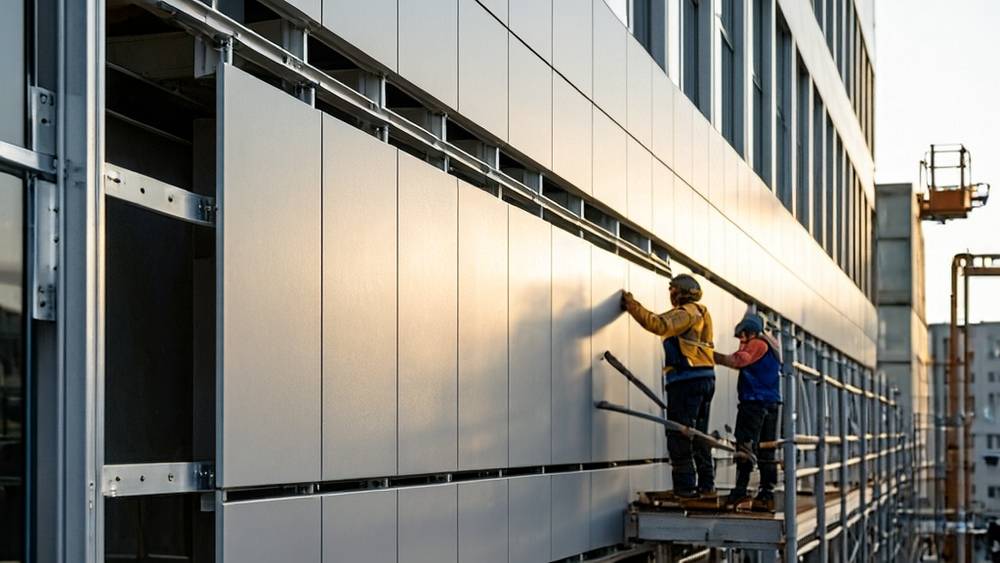
When a procurement manager for a mid-rise commercial project asks for a cladding wall price, the number that comes back is rarely a single figure. A 2026 survey of U.S. envelope contractors reveals that exterior cladding bids for the same 12,000-square-foot building envelope can swing from $18 to $55 per square foot installed, depending almost entirely on three variables: material type, gauge thickness, and the system's attachment method. The cladding wall price conversation gets even more complicated when specifiers move between solid aluminium panels, steel sheets, fibre cement, and natural stone veneer. Each material carries its own supply chain logic, fabrication lead time, and installed cost profile. This article zeroes in on what drives the spread between those numbers. Rather than offering a generic price list, it examines the structural and logistical factors that separate a $22/sq ft solid aluminium rainscreen from a $48/sq ft stone-and-substrate assembly, with real project data drawn from 2026 contractor estimates across the U.S. Midwest, Southeast, and West Coast markets.
Why Installed Cladding Wall Price Varies by $30 Per Square Foot
The gap between the lowest and highest cladding wall price on a commercial façade has less to do with the panel material's raw cost than most buyers assume. A 3.0 mm solid aluminium sheet with a PVDF finish might leave the factory at $8 to $12 per square foot. By the time it reaches the wall, the installed figure often lands between $22 and $35/sq ft. With natural stone veneer on a drainage mat and steel subframe, that same square foot can hit $55. The difference sits in five buckets: substrate preparation, the attachment system's part count, labor hours per panel, crane or mast climber access, and the local wage rate for architectural sheet metal crews.
The National Association of Home Builders' 2025 cost-of-construction survey pegged exterior finish labor at $38 to $72 per hour depending on metro area, with union commercial rates in Chicago and New York exceeding $95. A panel system that requires two workers eight minutes to hang versus one that needs four workers twenty-five minutes translates into a $9 to $14 per square foot labor delta before a single material cost enters the calculation. This is why comparing cladding wall price solely on material dollars is misleading. The installed figure is the only number that matters for budgeting.
Solid Aluminium vs Steel vs Stone: Material Cost Drivers at the Factory Gate
Raw material pricing for architectural cladding follows commodity cycles, but the fabrication step creates permanent cost differences between material categories. Solid aluminium sheet — specifically 5052-H32 or 3003-H14 alloy in 2.0 mm, 2.5 mm, and 3.0 mm gauges — sits in a middle band of the material cost spectrum. Below is a breakdown of factory-gate price ranges for common commercial cladding materials in 2026, based on contractor procurement data and supplier quotes for 10,000+ sq ft orders:
| Material | Typical Gauge/Format | Factory Price Range (per sq ft) | Finish Included | Lead Time (weeks) |
|---|---|---|---|---|
| Solid Aluminium (3003-H14) | 2.0 – 3.0 mm sheet | $6.50 – $12.00 | PVDF Kynar 500® (3-coat) | 4 – 6 |
| Steel (Galvalume AZ50) | 24 – 22 ga (0.6 – 0.8 mm) | $3.80 – $7.50 | SMP or PVDF | 3 – 5 |
| Fibre Cement Panel | 8 – 12 mm thick | $4.00 – $9.00 | Factory-applied coating | 2 – 4 |
| Natural Stone Veneer | 20 – 40 mm, mesh-backed | $14.00 – $28.00 | None (raw stone) | 6 – 12 |
| Terracotta Rainscreen | Extruded 15 – 40 mm | $18.00 – $35.00 | Glazed/unglazed | 10 – 16 |
Solid aluminium commands a premium over steel at the factory gate for a reason that shows up later in the building's lifecycle. The 5052 alloy specified for most architectural sheet work contains 2.2% to 2.8% magnesium, giving it corrosion resistance that steel requires a separate metallic coating to achieve. A Galvalume AZ50 coating on steel provides sacrificial protection, but field-cut edges expose the steel substrate. Aluminium's corrosion resistance is homogeneous through the thickness of the sheet. For coastal projects within 3 km of saltwater, this metallurgical difference pushes many specifiers toward solid aluminium despite the higher upfront cladding wall price.
The Attachment System: Where 40% of Installed Cost Hides
Panel material cost typically accounts for 45% to 55% of the total installed cladding wall price. The remaining 45% to 55% splits between the substructure (rails, brackets, thermal isolators, fasteners) and field labor. A pressure-equalized rainscreen system using aluminium T-profile rails, stainless steel dead-load brackets, and thermally broken wall anchors can add $9 to $16 per square foot in components alone before a single panel goes up.
Contractors in the U.S. Northeast increasingly specify a drained-and-ventilated cavity approach per ASTM E283 air leakage standards, which requires a secondary drainage plane behind the cladding. This adds membrane material ($1.50–$3.00/sq ft) and flashing labor, but removes the long-term moisture risk that generates warranty claims. The choice between a face-sealed system (lower upfront cladding wall price, higher maintenance exposure) and a rainscreen (higher upfront cost, lower lifecycle risk) is one of the most consequential budget decisions on any envelope project.
A Futeng® project team working on a 2025 mixed-use tower in Southeast Asia quantified the trade-off: moving from a simple Z-girt attachment to a thermally broken, pressure-equalized rail system added $7.80/sq ft to the cladding wall price but eliminated 22 linear meters of perimeter sealant joints per floor, cutting anticipated 10-year resealing costs by an estimated $41,000 in present-value terms. The math is project-specific, but the principle holds: attachment system design drives both first cost and lifecycle cost.
Gauge Selection and Its Ripple Effect on Price
Panel thickness is not a trivial specification checkbox. Moving from 2.0 mm to 3.0 mm solid aluminium changes the cladding wall price in three interconnected ways:
- Material cost: A 3.0 mm sheet contains roughly 50% more aluminium by weight than a 2.0 mm sheet. At current LME aluminium pricing around $2,350 per metric ton, the raw metal delta is approximately $1.80 to $2.50 per square foot. With PVDF finishing applied to both sides, the factory gate difference between 2.0 mm and 3.0 mm panels lands at $5 to $6.50/sq ft.
- Weight penalty on substructure: A 3.0 mm panel at roughly 8.1 kg/m² (1.66 lb/sq ft) versus 5.4 kg/m² (1.11 lb/sq ft) for 2.0 mm increases dead load on brackets and rails. For a 60-foot-high façade, this can require larger bracket spacing or heavier-gauge rails, adding $1.50 to $3.00/sq ft to the substructure cost.
- Flatness and oil canning resistance: The AAMA 508 voluntary specification for aluminium sheet flatness becomes harder to meet on large-format panels below 2.5 mm. Specifying 3.0 mm for panels larger than 1,200 mm in any dimension reduces the incidence of oil canning — a waviness defect that shows up under raking light and generates punch-list disputes. The thicker gauge's premium is often justified by avoiding re-fabrication and site rejection costs.
Regional Labor Multipliers: Why the Same Panel Costs More in Boston Than Atlanta
Cladding wall price is geographically elastic. The same 2.5 mm solid aluminium rainscreen system with identical shop drawings can carry an installed price 25% to 40% higher in union-dominated Northeast and West Coast markets compared to right-to-work states in the Southeast and Mountain West. The 2026 RSMeans data for architectural sheet metal installation shows the following labor rate spreads for cladding crews:
| Metro Area | Sheet Metal Installer Rate (per hour) | Typical Panel Hanging Rate (sq ft/day, 4-person crew) | Labor Cost Multiplier vs National Average |
|---|---|---|---|
| New York, NY | $94 – $112 | 480 – 620 | 1.35x – 1.50x |
| Chicago, IL | $82 – $98 | 500 – 650 | 1.20x – 1.35x |
| Atlanta, GA | $48 – $62 | 550 – 700 | 0.75x – 0.85x |
| Dallas, TX | $52 – $68 | 540 – 680 | 0.80x – 0.90x |
| Los Angeles, CA | $78 – $96 | 460 – 600 | 1.15x – 1.30x |
| Seattle, WA | $72 – $88 | 440 – 580 | 1.10x – 1.25x |
These rates include burden (workers' compensation, liability insurance, benefits). A general contractor budgeting cladding wall price for a project in multiple regions needs to apply location-specific labor factors, not just adjust the material line item. The Midwest — often used as a baseline in published cost guides — sits roughly 5% to 10% below the national average, which is why a "typical" installed figure of $28/sq ft for solid aluminium cladding in Ohio becomes $36 to $40/sq ft when the same system goes up in Brooklyn.
Finish Specification and Its Long-Term Price Implications
The coating on a solid aluminium panel represents $2.50 to $5.00 of the factory cladding wall price per square foot, but the wrong specification can generate six-figure remediation costs within a decade. Three coating systems dominate the architectural aluminium market:
- PVDF (Kynar 500® or Hylar 5000®) 70% resin system: The industry benchmark per AAMA 2605. Requires a 3-coat system (primer, color coat, clear coat) with minimum 1.2 mil total dry film thickness. Offers 20+ year color retention and chalk resistance in vertical exposure. Factory adder: $3.00–$5.00/sq ft over mill finish.
- FEVE fluoropolymer (Lumiflon®-based): Higher gloss retention than PVDF, with 60° gloss values above 70 after 10 years of Florida exposure. Specified for monumental projects where aesthetic longevity is non-negotiable. Factory adder: $4.50–$7.00/sq ft. Meets AAMA 2605 requirements.
- SMP (Silicone-Modified Polyester): Budget coating meeting AAMA 2604. Acceptable for interior applications or sheltered exterior soffits. 10–15 year color retention. Factory adder: $1.50–$2.50/sq ft. Not recommended for direct sun exposure on south-facing elevations.
A procurement decision that saves $3.00/sq ft by downgrading from PVDF to SMP on a 15,000 sq ft façade generates $45,000 in upfront savings. If that façade requires recoating after 12 years at $12 to $18/sq ft for site-applied fluoropolymer — a process that involves containment, surface preparation, and access equipment — the net present value of the "savings" turns negative. The cladding wall price conversation must include finish longevity, not just the factory invoice.
Shop Drawings, Engineering, and the Hidden Pre-Construction Cost Layer
Before a single aluminium sheet reaches the CNC router, the project has already incurred $8,000 to $35,000 in shop drawing and engineering costs. These fees — typically rolled into the per-square-foot cladding wall price by the panel fabricator — cover structural calculations for wind load per ASCE 7-22, attachment point analysis, thermal movement accommodation, and fabrication-ready CAD files for each unique panel in the façade matrix.
Projects with high panel repetition (office towers with identical floor plates, for example) amortize this engineering cost across thousands of square feet, adding perhaps $0.80 to $1.50/sq ft. A sculptural cultural building with 60% unique panel geometries might see engineering costs of $4 to $7 per square foot. When a contractor receives a cladding wall price quote that seems inexplicably high for the material specified, the panel repetition ratio is often the invisible driver.
Freight, Crating, and Site Logistics
Solid aluminium panels ship from fabricator to site on A-frame stillages with foam interleaving to prevent coating abrasion. A full truckload (typically 2,500 to 4,000 sq ft of 3.0 mm panels depending on format) moving 800 miles costs $2,800 to $4,200 in the current freight market, adding $0.70 to $1.70/sq ft. International containerized shipments — common when panels are sourced from Asian fabricators — add $0.90 to $2.50/sq ft for ocean freight, customs brokerage, and drayage, plus 3 to 6 weeks of transit time that must be built into the construction schedule.
Site logistics — crane time for panel hoisting, mast climber rental, laydown area security — typically add $1.50 to $3.50/sq ft to the installed cladding wall price. Projects with zero-lot-line conditions that prevent ground-level staging can see these costs double. A 2025 hospital expansion in Boston required all 9,800 sq ft of aluminium cladding panels to be hoisted from a single street-closure window between 10 PM and 5 AM, adding $4.20/sq ft in premium-time labor and police detail costs above the baseline estimate.
Cladding wall price is not a product number. It is the sum of material metallurgy, engineering density, attachment complexity, regional wage structures, finish chemistry, and site access conditions. Treating it as a commodity comparison between panel types produces budgets that miss by 20% or more.
Making the Budget Number Stick: Practical Steps for Procurement Teams
For a general contractor or envelope subcontractor building a reliable cladding wall price estimate, the following sequence produces numbers that survive value engineering scrutiny:
- Lock the panel gauge and alloy early. A specification that reads "aluminium cladding panels" without a gauge callout will attract bids ranging from 2.0 mm to 3.0 mm, with corresponding price spreads of $5 to $7/sq ft. Specify 5052-H32 at 2.5 mm or 3.0 mm for exterior applications, with mill certs required in the submittal package.
- Require the attachment system to be priced as a separate line item. Bundling panels and substructure into a single per-square-foot rate obscures the cost of over-engineered brackets. A separate line forces transparency on the rail-and-bracket package.
- Get labor rates from the local sheet metal union or open-shop contractor association, not from a national database. The $28/sq ft installed figure in a cost guide means nothing if the project is in San Francisco.
- Demand a finish warranty that matches the building's expected recladding cycle. A 20-year PVDF finish warranty from a certified applicator (PPG or AkzoNobel licensed) costs marginally more than a 10-year warranty but aligns with typical commercial building envelope renovation cycles.
- Factor in 5% to 8% for field modifications. Penetrations, flashings, and transitions to window systems invariably generate change orders. Building this contingency into the initial cladding wall price estimate prevents budget erosion during construction.
Solid aluminium cladding panels occupy a specific position in the cost hierarchy: more expensive at the factory gate than steel or fibre cement, less expensive than terracotta or stone, and uniquely balanced between weight, durability, and design flexibility. The installed cladding wall price for a properly specified 2.5 mm to 3.0 mm PVDF-finished aluminium rainscreen system in the U.S. market runs $22 to $38 per square foot in 2026, with the spread determined by the variables discussed above. A fabricator like Futeng®, operating with in-house finishing lines and CNC routing capability, can compress lead times and eliminate the markup chain that inflates costs when multiple subcontractors each take a margin on the same panel. Whether the project is a 40,000 sq ft office tower or a 5,000 sq ft municipal building, the discipline of separating material, attachment, labor, finish, and logistics costs is what turns a vague cladding wall price inquiry into a budget that the project can actually build against.