How Sheet Format and Nesting Yield Shift Aluminium Wall Sheet Price by 15 to 25 Percent
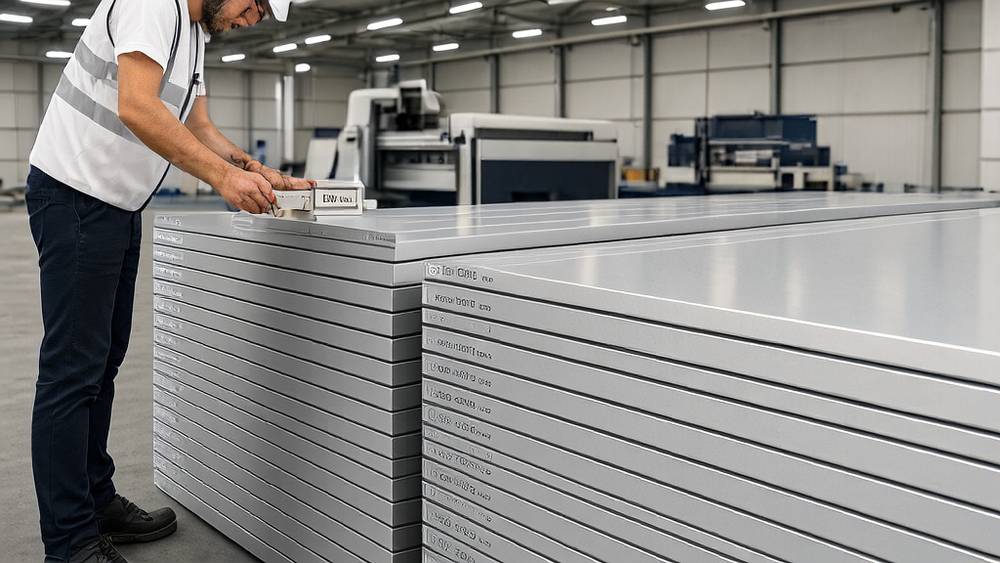
A purchasing manager at a London-based curtain wall contractor asked me last month why two aluminium wall sheet price quotations for the same project differed by 41%. Both suppliers quoted 3.0 mm solid aluminium panels. Both specified PVDF coating. Both included factory fabrication. The gap came from one number buried in the BoQ: sheet size optimisation. One supplier calculated yield from standard 1500×3000 mm sheets. The other worked from 2000×4000 mm sheets. For a facade with 1200×2800 mm panel modules, the wider sheet reduced off-cut waste from 22% to 7%. That single variable shifted the aluminium wall sheet price from $42/m² to $28/m² for the raw sheet portion alone. This article maps every variable that moves the aluminium wall sheet price needle, why "per m²" quotes without sheet size context are meaningless, and how to read a mill-supplied price table so your project budget reflects the sheet you actually need, not the one a distributor wants to sell from stock.
Why the Unit of Measure Creates More Confusion Than Clarity
Mill price lists typically quote aluminium wall sheet price per kilogram. Some distributors quote per square metre. A few quote per sheet. Each unit serves a different purpose, and converting between them requires knowing the exact alloy density, which many buyers skip.
Standard aluminium alloy 1050 has a density of approximately 2.71 g/cm³. Alloy 3003 sits at 2.73 g/cm³. Alloy 5052, commonly specified for coastal facades, runs at 2.68 g/cm³. A 3.0 mm sheet of 5052 in a 1500×3000 mm format weighs 36.18 kg. The same dimensions in 3003 weigh 36.86 kg. At a mill price of $3.20/kg for 5052 versus $2.95/kg for 3003, the per-sheet cost lands at $115.78 versus $108.74 — a $7.04 spread that compounds across 800 sheets into $5,632. That is real money left on the table if the specification allows either alloy and the purchaser defaults to the more expensive option.
Per-square-metre pricing introduces another trap. A distributor selling at $35/m² for 2.5 mm 3003 H14 might appear competitive against a mill quoting $3.10/kg, until the conversion reveals the mill price works out to $20.93/m² for the same specification. The distributor premium covers warehousing, cutting, and immediate availability — legitimate value if lead time matters. But the buyer who never runs the conversion never knows the size of that premium.
| Pricing Unit | What It Reveals | What It Conceals | Best Used For |
|---|---|---|---|
| Price per kg | Raw material cost, alloy grade differential | Fabrication waste, sheet format efficiency | Mill-direct purchases, bulk orders over 5 tonnes |
| Price per m² | Installed area cost, easy BoQ alignment | Thickness variance, alloy substitution risk | Budgeting, distributor comparisons |
| Price per sheet | Actual invoice amount, cutting yield visibility | Cross-supplier comparability (different sheet sizes) | Small orders, project BoQ with fixed panel modules |
Alloy Selection and Its Real Impact on Sheet Price
The aluminium wall sheet price hierarchy by alloy is not linear, and the premium for moving up a grade varies with market conditions. Based on 2026 Q1 mill data from European and Gulf producers, the spread between common facade alloys looks like this:
1050 — The Budget Baseline
At 99.5% aluminium content, 1050 H14 sheets carry the lowest aluminium wall sheet price in the market — typically $2.60–$2.90/kg ex-works. The trade-off is mechanical: tensile strength around 105–145 MPa and no meaningful work-hardening capacity. For interior cladding in dry, low-traffic environments, 1050 does the job. For any exterior application with wind loading, it requires thicker gauges that erase the per-kg savings. A 4.0 mm 1050 panel costs roughly the same as a 3.0 mm 3003 panel but weighs 33% more, adding dead load to the supporting structure.
3003 — The Workhorse for Standard Facades
Alloy 3003 H14 dominates commercial facade specifications because it balances formability (20–25% elongation), corrosion resistance, and cost. Mill pricing in early 2026 ranges from $2.80–$3.20/kg depending on order volume. The manganese addition (1.0–1.5%) provides enough strength for most architectural applications without the welding complications of 5xxx series alloys. For a mid-rise office building with 2,000 m² of solid aluminium cladding, choosing 3003 over 5052 saves approximately $8,000–$12,000 on raw sheet cost — provided the wind load calculations confirm 3003 at the specified gauge meets deflection limits under ASTM B209 or EN 485.
5052 — When Coastal Exposure Demands the Upgrade
The magnesium content (2.2–2.8%) in 5052 H32 pushes the aluminium wall sheet price to $3.10–$3.60/kg, but for projects within 5 km of a coastline or in industrial zones with acidic atmospheric conditions, the corrosion resistance jump is non-negotiable. Tensile strength of 210–260 MPa also permits thinner gauges for the same wind load, partially offsetting the per-kg premium. A 2.5 mm 5052 panel can often replace a 3.0 mm 3003 panel structurally, bringing the per-m² cost within 5–8% of the cheaper alloy.
Sheet Format and Nesting Yield: The Hidden 15–25% Cost Variable
This is the variable that separates experienced procurement teams from everyone else. Standard mill sheet sizes vary by origin: Chinese mills predominantly offer 1220×2440 mm and 1500×3000 mm. European mills stock 1250×2500 mm, 1500×3000 mm, and 2000×4000 mm. Gulf producers commonly supply 1524×3048 mm (5×10 ft) and 2000×4000 mm.
The aluminium wall sheet price per kg stays constant regardless of sheet dimensions. But the number of usable panels extracted from each sheet — the nesting yield — can swing the effective material cost by 15–25%. Consider a project requiring 1,000 panels at 900×2200 mm each:
- From 1220×2440 mm sheets: each sheet yields 1 panel plus a 320×2440 mm off-cut. Yield: 1,000 sheets, 1,000 off-cuts, 45% waste.
- From 1500×3000 mm sheets: each sheet yields 2 panels (900×2200 mm nested side by side with 300 mm remaining). Yield: 500 sheets, 8% waste.
- From 2000×4000 mm sheets: each sheet yields 4 panels with minimal trim. Yield: 250 sheets, 4% waste.
The raw aluminium wall sheet price might be identical across all three formats at $3.00/kg, but the effective material cost per installed panel drops from $32.50 to $14.20 simply by selecting the right sheet size. The sheet format question should be asked before the price question.
Thickness Tolerance and the "Nominal vs Actual" Pricing Trap
Aluminium sheet is sold by nominal thickness, but rolling mill tolerances mean the actual delivered thickness can vary. Under EN 485-3, a 3.0 mm nominal sheet can measure anywhere from 2.85 mm to 3.15 mm and still be within specification. Some mills consistently deliver on the lower side of tolerance — saving 5% on raw material per sheet while invoicing at the full 3.0 mm rate.
This matters for aluminium wall sheet price comparison because a $28/m² quote on 3.0 mm sheet that actually measures 2.85 mm is effectively $29.47/m² when normalised to true 3.0 mm gauge. Over a 5,000 m² project, that is a $7,350 hidden cost. The remedy is simple: specify thickness tolerance in the purchase order (e.g., "3.0 mm ±0.05 mm" rather than accepting standard mill tolerance) and confirm actual gauge on the first shipment with a calibrated micrometer. Mills that consistently hit mid-to-upper tolerance will quote a slightly higher aluminium wall sheet price, but the delivered value per kg is higher.
Coating Systems and Their Contribution to Total Cost
Raw sheet price covers the mill-finish aluminium. The applied coating system adds $8–$22/m² depending on chemistry, film thickness, and warranty requirements. Most architectural specifications fall into one of three tiers:
| Coating System | Resin Type | Typical DFT | Added Cost/m² | Warranty Standard | Best Application |
|---|---|---|---|---|---|
| PE (Polyester) | Polyester | 25–30 μm | $8–$12 | 5–10 years | Interior cladding, soffits, low-UV environments |
| PVDF (Kynar 500®) | 70% PVDF / 30% acrylic | 30–35 μm (2-coat), 40–45 μm (3-coat) | $14–$18 (2-coat), $18–$22 (3-coat) | 20–30 years per AAMA 2605 | Exterior facades, high-UV regions, prestige projects |
| FEVE (Fluoropolymer) | Fluoroethylene vinyl ether | 30–40 μm | $16–$22 | 25–30 years per AAMA 2605 | Coastal/chemical exposure, bright colours needing maximum gloss retention |
Three-coat PVDF systems command the highest aluminium wall sheet price premium among standard architectural coatings, but the incremental $4–$6/m² over two-coat buys a metallic or pearlescent finish that two-coat cannot deliver. The choice is aesthetic rather than protective — both meet the same AAMA 2605 performance benchmarks for chalk and fade resistance. Suppliers like Futeng® typically maintain pre-coated stock of standard PVDF colours (RAL 9006, RAL 9010, RAL 7016) which reduces lead time by 2–3 weeks versus custom colour matching.
Fabrication Cost Adders That Inflate the Installed Price
The aluminium wall sheet price ex-coating line is not the installed cost. Fabrication processes add between $15 and $45/m² depending on complexity:
- Cutting to size with guillotine shear: $2–$4/m². Simple rectangular panels. No kerf loss.
- CNC routing for openings (windows, louvers, penetrations): $5–$12/m² depending on perimeter length and corner radius requirements.
- Brake-press bending for folded edges, returns, and cassette profiles: $8–$18/m². A panel with four-edge 25 mm returns costs roughly double the bending labour of a two-edge fold.
- Perforation (round holes, slotted, custom pattern): $15–$35/m². Open area percentage drives cost more than hole diameter. A 30% open area pattern takes three times the machine time of a 10% pattern.
- Welded corner assembly for cassette panels: $10–$20/m². TIG welding aluminium requires skilled labour; automated welding lines reduce this but require amortisation across high volumes.
A flat 3.0 mm 3003 panel with PVDF coating and simple guillotine cutting might leave the factory at $42–$48/m². The same base sheet fabricated into a welded cassette with perforated face and four-edge returns can reach $95–$115/m². The aluminium wall sheet price conversation must specify which panel you are buying, not just which sheet.
Logistics, Packaging, and the Freight Cost Blind Spot
Ocean freight from Asian mills to European or North American ports adds $3–$8/m² depending on container utilisation, fuel surcharges, and port of discharge. A 40-foot high-cube container holds approximately 1,800–2,200 m² of 3.0 mm sheet depending on packing density. At $4,500 all-in freight cost, that works out to $2.05–$2.50/m². But the real freight cost driver is protective interleaving: uncoated mill-finish sheets can be stacked directly. PVDF-coated sheets require polyethylene or paper interleaving between each panel, reducing container capacity by 15–20% and adding $0.40–$0.70/m² in packing materials.
For projects in the Middle East, South Asia, or East Africa, Chinese and Gulf-based mills offer a landed aluminium wall sheet price advantage of 12–18% over European mills once freight is factored in. The caveat is lead time: 6–8 weeks from Asian mills versus 2–4 weeks from European stock. The procurement decision hinges on whether the project programme can absorb the longer supply chain.
Procurement Rule of Thumb: Request all quotations as "DDP project site" for true comparison. An EXW mill price of $28/m² can end up at $41/m² DDP after coating, fabrication, packaging, freight, customs clearance, and last-mile delivery. The spread between EXW and DDP is not constant across suppliers — mills with integrated coating and fabrication lines capture margin at multiple stages and can offer a tighter spread than a trader buying semi-finished sheet from one source and coating from another.
Market Dynamics Affecting 2026 Aluminium Wall Sheet Price
The London Metal Exchange (LME) aluminium price has traded between $2,100 and $2,600/tonne through 2025, with most analysts projecting a $2,300–$2,700 range for 2026. The LME price directly influences mill ingot cost, which accounts for roughly 55–60% of the final aluminium wall sheet price. The remaining 40–45% comes from rolling, annealing, finishing, and margin.
Three structural factors are shaping 2026 pricing more than short-term LME fluctuations:
- EU Carbon Border Adjustment Mechanism (CBAM): From January 2026, aluminium imports into the EU face carbon pricing based on embedded emissions. Chinese primary aluminium, with an average carbon intensity of 12–16 kg CO₂ per kg Al versus 4–8 kg CO₂ for European-produced aluminium using hydroelectric smelting, attracts a CBAM surcharge of €40–€80/tonne. This narrows the price gap between Chinese and European sheet for EU projects.
- Gulf capacity expansion: New rolling mills in Saudi Arabia and the UAE are adding 400,000+ tonnes of annual sheet capacity, targeting architectural grades specifically. Gulf mills benefit from low domestic energy costs and proximity to Middle Eastern and African construction markets.
- US Section 232 tariffs: The 10% tariff on aluminium imports remains in place, making domestically produced sheet from US mills competitive for American projects despite higher base production costs.
Reading a Mill Price Table: What the Numbers Actually Mean
A typical mill price list for aluminium sheet contains columns for alloy, temper, thickness range, width range, and price per kg. The price shown is rarely the price you pay. Here is what to look for:
Quantity breaks: Mills quote tiered pricing. A 500 kg order might carry a 30–40% premium over a 5-tonne order of the same specification. The aluminium wall sheet price difference between 2 tonnes and 10 tonnes can be $0.40–$0.70/kg. If your project needs 8 tonnes of sheet, do not split the order across three suppliers — the consolidated volume unlocks a better tier.
Width extras: Sheets wider than 1,500 mm often attract a width surcharge of 3–8% because fewer mills run wide rolling lines. The 2,000 mm wide format that delivers superior nesting yield may carry a $0.10–$0.25/kg premium over 1,500 mm. The math still favours the wider sheet if the yield improvement exceeds the surcharge, but it must be calculated per project.
Cut-to-length charges: Mill-standard lengths (2,440 mm, 3,000 mm, 4,000 mm) ship at base price. Non-standard lengths — 2,800 mm, 3,200 mm — incur a cutting charge of $1–$3 per sheet. If your panel module can be adjusted by 100–200 mm to align with a standard length, the savings on 2,000+ sheets justify the design coordination effort.
Sample Project Cost Build-Up: 2,500 m² Solid Aluminium Facade
To ground the discussion in real numbers, here is a cost build-up for a representative mid-rise commercial facade project in Western Europe, Q2 2026:
| Cost Component | Specification | Rate | Total (2,500 m²) |
|---|---|---|---|
| Mill-finish sheet | 3.0 mm 3003 H14, 1500×3000 mm | $3.05/kg ($24.70/m²) | $61,750 |
| PVDF coating | 3-coat, RAL 9006, AAMA 2605 compliant | $19.50/m² | $48,750 |
| Fabrication (cut + bend) | 4-edge 25 mm return, cassette profile | $22.00/m² | $55,000 |
| Packaging | PE interleaving, timber pallets, sea-worthy crating | $3.80/m² | $9,500 |
| Ocean freight + insurance | Shanghai to Rotterdam, 40' HC × 3 | $4.20/m² | $10,500 |
| EU customs + CBAM | 6% duty + carbon adjustment | $2.90/m² | $7,250 |
| Inland transport + site handling | Rotterdam to Frankfurt site | $2.50/m² | $6,250 |
| Total DDP site cost | $79.60/m² | $199,000 |
Note that the raw aluminium wall sheet price of $24.70/m² represents only 31% of the total installed material cost. The remaining 69% sits in processes that every supplier handles differently. Two suppliers quoting the same base sheet price can deliver DDP costs 15–20% apart based on coating line efficiency, fabrication automation, and logistics relationships.
Questions to Ask Before Comparing Supplier Quotes
When three aluminium wall sheet price quotations land on your desk, these seven questions separate comparable offers from misleading ones:
- What sheet format are you quoting? If Supplier A quotes 1500×3000 mm and Supplier B quotes 1220×2440 mm, the per-m² price is not comparable — the nesting yield will differ.
- Is the thickness nominal or guaranteed minimum? A 3.0 mm sheet that measures 2.88 mm on delivery costs 4% more per actual kg than a sheet measuring 3.02 mm.
- Does the coating price include primer and pretreatment? Some fabricators quote topcoat only; the full system requires chromate conversion coating, primer, colour coat, and clear coat for three-coat PVDF.
- What is the fabrication scrap rate assumption? A fabricator quoting 5% scrap versus 12% scrap is either more efficient or under-pricing the risk of remakes.
- Are accessories (stiffeners, brackets, gaskets) included or separate line items? A "panel only" price that excludes necessary stiffeners for large-format panels will mislead the budget.
- What is the delivery condition — EXW, FOB, CIF, or DDP? Only DDP gives the final landed cost.
- What testing and documentation is included? Mill test certificates per EN 10204 3.1, coating performance test reports, and AAMA compliance certificates should be line items, not assumptions.
Why the Cheapest Aluminium Wall Sheet Price Rarely Delivers the Lowest Project Cost
Procurement teams measured solely on purchase price variance will gravitate toward the lowest aluminium wall sheet price per square metre. But the project budget cares about total installed cost, which includes site labour, rework from dimensional inconsistencies, schedule delays from late deliveries, and the cost of managing a supplier that requires constant chasing.
A sheet that arrives flat, within thickness tolerance, with coating adhesion verified, on the promised delivery date, and in the sheet format that optimises panel yield will cost more per square metre than a mill-reject batch sold at a discount. But the discount supplier's sheet creates downstream costs: panels that warp after routing because residual stress was not relieved, coating that chalks after 7 years instead of 25, off-cut rates that blow the material budget by 18%.
The aluminium wall sheet price conversation, done properly, is not about finding the lowest number on a quote comparison spreadsheet. It is about understanding which supplier's number includes the things that prevent site problems and which supplier's number excludes them. The difference between those two numbers is the cost of procurement diligence — and it is always cheaper than the cost of procurement negligence.
<|DSML|parameter name="description" string="true">Aluminium wall sheet price varies by alloy, sheet format, coating system, and fabrication complexity. Learn why per m² quotes mislead and how to compare real landed costs.