Why Cut Edge Corrosion Destroys Decorative Metal Panels Outdoor Within 36 Months
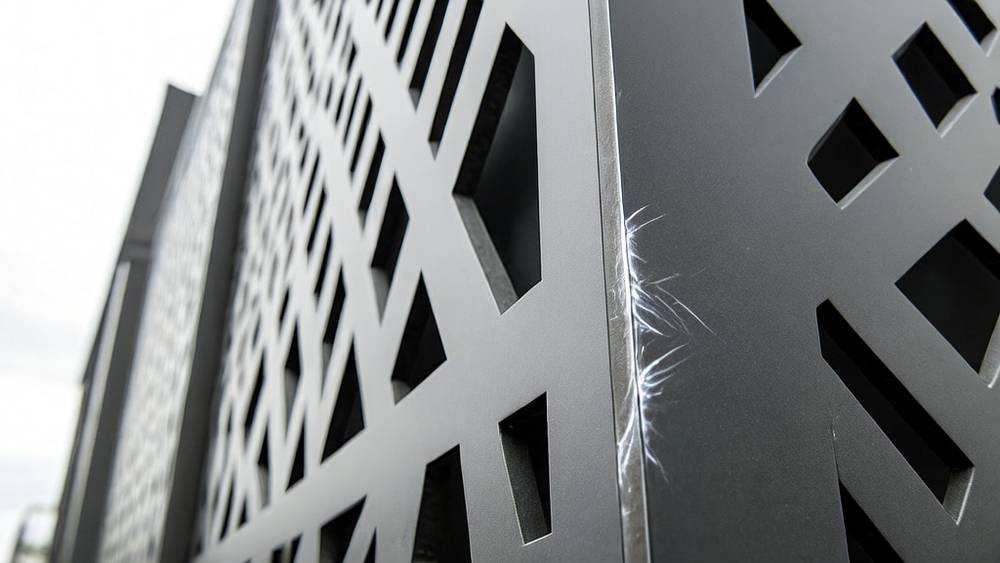
When a project team specifies decorative metal panels outdoor, the conversation almost always starts with aesthetics—perforation patterns, powder coat colors, the visual language of the facade. But six months after installation, what actually determines whether those panels still look like the architect's rendering is something far less glamorous: how the cut edges were treated. A 5052-H32 aluminium panel can carry a factory-applied PVDF coating rated for 30 years of Florida sun, yet if the fabricator leaves raw shear-cut edges exposed, corrosion will initiate at the perimeter and creep inward. Not might. Will. This is not a coating failure. It is a fabrication sequence failure, and it is one of the most common warranty claims on decorative exterior metalwork that nobody talks about at the specification stage.
The Edge Corrosion Problem Nobody Specifies
Architectural specifications for decorative metal panels outdoor routinely call out ASTM B209 for the aluminium substrate and AAMA 2605 for the fluoropolymer coating system. These are sensible baseline requirements. The problem is that neither standard addresses what happens at the cut line. When a 2.5 mm or 3.0 mm solid aluminium sheet is routed, punched, or waterjet-cut to create decorative perforations, the tool path exposes raw aluminium alloy at every single cut edge. On a panel with 200 laser-cut geometric openings, that means hundreds of linear millimeters of uncoated metal sitting directly in the weather.
Aluminium naturally forms a passive oxide layer in air. That oxide is stable in neutral pH conditions. But decorative panels installed outdoors encounter rain with dissolved atmospheric pollutants, chloride-laden coastal spray, and condensation cycles that trap moisture against the panel face. At every exposed edge, the electrochemical potential difference between the bare alloy and the adjacent coated surface creates a micro-scale galvanic cell. The cut edge becomes the anode. Corrosion initiates not as dramatic flaking but as fine white filiform tracks that propagate under the coating, eventually causing it to delaminate from the substrate.
This failure mode is well documented in marine and industrial environments. What surprises many project teams is that it also occurs in inland urban locations where de-icing salts, acid rain, or even prolonged condensation from building HVAC discharge create localized aggressive conditions. A study published by the National Association of Corrosion Engineers (NACE) on architectural aluminium in urban environments found that cut-edge corrosion accounted for 23% of premature coating failures in ventilated facade systems over a 10-year observation period.
Why Factory Coating Alone Cannot Solve This
There is a persistent assumption that a high-performance PVDF or FEVE coil coating, properly cured and meeting the AAMA 2605 specification for film thickness and adhesion, will somehow protect the entire panel including its edges. This assumption is wrong for any panel that undergoes post-coating fabrication.
In a typical production workflow for decorative aluminium panels, the flat sheet is coil-coated or spray-coated first, then moved to CNC routing, laser cutting, or turret punching stations for the decorative pattern work. Every cutting operation removes coating from the kerf width. Waterjet cutting leaves a slightly rougher edge profile that increases the surface area available for corrosion initiation. Laser cutting introduces a heat-affected zone where the alloy microstructure near the cut line may differ from the bulk material, potentially altering its electrochemical behavior.
The critical specification gap is this: AAMA 2605 governs the coating on the panel face. It does not address edge treatment. ASTM B209 governs the aluminium sheet before coating. It does not address post-fabrication edge condition. ISO 12944, which covers corrosion protection of steel structures by paint systems, has an entire section on edge protection for structural steel. There is no directly equivalent standard for architectural aluminium cladding edges. This means the edge treatment method becomes a fabrication-level decision, and if the specifier does not call it out, the fabricator's default is often to do nothing.
Three Edge Treatment Methods Compared
For solid aluminium panels used as decorative metal panels outdoor, there are three practical approaches to cut-edge protection. Each carries different cost, lead time, and performance implications. The table below summarizes the key trade-offs based on field performance data from projects in coastal and high-humidity environments.
| Edge Treatment Method | Process Description | Corrosion Resistance (ASTM B117 Salt Spray) | Relative Cost Per Panel | Lead Time Impact | Best Application |
|---|---|---|---|---|---|
| Post-Cut Touch-Up Paint | Manual brush application of liquid PVDF or acrylic touch-up coating to cut edges after fabrication | 500-800 hours to first blistering | Baseline (+5-8%) | Minimal (+1-2 days) | Low-humidity inland projects with limited decorative perforation density |
| Pre-Cut Masking + Strip Coating | Masking film applied before cutting; edges stripped and coated with compatible primer after fabrication | 1,200-1,800 hours to first blistering | Moderate (+15-22%) | Moderate (+3-5 days) | Medium-density perforation panels in urban or light-industrial environments |
| Post-Coating Anodizing of Cut Edges | Full panel re-anodized at edges after cutting; creates integral aluminium oxide layer at cut surfaces | 2,500+ hours to first blistering | High (+25-35%) | Significant (+7-10 days) | High-density decorative cutouts in coastal or chemical-exposure zones |
The cost figures above assume a panel with approximately 30% open area from decorative perforations. For panels with denser cut patterns, the edge treatment cost increases proportionally because more linear footage of cut edge requires treatment. On a project with 2,000 panels at 1.2 m² each, the difference between touch-up paint and post-coating anodizing can exceed $18,000—not trivial, but potentially far less than the cost of a facade reclad five years later.
What Actually Happens When Edges Are Left Raw
The timeline of cut-edge corrosion on decorative aluminium panels follows a predictable progression that field inspectors learn to recognize. Understanding this sequence helps explain why edge treatment is not a cosmetic option but a durability requirement for any project expecting a service life beyond 10 years.
Months 1-6: The raw cut edges develop a natural oxide film. In dry conditions, this oxide is stable and the panel looks fine. There is no visible change that would trigger a site observation report. But the oxide formed in ambient air is thin (2-4 nanometers) and porous compared to the engineered oxide from anodizing. It provides minimal barrier protection against chlorides.
Months 6-18: In the presence of moisture and chloride ions, the passive oxide at the cut edge begins to break down locally. Pitting initiates at microscopic intermetallic particles in the alloy. For 5052 alloy, these are typically iron-rich or silicon-rich particles that act as local cathodes. The surrounding aluminium matrix corrodes preferentially. At this stage, the damage is still invisible under the coating, but the bond between the PVDF coating and the substrate near the edge begins to weaken.
Months 18-36: Filiform corrosion becomes visible. Thin, worm-like tracks of white corrosion product (aluminium hydroxide) appear under the coating, radiating inward from cut edges. The coating remains intact on the surface, creating a blister-like appearance. Once filiform corrosion reaches this stage, it cannot be arrested by surface treatment—the affected panels must be replaced because the corrosion tracks have permanently undermined coating adhesion.
Beyond 36 months: Coating delamination occurs. Sections of PVDF coating peel away from the panel, exposing corroded aluminium substrate. The panel loses both aesthetic function and weather-barrier function. At this point, water can penetrate behind the panel, potentially causing secondary damage to the support structure or insulation layer.
The Perforation Density Factor
One variable that dramatically affects edge corrosion risk on decorative metal panels outdoor is the ratio of cut-edge length to panel surface area. A solid panel with only perimeter cuts has relatively little exposed edge. A panel with an intricate laser-cut filigree pattern may have 10 to 20 times more exposed edge per square meter.
Consider two panels, both 1,200 mm × 800 mm:
- Panel A (solid with perimeter cuts only): Total cut edge = 4,000 mm. Edge-to-area ratio = 4.17 m/m².
- Panel B (geometric pattern with 150 circular perforations, 40 mm diameter each): Total cut edge = 4,000 mm (perimeter) + 150 × π × 40 mm = 4,000 + 18,850 = 22,850 mm. Edge-to-area ratio = 23.8 m/m².
Panel B has nearly six times the exposed edge length of Panel A. If both receive the same edge treatment, Panel B will reach the filiform corrosion stage far sooner. This is why decorative panels with high perforation density demand a more robust edge treatment specification—post-coating anodizing or strip coating rather than simple touch-up paint. The project specification should explicitly link edge treatment requirements to perforation density, something few current master specifications do.
The American Architectural Manufacturers Association (AAMA) has published technical papers on the relationship between fabrication complexity and coating durability, though a formal standard addressing this directly remains under development. In the meantime, responsible fabricators like Futeng® address this by classifying panels into edge-exposure categories during the engineering review phase and recommending treatment levels accordingly.
Alloy Selection and Edge Behavior
Not all aluminium alloys behave identically at cut edges. The 5000-series alloys (5052, 5083, 5754) commonly used for architectural cladding contain magnesium as the primary alloying element. These alloys have good general corrosion resistance but can be susceptible to intergranular corrosion in certain tempers if exposed to elevated temperatures for extended periods—a condition known as sensitization.
5052-H32, the workhorse alloy for solid aluminium cladding panels, is generally resistant to sensitization because its magnesium content (2.2-2.8%) is below the threshold where beta-phase (Mg₂Al₃) precipitation at grain boundaries becomes a significant concern. However, at cut edges, the cold-worked microstructure of the H32 temper means the grain structure at the very edge may have different electrochemical characteristics than the bulk material. The shear-cutting process itself introduces plastic deformation at the cut line, creating a zone of higher dislocation density that can be slightly more anodic.
For projects in severe marine environments (within 500 meters of a coastline with prevailing onshore winds), some specifiers are now calling for 5083-H116 instead of 5052-H32. The H116 temper is specifically designed for marine service and provides improved resistance to exfoliation corrosion. The trade-off: 5083 is typically 10-15% more expensive than 5052 and may have longer mill lead times. The decision should be based on a site-specific corrosion risk assessment, not a blanket specification.
The Aluminum Association publishes detailed alloy selection guides that include environmental exposure classifications. Their guidance for architectural applications in coastal zones recommends 5000-series alloys with specific temper designations, though the final selection should involve input from a corrosion engineer familiar with the project's specific microclimate.
Fabrication Sequence: When Edge Treatment Happens Matters
The sequence of operations in the fabrication shop directly determines edge protection quality. There are two fundamentally different approaches, and they produce different results.
Approach 1: Coat First, Cut Later
This is the conventional sequence. The aluminium sheet is cleaned, pretreated, and coated with the full PVDF or FEVE system. The coated sheet then goes to CNC cutting for decorative patterns. After cutting, edges receive touch-up treatment. The weakness is that touch-up coating is applied in the shop under less-controlled conditions than the original factory coating. The touch-up film thickness is inconsistent. Adhesion to the cut edge depends on surface preparation that is often minimal. This approach works adequately for panels with low edge exposure but becomes risky as perforation density increases.
Approach 2: Cut First, Coat After
In this sequence, the aluminium sheet is cut to final shape and all decorative perforations are completed before any coating is applied. The entire panel—faces, edges, and interior cut edges—then goes through the full pretreatment and coating process. This means every surface, including every cut edge, receives the same corrosion protection system. The challenge is handling: panels with extensive cutouts can be fragile during the coating line process, and the cut edges must be deburred before coating to ensure proper film build at edges. This approach costs more and takes longer but delivers superior edge protection.
The choice between these approaches should be driven by the project's required service life and environmental exposure category as defined in ISO 9223. A 15-year facade in a C3 (medium) corrosion environment may perform adequately with Approach 1 plus quality touch-up. A 30-year facade in a C5 (very high) corrosion environment demands Approach 2 or post-coating anodizing of edges.
Specification Language That Actually Works
Most project specifications for decorative metal panels outdoor are silent on edge treatment beyond a generic line about "all exposed edges to be protected against corrosion." That language is unenforceable. A fabricator can interpret it as satisfied by the natural oxide that forms on aluminium within hours of cutting. Here is specification language that closes the gap:
"All cut edges of aluminium cladding panels, including edges created by perforation, routing, or any secondary fabrication operation, shall receive edge treatment in accordance with the panel's Edge Exposure Classification. Panels with total cut-edge length exceeding 8 meters per square meter of panel area shall be classified as High Edge Exposure and shall receive Method C (full post-fabrication anodizing of all cut edges) or Method B (strip coating with compatible two-component epoxy primer followed by PVDF topcoat to minimum 25 microns dry film thickness at edges). Touch-up paint applied by brush shall be permitted only for panels classified as Low Edge Exposure (total cut-edge length less than 4 meters per square meter of panel area). The fabricator shall submit edge treatment procedure and quality control records for each panel classification."
This language ties the treatment method to a measurable, shop-verifiable metric (cut-edge length per unit area). It removes ambiguity. It gives the contractor a clear compliance path. And it gives the specifier a basis for rejecting substandard work.
Quality Verification During Fabrication
Specifying edge treatment is necessary but insufficient. The project team must also verify that the treatment is actually being applied correctly. Three practical inspection points during fabrication can catch problems before panels ship:
- Pre-treatment inspection: Before edge treatment is applied, cut edges should be free of cutting fluid residue, loose burrs, and visible oxidation. A simple water-break test (ASTM F22) on a sample of cut edges can confirm cleanliness. If water beads up rather than sheeting off uniformly, the surface is not clean enough for coating adhesion.
- Dry film thickness measurement: After edge treatment, measure coating thickness at cut edges using a portable DFT gauge with a probe small enough to access the edge profile. The minimum thickness at edges should be specified—typically 25 microns for liquid-applied edge coatings. Document measurements for at least 5% of panels, with emphasis on high-edge-exposure panels.
- Adhesion testing after cure: Cross-hatch adhesion testing (ASTM D3359) on a representative sample panel provides quantitative adhesion data. For edge-applied coatings, a rating of 4B or better is a reasonable acceptance criterion. This test is destructive and should be performed on a dedicated test panel from the same production batch, not on panels destined for installation.
The Society for Protective Coatings (SSPC) offers training and certification programs for coating inspectors that are directly applicable to architectural metal fabrication quality control. Having an SSPC-certified inspector review edge treatment procedures during the first production run can identify issues before they become systemic.
Cost of Getting It Wrong
Edge corrosion on decorative metal panels outdoor is not a hypothetical risk. The cost of remediation after installation dwarfs the incremental cost of proper edge treatment during fabrication. A panel replacement on an occupied building involves:
- Scaffolding or swing stage access at $15-40 per square meter of facade area per month
- Removal of affected panels, which may require specialized tools if the original installation used blind fasteners
- Production of replacement panels with the correct edge treatment (now at premium lead-time pricing)
- Reinstallation, which on a ventilated facade system means disturbing the weather barrier and insulation at each replacement location
- Potential consequential damage to the air and water barrier behind the cladding if corrosion has allowed moisture ingress
A conservative estimate for replacing 10% of panels on a 2,000 m² decorative facade, five years after original installation, runs between $85,000 and $140,000 depending on building height and access complexity. The incremental cost of specifying post-coating anodizing on the original fabrication for that same project would typically range from $18,000 to $30,000. The math is straightforward. The hard part is getting the specification right before the purchase order is issued.
Closing the Knowledge Gap Between Design and Fabrication
The edge treatment problem persists not because solutions are unavailable but because responsibility for edge protection falls into a gap between the design team and the fabricator. Architects specify the visual result—the pattern, the color, the panel layout. Fabricators focus on producing panels that match the shop drawings. Edge treatment is a durability issue that manifests years after both parties have moved on to other projects. No one sees the corrosion at the punch list stage.
Closing this gap requires three things: specification language that defines edge treatment requirements in measurable terms tied to panel geometry, fabrication shop procedures that treat edge protection as a distinct quality control step rather than an afterthought, and on-site verification that the specified treatment has been applied before panels are installed. None of this is technically difficult. All of it requires someone on the project team to care about what happens at the cut line.
For project teams working with decorative metal panels outdoor in anything beyond the mildest environments, the edge treatment conversation should happen at the design development stage, not during submittal review. By the time shop drawings arrive, the fabrication sequence is already locked in. The time to decide whether touch-up paint is adequate or whether the panels need post-fabrication anodizing is when the budget still has room for the line item.