Hard Anodised Aluminium Exterior Panels 400 HV vs PVDF Coatings
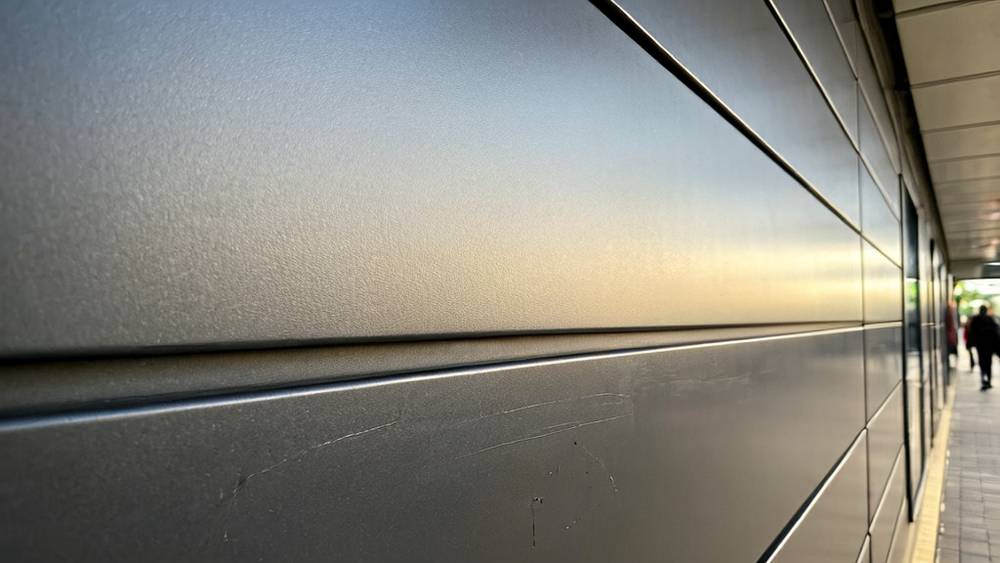
When a project specification calls for aluminium exterior cladding in high-traffic public environments, the conversation almost always lands on one question: what happens when someone deliberately scratches it, tags it with spray paint, or leans heavy equipment against the finished wall? These are not hypothetical scenarios. Transit stations, hospital entrances, retail plazas, and campus walkways subject building envelopes to mechanical abuse that standard PVDF coatings were never engineered to withstand.
The industry has quietly shifted toward anodised solid aluminium panels — not for aesthetics alone, but because the aluminium oxide layer formed during hard anodising registers 400–500 HV on the Vickers hardness scale. By comparison, a 70% PVDF liquid coating sits around 20–30 HV. That 15× differential determines whether a facade still looks serviceable after five years of ground-level exposure. This article examines the metallurgical basis for that performance gap, the specific anodising processes that matter for aluminium exterior applications, and the cost-calculation framework that general contractors need before submitting a value-engineering proposal.
The Metallurgical Difference Between Coated and Anodised Aluminium Surfaces
Paint — including high-performance PVDF systems — sits on top of aluminium. Hard anodising grows from within it. That distinction controls everything about scratch resistance, UV stability, and long-term maintenance economics for aluminium exterior panels.
In the anodising bath, a controlled electrochemical reaction converts the aluminium substrate surface into aluminium oxide (Al₂O₃). Unlike a coating that bonds mechanically or chemically to the substrate, the oxide layer is integral — it is literally part of the metal. The process penetrates roughly 50% into the original surface and builds 50% outward, meaning a 25 μm anodic film consumes approximately 12.5 μm of base aluminium and adds 12.5 μm above the original plane. This is why tight dimensional tolerances on panel edges and fastener holes must account for the growth before finishing, not after.
Three distinct anodising classes appear in aluminium exterior specifications:
- Class I (clear/natural anodising, AA-M10C10A31): Film thickness 10–15 μm. Suitable for interior applications or protected exterior locations. Not recommended for ground-level public-facing facades.
- Class I (architectural, AA-M10C10A41): Film thickness 17–25 μm. The workhorse for most commercial aluminium exterior cladding. Provides solid UV resistance and moderate abrasion tolerance.
- Class II (hard anodising, AA-M10C10A51): Film thickness 25–50 μm, sometimes specified up to 75 μm for extreme environments. This is the grade that delivers Vickers hardness values exceeding 400 HV.
The specifier's dilemma is that thickness alone does not guarantee performance. The electrolyte chemistry, current density, and bath temperature during anodising determine whether the oxide structure forms as a dense barrier layer or a more porous columnar structure suitable for colour absorption. Hard anodising typically runs at 0–5°C with higher current density, producing a finer, harder crystalline structure. Architectural Class I anodising operates at 18–22°C and yields a somewhat softer film — still far harder than any organic coating, but measurably less abrasion-resistant than true hard anodising.
Why Standard PVDF Coatings Fail in High-Abrasion Exterior Settings
PVDF (polyvinylidene fluoride) coil or spray coatings dominate the aluminium exterior market for good reason: they deliver 20–30 years of colour retention in normal atmospheric exposure when formulated to meet AAMA 2605. The resin system — typically 70% PVDF with 30% acrylic — provides exceptional resistance to UV degradation, acid rain, and chalking. But "normal atmospheric exposure" does not include skateboard edges, hospital gurney impacts, or maintenance crews leaning ladders against finished walls.
The failure mode is straightforward: PVDF coatings are 25–35 μm thick (dry film thickness, DFT). At 20–30 HV hardness, a sharp steel object with hardness above 200 HV cuts through the coating to bare aluminium in a single pass. Once the substrate is exposed, two problems cascade. First, the aluminium begins oxidising at the scratch line — harmless cosmetically at first, but the oxide wedge can lift adjacent coating from the substrate through filiform corrosion. Second, graffiti removal chemicals (often MEK or xylene-based) penetrate under the coating edge and attack the primer-to-aluminium bond.
Specifiers who anticipate ground-level abuse sometimes try to solve this with thicker coatings. A 50 μm PVDF film provides more material to scratch through, but the fundamental hardness mismatch remains. The coating is still a polymer, and polymers abrade faster than ceramics. Anodised surfaces invert the equation: the surface is harder than most objects contacting it, including steel wool and mild steel tools.
"Hard anodising is not a coating. It is a controlled corrosion process that transforms the aluminium surface into a ceramic-hard barrier. Once specifiers understand this, they stop comparing it to paint and start comparing it to the abuse the building will actually see."
The 5052 vs 6061 vs 5005 Alloy Decision for Anodised Facades
Not all aluminium alloys anodise equally, and choosing the wrong alloy for an aluminium exterior panel can produce blotchy grey finishes that no architect will accept — even if the mechanical properties are perfectly adequate.
Alloy 5005 (nominally Al-0.8Mg) delivers the most consistent clear anodised finish across batch runs. Its low iron content (0.7% max) and absence of copper produce a bright, clear silver tone that architects associate with premium anodised aluminium. For painted anodised panels — where the anodic film is dyed and sealed — 5005 also provides the most uniform colour absorption. The trade-off is mechanical: 5005-H14 offers tensile strength around 145 MPa, which limits maximum panel sizes for unsupported spans.
Alloy 5052-H32 (Al-2.5Mg-0.25Cr) provides a practical middle ground. Tensile strength reaches 210–230 MPa, enabling larger panel formats with thinner gauges — a 2.5 mm 5052 panel can often replace a 3.0 mm 5005 panel for the same deflection criteria. The anodised appearance is slightly warmer (a faint champagne tone) due to the higher magnesium content, but this is consistent and predictable across production lots. For most aluminium exterior applications where anodising is specified, 5052 is the pragmatic choice: better strength-to-weight ratio, acceptable anodised aesthetics, and broad mill availability.
Alloy 6061-T6 (Al-1.0Mg-0.6Si) presents the most complex trade-offs. At 290 MPa minimum tensile strength, it handles extreme structural demands — long cantilevered panels, heavy wind zones, blast-rated facades. But 6061 anodises inconsistently. The silicon and copper content (0.4–0.8% Si, 0.15–0.40% Cu) creates dark grey or even brownish tint variations that shift from panel to panel. For clear anodised aluminium exterior cladding, 6061 is generally avoided unless the specification explicitly calls for a dark anodised or dyed finish that masks the colour variation.
| Property | 5005-H14 | 5052-H32 | 6061-T6 |
|---|---|---|---|
| Tensile Strength (MPa) | 145–185 | 210–260 | 290–310 |
| Yield Strength (MPa) | 120–160 | 160–200 | 240–270 |
| Clear Anodised Appearance | Bright silver, excellent uniformity | Slight champagne tone, good uniformity | Dark grey, batch-to-batch variation likely |
| Hard Anodising Suitability | Good (expect matte grey-brown) | Excellent (consistent dark grey) | Fair (colour inconsistency risk) |
| Typical Panel Gauge for 1200 mm Span | 3.0 mm | 2.5 mm | 2.0 mm |
| Relative Cost (per m²) | Base | +8–12% | +15–20% |
Hard Anodising Surface Hardness and Real-World Abrasion Performance
The Vickers hardness of a properly executed hard anodised surface (400–500 HV) places it in the same league as tool steel and well above glass (approximately 500–600 HV for soda-lime glass). But hardness numbers alone do not tell the full story for aluminium exterior cladding subjected to repetitive abrasion.
Taber abrasion testing (ASTM D4060) using CS-17 wheels with a 1000 g load provides a more practical comparison. A 70% PVDF coating typically loses 25–40 mg of material after 1000 cycles. A Class II hard anodised surface (25 μm film, unsealed) loses 2–5 mg under identical conditions. The 10× difference in mass loss translates directly to the visual endurance specifiers care about: the anodised panel still looks uniform after abrasive events that would have stripped a PVDF coating to bare metal.
One caveat merits emphasis: hard anodising achieves maximum hardness only when left unsealed or minimally sealed. Hot water sealing — standard practice for architectural Class I anodising — hydrates the aluminium oxide, converting it from the hard gamma-phase to the softer boehmite structure. This improves corrosion resistance and dye retention but drops surface hardness to approximately 200–300 HV. For aluminium exterior applications where abrasion resistance is the primary specification driver, specifiers should request "hard anodised, unsealed" or "hard anodised with dichromate seal only." Dichromate sealing provides corrosion protection without the full hardness penalty of hydrothermal sealing.
Futeng® has supplied hard anodised solid aluminium panels to several transit-interchange projects where the specification explicitly required unsealed Class II anodising — a detail that eliminated costly re-coating cycles that neighbouring PVDF-clad structures required within three years of opening.
Graffiti Resistance and Chemical Cleaning Cycles
Graffiti removal from aluminium exterior panels imposes two simultaneous demands: the surface must resist the paint or marker adhesion in the first place, and it must survive the aggressive solvents used to remove whatever does stick.
Hard anodised surfaces offer a distinct advantage here that is rarely discussed in manufacturer literature: the oxide layer is chemically inert to most organic solvents. MEK (methyl ethyl ketone), xylene, acetone, and commercial graffiti removers that would soften, swell, or strip PVDF coatings have essentially zero effect on aluminium oxide. Maintenance crews can apply aggressive solvent blends with abrasive pads without degrading the building envelope.
The anti-graffiti performance can be further enhanced by specifying a secondary treatment. Fluoropolymer-based anti-graffiti sealers applied over hard anodising fill the microscopic pores of the oxide layer, preventing spray-paint from mechanically keying into the surface. These treatments typically add $8–15/m² to the panel cost but reduce graffiti removal time from 15–20 minutes per incident to under 2 minutes — a calculation that pays back within the first year for high-risk locations.
A real specification example illustrates the logic: a bus terminal in a northern European city specified 3.0 mm 5052-H32 panels with 40 μm Class II hard anodising (unsealed) plus a sacrificial anti-graffiti wax coating for all surfaces below 3 metres. Above 3 metres, standard 25 μm architectural anodising was used. The split specification saved approximately 18% on the total facade material cost compared to hard-anodising the entire elevation, while protecting exactly the surfaces that experience vandalism.
Cost Comparison Framework for Specifiers and Quantity Surveyors
Budgeting for anodised aluminium exterior panels requires a different cost model than PVDF-coated panels. The finishing cost is not a simple per-square-metre adder — it depends on alloy selection, film thickness class, colour requirements, and whether the anodiser can process the panel dimensions in a single dip.
For a typical 2.5 mm solid aluminium panel (5052-H32), the baseline material cost ex-mill sits around $28–35/m². Adding a standard AAMA 2605-compliant 70% PVDF spray coating (primer + colour coat + clear coat, 30–35 μm DFT) costs $22–30/m², bringing the finished panel to $50–65/m². Architectural Class I anodising (20 μm, clear) costs $18–25/m² — slightly less than PVDF at the lower end — bringing the total to $46–60/m². Hard anodising (35 μm, unsealed) commands $30–45/m² due to longer bath times, higher energy costs (chillers running at 0–5°C), and lower throughput. The finished panel lands at $58–80/m².
At first glance, hard anodising appears more expensive — and on a per-square-metre basis, it is. But the lifecycle calculation shifts the comparison dramatically for aluminium exterior applications in high-abrasion zones. Consider a 1,000 m² ground-level facade with a 20-year design life:
- PVDF scenario: Initial finishing cost $22,000–30,000. Recoating or panel replacement for damaged areas at years 5 and 12: $35,000–50,000 total. 20-year finishing cost: $57,000–80,000.
- Hard anodised scenario: Initial finishing cost $30,000–45,000. No recoating anticipated for 20+ years. 20-year finishing cost: $30,000–45,000.
The crossover point — where hard anodising becomes cheaper than PVDF — occurs at roughly year 7–9, assuming moderate vandalism exposure. For transit and healthcare projects where abuse is guaranteed, the payback arrives even sooner.
Factors That Influence Anodising Cost Beyond Film Thickness
Panel dimensions directly affect anodising cost, and this catches procurement teams off guard. Anodising tanks have physical size limits — typically 3–4 metres long, 1.5–2 metres deep, and 1–1.5 metres wide. Panels exceeding any dimension require custom tank setups or two-stage processing, which can double the finishing cost. Architects designing large-format aluminium exterior panels (above 3 metres in any direction) should verify anodiser capacity before finalising panel sizes. A 3.6-metre panel that splits across two standard tanks may cost more to anodise than two 1.8-metre panels combined — a detail that should inform the joint pattern design from the start.
Colour anodising adds another layer of cost. Clear anodising is the baseline. Electrolytic colouring (two-step process using tin, cobalt, or nickel salts) adds $10–18/m² and produces light bronze to black tones with excellent UV stability. Organic dye colouring (absorbed into the porous oxide before sealing) offers a wider palette — golds, reds, blues, greens — but adds $15–25/m² and carries UV-fading risks for aluminium exterior applications in direct sunlight. For exterior use, only inorganic pigments or electrolytic colouring should be specified; organic dyes fade within 3–7 years of sun exposure regardless of sealer quality.
Sealing Specifications That Determine Long-Term Exterior Performance
The sealing step — performed after anodising and any colouring — closes the porous oxide structure and locks in corrosion resistance. Sealing quality directly determines whether an anodised aluminium exterior panel develops chalky white bloom (sealing smut) or pitting within the first five years.
Four sealing methods dominate the specification landscape:
- Hot water sealing (boiling deionised water, 96–100°C, 2–3 minutes per μm of film thickness): The industry standard for architectural Class I anodising. Hydrates the oxide to boehmite, swelling the pore walls closed. Produces excellent corrosion resistance (1000+ hours neutral salt spray per ISO 9227) but reduces surface hardness as discussed earlier.
- Mid-temperature sealing (nickel acetate or nickel fluoride, 60–80°C): Faster cycle times and lower energy costs than hot water sealing. The nickel salts deposit inside the pores, forming a physical plug. Effective but introduces nickel compounds that some green-building certifications (LEED v4, BREEAM) scrutinise.
- Cold sealing (nickel fluoride at room temperature, 25–30°C): The fastest and cheapest method. However, cold-sealed anodising has a documented history of progressive sealing degradation in exterior exposure — the seal "ages" and pores slowly reopen over 5–10 years. Not recommended for aluminium exterior cladding without a secondary hot water or dichromate seal.
- Dichromate sealing (sodium or potassium dichromate, 90–100°C): The reference standard for corrosion-critical applications. Provides 3000+ hours neutral salt spray resistance. The hexavalent chromium content makes it environmentally contentious (REACH Annex XIV in the EU restricts its use), but for marine and industrial aluminium exterior environments, nothing else matches its protective performance.
The quality control test that matters most for specifiers is ASTM B680 (seal quality by acid dissolution). A properly sealed architectural anodised panel should lose no more than 2–3 mg/dm² in the acid dissolution test. Values above 5 mg/dm² indicate incomplete sealing and a high probability of premature corrosion in exterior service.
Installation Practices That Preserve Anodised Surface Integrity
Anodised aluminium exterior panels arrive on site with a ceramic-hard surface — and that surface can be permanently marred in seconds if handling protocols are not enforced. Unlike PVDF coatings, which can be touched up in the field (albeit imperfectly), anodised surfaces cannot be repaired on site. A scratch through the oxide layer is permanent because re-anodising requires full immersion in the process line.
Several field practices reduce damage rates from the typical 3–5% of panels to under 1%:
- Protective film: Specify UV-resistant polyethylene film (minimum 50 μm thickness) applied at the anodiser, not at the fabricator. The film must remain in place through fabrication (cutting, bending, punching) and only be removed after final installation. Films left on for more than 90 days in direct sunlight can leave adhesive residue; schedule accordingly.
- Handling equipment: Suction cup lifters with neoprene pads, not nylon slings. Nylon against anodised edges under load creates micro-abrasion visible as hazy patches under glancing light.
- Edge protection: Anodised cut edges — where the aluminium core is exposed — must be protected with a compatible touch-up sealer. These edges have no anodic film and will corrode within weeks of exterior exposure if left untreated.
- Fastener selection: Stainless steel (304 or 316 grade) fasteners only. Galvanised steel fasteners in contact with anodised aluminium create galvanic couples that pit the aluminium within months, particularly in coastal aluminium exterior installations.
Specifying Anodised Aluminium for Different Exposure Categories
Not every aluminium exterior application demands hard anodising. Matching the anodising specification to the actual exposure conditions avoids both under-specification (resulting in premature failure) and over-specification (wasting the client's budget).
For sheltered exterior applications — soffits, under-canopy panels, surfaces above 3 metres in low-traffic areas — architectural Class I anodising (20 μm, hot water sealed) on 5005 or 5052 alloy provides adequate performance at the lowest cost. These surfaces see rain washing but no mechanical contact, and the anodised finish will outlast the building's design life with zero maintenance.
For ground-level commercial facades — retail frontages, office lobbies, restaurant exteriors — Class I anodising at 25 μm with electrolytic colouring provides a reasonable balance of durability and aesthetics. The colour masks minor scuffs that would show on clear anodised surfaces, and the 25 μm film thickness offers enough material to absorb occasional light abrasion without exposing bare substrate.
For high-abuse public environments — transit stations, stadium concourses, hospital emergency entrances, school corridors — hard anodising (35–50 μm, unsealed or dichromate-sealed) on 5052-H32 is the only specification that avoids a major recoating programme within the first decade. The additional $12–20/m² for hard anodising over architectural anodising should be presented to the client not as a cost premium but as an insurance policy against known, predictable damage.
The aluminium exterior industry has spent decades optimising PVDF coating chemistries for UV resistance and colour stability — and those advances remain valuable for upper-facade applications. But the ground-level performance problem is fundamentally about mechanical durability, not weatherability. Anodising addresses it through metallurgy rather than polymer chemistry, and that distinction deserves a permanent place in every specifier's technical toolkit.
Specifications should reference the relevant standards explicitly: AAMA 611 for anodised architectural aluminium, ISO 7599 for anodising film thickness and sealing quality, and ASTM B580 for anodic coating thickness measurement. For projects in the Middle East and Southeast Asia — where humidity and airborne chlorides accelerate corrosion — the additional requirement of ISO 9227 neutral salt spray testing to 1500+ hours provides a defensible minimum performance threshold.