4x8 vs 5x10 Aluminum Perforated Plate Which Sheet Size Cuts Total Installed Cost
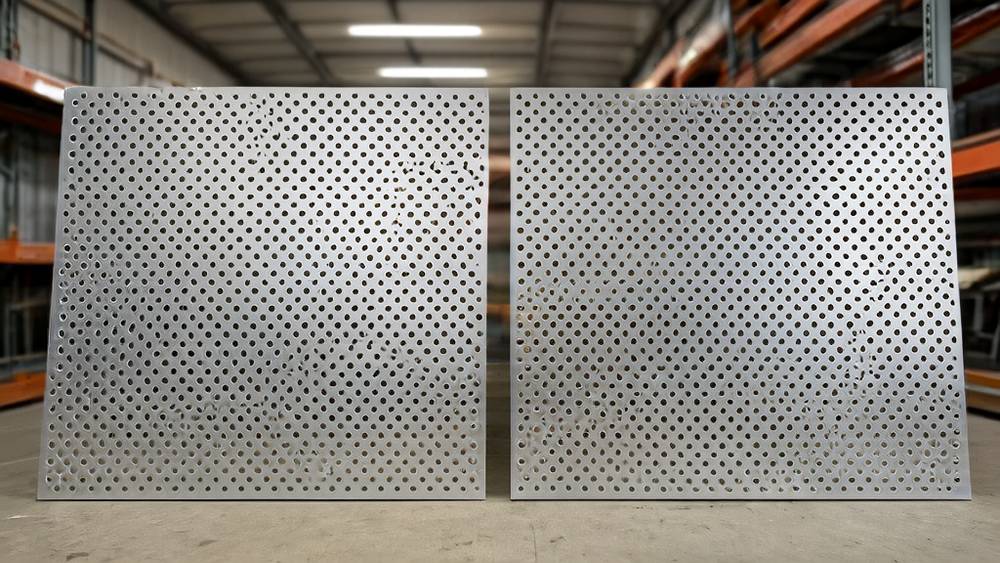
When a project specification calls for an aluminum perforated plate, the conversation almost always starts with hole size and open area percentage. But procurement teams on mid-to-large-scale facade jobs know there is another variable that can derail a budget just as fast: sheet dimensions. The standard 48" × 96" (1220 mm × 2440 mm) sheet is a distribution-center staple. The 60" × 120" (1524 mm × 3048 mm) option covers more ground with fewer seams. The choice between them ripples through material yield, fabrication nesting efficiency, freight class, and on-site handling logistics. This article unpacks what that 12-inch width difference actually costs — and when it pays for itself.
The Two Formats That Dominate North American Inventory
Walk into any major service center — McNICHOLS, Online Metals, Metal Supermarkets — and the two aluminum perforated plate sheet sizes you will find in stock, day after day, are 4' × 8' and 5' × 10'. Some suppliers also list 4' × 10' and 5' × 8' as standard, but those are far thinner in inventory depth. The 60" × 120" format is sometimes called "mill finish oversize" and may require 3-5 additional business days if the distributor does not stock it in your required gauge and hole pattern.
What actually matters for a commercial cladding package is not the nominal dimension but the net usable area after accounting for the perforated margin — the unpunched border that most fabricators need for bending, welding, or framing attachment. A 4' × 8' sheet with a 1" margin on all four sides delivers 1,288 in² of patterned face; the 5' × 10' equivalent with the same margin yields 2,088 in². That is a 62% jump in usable area per sheet, which changes the math on everything downstream.
Why the 48" × 96" Sheet Is Still the Workhorse
The 4' × 8' aluminum perforated plate is not popular because it is optimal. It is popular because the supply chain is built around it. Standard pallet racking, flatbed trailers, CNC table beds, and even elevator cabs in high-rise construction are dimensioned around 48" × 96" panels. A 3003-H14 perforated sheet in 0.063" (1.6 mm) gauge on this format can be handled by two installers without a vacuum lifter. That matters on a 30-story curtain wall replacement where the material hoist has weight restrictions.
From a fabrication standpoint, shops running 5' × 10' CNC routers are common, but shops running 4' × 8' tables are universal. If your project is in a secondary city and you are qualifying three local fabricators for competitive pricing, specifying 48" × 96" keeps the bid pool wide. Narrow it to 60" × 120" and you might lose two of those three shops — or see their quotes come back with a premium that reflects outsourcing the nest cutting.
Yield is the less obvious cost driver. Perforated aluminum sheets are punched from mill-finished coil, and the perforating process itself introduces slight edge distortion. A fabricator cutting 20 identical panels from 5' × 10' sheets might get 3% better material yield than the same panel nested on 4' × 8' — but only if the panel geometry divides cleanly into the larger format. If it does not, the extra square footage becomes scrap aluminum sold back at roughly 40% of purchase price.
When the 60" × 120" Format Earns Its Premium
The 5' × 10' aluminum perforated plate changes the game on three project types: long-span facade modules, ceiling systems with strict seam alignment requirements, and exterior screens where the architect has specified a maximum visible joint count per elevation. On a 200-foot-long building elevation, covering the field with 4' panels produces roughly 50 vertical seams. The same elevation in 5' panels drops that to 40 seams — a 20% reduction that directly cuts linear feet of perimeter extrusion, fasteners, and sealant joints.
There is also a structural argument. A perforated aluminum panel spanning between girts or vertical mullions sees its allowable span governed by bending stress and deflection limits — typically L/60 or L/90 for facade panels under wind load, depending on the spec. The width of the panel (the dimension perpendicular to the span direction) matters less than the span length itself, but a wider panel means fewer intermediate supports. On a 10' floor-to-floor curtain wall with mullions at 5' centers, the 60" panel lands directly on the vertical with no intermediate stiffener, while the 48" panel leaves a 12" cantilever that may require a secondary horizontal rail. That rail adds roughly $8-12 per linear foot in material and labor, which adds up across thousands of square feet.
Freight, Handling, and the Hidden Logistics Cost
Shipping class jumps when a pallet exceeds 96" in any dimension. A 5' × 10' aluminum perforated plate crated on a standard 48" × 96" pallet overhangs by 12" on the long side and 24" on the short side. That overhang can trigger a dimensional weight reclassification or require a flatbed shipment instead of a standard LTL carrier. The freight cost difference between a 4' × 8' shipment and a 5' × 10' shipment on the same route can range from 15% to 40%, depending on lane density and carrier access.
On-site handling is the other practical bottleneck. A 5' × 10' sheet of 0.080" 3003 aluminum perforated with 40% open area weighs approximately 42 lbs — manageable for two-person lift but awkward in windy conditions above the 10th floor. The same sheet in 0.125" gauge jumps to roughly 65 lbs. Compare that to a 4' × 8' sheet in the same 0.080" gauge at roughly 27 lbs, and the ergonomic case for the smaller format on a high-rise with restricted staging areas becomes clear. Some contractors will accept the extra seam count specifically to keep panels under the 35-lb single-person lift threshold defined in their site safety plan.
Gauge Availability by Sheet Size: What Distributors Actually Stock
Not all gauges are available in both formats across all hole patterns. The table below summarizes what the major North American distributors — including McNICHOLS, Online Metals, and Metal Supermarkets — typically stock in 3003-H14 perforated aluminum. Lead times assume standard round hole patterns (staggered, 60° offset) in 40-60% open area range. Custom patterns, slotted holes, or decorative perforations add 2-4 weeks regardless of sheet size.
| Gauge (in) | Thickness (mm) | 4' × 8' Stock Availability | 5' × 10' Stock Availability | Typical Lead Time (5' × 10') |
|---|---|---|---|---|
| 0.040" | 1.0 | High — multiple hole patterns | Moderate — round hole only | 3-5 business days |
| 0.063" | 1.6 | High — all standard patterns | High — round and square | 1-3 business days |
| 0.080" | 2.0 | High — all standard patterns | Moderate — round hole only | 3-7 business days |
| 0.100" | 2.5 | Moderate — limited patterns | Low — special order typical | 7-14 business days |
| 0.125" | 3.0 | Moderate — round hole only | Low — mill-direct minimums apply | 14-21 business days |
The practical takeaway: if your spec requires 2.5 mm or 3.0 mm solid aluminum perforated plate — typical for exterior facade panels that must span 24" or more between supports — and you want the 5' × 10' format, you are almost certainly ordering mill-direct with minimum order quantities of 50-100 sheets. That is not a problem on a 20,000 ft² facade but can be a dealbreaker on a 2,000 ft² lobby renovation. Futeng® Aluminum, which manufactures solid aluminum perforated panels in gauges from 1.0 mm to 3.0 mm, typically stocks 4' × 8' in 0.063" and 0.080" at its distribution hubs but runs 5' × 10' in heavier gauges against project-specific purchase orders, which keeps lead times competitive but eliminates the option of spot-buying a few extra sheets mid-installation.
The Open Area Variable: Why Sheet Size Affects Structural Performance
Open area percentage — the ratio of hole volume to total sheet area — is usually chosen for aesthetic, acoustic, or ventilation reasons. But it also directly reduces the section modulus of the panel. A 0.080" aluminum sheet with 40% open area has roughly 60% of the bending stiffness of a solid sheet of the same gauge. A 60% open area pattern cuts that to roughly 40%.
This interacts with sheet size in a way that is easy to miss during value engineering. Suppose the original design calls for a 5' × 10' panel spanning 48" between supports, using 0.100" gauge at 35% open area. The contractor proposes switching to 4' × 8' sheets to save on freight and handling. But now the panel width drops from 60" to 48", which means the support spacing must also drop — or the gauge must increase — to maintain the same deflection performance. If the support spacing stays at 48", the 4' panel is actually spanning the same distance as the 5' panel, so the structural demand is identical. The only change is more seams. But if the contractor also tries to drop to 0.080" gauge because "the panel is smaller," the deflection under wind load could exceed the L/60 limit by 30-40%, depending on the specific hole pattern geometry.
The correct sequence for value engineering an aluminum perforated plate facade is: lock the open area and hole pattern first (those are architectural decisions), then lock the support spacing (that is a structural decision), then choose the sheet format that minimizes total installed cost while meeting both constraints. Reversing that sequence — picking the sheet size first and forcing the other variables to accommodate it — is how projects end up with panels that oil-can in the first summer sun or rattle audibly in a 60 mph wind gust.
Nesting Efficiency and the Scrap Rate Reality
Fabricators think in terms of nest yield: what percentage of each sheet becomes billable finished panels versus scrap. On a 4' × 8' sheet, a panel that finishes at 22" × 46" nests four across with roughly 8% scrap. The same panel on a 5' × 10' sheet nests six across but with roughly 14% scrap because the 60" width does not divide cleanly by 22". The fabricator charges for the full sheet either way, so the scrap rate directly inflates the per-panel material cost. On 1,000 panels, an extra 6% scrap on a $4.50/ft² material cost adds roughly $2,700 to the job — not catastrophic but not nothing either.
The counterargument is that larger sheets mean fewer total sheets to handle, which reduces labor hours for loading, unloading, and positioning on the CNC table. A shop running 200 sheets at 4' × 8' might spend 12 labor hours on material handling; the same job on 5' × 10' sheets (roughly 130 sheets) might spend 8 hours. At a shop rate of $85/hour, that $340 savings partially offsets the higher scrap cost. The net difference is rarely more than 2-3% of the total fabrication contract, which is why sheet size selection should be driven by the factors that matter more: seam count, structural performance, and logistics feasibility.
Architectural Seam Planning on Large Elevations
Architects specify perforated metal facades for three reasons: solar shading, visual texture, and the semi-transparent effect that changes with viewing angle and daylight. All three are affected by seam placement. On a building where the perforated skin is the primary visual element — a museum, a corporate headquarters, a transit station — visible joints between panels are not just a technical detail; they are part of the architectural composition.
A 4' × 8' aluminum perforated plate laid in a running bond pattern creates horizontal seams every 4' and vertical seams every 8' (or vice versa, depending on orientation). A 5' × 10' sheet pushes those intervals to 5' and 10'. On a 60'-wide elevation, the 4' module divides evenly into 15 panels; the 5' module divides evenly into 12. Both work. But on a 100'-wide elevation, 4' divides into 25 panels and 5' divides into 20. Neither number is inherently better, but the 5' module means 20% fewer panels to fabricate, ship, and install — and 20% fewer joints to align, shim, and seal.
The joint itself is typically 3/8" to 1/2" on a well-executed perforated panel installation, using a tongue-and-groove or lap-joint detail that maintains the visual continuity of the perforation pattern across the seam. Achieving that continuity requires the fabricator to nest panels so that the hole pattern "reads through" the joint — meaning the distance from the last hole on panel A to the first hole on panel B equals the regular hole spacing. This is easier to control on larger sheets because there are fewer total seams to coordinate. On a 4' × 8' layout with 100 panels, the fabricator must maintain pattern continuity across 45 vertical seams (assuming a running bond). On a 5' × 10' layout with 64 panels, that number drops to roughly 28 seams. Fewer seams means fewer opportunities for a half-hole misalignment that the architect will notice from 50 feet away.
Coating and Finish Considerations by Sheet Size
Most exterior-grade aluminum perforated plate is finished with a PVDF (polyvinylidene fluoride) coating system conforming to AAMA 2605, applied either as coil coating before perforating or as spray coating after fabrication. Each route has implications for sheet size.
Coil-coated material — where the flat aluminum coil is painted in a continuous process before being perforated and cut to sheet size — offers superior color consistency across the entire project because every sheet comes from the same coated coil batch. The limitation is coil width. Standard PVDF coil coating lines in North America handle widths up to 62", which means 5' (60") wide sheets are feasible but leave almost no margin for edge trim. Some coaters max out at 60" precisely, which means a 5' × 10' sheet must be run on a line rated for 62" minimum, limiting the supplier base. AAMA 2605 specifies minimum dry film thickness of 1.2 mils (30 microns) for PVDF coatings on architectural aluminum. This applies regardless of sheet size, but applicators report that maintaining uniform film thickness across a 5' wide perforated sheet is more challenging than on a 4' sheet because the larger panel flexes more during the spray process, potentially causing slight thickness variation near the edges. Reputable coaters compensate with adjusted gun distance and conveyor speed, but it is a variable worth discussing during the submittal review.
Post-perforation spray coating — where the perforated sheet is formed, welded into a panel assembly, and then coated — avoids the coil-width limitation entirely but introduces the risk of coating bridging across small-diameter holes. On hole diameters below 3/16" (4.8 mm), PVDF spray can partially or fully close holes if the coating viscosity and spray pressure are not carefully controlled. This risk is independent of sheet size, but larger sheets with more holes per panel magnify the quality-control challenge simply because there are more holes to inspect.
ASTM and International Standards Referenced
Specifiers working across borders should anchor their aluminum perforated plate requirements to recognized standards. The key references include:
- ASTM B209 — Standard Specification for Aluminum and Aluminum-Alloy Sheet and Plate. This covers the base metal before perforation, including 3003-H14 and 5052-H32 alloys commonly used for perforated architectural panels.
- ASTM E84 — Standard Test Method for Surface Burning Characteristics of Building Materials. Perforated aluminum with a PVDF finish typically achieves Class A when tested per this standard, relevant for interior applications subject to flame spread requirements.
- ISO 9227 — Corrosion tests in artificial atmospheres — Salt spray tests. Used to validate the corrosion resistance of coated perforated aluminum panels for coastal and industrial environments.
- EN 13501 — Fire classification of construction products and building elements. Required for aluminum perforated plate used on European projects, particularly for rainscreen cladding systems where the panel is part of the external wall assembly.
These standards do not prescribe sheet dimensions, but they do prescribe the mechanical and surface properties that must be maintained regardless of whether the fabricator starts with a 4' × 8' or 5' × 10' sheet. A 3003-H14 sheet in either format must meet the same tensile strength range (17-24 ksi) and yield strength minimum (17 ksi) per ASTM B209. The perforation process itself does not alter the alloy's bulk mechanical properties, but it does reduce the effective section, and that reduction must be accounted for in the structural calculations regardless of sheet size.
Making the Call: A Decision Framework for Project Teams
There is no universal "better" format. The right sheet size for an aluminum perforated plate depends on the intersection of five project-specific factors:
- Facade module dimensions. If the structural grid is based on a 5' module, use 5' wide sheets. If it is based on a 4' module, use 4' wide sheets. Forcing a mismatch creates either excessive scrap or awkward seam placement.
- Site logistics. High-rise projects with restricted material hoists or projects in dense urban sites with limited laydown area should bias toward 4' × 8' for handling weight and maneuverability.
- Architectural seam tolerance. Projects where visible joints are a design feature (expressed joints with shadow gaps) are less sensitive to sheet size. Projects where the architect wants the perforated skin to read as a continuous surface should bias toward larger sheets to minimize seam count.
- Gauge requirement. Heavy-gauge panels (0.100" and above) in 5' × 10' format will likely be mill-direct with MOQ constraints. Confirm availability before locking the spec.
- Budget sensitivity. If the material cost difference between formats is marginal (typically under 5%), let the other four factors drive the decision. If the project is extremely cost-constrained, the 4' × 8' format's deeper inventory and broader fabricator pool will almost always produce the lowest total installed cost.
The worst outcome is not choosing the wrong format — it is choosing one format during design, issuing drawings based on it, and then discovering during procurement that the specified gauge/pattern/size combination has a 6-week lead time and a 100-sheet minimum. That discovery should happen during the schematic design phase, not during submittals. A 30-minute call with two distributors and one mill-direct manufacturer early in the process costs nothing and can prevent a schedule delay that burns thousands of dollars a day in general conditions.