Standard Plate Dimensions Per Sheet Why 1219mm 1200mm and 1000mm Widths Compete
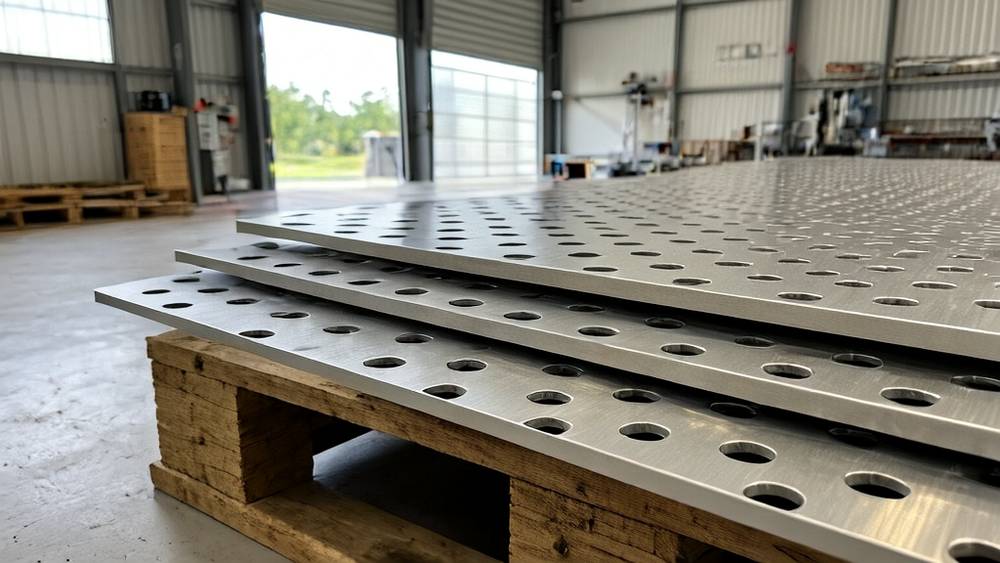
When procurement teams across Southeast Asia source perforated metal sheets for industrial screening or architectural cladding, the conversation almost always starts with one phrase: ukuran plat perforated per lembar. The term reflects a practical need to know exact sheet dimensions before freight logistics, fabrication planning, and structural load calculations can begin. Yet the market presents a fragmented picture. Some suppliers quote 1000 mm × 2000 mm as standard. Others insist on 1219 mm × 2438 mm. A third group advertises 1200 mm × 2400 mm. These discrepancies are not trivial rounding differences. They affect how many linear metres of framing you order, how much waste your CNC nesting produces, and whether your container hits weight limits before volume limits. This article examines what actually constitutes a standard ukuran plat perforated per lembar, why three size regimes coexist, and how to specify perforated aluminium sheets so your project avoids costly dimensional mismatches.
Three competing "standard" sheet sizes and where they come from
Walk into any steel service centre in Jakarta or Surabaya and ask for ukuran plat perforated per lembar. You will likely hear 4×8 feet first. That converts to 1219 mm × 2438 mm, the imperial-derived dimension that dominates Southeast Asian metal distribution. This size traces back to British and American rolling mill conventions established before metrication. Most coil-fed perforating lines in China and India are tooled for this width, which means 1219 mm remains the path of least resistance for importers.
But ask a local fabricator supplying government infrastructure projects and you will hear 1200 mm × 2400 mm. This clean metric dimension aligns with Indonesian SNI material standards and simplifies architectural grid layouts designed in millimetres. The 19 mm difference in width between 1219 mm and 1200 mm might sound negligible, but multiply it across 50 sheets on a facade and you have nearly one metre of cumulative gap that someone has to detail with closure pieces or custom-cut infill panels.
A third size, 1000 mm × 2000 mm, appears frequently on Tokopedia listings and in the catalogues of smaller stockists. This dimension originates from domestic re-rolling operations that process imported coil on narrower cut-to-length lines. The 1000 mm width also suits manual handling on construction sites where mechanical lifting is unavailable. Each regime serves a different segment of the supply chain, and none is universally "standard." The table below summarises the practical implications of each.
| Sheet Size (mm) | Origin | Common Users | Logistics Implication | Waste Factor (Typical) |
|---|---|---|---|---|
| 1219 × 2438 | Imperial (4×8 ft) | Importers, large fabricators | Efficient container fit; 5 sheets per layer on standard pallets | 8-12% when nesting into metric grids |
| 1200 × 2400 | Metric (SNI-aligned) | Government projects, architects | Slightly looser container fit; requires dunnage adjustment | 5-8% on metric-module facades |
| 1000 × 2000 | Domestic re-rolling lines | Small workshops, site-cut applications | Manual handling possible; higher per-sheet freight cost | 10-15% on large-format cladding |
Why aluminium perforated sheets follow different rules than steel
Most online resources discussing ukuran plat perforated per lembar default to mild steel or stainless steel. The Tokopedia listings, SMS Perkasa catalogues, and Harijaya Insulation data sheets overwhelmingly reference besi (iron/steel) substrates. Aluminium perforated sheet operates under different constraints that affect available sheet dimensions.
First, aluminium coil widths from Gulf and Chinese smelters commonly ship at 1250 mm, 1500 mm, or 1600 mm. A perforating line set up for 1219 mm steel coil cannot process 1500 mm aluminium without retooling. This means aluminium perforated sheets in the 1500 mm × 3000 mm format exist but require sourcing from suppliers who specialise in non-ferrous perforating. Second, the perforating process itself behaves differently. Aluminium's lower tensile strength compared to steel means closer punch-to-die clearances and more frequent tool changes. High-open-area patterns above 40% can cause aluminium sheets to warp during perforating, which forces suppliers to limit the maximum sheet size for heavily perforated aluminium to around 1000 mm × 2000 mm to keep flatness within commercially acceptable tolerances.
Third, aluminium's corrosion resistance means perforated aluminium sheets used in exterior architectural applications rarely carry the same mill-scale concerns as perforated steel. However, they introduce a different problem: galvanic compatibility with the supporting subframe. When a perforated aluminium panel is fixed to a galvanised steel substructure, the ukuran plat perforated per lembar must account for an isolation layer (typically EPDM gasket or nylon washer) at every fixing point, which slightly reduces usable panel area.
How perforation pattern interacts with sheet dimensions
A specification that reads "1200 × 2400 mm, 3 mm thickness, round hole 8 mm" is incomplete. The pitch (centre-to-centre distance between holes) and the pattern layout determine how holes terminate at sheet edges. This edge condition directly affects whether the stated ukuran plat perforated per lembar is the gross sheet size or the usable module size after accounting for margins.
Consider a 1219 × 2438 mm sheet with 8 mm diameter holes on a 12 mm staggered pitch (60° triangular pattern). The perforating tool requires a blank margin of approximately 15-20 mm along all four edges where no holes are punched, because the clamping system of the perforating press needs solid material to grip. This means the actual perforated field is roughly 1180 × 2400 mm. If your architectural intent requires holes running edge-to-edge across a visible facade joint, you must communicate this to the supplier before production. Some fabricators, including Futeng®, can achieve reduced margins of 8-10 mm with specialised fixturing, but this capability varies by factory.
The table below shows typical margin requirements for common perforation patterns across the three standard sheet sizes.
| Perforation Pattern | Hole Diameter (mm) | Pitch (mm) | Open Area (%) | Typical Edge Margin (mm) | Effective Perforated Field Loss (mm per side) |
|---|---|---|---|---|---|
| Staggered round, 60° | 6 | 10 | 32.7 | 12-15 | 24-30 total across width |
| Staggered round, 60° | 8 | 12 | 40.3 | 15-20 | 30-40 total across width |
| Straight line square | 10 | 15 | 34.9 | 10-12 | 20-24 total across width |
| Slotted (parallel) | 5 × 25 | 10 × 35 | 35.7 | 18-22 | 36-44 total across width |
Thickness ranges: what "per lembar" actually includes
When Indonesian buyers search for ukuran plat perforated per lembar, they often mentally bundle thickness into the same question. The phrase "per lembar" (per sheet) implies a single unit of purchase, and that unit has three spatial dimensions, not two. Aluminium perforated sheet thicknesses available in the Indonesian market typically span 0.8 mm to 3.0 mm for architectural applications, with 1.2 mm, 1.5 mm, and 2.0 mm being the most commonly stocked gauges.
A critical distinction exists between the nominal thickness of the parent sheet and the effective structural thickness after perforation. A 2.0 mm aluminium sheet with 40% open area does not behave like a 2.0 mm solid sheet. Its bending stiffness is reduced, and its effective section modulus for spanning between supports must be recalculated. The Aluminum Association publishes design guidelines for perforated sections in its ADM (Aluminum Design Manual), which provides reduction factors based on open area percentage. For a 40% open area, the effective bending stiffness is approximately 55-60% of the solid sheet value, depending on hole geometry and pattern orientation relative to the span direction.
This has practical implications. If a solid 2.0 mm aluminium panel spans 600 mm between supports at a given deflection limit, a perforated panel of the same nominal thickness with 40% open area might only span 400-450 mm. The project's structural engineer must receive the exact perforation specification to verify this, which is why the ukuran plat perforated per lembar question cannot be separated from the perforation pattern question.
Weight per sheet and why it matters for logistics
Procurement managers who calculate shipping costs based solely on sheet count often underestimate the weight implications of different ukuran plat perforated per lembar choices. Aluminium perforated sheets are lighter than their steel equivalents, but the weight still accumulates rapidly across a full container load.
A single 1219 × 2438 × 2.0 mm aluminium sheet with 0% perforation (solid) weighs approximately 16.0 kg based on aluminium density of 2,700 kg/m³. With 40% open area, the same sheet weighs roughly 9.6 kg. In a 20-foot container rated for 25,000 kg payload, you can fit roughly 2,600 perforated sheets at 9.6 kg each, or about 1,560 solid sheets at 16.0 kg each, before hitting the weight limit. But volume constraints usually bite first: a 20-foot container accommodates approximately 850-900 sheets of 1219 × 2438 mm size stacked on pallets, assuming 2.0 mm thickness and reasonable dunnage. The weight of 900 perforated sheets at 9.6 kg each is only 8,640 kg, well within payload limits, which means freight cost is driven by volume, not weight.
This calculation shifts if the project specifies 3.0 mm aluminium instead of 2.0 mm. At 3.0 mm thickness and 40% open area, each 1219 × 2438 mm sheet weighs about 14.4 kg, and 900 sheets total 12,960 kg. Still within limits, but approaching the point where combined container weight (including pallets and packing) starts affecting freight class and insurance declarations. The table below provides quick-reference weights for common configurations.
| Sheet Size (mm) | Thickness (mm) | Open Area (%) | Weight per Sheet (kg, aluminium) | Sheets per 20ft Container (approx.) | Total Payload (kg) |
|---|---|---|---|---|---|
| 1219 × 2438 | 1.5 | 30 | 8.4 | 950 | 7,980 |
| 1219 × 2438 | 2.0 | 40 | 9.6 | 900 | 8,640 |
| 1219 × 2438 | 3.0 | 40 | 14.4 | 850 | 12,240 |
| 1200 × 2400 | 2.0 | 35 | 10.1 | 920 | 9,292 |
| 1000 × 2000 | 2.0 | 40 | 6.5 | 1,400 | 9,100 |
Surface finishing and its impact on usable sheet dimensions
Perforated aluminium sheets destined for exterior architectural use typically receive PVDF (polyvinylidene fluoride) coating after perforation. The coating process itself imposes dimensional constraints that modify the effective ukuran plat perforated per lembar. Most horizontal coating lines in Asia can handle sheets up to 1600 mm wide, which comfortably accommodates 1219 mm and 1200 mm widths. But sheets wider than 1500 mm may require vertical coating lines that are less common and more expensive per square metre.
A more subtle issue is edge build-up. During spray application of PVDF, the coating thickness at sheet edges can be 5-10 microns higher than the centre due to electrostatic wrap-around effects and operator technique. For a perforated sheet with 8 mm holes near the edge, this extra thickness can reduce hole diameter by 0.01-0.02 mm at the extreme edges. This rarely matters for ventilation or screening applications, but it can be visible under raking light on architectural facades if the edge holes appear slightly smaller than interior holes. Quality-conscious suppliers address this by masking edges or adjusting spray parameters, but it requires explicit specification.
For interior applications where perforated aluminium serves as acoustic ceiling panels or decorative screens, powder coating is a common alternative. Powder coating lines often have size limits around 1200 mm × 2400 mm, which aligns neatly with the metric standard ukuran plat perforated per lembar. The powder coating thickness, typically 60-80 microns for architectural interior applications per Qualicoat specifications, also reduces hole diameters by a measurable but usually acceptable amount.
The SNI dimension question for Indonesian projects
Government-funded projects in Indonesia increasingly require SNI certification for building materials. SNI 07-0601-2006 covers hot-rolled steel plates, but perforated aluminium sheets fall into a greyer regulatory area. There is no single SNI standard that prescribes the ukuran plat perforated per lembar for aluminium. Instead, the material itself (the aluminium alloy, typically 3003-H14 or 5052-H32 for architectural perforated panels) must comply with SNI or equivalent ASTM/EN standards, while the sheet dimensions are specified by the project.
This regulatory gap creates procurement friction. A contractor bidding a government hospital project in Medan might specify 1200 × 2400 mm perforated aluminium panels, assuming this aligns with SNI preferences. But if the lowest compliant bid comes from a supplier whose standard is 1219 × 2438 mm, the contractor faces a choice: accept the imperial size and adjust framing layouts, or pay a premium for metric-cut sheets. The premium for custom shearing from 1219 mm down to 1200 mm is typically 5-8%, which on a facade requiring 500 sheets translates to roughly IDR 15-25 million in additional material cost, not counting the wasted 19 mm strip that becomes scrap.
The Badan Standardisasi Nasional has been working toward harmonising construction material dimensions with ISO preferences, but for now, the practical advice for specifiers is to state the acceptable dimensional tolerance (e.g., ±2 mm on width and length) rather than a single nominal dimension, which gives suppliers flexibility across their available tooling.
Open area trade-offs: more holes, fewer structural options
The appeal of perforated aluminium for architectural cladding lies in its ability to balance transparency, ventilation, and solar shading. But the relationship between open area percentage and maximum sheet size is inversely proportional. A sheet with 20% open area can be produced in large formats up to 1500 × 3000 mm with acceptable flatness. Push open area to 50% or above, and suppliers will strongly recommend limiting sheet size to 1000 × 2000 mm or even 1000 × 1500 mm to avoid handling damage and installation warping.
This constraint has design implications. An architect specifying 60% open area perforated aluminium for a parking structure facade that spans floor-to-floor at 3600 mm might envision single sheets covering the full height. In practice, the ukuran plat perforated per lembar for such a high-open-area panel will be limited to roughly 1200 mm in the long direction, which means horizontal joints at mid-span are unavoidable. These joints need to be detailed with supporting horizontals, adding secondary steel to the facade system cost. A conversation early in design development between the architect, facade engineer, and perforated sheet supplier can prevent this kind of late-stage value engineering scramble.
How to specify ukuran plat perforated per lembar in tender documents
Poorly written specifications are the root cause of most dimensional disputes on perforated sheet orders. A tender document that states "perforated aluminium sheet, 2 mm thick, 8 mm holes, 1200 × 2400 mm" leaves too much unsaid. The following specification framework reduces ambiguity and protects both buyer and supplier:
- Gross sheet dimensions: State nominal width × length with tolerance. Example: 1200 mm (±2 mm) × 2400 mm (±2 mm).
- Perforated field dimensions: State the area that must contain holes, measured from sheet edges. Example: Perforated field to extend to within 15 mm of all edges.
- Hole geometry and pattern: Diameter, pitch, pattern type (staggered 60°, straight, slotted), and orientation relative to sheet edges.
- Edge margin: State explicitly whether the margin is measured from the sheet edge to the centre of the first hole or to the edge of the first hole. This distinction is a frequent source of error.
- Flatness tolerance: Reference a standard such as ASTM A480 for flatness, adapted for perforated sheet. A typical requirement is ≤3 mm deviation per 1000 mm of sheet length.
- Alloy and temper: For aluminium, specify 3003-H14 for general architectural use or 5052-H32 for higher strength requirements.
Suppliers like Futeng® can work with this level of specification detail and typically provide a shop drawing showing the exact perforation layout relative to sheet edges before production begins. This review step catches dimension misinterpretations before metal is cut.
Regional availability: what sizes you can actually get in Southeast Asia
Stock availability of specific ukuran plat perforated per lembar combinations varies significantly across the region. Indonesian stockists listed on Tokopedia and SMS Perkasa primarily hold 1219 × 2438 mm in steel with hole diameters from 2 mm to 12 mm and thicknesses from 0.8 mm to 3.0 mm. Aluminium perforated sheet in the same size is less commonly stocked and more often produced to order, with lead times of 4-6 weeks from Chinese or Malaysian perforating mills.
For projects requiring 1500 × 3000 mm aluminium perforated sheets, the supply chain narrows considerably. Only a handful of mills in China operate perforating lines capable of handling 1500 mm wide aluminium coil at production volumes. This size typically commands a 15-20% price premium over 1219 × 2438 mm on a per-square-metre basis, reflecting both the wider coil cost and the lower throughput of the perforating line at wider settings. The Middle East Steel Industry data suggests that Gulf-based aluminium re-rollers are increasingly offering 1500 mm wide perforated sheet to serve Middle Eastern construction markets, and some of this capacity is available to Southeast Asian buyers through trading houses in Singapore.
For small-format sheets (1000 × 2000 mm), local perforating workshops in Jabodetabek and Surabaya can often produce from stock aluminium sheet within shorter lead times of 1-2 weeks, making this size practical for renovation projects or small commercial fit-outs where speed matters more than per-square-metre cost.
Making the right call for your project
The question behind ukuran plat perforated per lembar is not really about millimetres. It is about aligning your project's dimensional expectations with what the supply chain can deliver at a price that works. The three size regimes coexist because each solves a different problem: 1219 × 2438 mm for import efficiency and stock availability, 1200 × 2400 mm for metric architectural coordination, and 1000 × 2000 mm for small-scale flexibility and high-open-area applications where larger sheets would warp.
Before locking the specification, confirm your supplier's actual production capability on the exact alloy, thickness, and perforation pattern your project requires. Ask for a sample sheet showing edge conditions and flatness. Check that the coating line can handle the sheet size if post-perforation finishing is required. And if your project includes both metric-module architecture and high-open-area perforation, budget for the dimensional accommodation that these two requirements demand of each other. The industry does not offer a single standard sheet size for perforated aluminium, but it does offer enough clarity for an informed specifier to avoid the worst traps.