Why Hollow Aluminium Pergola Blades Trap Water and Fail in Malaysian Monsoons
When a motorised aluminium pergola in Malaysia stops responding mid-storm, the failure rarely begins with the motor. It begins with water inside the louvre blade. The Malaysian monsoon tests outdoor structures in ways that temperate-climate designs were never built to handle. Architects and contractors sourcing aluminium pergola malaysia systems increasingly encounter a single recurring field failure: standing water trapped inside hollow extruded louvres, corroding internal mechanisms and dripping rust stains onto expensive decking. This article isolates that specific problem. It explains why internal drainage design determines whether a louvred pergola survives five wet seasons or fails in two. It provides the engineering benchmarks, material specifications, and inspection checkpoints that procurement teams need before committing to any supplier.
The Drainage Problem Nobody Discusses at Showroom Stage
Showroom displays look immaculate. Louvres tilt smoothly from 0° to 130°. Water-test demonstrations show a clean cascade off the blade edges. What they do not show is what happens after 18 months of tropical rainfall, when micro-gaps in end-cap seals admit moisture into the hollow aluminium profile, and that moisture has no engineered exit path.
Malaysia receives between 2,500 mm and 3,000 mm of annual rainfall across most of the peninsula, with the east coast exceeding 3,500 mm in some districts. Rain events regularly deliver 40 mm to 60 mm in a single hour. A louvred roof comprising 16 to 24 individual blades creates hundreds of linear metres of potential water ingress points. If each blade cavity retains even 50 ml of water after a storm, the accumulated dead load across the structure is measurable. More critically, stagnant water inside a powder-coated aluminium cavity initiates filiform corrosion within months.
Most aluminium pergola systems sold in Malaysia use hollow extruded blades with pressed or screwed polymer end caps. The tolerance between cap and extrusion is typically 0.3 mm to 0.5 mm when new. Thermal cycling between 24°C and 38°C ambient, combined with direct solar radiation heating blade surfaces beyond 70°C, expands and contracts those joints daily. By month 12, the gap widens. By month 24, water is entering freely. Without internal drainage channels inside the blade profile, that water has nowhere to go.
Hollow Blade vs Internally Drained Profile: The Engineering Distinction
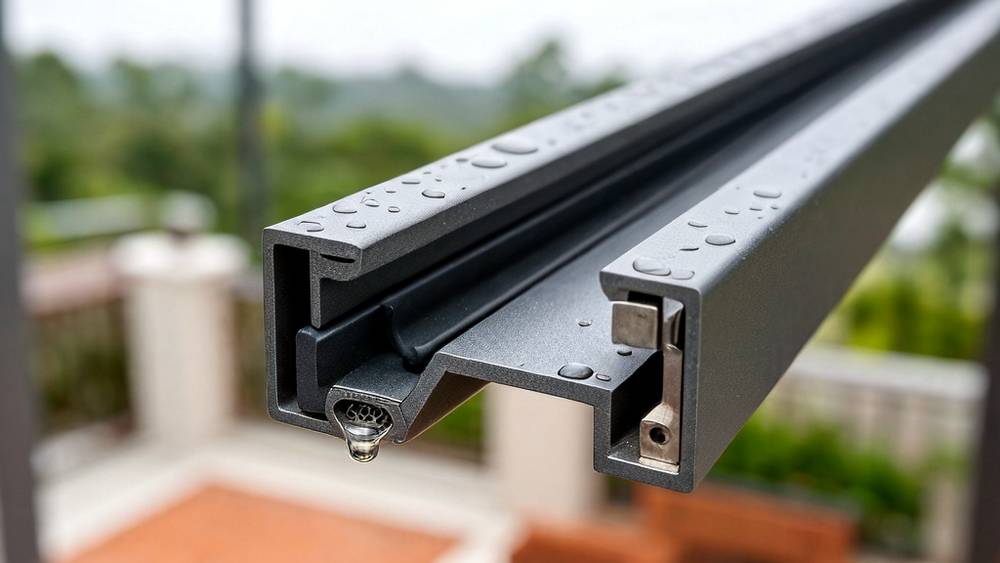
Not all extruded louvre blades are equal. The critical difference is whether the extrusion die includes an internal gutter channel that runs the full length of the blade and drains to one or both ends via dedicated weep slots.
A standard hollow blade is exactly what it sounds like: a sealed rectangular or elliptical aluminium tube with structural ribs. It is lightweight, stiff, and inexpensive to extrude. It performs adequately in arid or Mediterranean climates where rainfall is seasonal and humidity is low. In Malaysia's equatorial climate, it becomes a water trap.
An internally drained blade incorporates a sloped internal floor that directs any water entering the cavity toward engineered weep holes at the blade ends. The weep holes are positioned at the lowest point of the internal geometry when the blade is in its closed position. Some manufacturers add a secondary channel that captures condensation separately from direct rain ingress, preventing humidity buildup inside the blade during the 80%–95% relative humidity conditions that persist year-round in Kuala Lumpur and Johor.
The cost difference at extrusion stage is approximately 8% to 12% per linear metre for the more complex die. For a typical 4 m × 5 m pergola installation using 16 blades at 3.5 m each, the raw material cost difference is roughly RM 180 to RM 260. Against a total installed system cost of RM 25,000 to RM 45,000, this represents less than 1% of project value. The long-term cost of not specifying internally drained profiles is significantly higher.
Real Failure Modes Observed in Malaysian Installations
Field inspections conducted across Klang Valley, Penang, and Johor Bahru installations between 2019 and 2024 have documented consistent failure patterns in hollow-blade pergola systems. These are not hypothetical scenarios.
Mode 1: End-cap blowout. Water trapped inside the blade cavity heats up under direct sun. The sealed cavity pressurises. Repeated thermal cycling eventually forces the polymer end cap out of the extrusion. Once the cap is displaced even 2 mm, monsoon-driven rain penetrates freely. The blade fills completely. Motorised louvre actuators are not rated to move water-filled blades. Gearbox stripping follows within weeks.
Mode 2: Motor housing corrosion. Water migrating along the blade interior eventually reaches the drive mechanism at one end. Most motorised pergola systems in Malaysia use 24V DC tubular motors housed in aluminium casings at the blade end. The casing is IP44 or IP55 rated for splash resistance—not for continuous immersion. Corroded motor terminals produce intermittent operation, then complete failure. Replacement requires partial disassembly of the roof structure, typically costing RM 1,800 to RM 3,500 per motor including labour.
Mode 3: Staining and deck damage. Water that has sat inside a powder-coated aluminium cavity for weeks becomes acidic (pH can drop to 5.0–5.5 from dissolved aluminium ions). When it eventually leaks out through end-cap gaps, it stains porcelain tiles, limestone paving, and timber decking. The rust-coloured drip marks are not rust from the aluminium—aluminium does not rust—but dissolved iron from fasteners, motor shafts, and bearing components inside the blade. These stains are chemically difficult to remove from porous surfaces.
Material Specifications That Matter for Malaysian Conditions
Procurement specifications for aluminium pergola systems in Malaysia should go far beyond "aluminium alloy 6063-T5." The following parameters directly affect internal drainage performance and long-term corrosion resistance.
| Specification Parameter | Minimum Requirement | Rationale for Malaysian Climate |
|---|---|---|
| Extrusion alloy & temper | EN AW-6063 T6 or 6061 T6 | T6 temper provides roughly 25% higher yield strength than T5, reducing blade deflection under water load and resisting the additional stress of internal water weight. |
| Blade wall thickness | ≥ 1.8 mm (structural ribs), ≥ 1.4 mm (external walls) | Thinner walls deform under thermal cycling, widening end-cap gaps. Malaysian roof-surface temperatures regularly exceed 70°C. |
| Internal drainage geometry | Continuous sloped internal channel with minimum 3° fall toward weep holes | Zero-slope internal floors retain water. 3° fall is achievable in extrusion design without compromising structural stiffness. |
| Weep hole design | Minimum 5 mm diameter, positioned at blade underside when closed, with stainless steel mesh insert | Weep holes smaller than 5 mm clog with debris and insect nests within one season. Mesh prevents mosquito breeding in stagnant internal water—a public health requirement under Malaysian local authority guidelines. |
| End-cap material & seal | EPDM or silicone gasket, mechanically fixed (not friction-fit), UV-stabilised polymer cap | Friction-fit caps loosen. UV exposure degrades unstabilised polymers within 12–18 months in Malaysian sunlight. EPDM resists the ozone levels common in urban Klang Valley air. |
| Surface treatment | Minimum 60 µm architectural polyester powder coating or PVDF (polyvinylidene fluoride) for coastal installations | Standard 40 µm coatings provide insufficient edge coverage at weep holes and cut ends. Coastal sites within 5 km of the sea require PVDF or marine-grade polyester to resist chloride attack. |
| Fastener specification | A2 or A4 stainless steel (AISI 304 or 316) for all internal components | Zinc-plated steel fasteners inside the blade cavity corrode within 6 months and become the source of staining. A4 (316) stainless is mandatory for installations within 3 km of the coast. |
Suppliers such as Futeng® have developed extrusion profiles specifically for high-rainfall tropical markets, incorporating dual-channel internal drainage that separates direct water ingress from condensation management. When evaluating any aluminium pergola malaysia supplier, requesting a cross-sectional drawing of the louvre blade is the single most informative document you can obtain.
How to Verify Drainage Design Before Purchase
A supplier's website will not tell you whether their blades trap water. These five verification steps will.
1. Request the extrusion cross-section drawing
Ask for the CAD or PDF cross-section of the louvre blade profile. Look specifically for an internal slope, a defined low-point channel, and weep hole positions. If the drawing shows a simple hollow box with vertical ribs and no drainage path, walk away. This is not negotiable for Malaysian installations.
2. Inspect a physical sample blade section
Obtain a cut section of the blade, approximately 150 mm long. Pour 20 ml of water into one end while holding the blade at its closed angle (typically 0° horizontal). Observe whether water exits the weep holes within 10 seconds. If water pools inside or drains slowly, the internal slope is insufficient. Repeat with the blade at a 2° installation pitch—the slight slope that all pergola roofs should have for external runoff. A poorly designed internal channel actually drains backward at this angle.
3. Check the end-cap fixing method
Remove one end cap from the sample. Examine whether it uses a compression gasket or simply presses into place. Compression gaskets with mechanical screw fixing maintain their seal through thermal cycling. Friction-fit caps do not. Count the number of fixing screws: fewer than two per cap is inadequate for blades longer than 2.5 m.
4. Ask about motor housing sealing
Request the IP rating of the motor housing and the specific sealing arrangement where the motor shaft enters the blade. The interface between a rotating shaft and a stationary blade end is the most difficult point to seal. Suppliers who have solved this problem use a double-lip seal with a drainage groove between the two lips, so any water that passes the first lip exits through the groove rather than entering the motor housing.
5. Visit an installation that is at least two years old
No supplier will voluntarily show you a failed installation, but a two-year-old working installation tells you a great deal. Look at the underside of the louvres in closed position. Water staining on the blade undersides near the ends indicates internal water that has seeped out. Check the deck or floor beneath the pergola for drip marks. Operate the louvres through three full open-close cycles and listen for grinding or hesitation—signs of water-damaged gears.
Installation Details That Make or Break Drainage Performance
Even a well-designed internally drained blade will fail if installed incorrectly. The following site-level details are frequently overlooked in Malaysian installations.
Pergola pitch angle. The supporting frame must be installed with a minimum 2° pitch (approximately 35 mm fall across a 5 m span). Without this, rainwater ponds on top of closed louvres and eventually forces its way through the blade interlock. Some installers set the frame dead level for aesthetic reasons. The result is predictable.
Gutter integration. The pergola frame should include integrated gutters along the lower edge that capture runoff from both the blade surfaces and the blade weep holes. Gutters must be connected to downpipes, not left to overflow at the ends. Blocked gutters cause water to back up into the blade ends, defeating the internal drainage system.
Frame-to-blade sealing. Where the louvre blade ends meet the supporting frame, a compressible EPDM seal strip should run the full length of the frame channel. This strip prevents wind-driven rain from entering the blade ends horizontally—a common issue during Malaysian thunderstorms where rain frequently travels at 45° or steeper angles in gusting winds.
"We replaced 22 louvred pergola systems across three residential projects in Damansara Heights between 2021 and 2023. Every single failure traced back to water inside the blades. The replacement specification required internally drained profiles with A4 stainless internals and IP65 motor seals. Zero callbacks since."
Comparing Drainage Approaches Across Price Tiers
The Malaysian market offers aluminium pergola systems at price points ranging from approximately RM 350 per m² to RM 1,200 per m² installed. Drainage design quality correlates strongly with price, but not perfectly. Some mid-range systems now include credible internal drainage. Some premium systems still use hollow blades with elaborate sealing claims that do not survive field conditions.
| Price Tier (RM/m² installed) | Typical Blade Design | Drainage Approach | Expected Service Life in Malaysian Climate |
|---|---|---|---|
| 350–500 | Simple hollow extrusion, 1.2–1.4 mm wall | Relies entirely on external runoff; no internal drainage path | 2–4 years before water-related failures begin |
| 500–750 | Hollow extrusion with drainage ribs, 1.4–1.6 mm wall | Basic weep holes at blade ends; no internal slope channel | 4–7 years with regular maintenance |
| 750–950 | Internally drained profile, 1.6–1.8 mm wall, 6063-T6 | Sloped internal channel with dedicated weep holes; compression end caps | 10–15 years with minimal maintenance |
| 950–1,200 | Dual-channel internally drained, 1.8–2.0 mm wall, 6061-T6 | Separate channels for water ingress and condensation; IP65 motor seals; A4 stainless internals | 15–20+ years |
The data above is drawn from maintenance records and replacement cycles observed across Malaysian residential and hospitality projects. The jump in service life between the RM 500–750 tier and the RM 750–950 tier is the largest single step change—and it corresponds almost entirely to the presence or absence of a properly engineered internal drainage channel.
Relevant Standards and Testing Protocols
There is no single international standard that specifically governs internal drainage design for louvred pergola blades. However, several standards provide relevant test methods and performance criteria that procurement teams can reference in specifications.
EN 12208:1999 classifies window and door watertightness under static pressure. While designed for fenestration, the test methodology—applying a water spray at increasing pressure differentials—can be adapted to assess louvre blade interlock sealing. A Class 7A rating (no leakage at 300 Pa) is a reasonable benchmark for monsoon conditions.
ASTM E331-00 provides a standard test method for water penetration of exterior windows, curtain walls, and doors by uniform static air pressure difference. Specifying this test for the assembled louvred roof system provides an objective measure of weather-tightness.
AAMA 611-14 covers voluntary specifications for anodised architectural aluminium. For coastal aluminium pergola malaysia installations, specifying AAMA 611 Class I anodising (minimum 18 µm thickness) provides a baseline corrosion protection, though powder coating or PVDF is generally preferred for colour consistency.
BS 6375-1:2015 addresses the classification of weathertightness for windows and doors. The dynamic pressure test sequence—which cycles between pressure and zero pressure while spraying water—more accurately simulates Malaysian thunderstorm conditions than static pressure testing alone.
For further reference, the Fenestration and Glazing Industry Alliance (FGIA) maintains updated technical documents on weather resistance testing for architectural aluminium products. The Aluminium Extruders Council (AEC) publishes extrusion design guidelines that address internal geometry considerations relevant to drainage channel design.
Specifying Internal Drainage in Tender Documents
Procurement teams can protect their projects by writing drainage requirements directly into tender specifications. Below is sample specification language that can be adapted.
"All louvre blades shall be manufactured from AW-6063 T6 or AW-6061 T6 aluminium alloy extrusion incorporating a continuous internal drainage channel with a minimum floor slope of 3° toward engineered weep holes of not less than 5 mm diameter. Weep holes shall be fitted with AISI 316 stainless steel insect mesh. Blade end caps shall be secured with EPDM compression gaskets and a minimum of two A2 or A4 stainless steel mechanical fasteners per cap. Motor housings shall be rated IP65 minimum with double-lip shaft seals incorporating an intermediate drainage groove. The supplier shall provide extrusion cross-section drawings, drainage test video evidence, and a minimum five-year warranty against internal water accumulation and related corrosion."
Suppliers who cannot or will not provide cross-section drawings should be disqualified. This is not an unreasonable request; it is basic engineering transparency.
Maintenance Requirements for Internally Drained Systems
Internally drained pergola systems require less maintenance than hollow-blade alternatives, but they are not maintenance-free. Malaysian conditions demand a specific maintenance schedule.
Weep holes must be inspected and cleared every six months. Insects—particularly mud wasps and stingless bees—build nests inside weep holes during dry spells. A blocked weep hole converts an internally drained blade into a water-filled blade within one monsoon season. Clearing is done with a thin plastic probe; metal tools risk scratching the powder coating and creating corrosion initiation points.
Gutter channels should be cleared quarterly. Decomposing leaf litter in gutters produces tannic acid that can stain aluminium surfaces and accelerate coating degradation at cut edges. This is particularly important for installations near mature trees, common in Bangsar, Damansara, and other established Malaysian suburbs.
End-cap seals should be visually inspected annually. Look for gaps between the cap and the blade body, cracking in the polymer material, or rust staining around the fixing screws. Any of these signs warrants replacement of the affected cap and seal before the next monsoon season.
Motor operation should be tested monthly during the wet season (October to March on the west coast, November to February on the east coast). A motor that hesitates or produces unusual noise during operation may be experiencing early-stage water damage. Early intervention—typically seal replacement and internal drying—costs a fraction of a full motor replacement.
Why This Matters Now
The Malaysian aluminium pergola market has grown rapidly since 2020, driven by the pandemic-era surge in residential outdoor living investments and the hospitality sector's ongoing expansion. More suppliers have entered the market. More systems are being installed. And more systems are now reaching the two-to-four-year age range where internal water damage becomes visible.
For contractors and architects, the reputational risk is significant. A failed pergola on a RM 2 million property generates complaints, warranty claims, and negative referrals. For procurement managers, the financial risk extends beyond the direct replacement cost to include the cost of access (scaffolding or boom lifts), decking repair, and business interruption for commercial installations such as restaurants and hotel pool decks.
The difference between a system that lasts 15 years and one that fails in 4 years comes down to millimetres of internal geometry inside an aluminium extrusion—a detail invisible in marketing photographs and showroom displays. Asking for the cross-section drawing is the simplest, cheapest quality assurance step available to any buyer sourcing aluminium pergola malaysia systems. Those who skip this step are effectively betting their project's reputation on a supplier's untested assumptions about tropical weather resistance. The Malaysian monsoon has a way of collecting on that bet.