Fire Rated ACM Panels and Why the Core Material Decides Code Compliance Before the Finish
Specifying aluminium composite material for a rainscreen facade means confronting one question earlier than any other: which fire-rated core belongs in the building? The wrong answer has already rewritten insurance requirements across London, Dubai, and Melbourne. Yet project teams still treat the distinction between mineral-filled and standard polyethylene cores as a secondary decision, something to lock in after the visual samples are approved. That sequence is backward. The core material determines whether the assembly meets Chapter 26 of the IBC, whether the insurer will cover the structure, and whether the local authority having jurisdiction will sign off on the cladding at all. This article examines the fire-rated core types available in acm panels, the test standards that differentiate them, and the cost and engineering trade-offs that come with each choice.
Why the Core Defines More Than Fire Performance
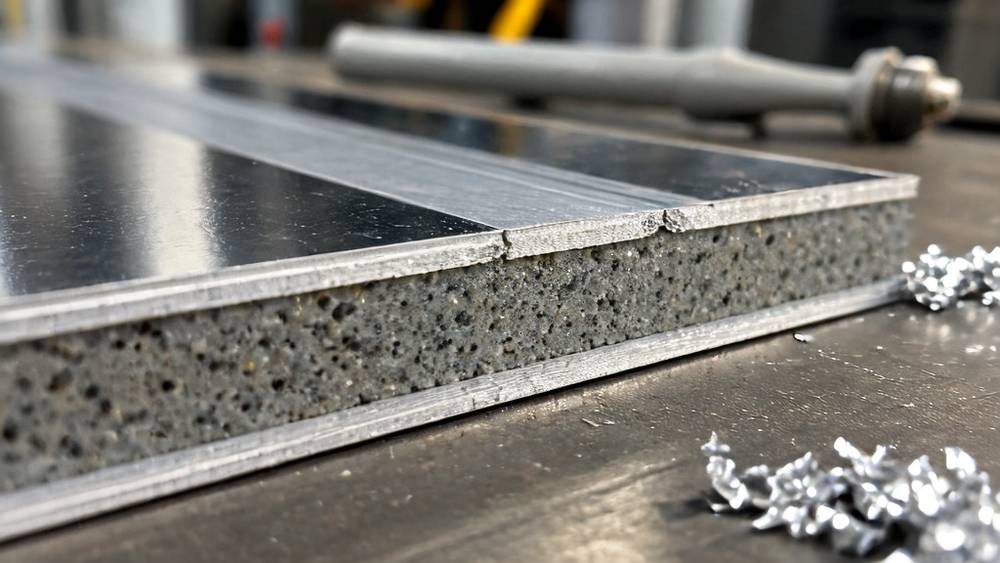
An ACM panel is a three-layer sandwich: two skins of aluminium, typically 0.5 mm each, bonded to a core that can range from 3 mm to 5 mm in thickness. The skins provide flatness, weather resistance, and the visible face. The core contributes roughly 70% of the panel's total thickness and governs its reaction to heat, its weight, and its behaviour during routing and fabrication.
When a standard polyethylene (PE) core is exposed to flame, it melts, drips, and sustains combustion. That is not a theoretical statement. The Grenfell Tower inquiry documented polyethylene-cored ACM contributing to vertical flame spread across 19 storeys in under 12 minutes. Since that event, jurisdictions worldwide have reclassified PE-cored panels as non-compliant for buildings above a certain height, and some have banned them entirely for exterior walls regardless of building height.
The mineral-filled core, by contrast, consists of approximately 70% inorganic mineral content blended with a polymer binder. When exposed to fire, the mineral component does not contribute fuel. The panel may delaminate and lose structural integrity, but it does not propagate flame in the same manner. This difference is not marginal. It is the dividing line between a cladding system that passes large-scale testing and one that fails.
Fire Classification Standards That Govern Specification
Understanding fire-rated acm panels requires fluency in three overlapping classification systems. The American system centres on ASTM E84 (surface burning characteristics) and NFPA 285 (full-scale multi-storey wall assembly testing). The European system uses EN 13501-1, which assigns classifications from A1 (non-combustible) through F (no performance determined). The British system, post-Grenfell, now mandates BS 8414 for rainscreen cladding assemblies on buildings over 18 metres.
ASTM E84, often called the tunnel test, measures flame spread index and smoke developed index. A Class A rating requires a flame spread index of 25 or less and a smoke developed index of 450 or less. Most mineral-filled ACM panels achieve Class A. Standard PE-cored panels typically fall into Class B or C. But ASTM E84 tests a single panel, not an entire wall assembly. That is where NFPA 285 enters.
NFPA 285 simulates a two-storey fire scenario with a window opening that exposes the cavity between the cladding and the structural wall. The test measures vertical and lateral flame propagation through the assembly. Passing NFPA 285 requires an engineered system: the panel, the air barrier, the insulation, the attachment system, and the fire-stopping details must all work together. A mineral-filled ACM panel is necessary but not sufficient. The entire assembly must be tested. Specifiers should request the full NFPA 285 engineering judgment or test report for the exact wall configuration proposed, not a generic letter covering a different insulation board or fastener pattern.
In the European framework, EN 13501-1 classifies ACM panels as B-s1,d0 (limited combustibility, minimal smoke, no flaming droplets) for the best mineral-filled products. A2-s1,d0 is achievable with certain high-mineral-content formulations. Standard PE panels typically rate D or E. The practical consequence: on a building over 18 metres in the UK, a panel rated below A2-s1,d0 may require a full-scale BS 8414 test on the specific assembly, adding £15,000 to £40,000 and 12 to 16 weeks to the pre-construction programme.
Mineral Core Types: Not All Fire-Rated Panels Are Equal
The term "fire-rated ACM" conceals meaningful variation. Three distinct mineral core formulations dominate the market, and each behaves differently under heat, during fabrication, and over time.
Aluminium Hydroxide (ATH) Cores: ATH is the most common mineral filler. When heated above 200°C, ATH releases water vapour through an endothermic reaction. This absorbs heat, cools the panel, and dilutes combustible gases. ATH-filled panels typically achieve B-s1,d0 under EN 13501-1 and can pass NFPA 285 in tested assemblies. The trade-off: ATH begins to degrade at temperatures reached during powder coating oven cycles, which means factory-applied PVDF finishes must be applied to the aluminium skins before bonding to the core. ATH cores also absorb moisture over time if panel edges are not properly sealed, which can cause minor dimensional movement in high-humidity climates.
Magnesium Hydroxide (MDH) Cores: MDH functions similarly to ATH but decomposes at a higher temperature, roughly 330°C. This gives MDH-cored panels a wider processing window during fabrication and better performance in assemblies where the panel might be exposed to sustained radiant heat from adjacent building elements. MDH panels are typically more expensive than ATH equivalents, adding roughly 12% to 18% to the material cost. They are specified disproportionately in the Middle East and Southeast Asia, where ambient temperatures already push the thermal envelope.
Clay-Nanocomposite and Hybrid Cores: A smaller category of panels uses layered silicate fillers or hybrid mineral-polymer formulations. These can achieve A2 classification under EN 13501-1, meaning they are classified as non-combustible in the European system. The aluminium skins still melt at roughly 660°C, so the panel as a whole is not truly non-combustible, but the core contributes negligible fuel. These panels command a premium of 25% to 40% over standard mineral-filled ACM and are typically reserved for high-rise residential projects in jurisdictions with the strictest post-Grenfell regulations.
Cost Comparison Across Core Types
Material cost is the most visible variable, but fabrication and installation costs shift with core type as well. The table below summarises the per-square-metre economics for a representative 4 mm ACM panel for a 5,000 m² rainscreen project, based on mid-2025 pricing from multiple distributors.
| Core Type | Material Cost (USD/m²) | Fabrication Differential | Installed System Cost (USD/m²) | Typical Project Suitability |
|---|---|---|---|---|
| Standard PE (3 mm PE core) | $28 – $38 | Baseline | $85 – $115 | Signage, single-storey, interior |
| ATH Mineral-Filled (3 mm core) | $48 – $62 | +5% to 8% | $120 – $155 | Mid-rise commercial, rainscreens |
| MDH Mineral-Filled (3 mm core) | $55 – $72 | +5% to 8% | $135 – $170 | High-rise, hot climates, airports |
| Hybrid A2-Rated (3 mm core) | $68 – $95 | +8% to 12% | $160 – $210 | Residential towers >18 m, London/Dubai |
The fabrication differential arises because mineral-filled cores are denser and more abrasive on router bits. A fabricator accustomed to PE panels will consume router bits roughly 20% faster when cutting mineral-filled panels and may need to adjust feed rates to avoid chipping the aluminium skin at the cut line. These are not prohibitive differences, but they add cost that should be priced in early, not discovered during the first week of fabrication.
Where the IBC and Local Amendments Draw the Line
The 2024 International Building Code, Section 1407, governs metal composite material systems. The critical provision: on buildings of Type I, II, III, or IV construction, MCM panels used on exterior walls must pass NFPA 285. Separately, Chapter 26 requires that foam plastic insulation in exterior walls of Type I-IV construction be covered by a thermal barrier, and the ACM panel itself can serve as that thermal barrier only if it passes specific testing.
But the IBC is a model code. Local amendments frequently impose stricter requirements. Since 2018, the California Building Code has required NFPA 285 compliance for MCM panels on all buildings regardless of height or construction type. New York City's building code mandates that exterior wall panels on buildings over 12 metres meet the equivalent of Class A per ASTM E84 and pass NFPA 285. The UAE Fire and Life Safety Code of Practice (2018 edition) effectively bans PE-cored ACM from exterior applications above 9 metres and requires mineral-filled panels with a minimum classification of B-s1,d0.
The practical takeaway for a specifier: do not assume that a panel rated Class A under ASTM E84 is sufficient. Check whether the jurisdiction requires NFPA 285, whether the specific assembly (not just the panel) has been tested, and whether any post-Grenfell amendments have been adopted since the last project in that jurisdiction.
Fabrication and Handling Considerations for Fire-Rated Cores
Fire-rated ACM panels route, fold, and fasten differently from PE-cored panels, and overlooking these differences leads to cracked bends, delaminated edges, and rejected shop drawings.
The mineral-filled core is more brittle. When a fabricator routs a V-groove for folding, the remaining skin thickness at the bottom of the groove must be controlled more tightly. For a PE-cored panel, a residual skin of 0.25 mm to 0.30 mm is typical. For a mineral-filled panel, 0.30 mm to 0.35 mm is safer, because the stiffer core transmits more stress into the aluminium skin during folding. If the residual is too thin, micro-cracks form along the bend line and can propagate under wind load cycling.
The minimum bend radius also changes. PE-cored panels can achieve a sharp 90-degree return with essentially zero radius. Mineral-filled panels, particularly those with hybrid cores, may require a minimum inside radius of 1.5 to 2 times the panel thickness to avoid core crushing. A fabricator accustomed to sharp returns on PE panels will need to adjust CNC programs and potentially redesign corner details.
Edge sealing is more critical for mineral-filled panels. The mineral content, particularly ATH, is hygroscopic. If water reaches the core through unsealed panel edges, it can cause edge swelling, visible telegraphing on the panel face, and, in freeze-thaw climates, delamination. The standard remedy is a factory-applied edge seal or a field-applied sealant on all cut edges. Some manufacturers, including Futeng®, supply panels with pre-sealed edges as part of their fire-rated product line, eliminating the field-sealing step and the associated quality control risk.
How Insurers Evaluate Fire-Rated ACM Specifications
Since 2019, global property insurers have developed internal cladding risk assessment frameworks. These are not published standards, but they directly affect premium calculations and, in some cases, whether a building is insurable at all.
The typical insurer checklist evaluates four factors: the core material classification (PE vs. mineral), the results of large-scale testing (NFPA 285 or BS 8414), the presence of cavity barriers and fire stops at each floor line, and the involvement of a façade engineer who has certified the assembly. A building clad in PE-cored ACM without NFPA 285 testing may face a premium loading of 15% to 30% or a straight decline. A building with mineral-filled ACM, a passed NFPA 285 test, and properly detailed fire stops may qualify for standard rates.
Some insurers now require a post-installation inspection report confirming that the panels installed match the panels tested. This is a response to the practice of value-engineering after approval: a contractor submits a mineral-filled panel for testing, wins the job, then substitutes a cheaper PE panel on site. The cost of an inspection is trivial compared to the cost of being discovered without one after a loss event.
Regional Market Differences in Fire-Rated ACM Adoption
The fire-rated ACM market is not global; it is fragmented by regulation, enforcement, and insurance practice.
North America: The NFPA 285 requirement in the IBC has pushed mineral-filled ACM to roughly 70% of the exterior ACM market for commercial buildings. PE panels remain dominant in signage and interior applications. Enforcement varies by municipality: Chicago and New York conduct plan reviews that specifically interrogate cladding fire performance; smaller jurisdictions may not.
United Kingdom: The post-Grenfell landscape is defined by Approved Document B, which now requires that all materials in the external wall of buildings over 18 metres be of limited combustibility (A2-s1,d0 or better). This has effectively eliminated standard mineral-filled ACM (B-s1,d0) from high-rise residential and driven demand toward A2-rated hybrid panels and solid aluminium alternatives.
Middle East: The UAE's 2018 Fire and Life Safety Code was one of the earliest comprehensive responses to high-rise cladding fires. It mandates mineral-filled panels with B-s1,d0 minimum for buildings above 9 metres. Enforcement has been inconsistent historically, but Dubai Civil Defence now requires third-party verification of installed cladding on new high-rise projects.
Australia: Following the Lacrosse Building fire in Melbourne (2014), which involved PE-cored ACM, the National Construction Code was amended to effectively ban PE-cored ACP on buildings above two storeys. State-level cladding rectification programs in Victoria and New South Wales have funded the replacement of non-compliant panels on over 1,000 buildings, at a combined cost exceeding AUD 600 million.
Testing vs. Reality: What a Passed Test Actually Means
An NFPA 285 test report is not a blanket approval. It applies to the exact assembly tested: the specific panel, the specific insulation type and thickness, the specific air and water-resistive barrier, the specific fastener type and spacing, and the specific window or opening detail. Change any one of those components, and the test may no longer be valid.
A common pitfall occurs when a contractor proposes a different insulation board than the one in the tested assembly, arguing that it has the same ASTM E84 rating. But NFPA 285 tests the interaction between the insulation and the panel. Some foam plastic insulations melt and drip behind the panel during a fire, opening a cavity that promotes chimney-effect flame spread. A mineral wool insulation behaves entirely differently. Substituting one for the other without an engineering judgment invalidates the fire engineering basis of the cladding system.
The industry has developed a system of engineering judgments, typically issued by the panel manufacturer or a qualified fire engineer, that extend a passed NFPA 285 test to assemblies with minor variations. But these judgments have limits. Changing the panel core from ATH to MDH, for example, is generally considered beyond the scope of an engineering judgment and requires new testing. Specifiers should request and review the full judgment letter, not just the summary, and confirm that the authority having jurisdiction accepts engineering judgments in lieu of project-specific testing.
Selecting the Right Fire-Rated ACM Panel for the Project
The decision tree for fire-rated acm panels should follow this sequence: determine the building height and construction type per the applicable building code; identify whether the jurisdiction has post-Grenfell amendments or local requirements stricter than the model code; confirm whether the insurer has specific cladding requirements; select a panel core that meets or exceeds the most restrictive standard; verify that an NFPA 285 or equivalent large-scale test exists for the proposed assembly; and lock the specification so that value-engineering substitutions cannot erode the fire performance basis.
The cost difference between a PE-cored and mineral-filled ACM panel on a mid-rise commercial building of 3,000 m² is approximately USD 60,000 to USD 90,000 in material alone. That number looks significant on a cost plan. Set against the cost of recladding the same building after a fire, or against a five-year insurance premium differential, or against the reputational damage of a non-compliance finding, it becomes negligible. The industry has learned this lesson repeatedly, at enormous expense. The question is whether the next project team will learn from those lessons or pay to learn them again.
For project teams seeking mineral-filled acm panels with documented NFPA 285 assembly testing, suppliers such as Futeng® offer a range of ATH and MDH core options with full engineering judgment packages, reducing the burden on the specifier to assemble test evidence from multiple sources.