2 0 mm vs 2 5 mm vs 3 0 mm Aluminium Plate for Curtain Wall Flatness and Fixing Cost
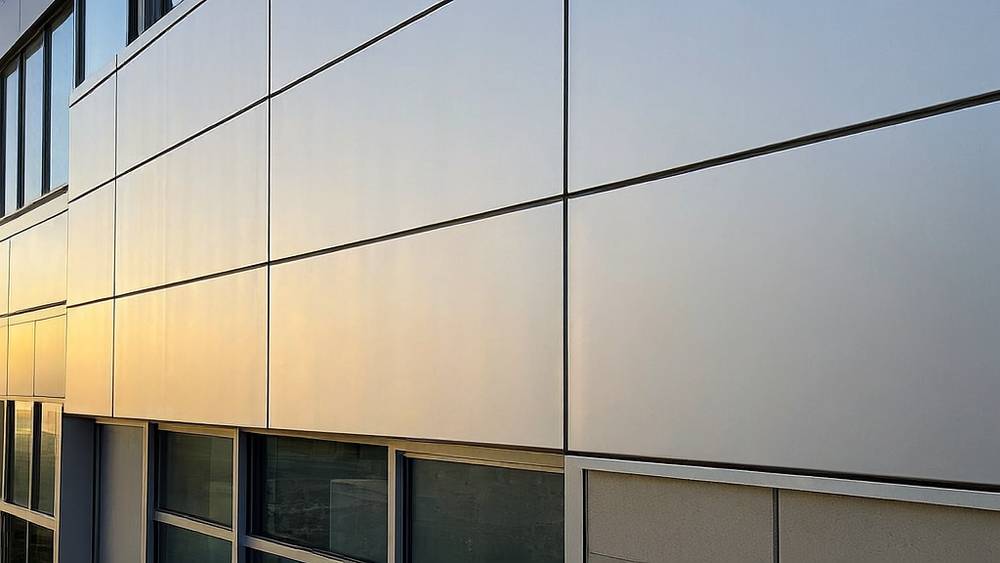
When a procurement manager specifies "aluminium plate" for a curtain wall package, the conversation rarely stays on alloy grades for long. Within the first three technical exchanges, the question shifts to thickness: 2.0 mm, 2.5 mm, or 3.0 mm. The difference between these numbers looks trivial on a spreadsheet but compounds into divergent outcomes across flatness, fixing cost, and long-term oil canning risk once panels exceed 1,200 mm in width. An aluminium plate that performs flawlessly as a 600 mm × 600 mm spandrel cover can become a warranty liability when stretched to a 1,500 mm × 3,000 mm vision-line panel at the same gauge. This article examines what actually changes across the three most common thicknesses for solid aluminium cladding panels, pulling from fabrication realities, wind load deflection measurements, and the cost logic that governs specification decisions on commercial facades.
Why Aluminium Plate Thickness Is Not a Linear Decision
The assumption that thicker always means better collapses once you examine how an aluminium plate behaves under negative wind load. A 3.0 mm panel is stiffer than a 2.0 mm panel, but stiffness does not scale linearly with thickness. The bending stiffness of a flat rectangular plate is proportional to the cube of its thickness. This means a 3.0 mm aluminium plate is roughly 3.4 times stiffer than a 2.0 mm panel, not simply 50% stiffer as the raw gauge difference would suggest. That cubic relationship drives everything: deflection limits, fixing center spacing, the number of stiffeners required per square meter, and ultimately the installed cost per panel.
Fabricators who handle aluminium plate daily learn something that specification writers in design offices sometimes miss: a 2.5 mm panel with properly engineered stiffeners can outperform a bare 3.0 mm panel on cost-to-performance ratio, especially on facades where panel dimensions push beyond 1,200 mm in the short direction. The key is understanding where each thickness fits before the shop drawings are locked.
2.0 mm Aluminium Plate: Where It Works and Where It Fails
A 2.0 mm aluminium plate represents the entry point for most rainscreen and cladding applications. At this gauge, the material weighs approximately 5.4 kg/m² before coatings, which keeps dead load manageable and reduces the structural burden on the supporting subframe. For internal soffits, column wraps, fascia panels under 800 mm wide, and spandrel covers with limited wind exposure, 2.0 mm is a legitimate engineering choice that saves material cost and speeds up handling on site.
However, problems surface when a 2.0 mm aluminium plate is stretched across large unsupported spans. The oil canning threshold at this thickness is unforgiving. Oil canning — the visible waviness or buckling that appears under certain lighting conditions — is not a structural failure, but it ranks among the most frequent reasons for facade panel rejection on commercial projects. The phenomenon is driven by residual stresses introduced during the rolling and forming process, and thinner material offers less resistance to these stresses manifesting as visible distortion.
Flatness tolerances for a 2.0 mm panel typically land around ±3 mm over a 1-meter straight edge under workshop conditions. Once mounted and subjected to thermal cycling and wind pressure, that tolerance can degrade. For panels larger than 1,000 mm × 1,000 mm, many fabricators will recommend stepping up to 2.5 mm or adding rear stiffeners — which partially erodes the cost advantage of specifying 2.0 mm in the first place.
2.5 mm Aluminium Plate: The Sweet Spot for Most Commercial Facades
Across mid-rise commercial buildings, transit stations, and education-sector projects, 2.5 mm has become the default aluminium plate specification — and for good reason. At 6.75 kg/m², the weight penalty over 2.0 mm is modest, but the improvement in panel rigidity is significant. The cubic stiffness relationship means the 2.5 mm panel is roughly 95% stiffer than its 2.0 mm counterpart, which translates directly into fewer stiffeners, wider fixing centers, and a visibly flatter installed surface.
Wind load data tells the story clearly. Consider a 1,200 mm × 2,400 mm aluminium plate panel simply supported on four edges, subjected to a design wind pressure of 1.5 kPa (typical for many urban mid-rise facades). A 2.0 mm 5052-H32 panel under these conditions may deflect beyond the commonly accepted L/90 limit, triggering the need for intermediate stiffeners or closer fixing spacing. The same panel in 2.5 mm stays within L/120 deflection limits without additional stiffening, which simplifies fabrication and reduces the per-panel labor content.
Another factor that tilts the decision toward 2.5 mm is handling damage. Panels in this thickness range resist denting during transport and installation far better than 2.0 mm material. On a project with 2,000 panels, reducing on-site rejection from handling damage by even 2-3% recovers the incremental material cost of the thicker gauge several times over. Futeng® has observed in its supply data that 2.5 mm now accounts for the largest share of solid aluminium cladding panel shipments to commercial projects across Southeast Asia and the Middle East, reflecting a market consensus around this balance point.
3.0 mm Aluminium Plate: When the Specification Demands Maximum Rigidity
A 3.0 mm aluminium plate at 8.1 kg/m² represents the heavy end of the cladding spectrum. This thickness is specified where wind loads are high — coastal towers, exposed high-rise facades above 60 meters, and buildings in typhoon or hurricane zones — or where architectural expectations demand the flattest possible appearance with zero tolerance for oil canning.
The engineering case for 3.0 mm becomes compelling at panel dimensions exceeding 1,500 mm in any direction. At these sizes, even 2.5 mm panels may require multiple stiffeners and closely spaced fixings to meet deflection criteria. The 3.0 mm panel often eliminates one or two stiffeners per panel and allows fixing centers to widen from 400 mm to 600 mm, which reduces the total number of brackets, anchors, and installation hours. The material cost increases, but the system cost — material plus labor — can be close to neutral or even favorable on large-format panels.
There is also a durability dimension. Thicker aluminium plate carries more metal behind the fixing holes, which matters for long-term fatigue performance under cyclic wind loading. For projects targeting a 50-year facade service life with minimal maintenance intervention, the additional corrosion allowance and mechanical robustness of 3.0 mm can justify the upfront cost increment.
Alloy Selection Interacts with Thickness
Thickness decisions cannot be isolated from alloy choice. The three alloys most commonly encountered in aluminium plate for cladding — 3003, 5052, and 6061 — each bring different forming and strength characteristics that shift the thickness calculus.
3003-H14 is the most formable of the three, with excellent corrosion resistance and a tensile strength around 130-150 MPa. It is the standard choice for perforated panels, complex folded geometries, and applications where deep drawing or intricate bending is required. Because 3003 is softer, fabricators often specify it at 2.5 mm or 3.0 mm to compensate for the lower stiffness compared to 5052 at the same gauge.
5052-H32 delivers higher tensile strength (210-260 MPa) and superior saltwater corrosion resistance, making it the dominant aluminium plate alloy for marine and coastal facades. A 2.5 mm 5052 panel can often match the stiffness of a 3.0 mm 3003 panel while saving roughly 17% on material weight. This substitution logic appears frequently in value engineering exercises where the design team wants to reduce dead load without sacrificing flatness.
6061-T6, with tensile strength reaching 290 MPa, is the strongest of the three but also the least formable. It is uncommon for general rainscreen panels but appears in structural cladding applications where panels must span between floors without intermediate support. At 3.0 mm in 6061-T6, an aluminium plate can handle spans that would require 4.0 mm or more in 3003. The trade-off is that 6061 welds require post-weld heat treatment to restore strength, adding fabrication complexity and lead time.
| Property | 3003-H14 | 5052-H32 | 6061-T6 |
|---|---|---|---|
| Tensile Strength (MPa) | 130–150 | 210–260 | 290–310 |
| Yield Strength (MPa) | 105–125 | 160–195 | 240–275 |
| Elongation (%) | 8–12 | 8–12 | 8–10 |
| Formability Rating | Excellent | Good | Fair |
| Corrosion Resistance | Very Good | Excellent (Marine) | Good |
| Typical Cladding Thickness | 2.5–3.0 mm | 2.0–3.0 mm | 3.0 mm (Structural spans) |
| Best Application | Perforated, folded geometries | Coastal, general rainscreen | Long-span structural panels |
Stiffener Economics: How Support Strategy Changes with Gauge
Rear stiffeners — typically aluminium extrusions or folded profiles bonded or mechanically fixed to the back of the panel — are the standard method for controlling deflection and oil canning in aluminium plate cladding. The number of stiffeners per panel is not an arbitrary fabrication choice; it is an engineering output driven by panel dimensions, design wind load, and plate thickness.
A 2.0 mm panel at 1,200 mm × 2,400 mm might require three horizontal stiffeners to meet L/120 deflection under 1.5 kPa wind load. The same panel in 2.5 mm might need only one stiffener, and in 3.0 mm it might need none. Each stiffener adds roughly 15-25 minutes of fabrication labor, plus material cost for the extrusion and adhesive or weld consumables. At typical workshop rates, eliminating two stiffeners per panel saves approximately $8-15 per panel in labor alone.
For a project with 1,500 panels, the stiffener reduction from upgrading from 2.0 mm to 2.5 mm can offset $12,000-22,500 of the incremental material cost. This is the kind of calculation that procurement teams should run before locking the specification, rather than defaulting to "2.0 mm minimum" because that is what the budget template says.
Surface Finish Considerations Across Thicknesses
The aluminium plate surface that meets the eye is a coating system — typically PVDF (polyvinylidene fluoride) or FEVE (fluoroethylene vinyl ether) — applied after the panel is formed and pretreated. Thickness of the substrate does not directly affect coating adhesion or color consistency, but it does influence the thermal mass of the panel and, consequently, how the coating responds to temperature swings.
Thicker panels heat up and cool down more slowly than thinner ones. On a facade that cycles between -5°C at night and 45°C under direct afternoon sun, a 3.0 mm aluminium plate will experience a narrower and slower thermal cycle than a 2.0 mm panel. This can reduce the stress on the coating-substrate interface over decades of service, particularly for dark colors where surface temperatures can spike above 70°C. While PVDF coatings are formulated to handle these conditions, the substrate beneath them plays a supporting role that is often overlooked in coating-focused specifications.
The standard PVDF coating system under AAMA 2605 applies a minimum 30-35 micron dry film thickness across a three-coat system (primer, color coat, clear coat). This specification remains constant regardless of whether the aluminium plate is 2.0 mm or 3.0 mm. The coating does not get thicker just because the metal does — a point that occasionally causes confusion when inexperienced specifiers attempt to correlate coating durability with metal gauge.
Fixing and Bracket Design: The Hidden Cost Driver
The thickness of aluminium plate directly governs the pull-through resistance of fasteners and the load capacity of each fixing point. Rivets and screws anchored into a 2.0 mm panel will pull through at lower loads than the same fasteners in 3.0 mm material. This matters because fixing failure is a more catastrophic failure mode than deflection — a pulled fastener can allow a panel to detach partially or fully, creating a safety hazard.
For mechanically fixed systems, many bracket manufacturers publish minimum substrate thickness requirements. A common threshold is 2.0 mm minimum for standard cassette fixing systems, with 2.5 mm recommended for panels exceeding 1,200 mm in any dimension. Some proprietary systems designed for high-wind zones require 3.0 mm minimum. Ignoring these requirements to save material cost is a specification error that can lead to fixing failures during storm events.
The fixing center spacing also interacts with thickness. Wider fixing centers reduce the total number of brackets and fasteners per panel, which cuts both material cost and installation time. A 3.0 mm aluminium plate might allow fixing centers of 600 mm, while a 2.0 mm panel may require 350-400 mm centers for equivalent performance. Over a large facade, the difference in total fixing count can be in the thousands, with each fixing representing a bracket, a fastener, a drilled hole, and an installation step.
| Parameter | 2.0 mm Panel | 2.5 mm Panel | 3.0 mm Panel |
|---|---|---|---|
| Weight (kg/m²) | 5.4 | 6.75 | 8.1 |
| Relative Stiffness (vs 2.0 mm) | 1.0× | 1.95× | 3.38× |
| Typical Fixing Centers (mm) | 350–400 | 450–500 | 500–600 |
| Stiffeners per 1.2×2.4m Panel (1.5 kPa) | 2–3 | 1–2 | 0–1 |
| Oil Canning Risk (Large Panels) | High | Moderate | Low |
| Pull-Through Resistance | Moderate | Good | Excellent |
| Material Cost Index (per m²) | 1.00 | 1.25 | 1.50 |
| Installed System Cost Index | 1.00 | 0.95–1.05 | 1.05–1.20 |
ASTM Standards and What They Actually Require
Aluminium plate used in architectural cladding falls under ASTM B209/B209M, the standard specification for aluminium and aluminium-alloy sheet and plate. This standard covers chemical composition limits, mechanical property requirements, and dimensional tolerances for flatness, thickness, width, and length. For cladding applications, the flatness tolerance is often the most scrutinized parameter, and ASTM B209 defines it as the maximum deviation from a flat surface measured with the sheet resting on a flat horizontal table.
The standard flatness tolerance for aluminium plate in the thickness range 2.0-3.0 mm and width over 1,000 mm is approximately 6 mm for stretcher-leveled material. However, this tolerance applies to the mill-supplied plate, not the fabricated and coated panel. Fabricators can improve flatness through roller leveling and careful handling, but they cannot eliminate the residual stress that causes oil canning. The only reliable controls are adequate thickness, properly designed stiffeners, and realistic expectations about what a 2.0 mm aluminium plate spanning 1,500 mm can achieve under grazing light.
For projects governed by ISO 6361 (wrought aluminium and aluminium alloy sheets, strips and plates), the dimensional tolerance framework is broadly similar, though the specific numerical values differ slightly from ASTM B209. Procurement teams working on international projects should clarify which standard governs the specification and ensure the fabricator's quality control documentation references the correct standard.
Fire Performance: Thickness as a Factor
Solid aluminium plate is inherently non-combustible. Unlike aluminium composite materials that contain a polyethylene or mineral-filled core, a solid aluminium plate contains nothing but metal. This distinction has become critically important in the years since the Grenfell Tower fire, as building codes worldwide have tightened restrictions on combustible materials in external wall assemblies.
Under EN 13501-1, solid aluminium plate achieves a classification of A1 (non-combustible) provided it does not contain any organic coating thicker than 1.0 mm or with a calorific value exceeding set thresholds. The PVDF coatings typically applied to architectural aluminium plate fall well within these limits, meaning the coated panel retains its A1 or A2-s1,d0 classification. This is a fundamental advantage over ACP products and one that specifiers in the UK, Australia, and the Middle East have increasingly mandated since 2017.
Thickness plays a secondary role here: thicker aluminium plate provides greater thermal mass and takes longer to reach critical temperatures under fire exposure. While the fire classification is driven primarily by combustibility, not thickness, the additional metal cross-section in a 3.0 mm panel provides more time before structural failure under extreme heat — a factor that fire engineers consider when evaluating facade systems for high-risk buildings.
Transport, Handling, and Site Logistics
The logistics of delivering aluminium plate to site change measurably with thickness. A container loaded with 2.0 mm panels carries more square meters of cladding than the same container loaded with 3.0 mm panels — roughly 50% more, based on weight. For projects with tight site access or limited crane time, the handling weight per panel also matters. A single 1,500 mm × 3,000 mm panel in 3.0 mm weighs approximately 36.5 kg, which is manageable by two installers but approaching the limit for safe manual handling without mechanical assistance.
Site storage conditions also interact with thickness. Thinner panels are more susceptible to damage from improper stacking, wind uplift in storage yards, and edge impacts during maneuvering. The cost of rejected or reworked panels due to site damage can exceed the material cost difference between 2.0 mm and 2.5 mm on a single large project. Experienced project managers factor these risks into the specification conversation, not just the ex-works price per square meter.
When Value Engineering Goes Wrong
The most dangerous specification change in aluminium plate cladding is the late-stage substitution of a thinner gauge to meet budget targets, without recalculating the engineering implications. A value engineering proposal that reads "reduce panel thickness from 2.5 mm to 2.0 mm to save 20% on material" ignores the stiffener count increase, the fixing center reduction, the higher oil canning risk, and the potential for installation damage. The net system saving is typically far less than 20%, and the long-term performance risk is substantially higher.
The smarter value engineering move is often the reverse: evaluate whether upgrading from 2.0 mm to 2.5 mm can eliminate enough stiffeners and widen fixing centers to offset the material premium. On many projects, the answer is yes — and the result is a flatter, more robust facade at a comparable or only marginally higher system cost.
Choosing the right aluminium plate thickness is not about picking the thickest option the budget allows. It is about matching the gauge to the panel dimensions, the wind environment, the fixing strategy, and the architectural expectations for flatness. When those variables are properly aligned, the specification writes itself — and the facade performs as intended for decades.