Aluminum Black Fence Chalking Prevented by AAMA 2604 Coating
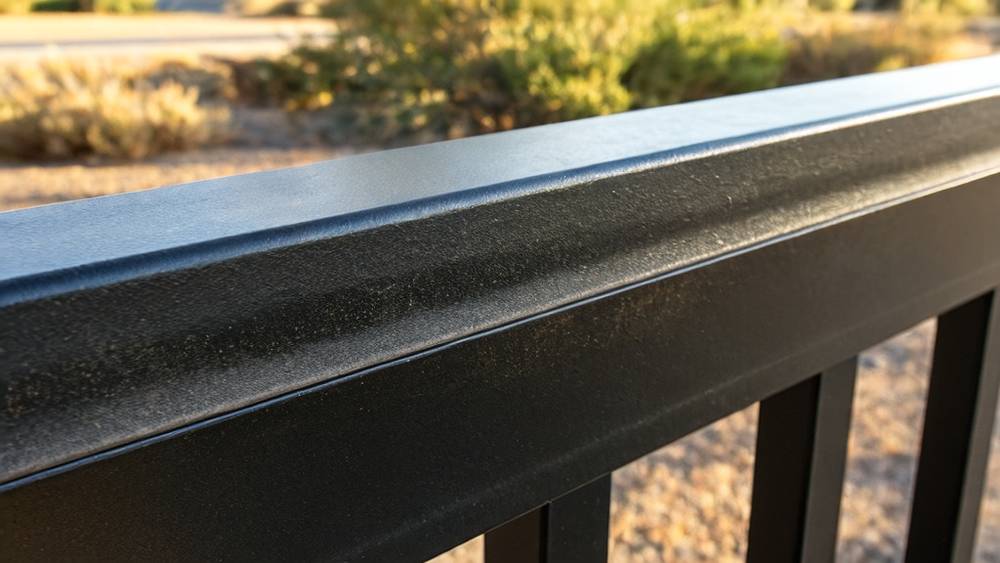
Powder coating failure on black aluminium fence systems is not a question of if it will happen, but when — and under what conditions. Across North American markets, black powder-coated aluminium fencing has become the default specification for residential communities, commercial perimeters, and pool enclosures. The aesthetic appeal of a matte or semi-gloss black finish combined with aluminium's inherent corrosion resistance creates a compelling value proposition. Yet project managers and procurement teams increasingly encounter a recurring problem: black finishes that chalk, fade, or delaminate within 3 to 5 years of installation, particularly in regions with sustained UV exposure, coastal salt spray, or freeze-thaw cycling. An aluminum black fence specified without understanding the distinction between standard polyester powder and AAMA 2604-compliant formulations represents a latent warranty liability that may not surface until well after final payment. This article isolates the powder coating variables that determine whether a black aluminium fence will maintain its appearance and structural coating integrity across a 15-to-20-year service window, drawing on accelerated weathering data, application thickness tolerances, and pretreatment chemistry.
Why Black Finishes Fail Faster Than Other Colours
Black powder coatings absorb more solar radiation than any other colour in the fence industry palette. A black aluminium fence panel exposed to direct sunlight in Phoenix, Arizona or Las Vegas, Nevada can reach surface temperatures of 75°C to 85°C (167°F to 185°F) during summer afternoons, compared to 50°C to 60°C for a white or light bronze equivalent. This thermal loading accelerates polymer chain scission within the powder coating's binder system. Standard polyester powders — typically TGIC-free polyester formulations applied at 2.0 to 3.0 mils (50 to 75 microns) — begin exhibiting measurable gloss reduction after approximately 1,200 to 1,500 hours of QUV-B 313 accelerated weathering. In real-world terms across the US Sun Belt, that translates to visible chalking within 3 to 4 years.
The colour itself compounds the problem. Black pigments, primarily carbon black, absorb across the full UV-visible spectrum. While carbon black does provide some UV-blocking function within the coating film, the sustained thermal cycling weakens the resin-pigment bond at the coating surface. What starts as a subtle loss of colour depth progresses to a whitish surface haze, then to outright pigment release that transfers to clothing or hands on contact. For specifiers managing multi-phase residential developments or HOA-governed communities, this degradation pattern triggers warranty claims that can cascade across dozens or hundreds of linear feet of aluminum black fence installation.
Reading the Powder Chemistry: Polyester vs. Super-Durable Polyester vs. Fluoropolymer
Not all black powder coatings carry the same performance profile. The North American architectural powder coating market segments into three tiers, each with distinct resin chemistry and weathering expectations. Understanding these tiers is the single most impactful decision a specifier can make when selecting an aluminum black fence system.
Standard polyester powders, built on carboxyl-functional polyester resins crosslinked with TGIC or HAA (β-hydroxyalkylamide), dominate the residential fencing market. These formulations offer excellent initial gloss (70 to 85 GU at 60°), good flow and levelling, and a competitive applied cost of $0.80 to $1.20 per square foot. However, their aromatic polyester backbone absorbs UV radiation intrinsically, meaning the resin itself photodegrades regardless of pigment protection. Accelerated weathering per AAMA 2603 typically certifies these coatings for one-year Florida exposure with a maximum of 30% gloss retention. For a black finish, that threshold is frequently breached within 18 to 24 months in high-UV geographies.
Super-durable polyester powders replace a portion of the aromatic polyester with aliphatic or cycloaliphatic building blocks, dramatically improving UV resistance. These formulations, qualified under AAMA 2604, must demonstrate 50% gloss retention after five years of South Florida exposure at 5° south. In practical terms, a super-durable black powder coating on an aluminum black fence should maintain acceptable appearance for 7 to 10 years before noticeable chalking begins. The applied cost premium runs $0.40 to $0.70 per square foot over standard polyester — a modest increment when amortised over the extended service life.
Fluoropolymer powders, based on PVDF (polyvinylidene fluoride) resin systems with acrylic modification, occupy the top tier. Meeting AAMA 2605 requirements — 50% gloss retention after 10 years Florida exposure — these coatings represent the benchmark for architectural aluminium. Their application to fencing remains relatively rare due to cost ($2.50 to $3.50 per square foot applied) and limited colour availability, but for high-visibility commercial perimeter fencing or coastal installations where maintenance access is difficult, the long-term economics can justify the premium. Futeng® has supplied PVDF-coated black aluminium fence panels for several high-end commercial projects where the specification explicitly required AAMA 2605 compliance.
| Coating Type | Resin Chemistry | AAMA Standard | Florida Exposure (Gloss Retention) | Expected Service Life (Black) | Applied Cost Premium (vs. Std Polyester) |
|---|---|---|---|---|---|
| Standard Polyester | Aromatic polyester + TGIC/HAA | AAMA 2603 | 1 year, ≥30% | 3–5 years | Baseline |
| Super-Durable Polyester | Aliphatic-modified polyester | AAMA 2604 | 5 years, ≥50% | 7–10 years | +$0.40–$0.70/sq ft |
| Fluoropolymer (PVDF) | PVDF + acrylic (70:30) | AAMA 2605 | 10 years, ≥50% | 15–20+ years | +$1.70–$2.30/sq ft |
| FEVE (Lumiflon-type) | Fluoroethylene vinyl ether | AAMA 2605 | 10 years, ≥50% | 15–20+ years | +$2.00–$2.80/sq ft |
Film Thickness: The Hidden Variable in Black Coating Durability
Powder coating chemistry gets the attention, but film thickness often determines whether a coating meets or misses its design life. AAMA 2604 requires a minimum dry film thickness (DFT) of 2.0 mils (50 microns) for super-durable polyester on aluminium extrusions and sheet. AAMA 2605 pushes the minimum to 1.2 mils (30 microns) for PVDF liquid coatings, but for powder-applied fluoropolymers, 2.0 to 3.0 mils is typical industry practice.
The problem with black powder on aluminium fence components — particularly pickets, rails, and punched ornamental elements — is that electrostatic application struggles to achieve uniform coverage on complex geometries. The Faraday cage effect causes powder to deposit thinly or not at all in inside corners, punched hole perimeters, and the interior surfaces of hollow rails. A specification that reads "2.0 mils minimum DFT" is meaningless if the applicator cannot physically achieve that thickness on the most vulnerable surfaces. For an aluminum black fence with decorative finials, scrollwork, or punched infill panels, the specifier should require a minimum of 2.5 mils DFT on all exterior-facing surfaces and mandate a written thickness measurement protocol using a calibrated DFT gauge at a defined sampling frequency.
Overspecifying thickness carries its own risks. Powder coatings applied above 5.0 to 6.0 mils (125 to 150 microns) can develop orange peel texture, reduced flexibility, and poor impact resistance. Black coatings are particularly unforgiving of surface texture defects because the dark colour amplifies any waviness or ripple in the cured film. The sweet spot for architectural black powder on aluminium fence components sits at 2.5 to 3.5 mils DFT for super-durable polyester and 2.0 to 3.0 mils for PVDF powder.
Pretreatment: What Happens Before the Powder Matters More
A $0.15-per-square-foot saving on pretreatment chemistry can destroy a $2.00-per-square-foot powder coating investment within two years. The aluminium surface must be absolutely clean and chemically activated before powder application, or no coating chemistry can compensate.
The industry standard for architectural aluminium pretreatment is a five-to-seven-stage chromate conversion coating process, though hexavalent chromium restrictions under EPA regulations have driven adoption of trivalent chromium and chromium-free alternatives. A proper pretreatment line includes alkaline cleaning, rinse, deoxidation/etch, rinse, conversion coating application, rinse, and a final deionized water rinse. Each stage must be maintained within defined pH, concentration, and temperature parameters. For black aluminium fence components destined for coastal environments — within 3 to 5 miles of saltwater — a minimum coating weight of 40 mg/sq ft for chromate or 20-30 mg/sq ft for zirconium-based non-chrome pretreatment is recommended per AAMA 2604 and 2605 guidelines.
One common failure mode: aluminium fence fabricators who outsource powder coating to job-shop applicators without verifying the pretreatment protocol. A shop accustomed to coating steel components may skip the deoxidation stage entirely or use an iron phosphate pretreatment that offers zero protection on aluminium. When the black powder coating on an aluminum black fence peels in sheets within 12 months, the root cause is almost always pretreatment failure — inadequate cleaning, no conversion coating, or contamination between stages.
UV Stabilisation and Gloss Retention: What the Data Shows
Gloss retention is the canary in the coal mine for black powder coatings. Once gloss drops below 30% of initial value (measured at 60° geometry), surface chalking has already begun, and the coating's protective function is compromised. For black finishes, the visual impact is particularly severe because the contrast between intact glossy areas and chalked matte areas creates a patchy, weathered appearance long before the underlying aluminium is exposed.
Independent testing by the Powder Coating Institute demonstrates that super-durable polyester formulations incorporating UV absorber (UVA) and hindered amine light stabiliser (HALS) additive packages retain 50% to 65% of initial gloss after 3,000 hours of QUV-B exposure, compared to 20% to 30% for standard polyester without stabilisers. For black coatings, the UV absorber selection is critical: benzotriazole-type UVAs provide broad-spectrum protection but can migrate within the film over time, while triazine-based UVAs offer better retention but at higher cost. A well-formulated super-durable black polyester powder for an aluminum black fence should specify both UVA and HALS at a combined loading of 2% to 4% by weight on total resin solids.
Geographic Risk Mapping: Where Black Aluminium Fence Coatings Fail First
Not all installation locations impose the same demands on a black powder coating. Specifiers can use a simple geographic risk framework to determine the minimum coating specification for a given project.
High-Risk Zone (Southwest US, Gulf Coast, Florida, Hawaii): Annual UV index consistently above 7, combined with high ambient temperatures and, in coastal areas, salt aerosol. Black aluminium fence installations in Phoenix, Miami, Houston, or Honolulu should specify super-durable polyester (AAMA 2604) as an absolute minimum, with PVDF (AAMA 2605) strongly recommended for projects with extended warranty requirements or difficult maintenance access. The incremental coating cost represents roughly 8% to 12% of total installed fence cost but can eliminate a full recoating cycle over a 15-year ownership period.
Moderate-Risk Zone (Midwest, Northeast, Pacific Northwest): Lower annual UV exposure but significant freeze-thaw cycling that stresses the coating-substrate bond through differential thermal expansion. Standard polyester may survive 5 to 7 years in these climates, but super-durable polyester still delivers better long-term value. The freeze-thaw mechanism is particularly relevant for black coatings because the higher daytime surface temperatures create a larger daily temperature swing — up to 40°C (72°F) in some locations — than lighter colours experience.
Low-Risk Zone (Shaded installations, northern latitudes): Standard polyester may be adequate for fence installations that receive less than 4 hours of direct daily sun exposure. However, specifiers should verify that the powder applicator's standard polyester formulation carries at least basic UV stabiliser loading, as some commodity powders intended for indoor use contain no UV protection whatsoever.
Warranty Language: What to Demand, What to Reject
Powder coating warranties for aluminium fence products vary dramatically in their practical value. A "15-year warranty" printed on a product brochure means nothing without defined failure criteria, measurement methodology, and remedy provisions. Procurement teams evaluating an aluminum black fence specification should scrutinise warranty language against these benchmarks:
- Gloss retention threshold: The warranty should state a minimum gloss retention percentage (e.g., 50% at 60° geometry) measured per ASTM D523, not a subjective "excessive fading" standard.
- Chalking rating: Per ASTM D4214, a chalking rating of 6 or better (on the 0-10 scale where 10 is no chalking) should be the minimum acceptable threshold for warranty claims.
- Adhesion: Cross-hatch adhesion testing per ASTM D3359, Method B, should achieve a rating of 4B or 5B throughout the warranty period.
- Colour change (Delta E): Measured per ASTM D2244 using CIELAB colour space, a Delta E of 5.0 or less is typical for AAMA 2604-compliant coatings; values above 8.0 indicate visually obvious colour shift.
- Remedy: The warranty must specify whether the remedy is coating replacement, panel replacement, or a depreciated credit. A prorated warranty that declines 7% per year offers little practical protection after year 5.
Some manufacturers offer extended warranties that combine the aluminium substrate warranty (typically 20 to 30 years against perforation corrosion) with the coating warranty. The specifier should ensure these are not conflated: the aluminium itself will almost certainly outlast the coating, and corrosion perforation of the substrate is a separate failure mode from coating degradation.
"The single most common warranty dispute we see involves black powder coatings that have chalked but not corroded. The client sees an ugly fence; the manufacturer sees a coating performing exactly as its chemistry allows. The gap is always in the specification language." — Industry technical director, architectural powder coating
Application Quality Control: Field Verification That Actually Works
Specification is the first step; verification is where projects succeed or fail. For commercial and multi-family residential aluminum black fence installations, a practical field QC protocol should include:
Pre-installation batch sampling: Request three random panels from the production run before bulk shipment. Measure DFT at 10 points per panel using a calibrated Type 2 electronic gauge. Record minimum, maximum, and mean values. Reject batches where any single reading falls below 1.5 mils or where the mean falls below the specified minimum.
MEK rub test: Per AAMA 2604 and 2605, a methyl ethyl ketone (MEK) double-rub test provides a rapid field check of cure completeness. Fifty double rubs with no breakthrough to bare aluminium indicates adequate crosslinking for super-durable polyester; 100 double rubs for PVDF. An undercured black powder coating may look acceptable at installation but will chalk and fade at two to three times the expected rate.
Post-installation touch-up protocol: Field-cut ends, drilled holes, and handling damage create breach points in the coating system. The touch-up coating — typically a two-component acrylic urethane or air-dry fluoropolymer in a matching black — must be applied to a clean, abraded surface within 24 hours of cutting. Zinc-rich primers are unnecessary on aluminium and can create galvanic incompatibility if applied to cut edges. Suppliers like Futeng® provide factory-matched touch-up kits formulated to the same resin chemistry as the original powder, which is essential for colour fidelity on black finishes where even slight gloss or hue mismatches are immediately visible.
Cost-Benefit Analysis: The 10-Year View
Procurement decisions driven by initial cost per linear foot consistently undervalue coating specification. Consider a 500-linear-foot aluminum black fence installation for a multi-family residential project in Dallas, Texas (high UV, moderate humidity, no salt exposure):
A standard polyester specification at $28 per linear foot installed yields a $14,000 project cost. Expected coating life to unacceptable chalking: 4 years. A super-durable polyester specification at $30.50 per linear foot installed yields $15,250. Expected coating life: 9 years. The $1,250 upfront premium avoids a recoating cycle that, at $8 to $12 per linear foot for field-applied liquid recoating (including surface preparation, masking, and labour), would cost $4,000 to $6,000 at year 4 or 5. The net present value calculation, using a 5% discount rate, favours the super-durable specification by approximately $2,800 over a 10-year analysis period.
This analysis does not account for the soft costs of recoating: resident complaints, access coordination, landscaping protection, and the reality that field-applied liquid coatings rarely match the appearance uniformity of factory-applied powder. For properties where curb appeal directly impacts rental rates or unit sales values, these soft costs can dominate the financial equation.
Specification Checklist for Black Aluminium Fence Coatings
Drawing together the technical threads of this article, the following checklist provides a concise reference for specifiers and procurement managers evaluating aluminum black fence coating requirements:
- Determine geographic risk zone based on UV index, proximity to saltwater, and freeze-thaw cycling frequency.
- Select minimum coating tier: Standard polyester (AAMA 2603) only for low-risk shaded installations; super-durable polyester (AAMA 2604) as the default for all exposed locations; PVDF (AAMA 2605) for high-UV coastal environments or extended warranty requirements.
- Specify DFT range: 2.5–3.5 mils for super-durable polyester; 2.0–3.0 mils for PVDF powder. Include measurement protocol and minimum single-point DFT.
- Require pretreatment certification: Chromate or non-chrome conversion coating per AAMA pretreatment guidelines, with written process documentation from the applicator.
- Mandate UV stabiliser package: UVA + HALS at ≥2% combined loading on resin solids for all black formulations.
- Define warranty metrics: Gloss retention (≥50% at 60°), chalking rating (≥6 per ASTM D4214), adhesion (≥4B per ASTM D3359), Delta E (≤5.0 per ASTM D2244).
- Implement batch QC: DFT measurements, MEK rub test, and visual colour match against an approved control sample prior to bulk acceptance.
- Plan for touch-up: Factory-matched touch-up kit specified and ordered with the fence package; field cutting and touch-up protocol included in the installer scope.
The black powder-coated aluminium fence market continues to grow across North American residential and commercial segments, driven by the combination of aluminium's corrosion immunity and black's architectural versatility. Success in specifying these systems depends less on the aluminium substrate — which, properly extruded or formed, will reliably deliver decades of structural performance — and more on the coating chemistry, application quality, and geographic matching that determine whether the black finish remains an asset or becomes a liability. A specification grounded in AAMA performance standards, verified through practical QC protocols, and matched to the installation environment transforms the aluminum black fence from a commodity product into an engineered exterior system with predictable long-term performance. For procurement teams managing multi-site portfolios, standardising on AAMA 2604 super-durable polyester as the minimum acceptable coating tier eliminates the most common source of post-installation dissatisfaction while adding less than 5% to total installed cost — a margin that the avoided recoating expense recovers several times over.