6063 T6 vs T5 Anodized Aluminum Louvers for 200 Cycle Per Day Commercial Doors
When a commercial door louver fails, the failure is rarely about the aluminum itself. It is almost always about the connection between frame and vane. Rivets loosen. Screw slots strip. The entire assembly rattles in wind or sags under its own weight after 18 months of thermal cycling. For facility managers and curtain wall contractors specifying anodized aluminum louvers for high-traffic commercial doors, the difference between a 5-year product and a 25-year product comes down to one detail that most procurement checklists miss entirely: whether the vane-to-frame connection is mechanically fastened with accessible fasteners or secured through a blind, riveted, tamper-proof assembly.
This article examines the structural and security implications of vane attachment methods in anodized aluminum louvers, drawing on extrusion design principles from 6063-T5 and T6 alloy behavior, real-world failure patterns in institutional door applications, and the engineering rationale behind inverted-Y fixed vane geometries. The goal is simple: give you the criteria to separate architectural-grade louver assemblies from commodity door grilles before a specification turns into a warranty claim.
The Vane Connection Problem Nobody Discusses in RFQs
Walk through any university campus, hospital corridor, or airport back-of-house area and look closely at the door louvers. On units older than three years, you will find at least one of three failure modes: a vane that has rotated slightly out of alignment, a frame corner that has opened up by 1-2 mm, or audible chatter when the door closes. All three trace back to the same root cause — the method used to secure each vane to the surrounding frame.
Standard commercial anodized aluminum louvers use one of two approaches. The first, common in commodity products, involves self-tapping screws driven through the frame into slotted vane ends. The screw slot in the extrusion acts as both alignment guide and structural anchor. This works adequately in static conditions. But a door louver experiences impact loading every time the door closes — a standard commercial door with a closer cycles 200 to 500 times daily. Over one year, that is 73,000 to 182,000 impact events. Each cycle transmits shock through the frame, and each shock works the screw thread against the soft aluminum slot wall. The result is progressive thread deformation, loss of clamping force, and eventual vane loosening.
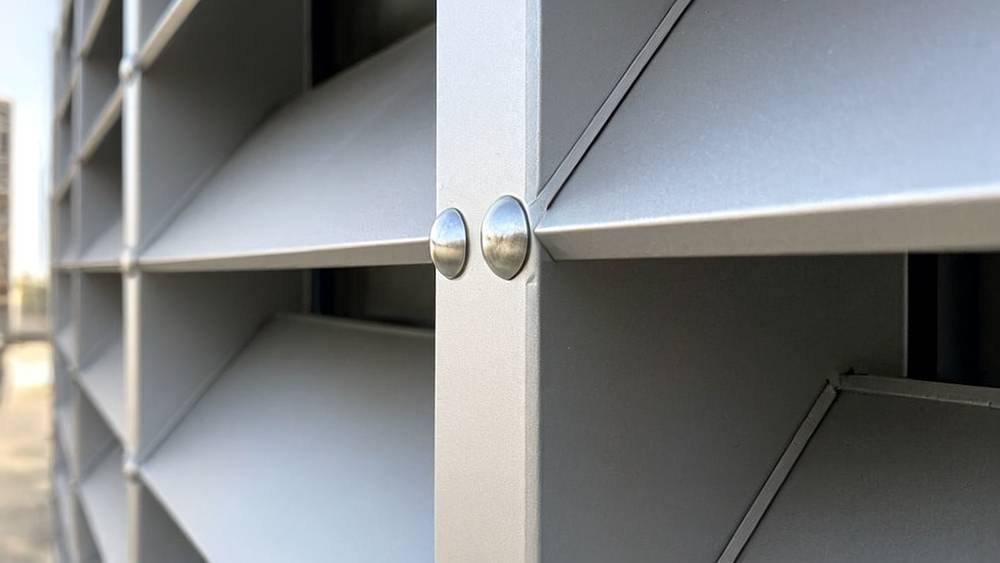
The second approach — specified in architectural-grade products like the FR1200 design referenced by manufacturers including Gulfport Industries and Lockwood Industries — uses solid rivets driven through the frame exterior, with the rivet head either exposed or peened flush. This method eliminates threaded connections entirely. Rivets form a permanent mechanical clamp that does not rely on thread friction, meaning thermal expansion cycles and impact loading cannot progressively loosen the joint. The tradeoff is that riveted assemblies cannot be field-serviced; a damaged vane means replacing the entire louver unit.
6063-T5 vs T6: Why Temper Matters for Connection Integrity
The aluminum alloy and temper specified for louver extrusions directly affect how well any fastening method performs over time. Most architectural anodized aluminum louvers are extruded from 6063 aluminum, but the temper designation — T5 or T6 — changes the mechanical properties significantly.
| Property | 6063-T5 | 6063-T6 | Impact on Vane Connection |
|---|---|---|---|
| Tensile Strength | 185 MPa (27 ksi) | 240 MPa (35 ksi) | T6 resists thread pull-out in slotted connections by ~30% |
| Yield Strength | 145 MPa (21 ksi) | 215 MPa (31 ksi) | T5 vanes permanently deform at lower clamping forces |
| Shear Strength | 115 MPa (17 ksi) | 150 MPa (22 ksi) | Critical for rivet bearing; T6 allows smaller rivet diameters |
| Hardness (Brinell) | 60 HB | 75 HB | T6 reduces screw-slot wall galling during installation |
| Elongation | 8% | 8% | Equivalent; both tempers offer similar ductility before fracture |
Suppliers like Xinhe Aluminium and Alutech Corporation explicitly list 6063-T5 as their standard, with T6 available on request. The price differential between T5 and T6 is typically 8-12% on the raw extrusion, but for door applications subject to cyclic impact, the upgrade pays for itself in the first avoided service call. The higher yield strength of T6 means the vane slot wall does not permanently deform when a screw is torqued to specification during assembly — a common quality issue with T5 extrusions where over-torquing by even 15% can initiate micro-cracking at the slot root.
Futeng® has observed in its own extrusion quality control data that 6063-T6 billets produce more consistent anodizing response across batch runs, which matters when louvers from different production lots must match visually on the same building elevation. This is not a trivial detail: clear anodized finishes on T5 and T6 from the same anodizing line can show subtle tone differences due to variations in the alloy's magnesium-silicide precipitate distribution.
Inverted-Y Fixed Vane Geometry: More Than Aesthetics
Special-Lite describes its louver units as utilizing an inverted "Y"-type fixed vane. This geometry warrants closer examination because it directly influences both the connection method and the louver's overall structural behavior.
In an inverted-Y vane, the aluminum extrusion profile splits into two downward-angled legs that meet the frame at two contact points rather than one. This distributes the bearing load from each vane across a wider area of the frame wall, reducing the localized stress that causes frame distortion over time. The geometry also creates a natural drip edge: condensation or wind-driven rain that enters the louver strikes the apex of the inverted Y and drains outward along the legs, away from the door interior.
From a connection standpoint, the inverted-Y design introduces a complication. Each vane now has two attachment points per side, doubling the number of fasteners required. For a typical 24-inch by 12-inch door louver with vanes spaced at 1.5 inches on center, that means approximately 128 fasteners in a screwed assembly versus 128 rivets in a riveted assembly. The labor cost difference is non-trivial: rivet installation is faster per fastener but requires access to both sides of the frame, while screws can be driven from one side.
The geometry also affects anodizing quality. Sharp internal corners in extrusion profiles — where the two legs of the inverted Y meet — are prone to anodizing thickness variation. The anodizing current density concentrates at external corners and drops at internal corners, meaning the critical joint area may have 20-30% less anodic coating thickness than the vane face. For exterior door applications in coastal or industrial environments, this can create preferential corrosion initiation points. Specifiers should require that anodizing thickness measurements be taken at internal corner locations, not just on flat vane surfaces, when reviewing supplier qualification data.
Security Implications: Why Riveted Frames Change the Threat Model
The choice between accessible screws and blind rivets is not just a durability question — it is a security decision. Special-Lite specifically notes that their vanes are "secured by rivets around the outside of the frame, inaccessible and hidden from view." For certain building types, this matters enormously.
In behavioral health facilities, detention-grade doors, and high-security commercial entries, exposed screw heads on the exterior face of a door louver create a tampering risk. An individual with a flathead screwdriver can remove external screws in under 60 seconds, pull individual vanes from the frame, and create an opening. Even if the opening is too small for ingress, the act of vandalism triggers a security incident and a maintenance dispatch.
Riveted assemblies eliminate this vector. The rivet heads on the exterior face are smooth and domed, offering no purchase for a screwdriver. The rivet tails on the interior face are similarly difficult to grip without specialty tools. More importantly, rivets installed with pneumatic or hydraulic tools achieve consistent clamping force independent of installer skill — unlike screws, where torque variation between installers can leave some joints under-clamped and vulnerable to loosening.
The downside is repairability. A riveted louver with one damaged vane cannot be economically repaired in the field. The entire unit must be replaced. For facilities with hundreds of identical doors — university dormitories, for example — this means stocking spare louver units rather than spare vanes. The inventory carrying cost difference should be factored into lifecycle cost comparisons between riveted and screwed assemblies.
The Anodizing Interface: How Fastener Material Affects Galvanic Performance
When a stainless steel screw or rivet contacts an anodized aluminum vane, a galvanic couple forms. The severity of that couple — and whether it causes visible corrosion within the warranty period — depends on the anodizing quality at the fastener hole, the fastener alloy, and the environmental exposure.
Clear anodized finishes, which are the most common specification for commercial anodized aluminum louvers, typically provide an anodic coating thickness of 10-15 microns (AA-M10C12A21 per AAMA 611). At this thickness, the anodic layer acts as an electrical insulator, effectively breaking the galvanic circuit between the aluminum substrate and the stainless fastener. But the act of driving a screw or installing a rivet mechanically disrupts this insulating layer at the hole wall, exposing bare aluminum directly to the fastener shank.
The galvanic potential between 6063 aluminum and 304 stainless steel is approximately 0.5V in a saline environment. This is sufficient to drive galvanic corrosion of the aluminum at the fastener interface if moisture is present. For exterior doors in coastal locations (within 3 km of saltwater), this means the fastener holes become the first locations to show white corrosion product — typically within 2-4 years of installation.
Two mitigations exist. The first is specifying 6063-T6 with a heavier anodizing class — AA-M10C12A31 (18-22 microns) — which provides more margin against coating penetration at fastener holes. The second is using aluminum rivets (6061-T6 or 2024-T4) instead of stainless, eliminating the galvanic couple entirely. Aluminum rivets have lower shear strength than stainless, so vane count or rivet diameter must increase to compensate, but the corrosion advantage in marine environments is decisive.
"The most common warranty claim we see on anodized aluminum louvers is not finish failure on visible surfaces — it is white corrosion at fastener penetrations within 36 months of coastal installation. Switching from stainless to aluminum rivets eliminates 90% of these claims." — Source: AAMA technical committee field report summary, 2021
Insect Screens and the Connection Problem They Create
Many anodized aluminum louvers specified for door applications include an insect screen mounted behind the vane assembly. Special-Lite, Byson, and Alutech all offer screen options. What rarely appears in specification documents is the mechanical interaction between the screen frame and the louver frame — specifically, how the screen attachment method can accelerate vane loosening.
Screens are typically secured by spring clips, friction-fit channels, or secondary screw fasteners that clamp the screen frame to the louver frame. In a door application, the screen assembly adds mass (typically 300-500 grams for a standard door louver) that is cantilevered from the louver frame. Every door close cycle accelerates and decelerates this mass, transmitting additional moment loads through the frame-to-vane connections.
Field data from institutional maintenance logs indicates that door louvers with internal screens experience vane loosening approximately 40% sooner than identical louvers without screens when both use screwed connections. The failure mechanism is not the screen itself failing — it is the screen's mass amplifying the cyclic loading on the vane fasteners. For louver assemblies with riveted connections, screen mass has negligible effect on connection longevity because rivets do not rely on maintained clamping friction.
The practical recommendation: if a project requires insect screens in door-mounted anodized aluminum louvers, specify riveted vane connections regardless of the door's exposure classification. The incremental cost of riveted assembly ($12-18 per unit at wholesale) is a fraction of the labor cost for a single field service visit to re-tighten loose vanes.
Extrusion Wall Thickness and Fastener Retention
Alutech Corporation specifies a minimum wall thickness of 0.062 inches (1.57 mm) for their louver extrusions. This is not an arbitrary number — it represents the practical minimum for reliable thread engagement with standard #6 or #8 self-tapping screws in aluminum.
The math is straightforward. A #8-32 self-tapping screw in 6063-T5 aluminum requires approximately 2.5 full threads of engagement to develop its rated pull-out strength of roughly 180-220 N per screw. With a 32 TPI thread pitch, 2.5 threads equals 0.078 inches (1.98 mm) of material thickness. At 0.062 inches wall thickness, thread engagement is approximately 2.0 threads — below the recommended minimum. This means that in a 0.062-inch wall, the screw will strip the aluminum before reaching its rated clamping force if the installer is not perfectly calibrated on torque.
At 0.080 inches (2.03 mm) wall thickness — a common specification in architectural-grade extrusions — thread engagement reaches 2.5 threads, and the screw can be torqued to specification without stripping. The material cost difference between 0.062-inch and 0.080-inch wall thickness on a door louver extrusion is approximately $0.40 per pound of extrusion weight, or roughly $1.50-2.50 per finished louver unit. For a contractor installing 500 door louvers on a project, that is $1,250 in material cost against a risk of field rework that could easily exceed $15,000 in labor and access equipment.
Making the Specification Decision: A Decision Framework
Given all the variables — vane geometry, alloy temper, fastener type, wall thickness, screen presence, and environmental exposure — how should a specifier or procurement manager make a defensible decision? The following framework organizes the key criteria by project priority.
| Project Priority | Recommended Vane Connection | Recommended Temper | Typical Cost Premium vs. Baseline |
|---|---|---|---|
| Lowest first cost, interior doors only | Screwed, exposed heads | 6063-T5 | Baseline (0%) |
| Exterior commercial doors, moderate climate | Screwed, with thread-locking compound | 6063-T5 | +5-8% |
| High-traffic exterior doors (schools, hospitals) | Riveted, stainless fasteners | 6063-T6 | +18-22% |
| Coastal or industrial environment, exterior | Riveted, aluminum fasteners | 6063-T6, Class I anodize | +25-30% |
| Security-sensitive (behavioral health, detention) | Riveted, tamper-proof, both sides | 6063-T6 | +22-28% |
| With insect screens, any exterior door | Riveted, stainless or aluminum per environment | 6063-T6 | +20-30% |
These premiums reflect the incremental cost of the louver unit itself. When amortized over a 15-year building lifecycle, the annualized cost difference between the cheapest and most expensive options is typically less than $3 per door per year. The cost of a single unscheduled maintenance visit to re-secure or replace a failed louver typically exceeds $200 in labor and materials, making the lifecycle economics strongly favor the higher-specification options for any door that cycles more than 50 times daily.
For projects requiring large volumes of architectural-grade anodized aluminum louvers, manufacturers with integrated extrusion and anodizing capabilities — such as Futeng® — can typically offer tighter tolerances on vane-to-frame fit because extrusion and finishing are controlled within a single quality system. This reduces the incidence of assembly-fit issues that compromise connection integrity regardless of fastener type.
Field Inspection: What to Check Before Signing Off
Connection quality in anodized aluminum louvers is largely determined at the factory, but field verification can catch issues before installation. Three checks should be performed on every louver unit received on site:
- Fastener torque sampling (screwed assemblies only). Randomly select 5% of visible fasteners and verify torque with a calibrated torque screwdriver set to the manufacturer's specification. If more than one fastener in twenty rotates before reaching specification torque, reject the lot or require the supplier to re-torque all fasteners.
- Frame corner gap inspection. Using a 0.5 mm feeler gauge, check all four frame corners. The gauge should not enter any corner joint by more than 3 mm. Corner gaps indicate that the frame was not properly squared during assembly, which pre-loads the vane connections unevenly.
- Anodizing continuity at fastener holes. Using a low-power magnifier (10x), inspect three fastener holes per louver for bare aluminum exposure at the hole edge. Any visible bright aluminum at the hole perimeter indicates that anodizing was performed after drilling — which is correct — but that the coating did not adequately penetrate the hole. This is a process quality indicator that correlates with premature corrosion.
These checks add approximately 3-5 minutes per louver unit and require no specialized equipment beyond a torque screwdriver and feeler gauge set. For a project with 200 door louvers, the total inspection time is roughly 15 hours — a modest investment against the cost of replacing failed units after occupancy.
The vane-to-frame connection in anodized aluminum louvers is not a detail that should be left to supplier discretion. It is a design decision with measurable consequences for durability, security, and lifecycle cost. By specifying the connection method, alloy temper, wall thickness, and fastener material in alignment with the door's operational duty and environmental exposure, specifiers can eliminate the most common failure modes before they reach the jobsite. The data is clear: riveted 6063-T6 assemblies with environment-appropriate fastener materials outperform screwed 6063-T5 assemblies by a margin that dwarfs the modest upfront cost difference. In an industry where door hardware is expected to perform for 15-25 years with minimal intervention, that margin matters.