Aluminum Cladding Qatar Deflection Limits Under QCS 2014 Wind Loads
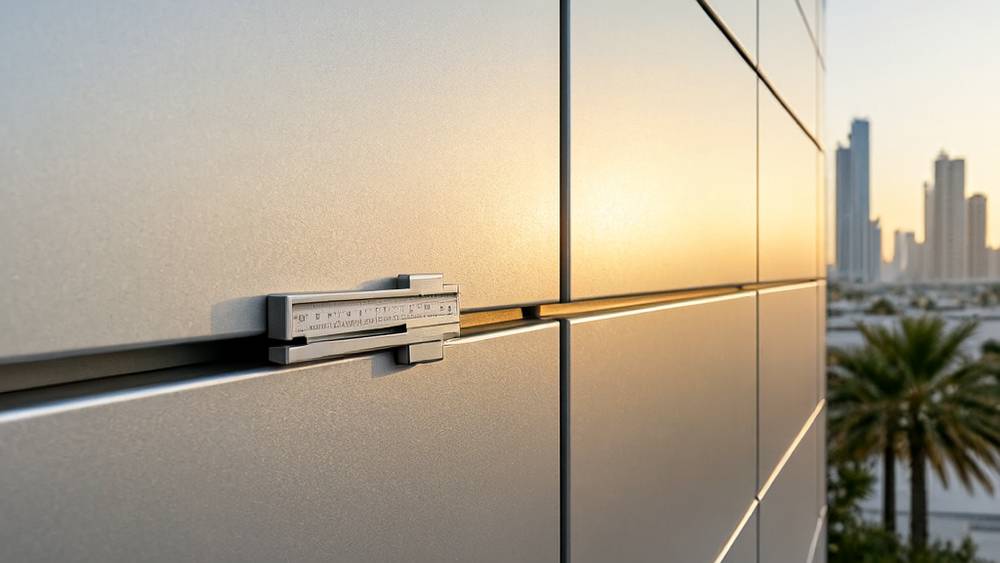
When specifiers in Doha, Lusail, or Al Wakrah evaluate facade materials, the conversation around aluminum cladding qatar increasingly narrows to one under-discussed variable: panel thickness versus spanning capability under the Gulf's combined thermal and wind loads. A 2.0 mm solid aluminium panel behaves differently from a 3.0 mm sheet when stretched across a 1,200 mm cassette span at 55°C ambient temperature. The difference is not merely structural, it ripples into flatness tolerance, fixing system selection, and ultimately the installed cost per square meter. This article isolates that relationship, providing procurement teams and facade engineers with the numerical reasoning needed to specify solid aluminium cladding thickness without over-engineering the budget or under-specifying the performance.
Why Panel Thickness Dominates Every Other Specification Decision
Solid aluminium cladding panels for the Qatari market are typically supplied in 1.5 mm, 2.0 mm, 2.5 mm, and 3.0 mm thicknesses. The selection of one gauge over another cascades into decisions about routing depth for V-groove fabrication, the type and spacing of fixing clips, the need for stiffener ribs on the reverse face, and wind-load deflection limits per ASTM E330. A project near the Doha Corniche, where wind speeds routinely exceed 120 km/h during shamal season, imposes different demands than an interior lobby cladding application in a Msheireb Downtown building.
The Qatar Construction Specifications (QCS 2014, Section 5) reference deflection limits of L/175 for exterior wall cladding under design wind pressure. For a typical 1,200 mm cassette span, that translates to a maximum allowable deflection of approximately 6.86 mm. A 2.0 mm 5052-H32 solid aluminium panel spanning 1,200 mm between fixings at 1.8 kPa wind pressure (the serviceability limit for many mid-rise Qatar structures) will deflect roughly 8.2 mm without stiffeners, exceeding the QCS limit. The same panel at 3.0 mm deflects approximately 3.1 mm, falling comfortably within compliance.
This single calculation explains why aluminum cladding qatar projects often gravitate toward 2.5 mm and 3.0 mm solid sheets for exposed elevations, reserving 2.0 mm for soffit linings, column wraps, and sheltered entrance canopies. The material cost difference, roughly 18-22 QAR per square meter between 2.0 mm and 3.0 mm, must be weighed against the cost of additional stiffeners, closer clip spacing, and the risk of site rejection for oil-canning.
Thermal Expansion and the Hidden Cost of Thin Panels
Doha's summer surface temperatures on dark PVDF-coated aluminium can reach 85°C. A 3-meter-long solid aluminium panel with a coefficient of thermal expansion of 23.4 × 10⁻⁶ /°C will expand approximately 4.2 mm from a 25°C installation temperature to an 85°C peak. That movement must be accommodated within the cassette joint design.
Thinner panels present a subtle but real problem here. A 2.0 mm panel, having lower flexural rigidity (EI value), is more prone to buckling under constrained thermal expansion than a 3.0 mm panel. The buckling manifests as a visible wave or oil-canning across the panel face, particularly on dark finishes where surface irregularities catch the harsh Qatari sunlight. This is not a material defect; it is a specification mismatch.
The AAMA TIR-A9 technical information report on metal wall cladding systems recommends that panel deflection from thermal loads be limited to L/240 for visually critical surfaces. For a 1,500 mm panel length, that is 6.25 mm. Engineers calculating combined wind and thermal deflection for aluminum cladding qatar installations should run both conditions, not just wind, before locking in the thickness specification.
Cassette Systems: How Routing Depth Determines Panel Rigidity
Cassette panel fabrication involves V-groove routing on the reverse face, folding the edges to create a return leg typically 20 mm to 30 mm deep. The routing removes material, leaving a residual thickness at the fold line. For a 2.0 mm panel, a typical routing depth of 1.5 mm leaves only 0.5 mm of residual aluminium at the fold. That is structurally adequate for the fold itself but means the panel edge stiffness relies almost entirely on the folded geometry, not the material thickness.
A 3.0 mm panel with the same residual routing depth of 0.5 mm retains 2.5 mm of solid material across the face, yielding dramatically higher bending stiffness. The moment of inertia for a flat plate is proportional to the cube of thickness: a 3.0 mm panel is roughly 3.4 times stiffer than a 2.0 mm panel. This is why many Middle Eastern facade consultants, including those specifying for aluminum cladding qatar high-rise projects, mandate 3.0 mm as the minimum for any cassette panel exceeding 600 mm in the short dimension.
Suppliers such as Futeng® have addressed this by standardizing their solid aluminium cassette offerings around 2.5 mm and 3.0 mm gauges for the Gulf market, with 2.0 mm available only for non-structural interior applications or small-format panels under 400 mm. The logic is rooted in the deflection math, not marketing preference.
Wind Load Zones Across Qatar: A Thickness Selection Map
The Qatar peninsula does not experience uniform wind loads. The eastern coastline from Al Khor to Al Wakrah sees sustained design wind speeds of 45 m/s (162 km/h) per the ISO 4354 wind actions standard, while inland areas around Al Rayyan may drop to 38 m/s. Tall buildings in West Bay and The Pearl-Qatar experience additional pressure from funnelling effects between towers.
The rough rule for solid aluminium cladding:
- Coastal high-rise (>30 m) – 3.0 mm minimum, 5052-H32 or 5754-H22 alloy, stiffeners at 400 mm centers
- Mid-rise urban (10-30 m) – 2.5 mm adequate for cassette panels up to 900 mm span
- Low-rise inland (<10 m) – 2.0 mm acceptable for panels with folded returns on all four sides
- Soffits and canopies (any zone) – 2.0 mm, as negative wind pressure governs and spans are typically shorter
These recommendations assume PVDF-coated 3xxx or 5xxx series aluminium with a minimum yield strength of 170 MPa. For projects near the Industrial Area or Mesaieed, where airborne chlorides and sulphates accelerate corrosion, the additional 0.5 mm of material thickness also provides a longer service life before perforation from pitting corrosion, a concern documented in the NACE International corrosion database for Arabian Gulf environments.
| Panel Thickness | Max Span (Cassette, L/175) | Deflection at 1.8 kPa (1,200 mm span) | Stiffener Required? | Approx. Material Cost (QAR/m²) |
|---|---|---|---|---|
| 2.0 mm | 850 mm | 8.2 mm (fails) | Yes, at 500 mm centers | 145-165 |
| 2.5 mm | 1,050 mm | 4.8 mm (passes) | Optional, dependent on wind zone | 170-195 |
| 3.0 mm | 1,300 mm | 3.1 mm (passes) | Not required for spans <1,100 mm | 195-225 |
Table assumptions: 5052-H32 alloy, four-edge simply supported, serviceability wind pressure 1.8 kPa, 50 mm return leg. Actual values must be verified by project-specific structural calculations per QCS 2014.
Stiffener Economics: When Adding Aluminium Beats Buying Thicker
A recurring debate among Qatari facade contractors is whether to specify 3.0 mm panels or use 2.0 mm panels with welded or adhesive-bonded aluminium stiffener profiles on the reverse face. The calculation is not intuitive.
Stiffeners add material, labor, and quality-control steps. A typical hat-section stiffener in 1.5 mm aluminium, 40 mm wide and 20 mm deep, costs approximately 12-18 QAR per linear meter fabricated and bonded. For a 1,200 mm × 600 mm panel requiring two stiffeners at 400 mm spacing, the added cost is roughly 30-40 QAR per panel, or 42-56 QAR per square meter. When added to the base 2.0 mm panel cost of 145-165 QAR/m², the total reaches 187-221 QAR/m², which overlaps with the 3.0 mm panel range of 195-225 QAR/m².
The deciding factor becomes reliability. Adhesive-bonded stiffeners depend on surface preparation, curing conditions, and long-term durability of the structural adhesive under Gulf UV and thermal cycling. The ASTM C794 standard for adhesive-in-peel tests provides a benchmark, but site conditions in Qatar rarely match laboratory environments. A monolithic 3.0 mm panel eliminates this variable entirely. For aluminum cladding qatar projects with tight construction schedules, particularly during the summer months when adhesive open times shrink dramatically, the thicker panel often proves cheaper when factoring in the risk of stiffener delamination and rework.
Perforated Panels: Why Thickness Selection Flips the Logic
Perforated solid aluminium screens are widely specified in Qatar for solar shading, parking structure cladding, and mashrabiya-inspired architectural features. Here the thickness calculation inverts: a 3.0 mm panel with 40% open area (common for aluminum cladding qatar solar screen applications) loses significant in-plane stiffness because the perforation pattern interrupts the load path.
The effective elastic modulus of a perforated plate with 40% circular perforations in a staggered pattern drops to approximately 45% of the solid plate modulus, per analytical models validated by ASME pressure vessel design codes. A 3.0 mm perforated panel may therefore behave structurally like a 2.0 mm solid panel. Specifiers must either increase the thickness to 3.5 mm or 4.0 mm, reduce the panel span, or add a perimeter sub-frame.
The practical outcome seen on projects from Lusail Marina to Msheireb: perforated panels below 1,200 mm in the short dimension use 3.0 mm as standard, but panels exceeding 1,500 mm require 4.0 mm or an engineered aluminium sub-frame welded to the reverse face. The sub-frame approach adds 80-120 QAR/m² but preserves the visual lightness that perforated panels are specified to achieve.
Coating Thickness and Panel Flatness: An Overlooked Interaction
PVDF coatings for architectural aluminium in Qatar are typically applied at 30-35 microns minimum dry film thickness for a three-coat system, per AAMA 2605. For a 2.0 mm panel, the coating represents approximately 1.6% of total thickness. For a 3.0 mm panel, it drops to 1.1%. This seems negligible, but the coating application involves a curing cycle at 230-250°C that partially anneals the aluminium substrate.
Post-cure flatness is harder to maintain on thinner panels because the residual stresses from the coil-rolling process relax unevenly during the thermal cycle of coating. A 2.0 mm panel emerging from the curing oven may exhibit edge wave or center buckle that a 3.0 mm panel, with greater self-weight and stiffness, resists. Quality-conscious suppliers serving the aluminum cladding qatar market tension-level their coil stock before coating and perform flatness checks to within 0.4% of panel diagonal, measured per EN 485-3.
Specifier note: When reviewing sample submissions for aluminium cladding projects in Qatar, request flatness measurement data for the actual thickness proposed, not a generic mill certificate. A 2.0 mm sample that measures flat may have been selected; production batches will show greater variation.
Fixing Systems and the Thickness Connection
The choice between face-fixed, secret-fixed, and cassette clip systems intersects directly with panel thickness. Face-fixed systems using exposed rivets or screws can tolerate thinner panels because the fasteners constrain the panel edges at close intervals. Secret-fixed systems using perimeter clips that engage a routed groove in the panel edge demand greater panel stiffness because the clip engagement depth (typically 8-12 mm) relies on the panel resisting torsional rotation under suction wind loads.
For secret-fixed aluminum cladding qatar installations above 20 meters, 2.5 mm should be treated as the floor, with 3.0 mm strongly recommended. The clip pull-out capacity from a 2.0 mm panel edge with a 1.5 mm routing depth is approximately 0.6 kN per clip; the same clip in a 3.0 mm panel with a 2.0 mm routing depth achieves 1.1 kN. Doubling the number of clips on thinner panels erodes the aesthetic advantage of a secret-fixed system and adds labor cost that often exceeds the material saving.
Procurement Checklist: Verifying Thickness on Site
Discrepancies between specified and delivered panel thickness are not uncommon in fast-track projects. A digital micrometer with 0.01 mm resolution costs under 500 QAR and should be standard equipment for any consultant's site team overseeing aluminum cladding qatar installation. Measurements should be taken at five points per panel: four corners and center. The tolerance on nominal thickness for EN 485-3 compliant sheet is ±0.08 mm for 2.0 mm and ±0.10 mm for 3.0 mm.
Beyond the micrometer check, the panel weight provides a rapid field verification. A 3.0 mm solid aluminium panel weighs approximately 8.1 kg/m², while a 2.0 mm panel weighs 5.4 kg/m². A 50-panel lot of 1,200 mm × 800 mm panels (0.96 m² each) should weigh roughly 389 kg for 3.0 mm versus 259 kg for 2.0 mm. A discrepancy of more than 5% warrants micrometer verification of the full batch.
Panel thickness in solid aluminium cladding is not a trivial catalog selection. It is the variable around which wind compliance, thermal stability, fixing design, flatness tolerance, and installed cost all orbit. For Qatar's specific combination of coastal wind loads, summer surface temperatures exceeding 80°C, and consultant expectations aligned to QCS deflection limits, the data points consistently toward 2.5 mm as a practical minimum for exposed cassette facades and 3.0 mm as the standard for high-rise or secret-fixed applications. The cost difference, properly calculated against stiffener elimination and reduced clip density, narrows to the point where the thicker panel becomes the economically rational choice on most projects.