Metal Cladding Standard Size 1220 x 2438 mm Impacts Fabrication and Freight Costs
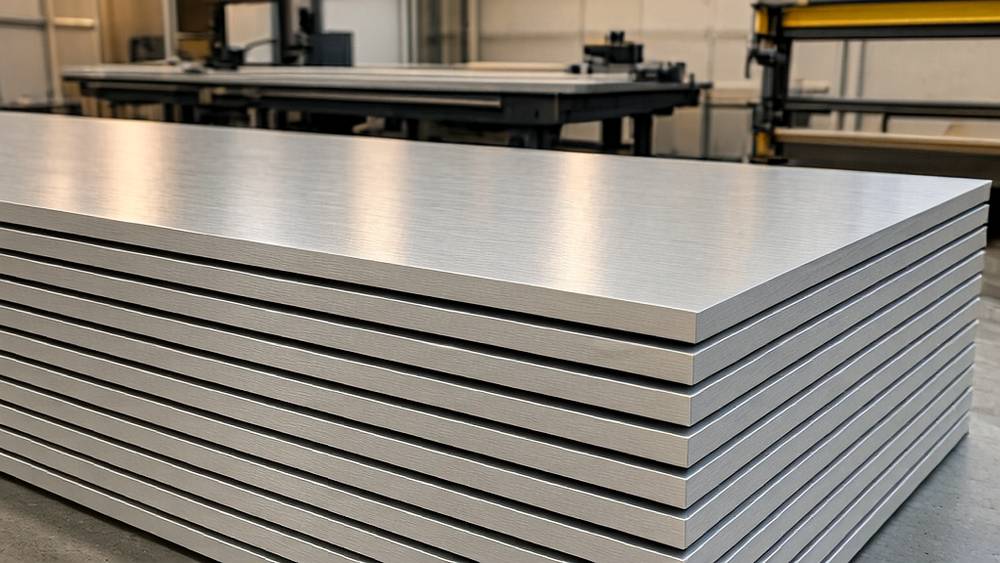
When a facade contractor in Dubai asks for aluminium cladding panels, the first specification question is almost always the same: what sheet size can you supply? The answer to that question dictates structural grid spacing, waste factors, container logistics, and ultimately the installed cost per square meter. Yet the phrase "metal cladding standard size" is surprisingly slippery. It does not point to one universal dimension. It varies across alloy grades, mill capabilities, and regional supply chains. For solid aluminium cladding panels—flat sheets fabricated from 1xxx, 3xxx, or 5xxx series alloys—the most commonly quoted factory standard is 1220 mm × 2438 mm (4 ft × 8 ft) or 1220 mm × 3048 mm (4 ft × 10 ft). But anyone who has managed a multi-tower facade package knows that ordering exclusively in mill-standard sheets can cost more than it saves. This article examines what "standard" actually means across the solid aluminium cladding supply chain, how sheet dimensions interact with real-world fabrication constraints, and where the hidden costs accumulate when standard sizing assumptions meet complex architectural geometry.
What Metal Cladding Standard Size Actually Means Across the Supply Chain
The term "metal cladding standard size" carries three distinct meanings depending on who uses it. For aluminium rolling mills, it describes the maximum coil width and the cut-to-length sheet dimensions their lines can produce without switching tooling setups. For panel fabricators, it means the blank sheet dimensions that fit on CNC routing tables and press brake beds with minimal offcut. For installers, it translates to the module width that aligns with floor-to-floor heights and wind-load-calibrated sub-frame spacing. These three definitions rarely align perfectly on a real project.
Most aluminium mills serving the architectural market run coil widths between 1500 mm and 2000 mm. A mill producing 1.5 m wide coil can supply cut sheets up to approximately 1500 mm × 4000 mm, though practical limits are often lower once trimming and edge conditioning are accounted for. The 1220 mm width persists because it is the standard width for many coil-coating lines designed decades ago, particularly those running PVDF (polyvinylidene fluoride) coating systems. When a project specification calls for Kynar 500® or Hylar 5000® PVDF coatings in a custom color, the coater's line width often becomes the binding constraint on sheet dimensions.
Futeng® aluminium cladding products, for instance, are manufactured with sheet dimensions that reflect these mill constraints while optimizing for containerized export. The default blank sizes accommodate standard 20 ft and 40 ft container internal widths, reducing the dead freight that plagues oversized custom sheets.
Standard Sheet Dimensions by Alloy and Application
Not all aluminium cladding alloys behave the same way on a press brake, and this has direct consequences for practical sheet sizing. The table below summarizes the most widely available standard sheet sizes for solid aluminium cladding panels, organized by alloy series and typical architectural application.
| Alloy & Temper | Standard Sheet (mm) | Standard Sheet (in) | Thickness Range (mm) | Typical Application |
|---|---|---|---|---|
| 1100-H14 | 1220 × 2438 | 48 × 96 | 1.5 – 3.0 | Interior wall cladding, soffit liners |
| 3003-H14 | 1220 × 3048 | 48 × 120 | 2.0 – 3.0 | General exterior facade, column covers |
| 3003-H14 | 1500 × 3000 | 59 × 118 | 2.5 – 3.0 | Spandrel panels, large-format facades |
| 5052-H32 | 1220 × 2438 | 48 × 96 | 2.0 – 3.0 | Coastal facades, high-humidity zones |
| 5052-H32 | 1524 × 3048 | 60 × 120 | 2.5 – 4.0 | Marine environments, industrial cladding |
| 5754-H22 | 1250 × 2500 | 49.2 × 98.4 | 2.0 – 3.0 | European projects, curtain wall spandrels |
Two observations stand out. First, the 5052-H32 alloy—favored for its superior corrosion resistance in chloride-rich atmospheres—is typically available in slightly wider sheet formats than 3003-H14, though lead times can stretch because fewer mills run 5xxx-series architectural coil continuously. Second, the 1250 mm × 2500 mm format seen in European supply chains reflects metric coil widths that differ from the imperial-legacy 48-inch (1220 mm) width dominant in North American and Asian markets. For a procurement manager sourcing panels across continents, this metric-imperial mismatch can generate unexpected cutting waste.
The Fabrication Floor: Why Blank Size Drives CNC Nesting Efficiency
A solid aluminium cladding panel rarely leaves the fabricator's shop as a flat rectangle. Most architectural panels require perimeter returns (bent edges), stiffener grooves, corner notches, and openings for windows or louvers. Each of these operations consumes material from the blank sheet edge, reducing the usable flat area.
Consider a typical 3 mm thick 3003-H14 panel measuring 1200 mm × 600 mm finished face, with 25 mm returns on all four sides. The blank required is approximately 1250 mm × 650 mm. From a standard 1220 mm × 2438 mm sheet, a fabricator can nest three such panels per sheet, yielding roughly 72% material utilization. Increase the finished panel width to 1300 mm, and the blank width jumps to 1350 mm—which exceeds the 1220 mm standard. The fabricator must either source 1500 mm wide sheets (where available) or redesign the panel into smaller modules with additional joints. Both options have cost consequences.
The 1524 mm (60-inch) width available in some 5052-H32 stock offers meaningful nesting advantages for larger panel formats. A 1500 mm wide blank can accommodate a 1450 mm finished panel with full returns, avoiding a horizontal joint that would otherwise break the architectural intent. This is why coastal projects in the Middle East—where 5052 is often specified and large-format monolithic panels are aesthetically preferred—tend to gravitate toward 5 ft wide stock sheets.
Container Logistics and the Economics of Oversized Sheets
Sheet dimensions interact with freight economics in ways that procurement schedules often overlook. A standard 20 ft general-purpose container has internal dimensions of approximately 5898 mm × 2352 mm. A 40 ft container measures roughly 12032 mm × 2352 mm internally. Sheets longer than 2400 mm cannot be loaded flat across the short axis of a standard container; they must be loaded lengthwise or on an angle, which reduces packing density.
For a typical export shipment of 1220 mm × 2438 mm sheets, a 20 ft container can hold approximately 12 to 16 metric tons depending on sheet thickness and packaging configuration. Switch to 1524 mm × 3048 mm sheets, and the same container may hold only 60–70% of that weight because the larger sheets cannot stack as efficiently. For a project requiring 20 metric tons of cladding, the oversized sheet format could add one extra container—roughly $3,000 to $6,000 in ocean freight depending on route—plus additional handling charges at both ports.
There is also the issue of sheet flatness during transit. Longer, wider sheets are more prone to flexural damage if not properly crated. Solid aluminium panels in 3 mm and 4 mm thicknesses have good inherent stiffness, but 2 mm and 2.5 mm sheets in 1500 mm × 4000 mm formats require reinforced timber pallets and sometimes steel edge protectors. These packaging costs are rarely itemized in mill quotes but can add 3–5% to the landed cost.
Installation Module Width and Sub-Frame Economics
From the installer's perspective, the most important dimension is not the blank sheet size but the installed module width. Most curtain wall and rainscreen sub-frame systems are designed around vertical mullion spacing of 1200 mm to 1500 mm, which aligns conveniently with standard sheet widths. But when the architectural design calls for a module width of 1350 mm—perhaps to align with interior planning grids or glazing modules—the mismatch with standard 1220 mm wide sheets becomes a real cost driver.
A 1350 mm module cut from a 1500 mm wide sheet leaves a 150 mm offcut strip. Over 5,000 m² of cladding, that strip represents roughly 10% material waste if it cannot be repurposed for smaller elements like window reveals or column wraps. The alternative—sourcing 1350 mm wide custom sheets from the mill—requires a minimum order quantity (MOQ) that may exceed the project requirement by a factor of three or more. Most mills set MOQs for non-standard coil slitting at 5 to 8 metric tons per width, according to industry data from The Aluminum Association.
This is where the trade-off between material cost and installation labor becomes project-specific. A higher material waste percentage from standard sheets may still be cheaper than the premium for custom-width coil, especially when the custom width must be air-freighted to meet a tight schedule. The calculation should always compare total installed cost—material plus labor plus freight plus waste disposal—not just the per-sheet mill price.
Thickness Tolerances and Their Effect on Effective Size
Standard size is not only about length and width. Thickness tolerance directly affects panel flatness, which in turn determines whether the installed module width can be maintained without visible waviness or oil canning. The Philippine DPWH standard specification for aluminium cladding, referenced in Department Order 044 Series 2015, highlights that thickness tolerances must be clearly defined for architectural-grade panels. International practice generally follows ASTM B209/B209M-21 for aluminium sheet and plate, which specifies a tolerance of ±0.08 mm for sheets in the 2.0 mm to 3.0 mm range.
What this means in practice: a nominally 2.5 mm panel may measure anywhere from 2.42 mm to 2.58 mm and still conform to the standard. For a large-format panel spanning 1200 mm between stiffener attachment points, a 0.16 mm thickness variation across the sheet can produce visible distortions under certain lighting conditions. This is not a material defect—it is a physical consequence of rolled aluminium sheet tolerances. Fabricators address it by adjusting stiffener spacing, specifying tighter mill tolerances at additional cost, or selecting thicker nominal gauges (3.0 mm instead of 2.5 mm) for critical visible elevations.
Regional Variations in Standard Sizing Norms
Procurement teams working across multiple regions quickly learn that "standard" is a local concept. North American projects default to imperial sheet dimensions: 48" × 96" and 48" × 120". Southeast Asian fabricators, particularly those in China and Vietnam, predominantly stock metric 1220 mm × 2440 mm and 1220 mm × 3050 mm sheets, which are close but not identical to the imperial equivalents. European projects may reference EN 485-2 for sheet tolerances and work with 1250 mm × 2500 mm or 1500 mm × 3000 mm formats.
The Australian market, as noted by Metal Cladding Systems' technical guidance, ties panel widths closely to coil dimensions and profile geometry. For solid aluminium flat panels, the most practical sheet widths for Australian projects typically fall between 1200 mm and 1500 mm, with lengths up to 4000 mm available on indent. The constraint is often not the mill but the powder coating line: many Australian architectural coaters run booths optimized for 1200 mm to 1400 mm wide sheets.
For a contractor importing panels from an Asian fabricator for an Australian project, the sheet size conversation must address three layers: mill coil width, coating line width, and container internal width. Missing any one of these constraints can result in panels that are technically available from the mill but practically unshippable or uncoatable in the required finish.
When Custom Sizes Actually Save Money
The instinct to default to standard sheet sizes is rational but not always optimal. On large projects with repetitive panel modules, ordering custom sheet dimensions can reduce fabrication waste by 8–15%, which may more than offset the mill's custom-slitting surcharge. The break-even point depends on the specific alloy, the quantity, and the difference between the standard and custom width.
Consider a project requiring 8,000 m² of 3003-H14 cladding with a finished module width of 1280 mm. Using 1220 mm standard sheets, each panel requires two sheets joined, doubling the number of panels, increasing fabrication labor, and adding visible joints that may conflict with the architectural intent. Alternatively, sourcing 1300 mm wide sheets eliminates the joints but requires approximately 12 metric tons of custom-width coil. If the custom slitting surcharge is $200 per metric ton and the project saves 300 hours of fabrication labor at $45/hour, the custom route saves roughly $11,000 net.
This kind of analysis is standard practice for experienced facade quantity surveyors but is often skipped when procurement is siloed from fabrication. The American Architectural Manufacturers Association (AAMA) provides technical resources that support this integrated approach to material specification, though the detailed cost modeling remains project-specific.
Stiffener Layout and Sheet Size Interaction
Solid aluminium cladding panels rely on mechanically attached or adhesive-bonded stiffeners to resist wind loads without excessive deflection. The stiffener layout depends on the unsupported span, which is a function of the panel's installed dimensions and the sub-frame attachment pattern.
A panel measuring 1200 mm × 600 mm with four-edge support may require only perimeter stiffeners. The same panel at 1200 mm × 1200 mm typically needs intermediate stiffeners at 400 mm to 600 mm centers to meet deflection limits of L/175 under design wind load, as referenced in ASTM E1300 for structural load resistance. The interaction between sheet size and stiffener requirements means that a marginal increase in panel dimensions can trigger a disproportionate increase in fabrication cost, especially if the stiffeners must be welded rather than bonded.
For 3 mm thick 3003-H14 panels, the following approximate stiffener spacings apply under a typical 1.5 kPa design wind load:
- Panel width up to 600 mm: perimeter stiffeners only
- Panel width 600 mm to 900 mm: one intermediate stiffener at mid-span
- Panel width 900 mm to 1200 mm: two intermediate stiffeners at third-points
- Panel width 1200 mm to 1500 mm: three intermediate stiffeners, or upgrade to 4 mm thickness
This relationship explains why experienced facade engineers often cap solid aluminium panel widths at 1200 mm for 3 mm thick material, even when wider sheets are available from the mill. The stiffener cost and the risk of visible read-through on the panel face outweigh the aesthetic benefit of a joint-free surface.
PVDF Coating Line Constraints on Sheet Dimensions
Architectural solid aluminium cladding is almost always factory-finished with a PVDF or FEVE coating system before fabrication. The coating line's physical dimensions impose hard limits on sheet size that can override mill capabilities. Most PVDF coil-coating lines in Asia operate with a maximum coatable width of 1550 mm and a maximum sheet length of 4000 mm for spray-applied systems. Panels wider than 1550 mm require a spray line with a wider bed, which fewer coaters maintain.
For projects specifying AAMA 2605-compliant PVDF finishes—the highest performance category for architectural coatings—the coater must apply a primer, a color coat, and a clear topcoat, each oven-cured at specific temperatures. The curing ovens are the dimensional bottleneck. A coater with a 1600 mm oven opening can handle 1550 mm sheets with clearance; a 1500 mm oven cannot. When a project specifies a 1524 mm (60-inch) wide sheet, the procurement team must verify that the coater's oven can accommodate it before committing to the mill order.
The National Coil Coating Association (NCCA) publishes technical guidelines on coating line capabilities that specifiers can reference when evaluating whether a given sheet size is practically coatable in the required finish.
Making the Right Size Decision for Your Project
There is no single correct answer to the metal cladding standard size question. The right sheet dimension for a given project balances mill availability, coating line capacity, fabrication nesting efficiency, container logistics, and installed module geometry. What works for a 2,000 m² low-rise office in a temperate climate may be entirely wrong for a 20,000 m² coastal high-rise.
The most common procurement error is optimizing for mill sheet price without accounting for the downstream consequences. A $2/m² saving on standard sheets can evaporate into a $15/m² loss after factoring in fabrication waste, additional stiffeners, extra joints, and container inefficiency. The reverse error—specifying custom sheet sizes for a small project and absorbing the mill MOQ surcharge—is equally damaging.
Solid aluminium cladding in 3003-H14 and 5052-H32 alloys, in thicknesses from 2.0 mm to 3.0 mm, remains the workhorse material for ventilated rainscreen facades and curtain wall spandrel panels globally. The standard sheet dimensions of 1220 mm × 2438 mm and 1220 mm × 3048 mm cover the majority of architectural requirements efficiently. When a project genuinely needs something different, the conversation should start with the fabricator and the coater, not the mill sales desk. Their constraints define what is practically available, regardless of what the mill data sheet says.