2 5 mm vs 1 5 mm Perforated Panel Singapore Gauge Selection for Coastal Facades
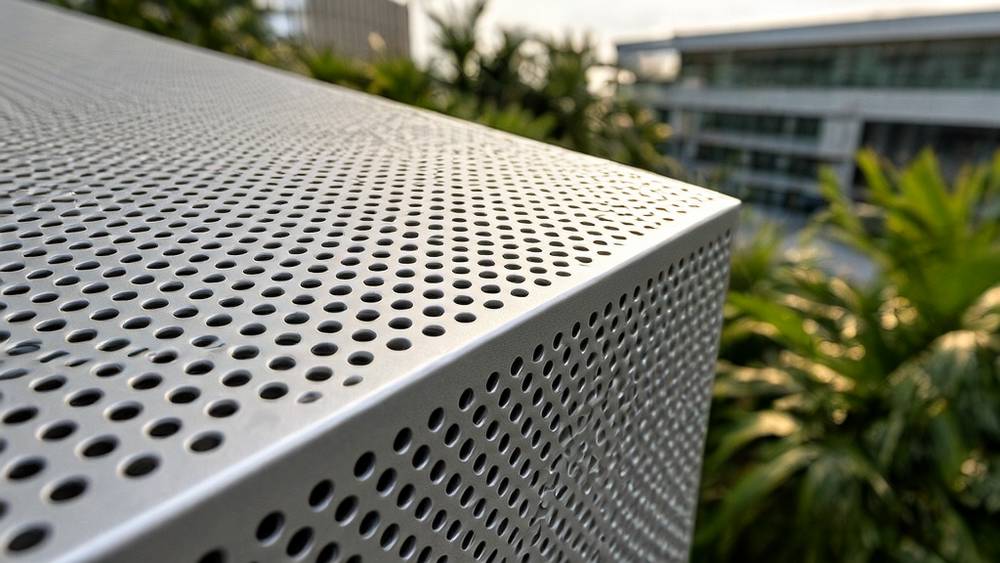
When a project brief lands on your desk calling for a perforated metal facade in Singapore's tropical climate, the first specification most teams lock in is the hole pattern. Round, square, hexagonal — the visual choice gets all the attention. But the decision that quietly determines whether the panels perform over a 20-year service life sits one line down in the spec sheet: 1.5 mm or 3.0 mm. In Singapore's combination of 80% average humidity, salt-laden coastal air, and the relentless thermal cycling of equatorial sun, sheet thickness on perforated panels is not a secondary consideration. It is the variable that governs flatness retention, corrosion resistance at every punched hole edge, and whether the facade still looks like the architect's rendering after five monsoon seasons. This article examines how material thickness selection shapes the real-world outcomes of perforated panel singapore installations, drawing on fabrication principles, onsite failure patterns, and the metallurgical realities that make thin-gauge perforated aluminium a riskier proposition than many specification writers assume.
Why Hole Punching Changes the Structural Rules for Aluminium Sheet
A 2.0 mm solid aluminium panel behaves predictably under wind load. Remove 30% to 40% of the material through perforation and the remaining web structure carries stress in ways that flat-plate formulas do not fully capture. Each punched hole creates a stress concentration point at its perimeter. When holes are arranged in a staggered 60-degree pattern — the most common specification for perforated panel singapore facades — the ligaments between adjacent holes become the critical load path. A 2.0 mm sheet with 6 mm holes on 8 mm staggered centres leaves ligament widths of roughly 2.0 mm. That narrow aluminium bridge must resist bending moments that, in an unperforated sheet, would be distributed across the full panel width.
The practical consequence shows up during fabrication. Perforated panels pressed from 1.5 mm 3003-H14 aluminium frequently exhibit localised buckling around hole perimeters during the punching process itself. The punch-and-die clearance that works cleanly on 2.5 mm material produces micro-tearing and edge deformation on thinner gauges. These defects become initiation points for two failure modes: fatigue cracking under cyclic wind loading, and preferential corrosion attack where the PVDF coating struggles to achieve uniform coverage on compromised hole edges. Suppliers familiar with Southeast Asian conditions, including Futeng® aluminium, typically recommend minimum 2.0 mm base material for architectural perforated panels and push toward 2.5 mm or 3.0 mm where open area exceeds 35%.
Corrosion at the Hole Edge: Singapore's Hidden Degradation Mechanism
Singapore sits within ISO 9223 corrosivity category C4 to C5, depending on proximity to the coastline. For perforated aluminium panels, the corrosion risk concentrates at the single most vulnerable location on the entire component: the interior surface of every punched hole. Here is why this matters more than most project teams anticipate.
When a PVDF or powder coating system is applied to a perforated sheet, the coating thickness at the hole edge is inherently thinner than on the flat surface. The geometry of a punched hole — a sharp 90-degree transition from face to interior wall — creates a natural coating discontinuity. Electrostatic spray application struggles to wrap effectively into the hole interior. Even with diligent pretreatment, the mill-finish aluminium inside each perforation may receive only 50% to 70% of the specified dry film thickness. In Singapore's humidity, any exposed aluminium substrate at these edges becomes a galvanic cell waiting to activate.
Thicker base material provides a straightforward defence. A 3.0 mm perforated panel offers substantially more sacrificial aluminium mass at each hole edge than a 1.5 mm equivalent. The corrosion rate, measured in microns per year of metal loss, remains similar — but the time to perforation or structural compromise multiplies. Field surveys of perforated panel singapore installations within 500 metres of the East Coast and Sentosa shorelines show that 1.5 mm panels punched with 8 mm round holes at 40% open area begin showing white corrosion product around hole perimeters within 36 to 48 months. Comparable 2.5 mm panels from the same alloy and coating specification show negligible edge corrosion at the five-year mark.
Flatness Under Thermal Load: The Gauge-Dependent Variable
Perforated aluminium panels expand and contract under Singapore's diurnal temperature swing, which typically ranges from 24°C at dawn to 34°C by mid-afternoon. The coefficient of thermal expansion for 3003 aluminium alloy is approximately 23.4 × 10⁻⁶ per °C. A 1,500 mm wide panel subjected to a 10°C temperature rise expands by roughly 0.35 mm. In a solid panel, the material accommodates this movement through the flexing of the overall sheet. In a perforated panel, the expansion concentrates in the ligament network between holes.
Thinner material offers less resistance to thermal buckling. A 1.5 mm perforated sheet with 30% open area can develop visible oil-canning — localised concave or convex distortions between hole rows — when surface temperature rises rapidly, such as when morning sun hits an east-facing facade. The phenomenon is partly elastic and partly plastic. Repeated daily cycles gradually accumulate permanent deformation. By year three, the panel that looked flat during installation now catches light unevenly, creating a wavy appearance that undermines the clean geometric aesthetic perforated facades are specified for.
Moving to 2.5 mm or 3.0 mm material increases the panel's bending stiffness non-linearly. The section modulus scales with the square of thickness, so a 3.0 mm panel offers roughly four times the bending resistance of a 1.5 mm panel of identical alloy and hole pattern. This stiffness gain directly suppresses the thermal buckling mode. Projects where perforated panel singapore panels are specified at 2.5 mm minimum consistently report better long-term flatness than those where value engineering drove the gauge down to 1.5 mm.
Open Area Percentage and the Gauge Selection Matrix
The relationship between open area percentage and minimum recommended thickness is not linear, and understanding where the thresholds sit helps avoid the most common specification errors. The table below consolidates engineering guidance drawn from fabricator experience across Southeast Asian projects, cross-referenced with aluminium association technical bulletins on perforated sheet design.
| Open Area (%) | Typical Hole Pattern | Minimum Recommended Gauge | Rationale |
|---|---|---|---|
| 10% – 20% | 4–6 mm round, wide pitch | 1.5 mm | Sufficient ligament width; low stress concentration |
| 20% – 30% | 6–8 mm round, standard pitch | 2.0 mm | Moderate web reduction; 2.0 mm provides acceptable stiffness |
| 30% – 40% | 8–10 mm round or slotted | 2.5 mm | Narrow ligaments demand higher bending resistance |
| 40% – 50% | 10–12 mm round, dense pattern | 3.0 mm | Thin webs between holes; 3.0 mm essential for flatness |
| Above 50% | Custom large perforations | 3.0 mm minimum; consider stiffener frames | Panel approaches mesh behaviour; structural review required |
This matrix assumes 3003-H14 or 5052-H32 aluminium alloy, which together account for the majority of perforated panel singapore architectural specifications. When a project demands open area above 40%, the conversation should shift from "can we use thinner material to save cost" to "what stiffening strategy will maintain panel integrity." Some fabricators introduce intermediate stiffener ribs bonded or mechanically fastened to the rear face. Others switch to 5052-H32, which offers roughly 15% higher yield strength than 3003-H14, gaining back some of the stiffness lost to perforation without increasing gauge.
Alloy Selection Interacts With Gauge Decisions
Two aluminium alloys dominate the Singapore perforated panel market: 3003 and 5052. The choice between them is not independent of thickness selection — they interact in ways that affect both fabrication success and long-term performance.
3003-H14 is the workhorse. Manganese-alloyed, it punches cleanly and accepts PVDF coatings well. Its tensile strength of approximately 150 MPa and yield strength around 125 MPa provide adequate structural performance for most architectural applications when specified at 2.0 mm or above. At 1.5 mm with high open area, however, 3003-H14 panels can be pushed close to yield during handling and installation, introducing residual stress that later manifests as distortion.
5052-H32 brings magnesium into the alloy, pushing yield strength to roughly 160 MPa — a 28% increase over 3003-H14. This higher strength allows a 2.0 mm 5052 panel to perform similarly to a 2.5 mm 3003 panel in bending stiffness terms. For projects where weight reduction matters — ceiling-hung perforated acoustic baffles, for example — 5052 at 2.0 mm can replace 3003 at 2.5 mm, saving approximately 1.4 kg per square metre. The trade-off is cost: 5052 typically carries a 15% to 20% premium over 3003 in the Singapore market, and it requires slightly different punch tooling clearances to achieve clean hole edges without excessive burr formation.
The Singapore market also sees occasional specifications calling for 6061-T6 perforated panels, usually where the perforated element forms part of a structural balustrade or walkway screen. At 3.0 mm thickness, 6061-T6 offers yield strength exceeding 240 MPa — nearly double that of 3003-H14. But 6061 punches less cleanly, with a tendency toward micro-cracking at hole edges if tool clearance is not precisely controlled. For typical architectural screens and facades, the 3003/5052 choice covers virtually all requirements, with thickness selection being the more consequential variable.
Fabrication Realities: What Happens on the Shop Floor
Specifying a material thickness on paper and getting panels that meet that specification after punching, forming, and coating are two different things. The fabrication sequence introduces variables that can degrade effective thickness at critical locations.
Punching aluminium work-hardens the material immediately surrounding each hole. In 3003-H14, the cold work from punching can raise local hardness to the equivalent of H18 condition — a significant increase in strength but accompanied by a sharp reduction in ductility. This hardened zone extends roughly 0.5 mm to 1.0 mm from the hole edge. In a 1.5 mm sheet with 6 mm holes on tight pitch, the work-hardened zones from adjacent holes can overlap, creating a brittle network through the panel. The panel becomes susceptible to cracking if subjected to bending during installation or if wind-induced vibration excites a resonant frequency.
Thicker starting material mitigates this because the ratio of work-hardened depth to total thickness is lower. In a 3.0 mm sheet, the 0.5 mm hardened zone represents only 17% of the cross-section, leaving ample ductile core material. In 1.5 mm, the same 0.5 mm represents 33% — a far more significant compromise of the material's ability to absorb strain without fracturing.
Coating adhesion at hole edges presents another fabrication challenge. For perforated panel singapore projects specifying PVDF coil-coated material — where the coating is applied to the flat sheet before punching — the hole edge is left as bare aluminium. Post-punch edge treatment becomes essential. Chromate conversion coating applied after punching provides some protection, but achieving uniform coverage inside thousands of small holes per panel is technically demanding. For projects within 1 km of Singapore's coastline, some specifiers now require a two-stage post-punch treatment: chromate conversion followed by a thin spray-applied epoxy primer targeting hole interiors. This adds roughly SGD 6 to SGD 10 per square metre but significantly extends the panel's corrosion-free service interval.
Wind Load Performance of Perforated vs Solid Panels
The Building and Construction Authority of Singapore references wind load calculations aligned with EN 1991-1-4 and the Singapore National Annex. For solid aluminium cladding panels, the wind pressure calculation follows standard principles: determine the design wind pressure based on building height, terrain category, and local wind climate, then verify that the panel's bending capacity exceeds the applied moment.
Perforated panels complicate this. The open area reduces the wind-affected surface, which might suggest lower net wind loads. But the aerodynamic behaviour of a perforated sheet differs fundamentally from a solid one. Wind tunnel studies referenced in AAMA technical papers show that perforated panels with 30% to 40% open area can experience higher local pressure coefficients at certain wind angles than solid panels. The holes generate turbulence and vortex shedding that solid surfaces do not. The pressure equalisation that perforations provide is partial, not complete — a common misconception among designers who assume that "holes mean no wind load."
The practical design approach adopted by experienced perforated panel singapore fabricators applies a reduced effective area for wind load calculation — typically the solid portion of the panel — but maintains the full panel dimensions for bending moment calculation. This means the load per unit area drops, but the span that the reduced-section panel must resist does not. A 3.0 mm perforated panel spanning 1,200 mm between fixing rails at 40% open area may have similar bending utilisation to a 2.0 mm solid panel spanning the same distance. Understanding this equivalence helps specification writers avoid the trap of specifying perforated panels at the same gauge they would use for solid cladding on the same project.
Cost Implications of Gauge Selection: A Real Project Perspective
Material cost represents roughly 35% to 45% of the installed cost of a perforated aluminium panel system in Singapore. Moving from 1.5 mm to 2.5 mm increases raw material cost by approximately 40% on a per-kilogram basis, but the per-square-metre cost increase is moderated because the panel count and fixing system may remain unchanged. For a typical mid-rise commercial facade with 800 square metres of perforated panels, the material cost difference between 1.5 mm and 2.5 mm 3003-H14 might range from SGD 18,000 to SGD 25,000, depending on alloy, hole pattern complexity, and coating specification.
What gets overlooked in value-engineering discussions is the lifecycle cost. A 1.5 mm panel that requires replacement or remediation after 8 to 10 years due to corrosion or distortion generates costs far exceeding the upfront saving. Access equipment, downtime, and the logistical complexity of facade work in occupied buildings in Singapore's CBD push remedial work costs to multiples of the initial installation rate. Several building owners who opted for thinner-gauge perforated panels in the early 2010s have since undertaken partial recladding programs, with total project costs exceeding what a 2.5 mm specification would have added to the original contract.
The insurance and warranty dimension also favours conservative gauge selection. Professional indemnity insurers and facade warranty providers are increasingly asking for structural justification when perforated panel thickness falls below 2.0 mm for external applications in corrosive environments. Some warranty providers now reference ISO 12944-2 corrosion categories explicitly, requiring minimum coating specifications and substrate thicknesses that effectively rule out sub-2.0 mm perforated aluminium for C4 and C5 environments.
Specifying Perforated Panels for Singapore: A Practical Checklist
Drawing together the technical threads, the following framework helps project teams make defensible gauge decisions for perforated panel singapore specifications:
- Determine the actual open area percentage from the perforation pattern drawing, not from an estimate. Calculate ligament width at the narrowest point between adjacent holes. If ligament width falls below 1.5 times the material thickness, consider increasing gauge or adjusting the pattern.
- Assess the corrosivity category per ISO 9223 for the specific site. Projects within 500 m of the coastline fall into C5; those 500 m to 2 km inland typically C4; central Singapore locations may be C3. Let this drive both coating specification and minimum thickness.
- Request fabricator samples at the proposed gauge and pattern before finalising the specification. Examine hole edge quality under 10x magnification. Look for tearing, burr formation, and coating coverage at edges.
- Verify the fixing system is designed for the reduced bending stiffness of the perforated panel. Closer fixing centres can compensate for thinner material, but this increases substructure cost and thermal bridging — the trade-off needs explicit evaluation.
- Specify post-punch edge treatment for any panel in C4 or C5 environments. Chromate conversion as a minimum; two-stage treatment with epoxy primer for high-exposure facades.
- Consider 5052-H32 where weight constraints preclude moving to a thicker 3003 gauge. The strength premium can resolve stiffness concerns without the mass penalty.
The perforated panel market in Singapore has matured considerably over the past decade. Fabricators have moved up the learning curve on what works and what fails in the local climate. The collective experience points consistently toward one conclusion: the cost of adequate material thickness is a fraction of the cost of inadequate performance. For architectural perforated aluminium panels in Singapore's environment, 2.0 mm represents the floor, not the target. Where open area exceeds 30%, where panels face prevailing wind, or where the site sits within sight of the sea, 2.5 mm or 3.0 mm is the specification that aligns with a 20-year service expectation.
Thickness selection on perforated panels is fundamentally a risk allocation decision. The specification writer who defaults to the thinnest available gauge is transferring the cost of potential failure to the building owner. The engineer who specifies conservatively is buying insurance against Singapore's climate — and the premium is measured in millimetres of aluminium, not in multiples of the project budget.