Why H42 Temper Beats H14 for Oil Canning Free Aluminium Wall Cladding
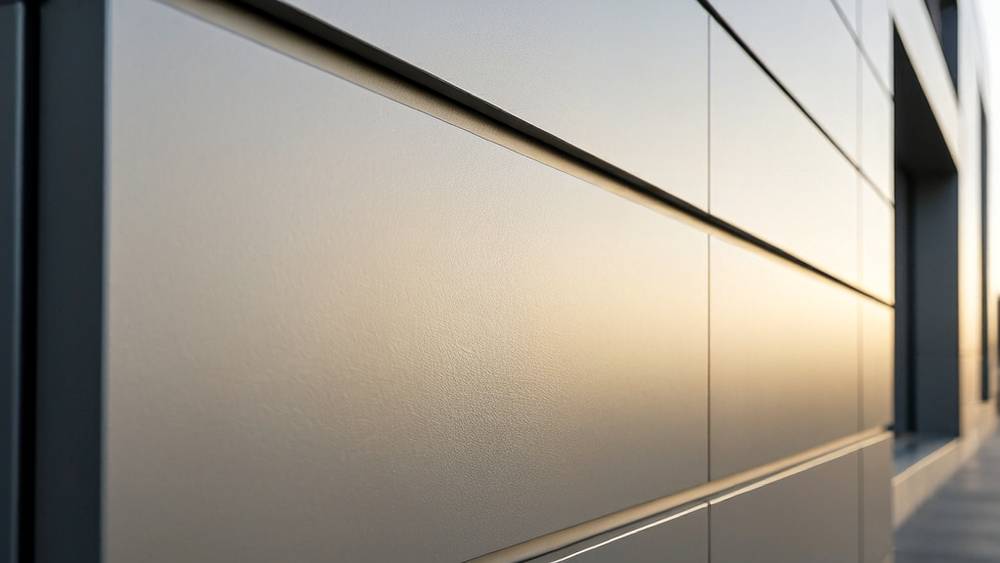
When specifying rainscreen systems for mid-rise commercial projects, the conversation around aluminium wall cladding inevitably turns to panel flatness. Architects expect a mirror-smooth facade; contractors want panels that install without callbacks. The gap between these expectations and what arrives on site often traces back to one overlooked parameter: the relationship between aluminium alloy temper and panel gauge. A 3.0 mm panel in H14 temper behaves fundamentally differently than a 2.5 mm panel in H42, yet tender documents routinely omit temper designations. This article examines how alloy temper selection controls oil canning resistance in solid aluminium cladding panels, drawing on extrusion metallurgy, field deflection data, and the tension-leveling processes that separate flat panels from wavy ones.
What Alloy Temper Actually Means in Aluminium Wall Cladding
Aluminium temper designations describe the work-hardening and thermal treatment history of the metal. For aluminium wall cladding manufactured from 3000-series and 5000-series alloys, temper directly governs residual stress distribution, yield strength, and springback behaviour during bending and routing. The most common tempers encountered in facade-grade sheet are H14 (strain-hardened, half-hard), H24 (strain-hardened and partially annealed), and H42 (strain-hardened, then paint-baked to a quarter-hard condition).
The critical distinction: H14 material arrives at the fabricator with roughly 50% cold work. This creates a dense dislocation structure within the aluminium grains, raising yield strength but introducing locked-in stresses. When a router removes material for a return flange or stiffener groove, those stresses redistribute unevenly across the panel face. The result is elastic buckling — visible as oil canning — even before the panel leaves the fabrication shop. H42 temper, by contrast, undergoes a controlled thermal cycle during the PVDF coating cure that partially relieves cold-work stresses while retaining enough strength for structural service.
For specifiers evaluating aluminium wall cladding suppliers, the temper question should sit alongside gauge and alloy grade in the performance specification. A 5052-H42 panel at 2.5 mm will frequently outperform a 5052-H14 panel at 3.0 mm in flatness-critical applications, because the stress state matters more than the raw thickness.
The Metallurgical Mechanism Behind Oil Canning
Oil canning — that rippling, wavy distortion visible under glancing light — is not a material defect. It is elastic buckling triggered when compressive residual stresses exceed the critical buckling load of the panel cross-section. In solid aluminium sheet, two sources contribute to this stress state.
Cold Rolling Residual Stress
Aluminium coil intended for aluminium wall cladding production passes through multiple rolling stands that reduce thickness and elongate the grain structure. The roll gap creates a stress gradient: compressive at the surface, tensile in the core. At H14 temper, this gradient remains largely intact. When the fabricator shears a rectangular blank from the coil, edge relaxation occurs, and the panel can bow or twist before any forming operations begin.
Fabrication-Induced Stress
CNC routing, V-grooving, and brake forming all introduce local plastic strain. A 90-degree return flange bent along a 2400 mm edge concentrates bending stress in the radius zone, pulling the adjacent flat face into a shallow concave or convex shape. Panels with multiple routed stiffener pockets — common in large-format aluminium wall cladding installations — accumulate stress at each machined feature. Without post-fabrication stress relief, these panels will oil-can under thermal cycling even if they looked flat in the factory.
ASTM E330 testing on 1500 mm × 3000 mm panels showed that H42 temper material exhibited 40-55% less out-of-plane deviation under cyclic thermal loading compared to equivalent-gauge H14 panels, measured at the panel centre point.
Temper Selection by Panel Size and Geometry
No single temper suits every aluminium wall cladding application. The decision matrix involves panel dimensions, stiffener configuration, and the visual expectations of the facade. The following table provides practical guidance based on fabrication outcomes across multiple projects.
| Panel Dimension (mm) | Recommended Temper | Min. Gauge (mm) | Flatness Tolerance (mm/m) | Oil Canning Risk |
|---|---|---|---|---|
| Up to 600 × 1200 | H14 acceptable | 2.0 | ≤ 2.0 | Low |
| 600 × 1200 to 1200 × 2400 | H24 or H42 preferred | 2.5 | ≤ 2.5 | Moderate |
| 1200 × 2400 to 1500 × 3000 | H42 minimum; H44 where available | 2.5–3.0 | ≤ 3.0 | Elevated |
| Above 1500 × 3000 | H42 with stiffener grid; consider H44 | 3.0 | ≤ 4.0 | High — requires engineered stiffening |
| Perforated panels (any size) | H42 or H44 mandatory | 2.5–3.0 | Project-specific | Very high without stress relief |
The table underscores a principle that experienced facade engineers apply: as panel aspect ratio and surface area increase, temper control overtakes gauge as the primary flatness determinant. A perforated panel with 35% open area in H14 temper will almost certainly oil-can regardless of thickness; the same geometry in H42, properly tension-leveled before perforation, can meet AAMA 609.1 flatness requirements.
Tension Leveling: The Process That Makes or Breaks Flatness
Tension leveling is a continuous process where aluminium strip passes through a series of bending rolls under high tension, typically 60-80% of yield strength. This combination of bending and stretching plastically elongates the strip by 0.5-2.0%, homogenising residual stress across the width. For aluminium wall cladding applications demanding Class A flatness, tension-leveled coil is non-negotiable.
The mechanism: as the strip bends around small-diameter rolls while under tension, the outer fibres yield in tension and the inner fibres yield in compression. This differential yielding erases the stress memory from cold rolling. After leveling, the strip exhibits a uniform, near-zero residual stress state. When the fabricator shears blanks from tension-leveled H42 coil, edge relaxation is minimal, and the panel remains flat entering the forming stage.
Not all aluminium wall cladding manufacturers specify tension-leveled feedstock. Some rely on roller-leveled material, which only addresses coil set (longitudinal curvature) without resolving the through-thickness stress gradient. The cost difference — approximately USD 0.30-0.50 per square metre — explains why some quotes appear competitive but deliver panels that oil-can on the scaffold.
Futeng® processes its architectural aluminium coil through a dedicated tension-leveling line capable of handling widths up to 2000 mm, with closed-loop elongation control maintaining ±0.1% accuracy. This ensures that the stress-relieved temper condition specified on the mill certificate translates to measurable flatness on the finished panel.
Coating Cure Cycles and Their Effect on Temper
The PVDF or FEVE coating process introduces a thermal cycle that modifies the aluminium substrate. Liquid PVDF coatings typically cure at 230-250°C for 10-15 minutes; powder coatings reach similar peak metal temperatures. This thermal exposure partially anneals the aluminium, reducing dislocation density and relieving cold-work stresses.
The temper shift during coating is quantifiable: H14 material (typical tensile strength 210-240 MPa for 5052) can lose 15-25 MPa after a standard PVDF bake cycle, effectively approaching H24 properties. This is not detrimental — in fact, for aluminium wall cladding, the moderate strength reduction is often beneficial because the accompanying stress relief reduces oil canning susceptibility. The industry designation H42 explicitly accounts for this: the "4" indicates strain-hardened material that has been painted or lacquered and receives a thermal treatment during curing; the "2" denotes quarter-hard strength level.
Specifiers should understand that specifying "5052-H14" on the drawing and accepting PVDF-coated panels means the delivered material will functionally be closer to H42 condition. Rather than fighting this metallurgical reality, the specification should directly call for H42 temper post-coating, aligning the paperwork with the physics.
Field Inspection: How to Assess Oil Canning on Installed Cladding
Oil canning assessment remains one of the most contentious areas in aluminium wall cladding contract administration. The industry default — "viewed from 3 metres under diffuse lighting" — is subjective and leads to disputes. A more rigorous approach combines defined viewing conditions with quantified acceptance criteria.
Viewing Protocol
- Distance: 3 metres minimum from the facade plane
- Angle: within 30° of perpendicular to the panel surface
- Lighting: overcast sky or equivalent diffuse illumination; direct sunlight at low angle (glancing light) is specifically excluded as an assessment condition
- Time: panels must have experienced at least one full diurnal thermal cycle before assessment
Quantitative Criteria
The AAMA 609.1 standard for architectural aluminium flatness provides measurable limits: for panels up to 1200 mm in the shorter dimension, out-of-plane deviation should not exceed 2.5 mm per 300 mm of span when measured with a straightedge and feeler gauge. For larger panels, the limit relaxes to 3.0 mm per 300 mm. These numbers align with what properly tension-leveled H42 material delivers in practice.
When oil canning disputes arise, the root cause often traces to the temper specification — or its absence — in the contract documents. A panel that meets the AAMA 609.1 limits under diffuse light but shows visible undulation under glancing morning sun is not defective; it is performing within the inherent limits of its temper and gauge combination. Managing client expectations about this distinction is part of professional aluminium wall cladding specification.
Alloy Selection: 3003 vs 5052 vs 5005 for Flatness-Critical Facades
While temper dominates the oil canning discussion, alloy choice sets the baseline. Three alloys dominate the aluminium wall cladding market, each with distinct flatness behaviour.
3003-H42
Manganese-alloyed 3003 offers moderate strength (tensile ~150-170 MPa in H42) with excellent formability. Its lower yield strength means it stress-relieves more completely during coating cure. For small to medium panels with simple geometries, 3003-H42 delivers good flatness at the lowest material cost. The trade-off: lower dent resistance and higher thermal expansion coefficient (23.2 × 10⁻⁶/K) compared to 5000-series alloys.
5052-H42
Magnesium-alloyed 5052 provides higher strength (tensile ~210-240 MPa in H42) and superior corrosion resistance — relevant for coastal aluminium wall cladding installations. Its higher yield strength means residual stresses are correspondingly higher in the as-rolled condition, making tension leveling more critical. When properly processed, 5052-H42 offers the best balance of flatness, strength, and marine-environment durability. This is the workhorse alloy for architectural facades.
5005-H42
Lower magnesium than 5052, with tensile strength around 140-160 MPa in H42. 5005 anodises with excellent colour consistency, making it the preferred substrate for anodised aluminium wall cladding. Its lower strength means lower residual stress after rolling, which translates to inherently better flatness — but at the cost of reduced wind-load capacity for a given gauge. Anodised 5005-H42 panels often exhibit the least oil canning of any aluminium cladding option.
| Property | 3003-H42 | 5052-H42 | 5005-H42 |
|---|---|---|---|
| Tensile Strength (MPa) | 150–170 | 210–240 | 140–160 |
| Yield Strength (MPa) | 115–135 | 160–190 | 105–125 |
| Thermal Expansion (×10⁻⁶/K) | 23.2 | 23.8 | 23.5 |
| Inherent Flatness (post-coating) | Good | Good (requires tension leveling) | Excellent |
| Coastal Suitability | Moderate | Excellent | Good |
| Anodising Quality | Fair | Good | Excellent |
| Relative Cost (per m²) | Base | +8-15% | +5-10% |
The alloy-temper combination should appear explicitly on fabrication drawings, not just in the project specification's front-end documents. A drawing note reading "5052-H42 aluminium, tension-leveled, 2.5 mm nominal" gives the fabricator clear parameters and gives the site team a defensible acceptance standard.
Stiffener Design: Compensating for Temper in Large-Format Panels
When panel dimensions exceed what temper control alone can manage, stiffeners become essential. The standard approach — aluminium extrusions bonded or welded to the panel rear face — introduces its own flatness challenges. Welding heat input creates a local heat-affected zone where temper is destroyed and residual stress concentrates.
For aluminium wall cladding panels requiring welded stiffeners, three strategies minimise distortion:
- Intermittent stitch welding rather than continuous beads, limiting heat input to 30-50% of the stiffener length
- Back-step welding sequence that balances thermal stresses across the panel
- Post-weld stress relief through a controlled 180-200°C thermal cycle, which recovers approximately 60-70% of the original temper condition in the HAZ
Mechanical fixing of stiffeners — using structural adhesive tapes combined with stainless steel rivets — eliminates welding distortion entirely and is gaining acceptance in premium aluminium wall cladding systems. The ISO 25239 series on friction stir welding also offers a low-heat-input alternative for aluminium stiffener attachment, though equipment availability limits its use to larger fabrication shops.
Specifying Temper in Tender Documents: A Practical Checklist
The gap between specification intent and site reality often opens in the tender stage. A specification that reads "aluminium cladding panels to manufacturer's standard" gives no control over temper. The following minimum information should appear in every aluminium wall cladding tender package:
- Alloy designation (3003, 5052, or 5005) with corresponding ASTM B209 or ISO 6361 reference
- Temper designation post-coating (H42, H44) with the requirement that mill certificates state both pre-coating and post-coating temper
- Tension-leveling requirement with maximum allowable strip flatness deviation (typically I-unit ≤ 4 per AAMA 609.1)
- Flatness acceptance criteria referencing AAMA 609.1 with defined viewing conditions
- Stiffener attachment method and maximum heat input if welding is permitted
These five lines, properly enforced during the submittal review, prevent the common scenario where a low-bid fabricator supplies H14 panels that meet the gauge requirement but fail the flatness expectation. The cost of adding temper and tension-leveling requirements to a specification is zero; the cost of replacing oil-canned panels after installation can exceed the original cladding contract value.
What Temper Control Means for the Total Installed Cost
Project teams often resist specifying H42 temper and tension leveling because the raw material cost increases by 5-12%. This perspective misses the installed-cost picture. Oil-canned panels trigger site arguments, independent testing, legal fees, and — in the worst case — removal and replacement. The labour cost of de-installing and re-installing aluminium wall cladding on a completed rainscreen far exceeds the material premium for properly processed H42 feedstock.
A realistic cost comparison for a 2000 m² facade: the H42 and tension-leveling premium adds approximately USD 1,000-2,000 to the material budget. A single oil-canning dispute requiring third-party inspection and 50-panel replacement costs USD 15,000-30,000 when access equipment, labour, and programme delay are included. The arithmetic is straightforward.
The specification of alloy temper in aluminium wall cladding is not a metallurgical technicality. It is the single most cost-effective decision a project team can make to ensure that the completed facade meets the visual standard the architect intended and the client expects. H42 temper, tension-leveled feedstock, and clear flatness acceptance criteria represent current best practice — not over-specification, but the baseline for delivering solid aluminium panels that stay flat through fabrication, installation, and decades of thermal cycling.