How 22 Gauge to 8 Gauge Alters Aluminium Wall Panels Price Per Sq Ft in 2026
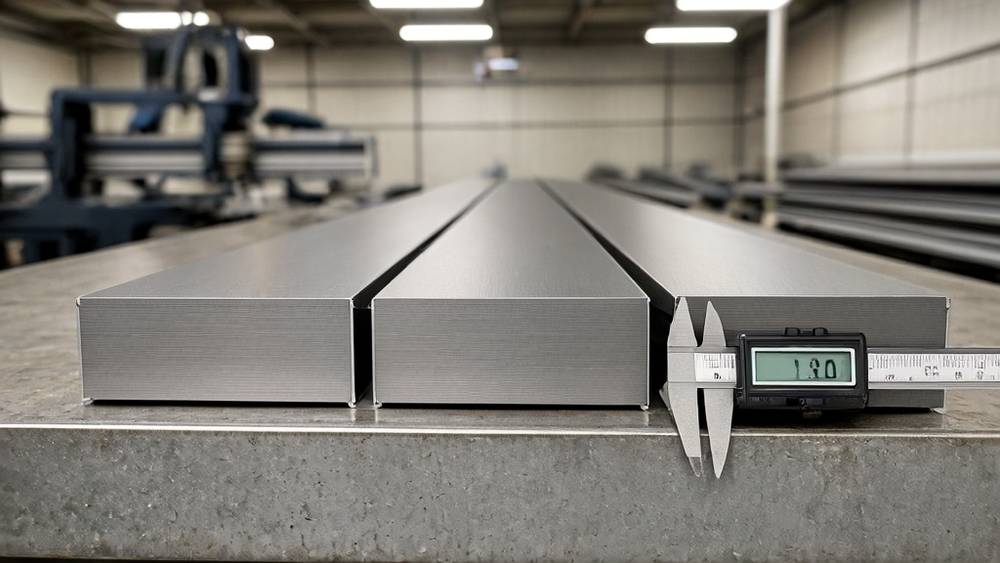
When a project estimator in Houston or Dubai pulls up a spreadsheet to budget a 30-storey commercial facade, the first figure they hunt for is aluminium wall panels price per sq ft. That number, however, is not one number. It fractures into a dozen sub-variables the moment you specify gauge, alloy, coating chemistry, rib geometry, and whether the panels ship from a domestic extrusion line or an overseas fabricator with ISO 9001 certification. The search results across 2026 industry databases show a bewildering range: some sources quote $3.50 per sq ft for thin-gauge residential siding, while others push past $45 per sq ft for insulated architectural systems. This article zeroes in on one specific and under-discussed cost driver — panel thickness expressed in gauge and millimetres — and traces how stepping from 22-gauge (0.64 mm) aluminium coil stock up to a solid 3.0 mm (approx. 11-gauge) sheet metal panel reshapes material cost, fabrication lead time, flatness tolerance, and ultimately the installed budget that a general contractor signs off on.
Why Gauge Thickness Dictates the Baseline aluminium wall panels price per sq ft
Solid aluminium cladding panels are specified by millimetre thickness in most architectural spec books — 2.0 mm, 2.5 mm, and 3.0 mm being the three workhorses of commercial curtain wall and rainscreen design. In the North American supply chain, however, metal service centres and coil distributors still quote substrate in gauge numbers. This dual-language creates a practical headache: an architect writing "2.5 mm solid aluminium panel" is effectively calling for a 12-gauge sheet, and the cost jump from 14-gauge (1.6 mm) to 12-gauge is not linear. Aluminium coil pricing on the London Metal Exchange (LME) plus Midwest Premium sets a baseline, but the conversion from mill finish coil to a fabricated, routed, and PVDF-coated panel adds layers of value-add cost that magnify with thickness. A 2026 metal wall panel cost survey by The Roofing Brief indicates that exposed-fastener aluminium panels can start as low as $4 per sq ft for thin-gauge stock, but solid architectural panels — the kind with folded returns, welded corners, and Kynar 500® finishes — routinely land between $12 and $28 per sq ft for material alone before a single clip or anchor enters the picture.
The physical reason thickness drives price is straightforward: a 3.0 mm panel weighs roughly 8.1 kg per square metre (1.66 lb per sq ft), compared to 5.4 kg/m² for 2.0 mm stock. That 50% mass increase translates directly into higher billet consumption at the smelter, higher freight cost per truckload, slower CNC routing speeds, and more frequent tool changes on the fabrication floor. Futeng® production data from their Jiangsu facility shows that routing a 3.0 mm panel consumes approximately 40% more machine time than an identical geometry in 2.0 mm, a shop-floor reality that gets baked into the per-square-foot quote but rarely appears in generic online calculators.
Decoding the Gauge-to-Millimetre Map for Solid Aluminium Panels
Before an estimator can make sense of any aluminium wall panels price per sq ft quotation, they need a clear cross-reference between the gauge language of metal suppliers and the millimetre language of specification documents. The table below distils the most common thicknesses encountered in solid aluminium cladding procurement, with approximate material-only price ranges observed in Q1-Q2 2026 US and Middle East markets.
| Gauge (AWG) | Thickness (mm) | Thickness (inch) | Typical Application | Material Cost Range (USD/sq ft) | Weight (lb/sq ft) |
|---|---|---|---|---|---|
| 22 ga | 0.64 | 0.025 | Residential siding, soffit liners | $1.80 – $3.20 | 0.45 |
| 20 ga | 0.81 | 0.032 | Light commercial soffits, interior wall liners | $2.40 – $4.00 | 0.57 |
| 18 ga | 1.02 | 0.040 | Rainscreen back pans, spandrel covers | $3.00 – $5.50 | 0.72 |
| 16 ga | 1.29 | 0.051 | Entry-level solid cladding, small-format panels | $4.50 – $7.50 | 0.91 |
| 14 ga | 1.63 | 0.064 | Mid-range architectural panels, column covers | $6.00 – $10.00 | 1.15 |
| 12 ga | 2.05 | 0.081 | Standard 2.0 mm solid cladding spec | $8.00 – $14.00 | 1.44 |
| 11 ga | 2.30 | 0.091 | Enhanced flatness, large-format panels | $10.00 – $17.00 | 1.62 |
| 10 ga | 2.59 | 0.102 | 2.5 mm architectural spec, high-wind zones | $12.00 – $20.00 | 1.82 |
| 9 ga | 2.91 | 0.114 | Near-3.0 mm heavy-duty cladding | $14.00 – $24.00 | 2.05 |
| 8 ga | 3.26 | 0.128 | Oversized 3.0 mm+ panels, blast-resistant facades | $17.00 – $28.00 | 2.29 |
These figures represent substrate plus basic fabrication — shearing, bending, and a standard PVDF two-coat finish. They do not include complex routing patterns, perforation, welded corners, custom embossing, or the carrier angles and clip systems that make up the installed cost. A useful rule of thumb from the 2026 Homewyse aluminium panel siding cost guide: material typically accounts for 40-55% of total installed cost, with the remainder split between labour, fasteners, subframe, and waste factor. On a large commercial job, that ratio shifts — material can climb to 60% when labour efficiencies kick in at scale.
What Happens to Flatness When You Push Gauge Thinner
One of the least-discussed consequences of chasing a lower aluminium wall panels price per sq ft by down-gauging is the flatness penalty. Solid aluminium panels gain their visual authority from the perception of a perfectly planar surface. When an architect specifies a 1,500 mm × 3,000 mm panel in 2.0 mm, the fabricator faces a genuine physics problem: that aspect ratio, unsupported across the long axis, will exhibit visible undulation under raking light unless the panel is stiffened with rear ribs or a honeycomb core.
The ASTM E2835 standard for aluminium panel flatness tolerances does not, by itself, prevent oil canning — the elastic buckling phenomenon that produces visible waves across a panel surface under thermal stress. Oil canning is not a material defect per se; it is a behaviour of thin, wide metal sheets subjected to compressive stress from thermal expansion. A 3.0 mm panel resists oil canning far more effectively than a 2.0 mm panel of identical dimensions simply because its flexural rigidity scales with the cube of thickness. The math is unforgiving: a 3.0 mm panel is roughly 3.4 times stiffer in bending than a 2.0 mm panel. That stiffness premium is invisible on a unit-price spreadsheet but painfully visible on a completed facade at 4 PM when low-angle sunlight sweeps across the wall.
For projects in the Gulf Cooperation Council (GCC) region, where summer ambient temperatures routinely exceed 48°C (118°F) and dark-coloured panels can reach 85°C surface temperature, the thermal expansion differential between a dark PVDF-coated aluminium skin and the supporting steel subframe is severe. The linear thermal expansion coefficient of aluminium is approximately 23.2 × 10⁻⁶ /°C — nearly double that of steel at 12.0 × 10⁻⁶ /°C. A 3-metre-long panel subjected to a 60°C temperature swing expands by roughly 4.2 mm. In a 2.0 mm panel, that expansion finds release through buckling. In a 3.0 mm panel, the same expansion is more likely to be absorbed by the slip joints in a properly designed clip system. The cost of the thicker panel, in this context, is insurance against a callback that no contractor wants.
Fabrication Complexity as a Thickness-Dependent Cost Multiplier
The relationship between panel thickness and fabrication cost is rarely linear, and estimators who treat it as such leave money on the table — or leave their bid exposed. Consider three common fabrication operations and how they scale with gauge:
- CNC routing and cut-outs: A 3.0 mm panel requires slower feed rates, deeper passes, and more frequent tool changes than a 2.0 mm panel. Production throughput drops by 30-40% for the same part geometry, and tooling amortisation per square foot increases proportionally.
- Bending and folding: A press brake that folds a 2.0 mm panel with a 90-degree return in a single hit may require two hits or a larger die opening for 3.0 mm stock. The bend radius minimum also increases — typically 1.5× material thickness for 3003-H14 alloy — which affects corner aesthetics and requires design adjustments.
- Welded corners: TIG welding a 3.0 mm panel corner consumes more filler rod, more argon shielding gas, and more skilled-labour minutes than a 2.0 mm corner. Post-weld grinding and polishing to achieve a seamless corner on a dark PVDF finish adds further labour that compounds with thickness.
These shop-floor realities mean that a fabricator's quote for a 3.0 mm panel is not simply 50% higher than a 2.0 mm panel despite the 50% greater material mass. The fabrication premium can push the total delta to 65-80% on complex geometries. The CurrentCost.org 2026 exterior metal panel analysis confirms this non-linearity, noting that panel thickness is among the top three cost drivers alongside finish specification and project geography.
Coating Chemistry Meets Substrate Thickness: A Cost Intersection
PVDF (polyvinylidene fluoride) coatings — commonly specified as 70% PVDF resin systems meeting AAMA 2605 — dominate the architectural aluminium cladding market. The coating cost per square foot is largely independent of substrate thickness: a 2.0 mm panel and a 3.0 mm panel both pass through the same spray line and receive the same 30-35 micron dry film thickness. However, the economic logic of pairing a premium coating with a thin substrate deserves scrutiny.
A 2.0 mm panel with a AAMA 2605-compliant three-coat PVDF finish might cost $14 per sq ft for material. A 3.0 mm panel with the identical coating might cost $22 per sq ft — a 57% increase. But the coating represents a smaller percentage of total cost on the thicker panel (roughly 18% versus 25%), which means the buyer is allocating proportionally more budget to the aluminium substance that delivers structural performance, flatness, and longevity. For a facade designed for a 40-year service life under AAMA guidelines, that allocation logic favours the thicker panel: the coating will weather similarly on both substrates, but the substrate itself is the component most vulnerable to physical damage, wind-induced fatigue, and handling abuse during construction.
FEVE (fluoroethylene vinyl ether) coatings, sometimes specified for extreme chemical or coastal environments, add another $3-6 per sq ft to the coating line item. On a thin panel, the coating cost can exceed the substrate cost — an inversion that makes little engineering sense. The smarter specification pairs FEVE with 2.5 mm or 3.0 mm substrate, ensuring the base metal justifies the premium finish.
Installed Cost: Where Gauge Decisions Hit the Balance Sheet
The installed aluminium wall panels price per sq ft is the figure that procurement managers actually care about, and it is here that thickness choices cascade through labour, substructure, and logistics in ways that can erase the apparent savings of a down-gauge strategy. The table below models three realistic specification scenarios for a 20,000 sq ft commercial rainscreen project in a major US metropolitan market, with labour rates calibrated to union-scale installation crews.
| Cost Component | 2.0 mm (12 ga) Solid Panel | 2.5 mm (10 ga) Solid Panel | 3.0 mm (8 ga) Solid Panel |
|---|---|---|---|
| Material (panel + finish) | $11.00 / sq ft | $16.00 / sq ft | $22.00 / sq ft |
| Subframe (aluminium extrusions) | $4.50 / sq ft | $5.00 / sq ft | $5.50 / sq ft |
| Fasteners, clips, thermal breaks | $2.80 / sq ft | $3.00 / sq ft | $3.20 / sq ft |
| Installation labour | $8.00 / sq ft | $9.00 / sq ft | $10.50 / sq ft |
| Freight & logistics | $1.20 / sq ft | $1.60 / sq ft | $2.00 / sq ft |
| Waste factor (5-8%) | $1.40 / sq ft | $1.75 / sq ft | $2.15 / sq ft |
| Total Installed Cost | $28.90 / sq ft | $36.35 / sq ft | $45.35 / sq ft |
Three observations leap out from these figures. First, the installed delta between 2.0 mm and 3.0 mm — roughly $16.45 per sq ft — is significant enough to drive specification decisions on a tight budget. Second, labour and subframe costs rise with panel weight: a 3.0 mm panel requires two-person handling more consistently, slows the installation rate from roughly 120 sq ft per installer-day to maybe 90 sq ft, and demands a slightly heavier subframe grid to carry the additional dead load. Third, the freight line item doubles from 2.0 mm to 3.0 mm because shipping containers hit weight limits before they cube out, a logistics reality that overseas procurement teams at Futeng® routinely flag during the quoting stage.
The RemodelingExpense 2026 aluminium siding calculator corroborates this pattern: projects using heavier-gauge material consistently report 15-25% higher labour costs than thin-gauge equivalents, a premium attributable to handling weight, slower fastening cycles, and the tighter alignment tolerances demanded by thicker architectural panels.
Regional Labour Markets and Their Impact on Gauge Economics
If the same 20,000 sq ft project were tendered in Dubai rather than Dallas, the calculus shifts. Labour rates for skilled curtain wall installers in the UAE run substantially lower than union rates in the northeastern US, which means the labour penalty for heavier panels shrinks as a percentage of total installed cost. In markets where labour is $4-6 per sq ft rather than $8-11, the material cost differential between 2.0 mm and 3.0 mm dominates the budget conversation. This tilts GCC and Southeast Asian projects toward thicker specifications — the incremental material cost buys flatness and durability at a lower total premium.
Conversely, in high-labour-cost markets like Switzerland, Singapore, or New York City, the combined effect of slower installation rates and higher hourly wages makes 2.0 mm panels economically compelling for projects where the facade design can tolerate smaller panel modules and closer stiffener spacing. The Modernize 2026 aluminium siding guide notes that regional labour variance alone can swing total project cost by 30% or more, a reminder that any per-square-foot figure quoted without a ZIP code or city reference is a rough estimate at best.
Procurement Strategy: When to Pay for Gauge and When to Engineer Around It
The engineering answer to "what thickness should I specify" is almost always "it depends on span, wind load, and flatness tolerance." The procurement answer is more nuanced. For a project team weighing aluminium wall panels price per sq ft against performance requirements, the decision tree should consider these factors in order:
- Panel dimensions: Any panel exceeding 1,200 mm in the short dimension or 2,400 mm in the long dimension benefits measurably from 2.5 mm or 3.0 mm stock. Smaller modules — 600 mm × 1,200 mm — perform adequately in 2.0 mm with proper stiffening.
- Wind zone: Projects in ASCE 7 wind zones exceeding 130 mph (basic wind speed, Risk Category II) should default to 2.5 mm minimum. The additional stiffness reduces fastener fatigue across the service life.
- Colour and solar absorption: Dark colours (R-value below 50 on the Hunter scale) absorb more solar radiation and experience higher thermal expansion cycles. Thicker panels manage this stress with less visible distortion.
- Access for replacement: If the facade is difficult to access post-construction — a 40-storey tower with no swing-stage provisions at certain elevations — the cost of premature panel replacement dwarfs the upfront gauge premium. Specify 3.0 mm and move on.
- Supplier capability: Not all fabricators can handle 3.0 mm stock reliably. Verify that the supplier's press brakes, routers, and welding stations are rated for the thickness you are specifying. Futeng® maintains dedicated heavy-gauge production lines for 2.5 mm and 3.0 mm architectural panels, a capability worth confirming with any shortlisted fabricator.
The DesignTransitionStudio 2026 aluminium cost breakdown reinforces this logic: alloy grade and panel thickness together account for roughly 35-45% of total material cost variance, making gauge selection the single most impactful specification decision a project team makes.
Waste Factor and Nesting Efficiency: The Hidden Thickness Variable
A cost line item that rarely surfaces in preliminary budgets but bites hard during fabrication is the waste factor. Aluminium coil and sheet stock arrives in standard widths — typically 1,219 mm (48 inches), 1,524 mm (60 inches), or 2,000 mm for metric-sourced material. The nesting efficiency — how many panels can be cut from a single sheet — depends on panel geometry relative to sheet dimensions. Thicker sheets, being more expensive per unit area, make every percentage point of waste proportionally more costly.
Consider a project requiring 900 mm × 1,800 mm panels. From a 1,524 mm × 3,048 mm sheet, a fabricator can nest two such panels with a 276 mm × 1,248 mm remnant. That remnant represents roughly 7.4% of the sheet area. If the sheet is 2.0 mm 3003-H14 at $8 per sq ft, the waste costs $0.59 per sq ft of finished panel. If the sheet is 3.0 mm at $22 per sq ft, the same waste pattern costs $1.63 per sq ft — nearly triple the dollar impact. Smart panel dimensioning, coordinated between architect and fabricator during the design development phase, can compress waste factors from 8% down to 3-4%, generating savings that dwarf the effort involved.
Making the Gauge Decision Stick Across the Supply Chain
The most expensive mistake in solid aluminium cladding procurement is not choosing the wrong gauge — it is having one gauge in the specification, another in the shop drawings, and a third arriving on site. Substitution risk is real, particularly when a general contractor's procurement team sees an opportunity to trim cost by swapping 3.0 mm for 2.5 mm without revisiting the engineering calculations. The remedy is a specification that ties panel thickness to measurable performance criteria — span tables, wind-load test reports, and flatness inspection protocols under ASTM E2835 — rather than stating thickness in isolation.
A well-written performance spec might read: "Solid aluminium panels shall be fabricated from 3003-H14 or 5052-H32 alloy sheet, minimum 2.5 mm nominal thickness, such that any panel up to 1,200 mm × 3,000 mm exhibits no visible oil canning when installed per manufacturer's clip spacing and subjected to a 50°C thermal differential." That language gives the fabricator a clear target, gives the inspector a pass/fail criterion, and gives the owner assurance that the aluminium wall panels price per sq ft they approved corresponds to a facade that will look flat and perform durably for decades.
Projects that treat gauge as a variable to be optimised — not simply minimised — tend to produce facades that age gracefully. The premium for moving from 2.0 mm to 2.5 mm or 3.0 mm is real and must be budgeted honestly. But the cost of a facade that reads as wavy under morning light, or that requires panel replacement after a single severe storm because fastener tear-out occurred at thin-gauge edges, is a budget line item that no contractor wants to explain to an owner after the hoarding comes down.