Why 1.0 NRC in an Aluminium Strip Ceiling Catalogue Still Fails Acoustical Field Tests
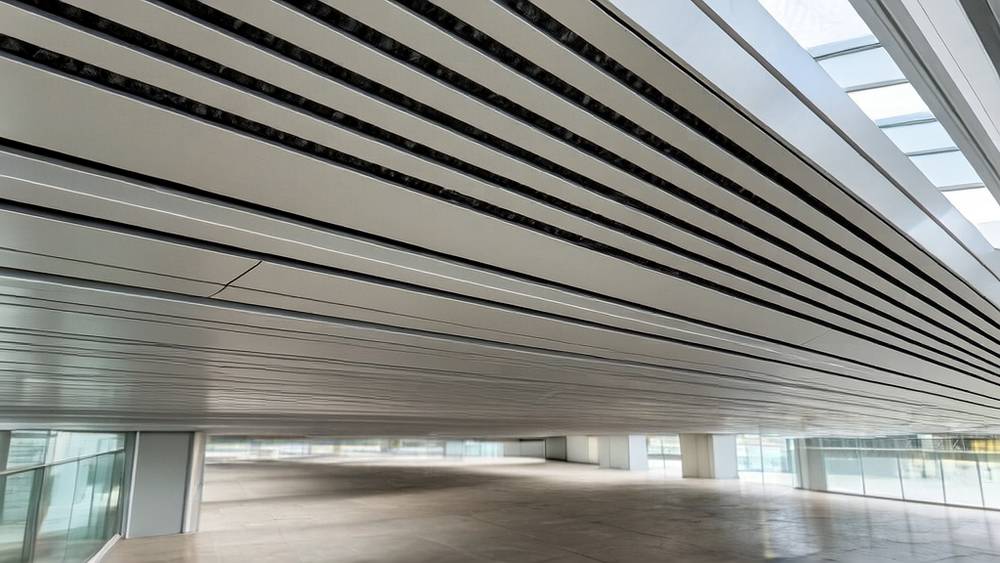
An aluminium strip ceiling catalogue is rarely opened for inspiration. It is opened because someone on a project team has hit a wall: the linear metal ceiling specified for a transit hall, airport check-in zone, or retail atrium carries a published NRC rating that looks adequate on paper but collapses under real-world acoustical loads. The problem is rarely the panel itself. It is the gap between what a catalogue lists as "acoustical performance" and what actually happens when hundreds of linear metres of aluminium strip ceiling are suspended across a hard-surfaced public concourse with 12-metre floor-to-deck heights. This article examines how to read the fine print in an aluminium strip ceiling catalogue through the lens of one specification line that frequently misleads procurement teams: Noise Reduction Coefficient values and the backing materials that generate them.
The NRC Number That Looks Right But Is Not
Most aluminium strip ceiling catalogue documents publish a single NRC figure. USG Middle East, for example, supplies metal ceiling panels with acoustical performance reaching up to 1.0 NRC and 34 dB CAC when paired with specific sound-absorbing backing options. The figure 1.0 NRC is the ceiling equivalent of perfect sound absorption in laboratory conditions. In a reverberation chamber, a 1.0 NRC aluminium strip ceiling absorbs 100% of incident sound energy across the four tested frequency bands: 250 Hz, 500 Hz, 1000 Hz, and 2000 Hz.
The pitfall is not the number. It is the assumption that a 1.0 NRC strip ceiling installed in a 10,000-square-metre departure hall will deliver the same acoustical outcome that the catalogue promises. It will not. The laboratory measurement follows ASTM C423, which tests a ceiling in a sealed chamber with a controlled sound field. Real spaces introduce variables that no aluminium strip ceiling catalogue can control: parallel reflective walls, mezzanine overhangs, occupant density, and most critically, the plenum depth above the suspended ceiling. A catalogue listing 1.0 NRC with a 50 mm thick acoustic fleece backing does not tell you what happens when the plenum is 800 mm deep and houses exposed ductwork that reflects mid-frequency sound back through the strip gaps.
How Backing Materials Drive Catalogue Acoustics Data
Every aluminium strip ceiling catalogue worth its engineering credentials will list backing material options. These are not decorative choices. They are the primary mechanism by which a linear aluminium ceiling achieves its published NRC and CAC values. Three common backing types appear across manufacturer catalogues:
1. Acoustic Fleece (Non-Woven Polyester or Mineral Wool Insert)
This is the most common backing specified in aluminium strip ceiling catalogue entries aimed at commercial interiors. The fleece sits directly atop the aluminium strip, typically 30 mm to 50 mm thick, and absorbs sound energy passing through the open joints between strips. Catalogue values for fleece-backed strip ceilings commonly range from 0.70 to 1.0 NRC, but the performance depends heavily on the open area percentage of the strip layout.
A strip ceiling with 16 mm gaps between 84 mm wide panels (common across Southeast Asian manufacturers such as those in the Thung Hing catalogue) yields approximately 16% open area. With a 50 mm acoustic fleece, this can deliver 0.85-0.95 NRC. Reduce the gap to 10 mm, and the open area drops to roughly 10.6%. The same fleece now delivers 0.65-0.75 NRC. The aluminium strip ceiling catalogue may publish the higher figure. The specifier who orders a tighter gap for visual reasons inherits the lower performance without the catalogue ever stating so explicitly.
2. Acoustic Black Tissue (Perforated Panel Backing)
Some strip ceiling systems use perforated aluminium panels rather than relying solely on open joints for sound absorption. In these configurations, the catalogue will reference a black acoustic tissue bonded to the rear of the perforated strip. This tissue prevents dust ingress into the mineral wool above while maintaining acoustic transparency. NRC values with perforated strips and tissue-plus-wool combinations typically test at 0.80-0.95 NRC. The trade-off is cost: perforated strip panels add 15-25% to the material line item compared to standard non-perforated strips relying on joint-gap absorption alone.
3. No Backing (Reflective Ceiling)
When an aluminium strip ceiling catalogue shows a system without acoustic backing — common in exterior soffit applications or purely decorative interior zones — the NRC drops to 0.05-0.15. The aluminium surface reflects almost all incident sound. This is sometimes intentional. Transport hubs in hot climates may specify reflective strip ceilings above retail kiosks to contain noise locally while using absorptive ceilings in waiting areas. The catalogue rarely explains this zoning logic; it simply lists the two NRC extremes.
| Backing Type | Typical NRC Range | CAC Range | Cost Premium vs Unbacked | Open Area Dependency |
|---|---|---|---|---|
| 50 mm Acoustic Fleece | 0.75-1.0 | 28-34 dB | +30-45% | High (gap-sensitive) |
| Perforated Panel + Tissue + Wool | 0.80-0.95 | 30-35 dB | +45-60% | Moderate |
| Black Acoustic Tissue Only | 0.40-0.65 | 22-28 dB | +15-25% | Low |
| No Backing (Reflective) | 0.05-0.15 | 15-20 dB | Baseline | None |
CAC: The Number That Catalogue Comparisons Often Miss
Noise Reduction Coefficient tells you how much sound the ceiling absorbs within a room. Ceiling Attenuation Class (CAC) tells you how much sound passes through the ceiling from the plenum into the occupied space below. An aluminium strip ceiling catalogue that publishes NRC without CAC is telling half the story. In open-plan offices where duct-borne mechanical noise travels through the ceiling plenum, CAC is arguably the more important metric.
USG Middle East publishes strip ceiling systems reaching 34 dB CAC. This is a meaningful number. A CAC of 34 dB means that a 70 dBA air-handling unit rumble in the plenum registers at roughly 36 dBA in the occupied space — quiet enough for conversation but noticeable in a boardroom. Drop to 20 dB CAC (typical of unbacked strip ceilings), and that same 70 dBA plenum noise arrives at 50 dBA in the room, equivalent to a loud conversation. Specifiers who select a strip ceiling from an aluminium strip ceiling catalogue based solely on visual appearance and NRC often discover this difference during commissioning, when acoustic testing reveals speech privacy failures.
Three factors govern CAC in strip ceiling systems: the mass of the panel (0.5 mm aluminium vs 0.7 mm aluminium changes the transmission loss curve), the density of the acoustic backing, and the integrity of the seal between adjacent panels. Light-gauge strip panels at 0.4-0.5 mm — common across many Asian-manufactured systems — inherently limit CAC regardless of backing quality. The catalogue may not flag this. A specifier comparing two aluminium strip ceiling catalogue entries with identical NRC ratings but different panel gauges is comparing ceilings with meaningfully different sound-blocking performance.
Reading Between the Lines of Catalogue Acoustical Test Reports
Any aluminium strip ceiling catalogue that takes acoustics seriously will reference ASTM C423 (sound absorption) and ASTM E1414 (CAC testing in a laboratory). The key question for the procurement team is not whether the test was performed, but what configuration was tested. A catalogue listing 1.0 NRC for a strip ceiling may have achieved that rating with:
- A specific strip width and gap combination (e.g., 84 mm panel, 16 mm gap producing 16% open area)
- A specific plenum depth (ASTM C423 Type E mounting, typically 400 mm)
- A specific fleece density and thickness (e.g., 50 mm, 32 kg/m³ polyester)
- A specific carrier spacing (e.g., carriers at 1200 mm centres)
If the installed condition deviates from any of these — the architect tightens the gap to 10 mm for visual reasons, or the MEP engineer requires 600 mm plenum clearance for ductwork — the catalogue NRC is no longer valid. The project either accepts the performance deviation or commissions a field test per ASTM E2235 to measure actual absorption. Few projects budget for this.
A practical rule: when an aluminium strip ceiling catalogue publishes an NRC above 0.90, ask the manufacturer for the full test report, not just the summary data sheet. Check the tested open area percentage and backing specification. If the installed open area will differ by more than 2 percentage points from the tested configuration, request a written engineering judgment confirming the expected NRC at the as-designed open area. Most reputable manufacturers — including those supplying systems through distributors like Futeng® — can provide this. Those that cannot are signalling that the catalogue number is a marketing value, not an engineering one.
Plenum Depth and Its Outsized Effect on Low-Frequency Absorption
ASTM C423 reports absorption coefficients in 1/3-octave bands from 100 Hz to 5000 Hz. The single-number NRC averages only the 250, 500, 1000, and 2000 Hz bands. Low-frequency absorption — the 100 Hz, 125 Hz, and 160 Hz bands — is excluded from NRC entirely. This matters because aluminium strip ceilings with acoustic fleece absorb mid and high frequencies efficiently but struggle below 250 Hz. The plenum depth determines where this low-frequency roll-off begins.
A deeper plenum (above 600 mm) shifts the resonant absorption of the ceiling-plus-plenum system to lower frequencies. With 800 mm plenum depth, a fleece-backed strip ceiling may deliver meaningful absorption down to 160 Hz. At 200 mm plenum depth — common in retrofits where existing structure limits suspension depth — the same ceiling absorbs little below 400 Hz. The NRC might be identical in both cases because NRC ignores the low-frequency bands where the difference is most pronounced. The aluminium strip ceiling catalogue that reports only NRC hides this entirely.
For projects where low-frequency noise is a known concern — transport terminals with diesel engine idling, data centre adjacent office zones with transformer hum, auditorium lobbies — the specifier needs the full absorption coefficient table, not the single-number NRC. If the catalogue does not publish it, ask for it before ordering 3,000 linear metres of strip ceiling.
Oil Canning, Panel Gauge, and the Acoustical Connection
There is a relationship between the visual flatness of aluminium strip ceilings and their acoustical performance that few catalogues address. The Thung Hing strip ceiling catalogue includes an important note: flat metal surfaces will display waviness commonly referred to as oil canning, caused by steel mill tolerances and characteristic of light-gauge metal. This is not a defect statement; it is a material physics reality.
Why does oil canning intersect with acoustics? Because a strip ceiling panel that exhibits visible waviness has internal stress patterns that can, under thermal cycling, cause the panel to flex microscopically. Over time, this flexing can open micro-gaps between the panel and its acoustic fleece backing, reducing the contact area through which sound energy transfers into the absorptive layer. The effect is small — perhaps 0.05-0.10 NRC points over a decade — but it is real in environments with wide temperature swings, such as naturally ventilated transit concourses or semi-outdoor retail arcades.
Specifying a 0.6 mm or 0.7 mm gauge aluminium strip instead of 0.4 mm reduces oil canning susceptibility and maintains more consistent backing contact over the service life. The cost increment is roughly 12-18% on material. For acoustically critical projects, this is cheap insurance that no aluminium strip ceiling catalogue will explicitly recommend. The specifier must connect these dots independently.
Fire Performance and Acoustic Backing Trade-offs
Acoustic fleece and mineral wool backings are combustible to varying degrees. An aluminium strip ceiling catalogue that specifies a polyester fleece with 1.0 NRC may not highlight that the same fleece achieves only Euroclass E or ASTM E84 Class B flame spread. For projects requiring Euroclass A2-s1,d0 or ASTM E84 Class A — common in transit infrastructure and healthcare — the fleece must be replaced with a non-combustible mineral wool backing.
Mineral wool backings typically deliver NRC values 0.05-0.15 lower than equivalent-thickness polyester fleece because their flow resistivity differs. A catalogue listing 1.0 NRC with polyester may drop to 0.85-0.90 NRC with mineral wool at the same thickness. If the project specification mandates both 1.0 NRC and Class A fire rating, the specifier has created an impossible requirement that no aluminium strip ceiling catalogue can satisfy without increasing wool thickness to 75 mm or switching to a perforated-panel system with greater absorptive area. Procurement teams should flag this conflict early, ideally during the design development phase before tender documents are locked.
ASTM C423 and ASTM E1414 are the two standards that govern how acoustical performance data appears in any credible aluminium strip ceiling catalogue. Insist on seeing the full test reports, not just the summary values.
What a Procurement-Ready Aluminium Strip Ceiling Catalogue Should Include
After two decades of reviewing submittals on commercial and infrastructure projects, there is a short list of what separates a procurement-grade aluminium strip ceiling catalogue from a marketing brochure:
- Full absorption coefficient tables (100 Hz to 5000 Hz in 1/3-octave bands), not just the NRC single number
- CAC values for each backing configuration, tested per ASTM E1414 with the specific panel gauge and carrier system offered
- Tested open area percentage clearly stated alongside the NRC value
- Plenum depth used in the ASTM C423 test (Type E mounting depth)
- Backing material composition, density (kg/m³), and fire classification (ASTM E84 or EN 13501-1)
- Panel gauge options and a statement on oil canning expectations per relevant metal construction standards
- Weight per square metre including carrier system, so the structural engineer can verify suspension loads
A catalogue missing any of these is useful for preliminary design only. It cannot support a defensible specification. This is not an indictment of manufacturers; it is a recognition that catalogues serve dual purposes — marketing and engineering — and the procurement team must know which sections answer which questions.
Practical Specification Language for Acoustical Strip Ceilings
When writing a performance specification that references an aluminium strip ceiling catalogue, avoid the common mistake of copying the catalogue's NRC value directly into the spec without qualification. A defensible specification reads something closer to:
"Aluminium strip ceiling system shall achieve minimum NRC 0.85 and minimum CAC 30 dB when tested in accordance with ASTM C423 (Type E mounting, 400 mm plenum) and ASTM E1414 respectively, with the as-installed strip width, gap, and backing configuration matching the tested assembly. Submit full laboratory test reports for review. Field testing per ASTM E2235 may be required at the engineer's discretion if installed open area deviates more than 2 percentage points from tested configuration."
This language closes the gap between catalogue promise and installed reality. It also signals to the bidding contractors that acoustics are being taken seriously, which tends to improve the quality of submittals received.
Regional Variations in Catalogue Acoustics Data
A scan of aluminium strip ceiling catalogue documents from different manufacturing regions reveals systematic differences in how acoustical data is presented. Southeast Asian catalogues, such as those from Colform and Thung Hing in Malaysia, tend to emphasize visual system configurations and dimensional flexibility, with acoustical data presented as supplementary information. Middle Eastern catalogues, notably from USG Middle East and GTI, tend to treat acoustics as a primary performance parameter with detailed backing options and test references. European manufacturers typically publish the most complete acoustical data packages, reflecting the regulatory environment where EN ISO 354 and EN ISO 11654 govern sound absorption testing and rating.
For international projects, procurement teams should not assume that a catalogue from one region meets the documentation standards of another. A Southeast Asian catalogue may be sufficient for a domestic project in Kuala Lumpur but will require supplementary technical data to satisfy a specification reviewer in London or Dubai. Factor this into the vendor qualification timeline.
The aluminium strip ceiling catalogue remains the starting point for specification, but it is never the ending point. The NRC printed on page 12 is a laboratory value obtained under conditions that the installed ceiling will approximate but never replicate. Understanding the variables — backing material, open area, plenum depth, panel gauge, fire classification — allows the procurement team to close the gap between catalogue promise and built performance. On projects where speech intelligibility, passenger comfort, or tenant productivity depend on getting the acoustics right, that gap is worth closing with engineering rigour rather than catalogue trust.