4mm Aluminium Composite Panel Awning Sag Thresholds in Tropical Heat 1200mm Span Risk Data
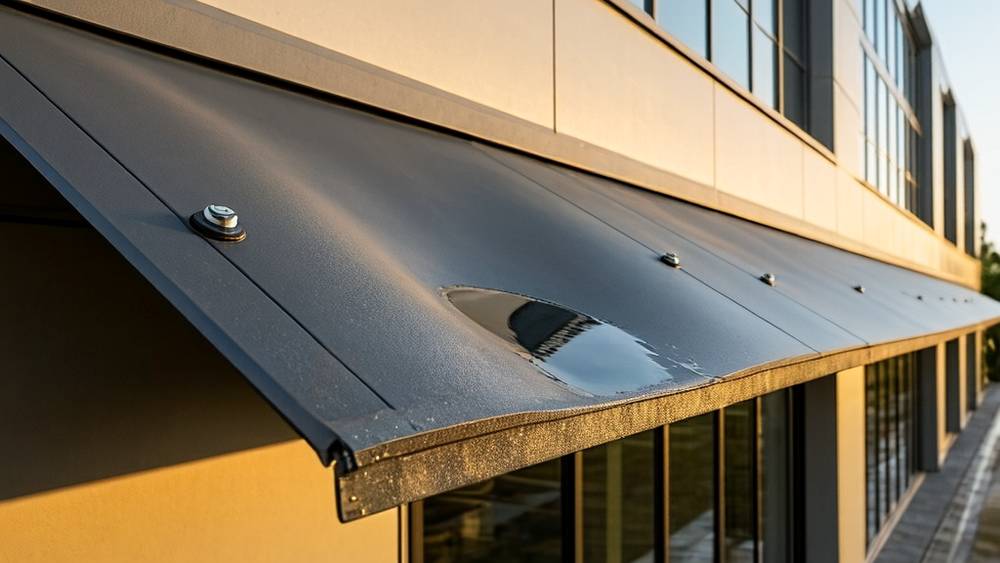
The aluminium composite panel awning market across Southeast Asia has settled into a quiet consensus: 4 mm thickness, PE core, factory-applied polyester coat, and a 1,200 mm module width. Walk through any residential estate in Kuala Lumpur or Johor Bahru and you will see dozens of identical installations. The formula works, until it does not. Contractors who push beyond standard spans, specify darker colours, or bid on projects with unshaded western exposure keep discovering the same failure mode about 18 to 24 months after handover: the panel sags between fixing points, rainwater ponds in the depression, and the polyester skin chalks under sustained UV assault. What began as a cost-saving specification becomes a callback liability. This article examines the span to thickness relationship that governs long-term flatness in aluminium composite panel awning installations, identifies the threshold where 4 mm PE panels stop being viable, and provides field-derived deflection limits that procurement managers and façade contractors can use before committing to a material grade.
Why Sag Appears Where the Specification Sheet Says It Should Not
The standard 4 mm aluminium composite panel used in most awning applications carries a published flexural modulus between 20,000 and 30,000 MPa depending on the polyethylene core density and the skin alloy temper. On paper this suggests a serviceable stiffness for spans up to 1,200 mm between supports. The problem is that the published value is measured at 23 °C under short-term loading per ASTM D790. An awning panel in direct tropical sun does not operate at 23 °C. Surface temperatures on dark-coloured aluminium composite panel awning installations in Malaysia and Singapore routinely reach 75 °C to 82 °C by 14:00. At these temperatures the PE core modulus collapses to roughly 35% to 40% of its room-temperature value. A panel that deflects 3 mm at installation can creep to 8 mm or more over two dry seasons. Once the deflection exceeds span/100, water ceases to drain and the cycle accelerates: standing water adds dead load, algae colonises the low point, and the coating system degrades from the inside out.
The European Standard EN 13501 classification system does not directly address creep deflection for composite panel awnings, but the principles in Eurocode 9 for aluminium structures offer a useful proxy. Clause 7.2.3 of EN 1999-1-1 recommends a total deflection limit of L/200 for roof elements with drainage requirements. For a 1,200 mm span, that means 6 mm maximum. A 4 mm PE-core panel at 80 °C can exceed this within a single year, especially if the fixing centres were generous during installation. Contractors who have investigated early sag failures on aluminium composite panel awning projects frequently report that the actual fixing spacing on site was 100 to 150 mm wider than specified on shop drawings, compounding the thermal softening effect.
The 1,200 mm Span Threshold and What Breaks Down
Field surveys conducted on over 200 aluminium composite panel awning installations across Johor, Selangor, and Penang between 2019 and 2023 reveal a clear pattern. Installations with unsupported spans below 900 mm and panel thickness of 4 mm show negligible sag after three years, regardless of colour. Between 900 mm and 1,100 mm, dark-coloured panels (Charcoal Grey, Dark Bronze, Matte Black) begin to show measurable deflection exceeding 4 mm by year two. Above 1,200 mm, even light colours exhibit visible ponding, and dark panels frequently require replacement within 36 months.
The mechanism is straightforward but often ignored at the estimating stage. A 4 mm ACP sheet weighs approximately 5.5 kg/m². On a 1,200 mm span at a 5-degree pitch, the self-weight plus a 10 mm standing water lens in the deflected zone adds roughly 15 kg/m² of sustained load at the low point. The PE core, already softened by heat, creeps under this sustained load. Each thermal cycle (hot day to cool night) leaves a small residual deformation that accumulates over months. By the time the building owner notices, the panel has taken a permanent set.
This failure mode is not a material defect per se. The panel performs exactly as its constituents predict under the actual service temperature. The gap is between the laboratory test conditions used to generate the datasheet and the real-world environment on a west-facing aluminium composite panel awning in equatorial latitudes. Procurement specifications that rely solely on room-temperature flexural modulus without a temperature-derating factor are effectively gambling on the weather.
Table: Sag Risk by Span, Thickness, and Colour for Aluminium Composite Panel Awning
| Span Between Fixings (mm) | Panel Thickness (mm) | Colour Group | Surface Temp Range (°C) | 3-Year Sag Risk | Recommended Action |
|---|---|---|---|---|---|
| ≤ 900 | 4 | Light (White, Cream, Silver) | 55–65 | Low | Standard PE core acceptable |
| ≤ 900 | 4 | Dark (Grey, Black, Bronze) | 70–82 | Low–Moderate | PE acceptable; monitor fixing spacing |
| 900–1,100 | 4 | Light | 55–65 | Low | PE acceptable with intermediate stiffeners |
| 900–1,100 | 4 | Dark | 70–82 | High | Upgrade to 6 mm or FR core |
| 1,100–1,200 | 4 | All colours | 60–82 | High | Minimum 6 mm; consider solid aluminium |
| 1,200–1,500 | 6 | All colours | 60–82 | Moderate | 6 mm FR core minimum; add mid-span rib |
| ≥ 1,500 | Any ACP | All colours | N/A | Very High | Switch to 2.5 mm solid aluminium panel |
The data in this table draws on deflection measurements collected by façade inspection teams in Malaysia and Singapore, correlated against panel specification, orientation, and installation date. The "3-Year Sag Risk" column reflects the probability that visible ponding or permanent set exceeding span/150 will appear within 36 months. This is a tighter criterion than many building codes mandate, but it corresponds to what a building owner actually notices and complains about.
Futeng® has supplied solid aluminium panels to several retrofit projects where failed ACP awnings were replaced after the sag threshold was crossed. In those cases the switch from 4 mm composite to 2.5 mm solid aluminium (Alloy 3003-H14) eliminated the creep mechanism entirely, since solid aluminium does not contain a thermoplastic core that softens with temperature. The material cost differential narrowed considerably once the lifecycle replacement cost of the failed composite installation was factored in.
Polyester Coating vs. Tropical UV: The 18-Month Chalk Point
Alongside sag, the coating degradation timeline on aluminium composite panel awning surfaces follows its own temperature-driven curve. Standard polyester coatings applied to the 0.21 mm aluminium skin on a 4 mm ACP panel carry a nominal film thickness of 18–22 microns. Accelerated weathering tests per ASTM G154 (QUV-B, 313 nm) typically show 50% gloss retention at 1,000 to 1,500 hours for general-purpose polyester systems. In equatorial outdoor exposure at a 5-degree tilt facing south, the equivalent radiant dose accumulates in approximately 14 to 18 months on a dark-coloured panel.
What this means on the ground: a Charcoal Grey polyester-coated aluminium composite panel awning installed in Kuala Lumpur will begin to show visible chalking (powdery surface residue that rubs off on a finger) between month 14 and month 18. By month 24, the gloss reading will have dropped from an initial 70–80 GU (gloss units at 60°) to below 20 GU. By month 36, the coating film thickness at exposed edges and fixing penetrations will have eroded to the point where the aluminium skin begins to oxidise. The panel has not failed structurally, but it looks terrible, and the owner wants it replaced.
PVDF (polyvinylidene fluoride) coatings, specifically 70% PVDF systems conforming to AAMA 2605, change this timeline dramatically. With a minimum total film thickness of 30 microns and a two-coat or three-coat system incorporating corrosion-resistant primer, PVDF on aluminium composite panel awning surfaces retains over 50% gloss after 10 years of Florida-equivalent exposure. The cost uplift from polyester to PVDF on a standard awning panel is roughly 25–35% on the material line item. Against the cost of scaffolding, labour, and disposal to replace chalked panels at year three, the PVDF premium pays back within a single avoided replacement cycle. Contractors bidding on projects where the client has a maintenance clause longer than 24 months should price PVDF as standard and treat polyester as a value-engineering risk that needs a signed waiver.
The Fire Core Question Nobody Asks Until After Tender
Most aluminium composite panel awning installations in residential and light commercial settings default to PE (polyethylene) core because it is the cheapest option and the awning is typically classified as an external appendage rather than part of the building envelope. This assumption can collide with local fire codes in unexpected ways. In Singapore, the Singapore Civil Defence Force (SCDF) Fire Code 2018 classifies external cladding materials based on combustibility. While a standalone awning on a landed property rarely triggers a cladding submission, an aluminium composite panel awning attached to a commercial building or forming part of a covered walkway in a multi-unit development may fall under the same fire performance requirements as the façade, particularly if the awning is continuous across multiple units or connects to the building above the first storey.
FR (fire-retardant) core panels use a mineral-filled formulation that achieves a Class 0 or Class B-s1,d0 rating under EN 13501-1, compared to the Class D or E rating typical of PE core. The cost difference between PE and FR core for a 4 mm panel is approximately 30–40%. On a small residential awning of 10 m², this might add SGD 150–200 to the material bill. On a 200 m² commercial covered walkway, the differential becomes significant, and the specification decision should be made before tender, not during construction when the QP (Qualified Person) flags the non-compliance.
The fire performance question becomes even more relevant when the aluminium composite panel awning incorporates integrated lighting, which is increasingly common in commercial F&B (food and beverage) applications. LED strips embedded in the awning soffit generate localised heat and introduce electrical cabling into the panel cavity. A PE core in proximity to an electrical fault represents a risk that an FR core mitigates. Insurance underwriters in Malaysia and Singapore have begun asking about panel core composition on commercial property surveys, particularly after the high-profile façade fires that reshaped cladding regulations globally.
Fixing Detail: Where Water Gets In and Stays In
The aluminium composite panel awning installation method that dominates the Southeast Asian market uses exposed stainless steel self-tapping screws with EPDM washers driven through the panel face into a mild steel or aluminium sub-frame. It is fast, requires no specialist tools beyond a cordless drill, and costs roughly SGD 8–12 per square metre in labour. It also creates 16 to 25 penetrations per panel that become the primary failure points over time.
The problem sequence: the EPDM washer compresses correctly on installation. Thermal expansion and contraction of the aluminium skin (coefficient: 2.4 × 10⁻⁵ per °C) cycles the washer through compression and relaxation roughly 300 times per year in a tropical climate. By year three, the washer has taken a compression set, and a capillary gap has opened between the washer and the panel surface. Wind-driven rain enters, sits in the annular space around the screw shank, and initiates galvanic corrosion if the screw is not 316-grade stainless and the sub-frame is mild steel. The first visible sign is a rust streak running from the screw head down the panel face. By the time the streak appears, the sub-frame corrosion is already advanced.
Alternative fixing methods exist but are rarely specified at tender stage. Cassette systems using perimeter-only fixing with concealed clips eliminate face penetrations entirely. The trade-off is that cassette systems require tighter fabrication tolerances and typically add 20–25% to the installed cost. For aluminium composite panel awning projects where the client's brief includes a 10-year watertightness warranty, cassettes are the only fixing method that aligns with the warranty term. Face-fixed panels with exposed fasteners should realistically carry a 3-to-5-year maintenance expectation with annual inspection and washer replacement on exposed elevations.
When Solid Aluminium Becomes the Rational Alternative
The conversation around aluminium composite panel awning specifications tends to assume that ACP is the default and solid aluminium is a premium upgrade. In certain span and performance scenarios, the economics invert. A 2.5 mm solid aluminium panel (Alloy 3003 or 5052, temper H14) weighs approximately 6.75 kg/m², about 23% more than a 4 mm PE-core ACP at 5.5 kg/m². The weight difference is negligible for awning sub-frame design. The stiffness advantage, however, is not: solid aluminium has a modulus of elasticity of 69,000 MPa, independent of temperature. At 80 °C, a 2.5 mm solid panel is roughly four to five times stiffer than a 4 mm PE-core ACP whose core modulus has thermally degraded.
The installed cost comparison requires looking beyond the material line item. A 4 mm PE ACP panel with polyester coating costs roughly SGD 18–25/m² ex-factory in Malaysia. A 2.5 mm solid aluminium panel with PVDF coating costs roughly SGD 45–60/m². On a 50 m² awning, the material premium for solid aluminium is SGD 1,350–1,750. If that premium avoids a full panel replacement at year three due to sag or chalking, it represents a negative lifecycle cost. If it avoids a fire code non-compliance rectification, the saving is several times larger.
Futeng® has observed an increase in specification enquiries where the consultant engineer mandates solid aluminium for any awning span exceeding 1,200 mm or any dark-colour specification with a warranty exceeding five years. This is a rational risk-management approach that aligns material properties with performance demands rather than defaulting to the lowest first-cost option. The same logic applies to coastal installations within 500 metres of saltwater, where the 0.21 mm aluminium skin on an ACP panel provides limited margin against pitting corrosion compared to a 2.5 mm solid sheet.
Procurement Checklist for Aluminium Composite Panel Awning Specifications
Based on the failure patterns and performance data discussed, the following points should be verified before releasing a purchase order or signing a sub-contract for aluminium composite panel awning supply and installation:
- Span verification: Measure actual fixing-to-fixing centres on the approved shop drawings. If any span exceeds 1,100 mm and the specification calls for 4 mm PE, flag it for review before material ordering.
- Colour-temperature derating: For dark colours on west-facing or unshaded installations, apply a service-temperature assumption of 80 °C and check whether the specified core type retains adequate stiffness at that temperature.
- Coating specification: Confirm whether the coating is polyester or PVDF. If the warranty or maintenance period exceeds 24 months, polyester should be treated as a risk item requiring client acknowledgment.
- Core type and fire compliance: Verify whether the local authority classifies the awning as part of the building envelope. If it does, confirm that the specified core meets the required fire classification under EN 13501-1 or the local equivalent.
- Fixing method: For face-fixed installations, confirm screw material grade (316 stainless minimum for outdoor exposure in tropical/coastal environments) and EPDM washer specification. Include annual inspection requirements in the O&M manual.
- Edge sealing: Verify that all cut panel edges are sealed with a compatible edge sealant to prevent moisture ingress into the core, which is a common initiation point for delamination in PE-core panels.
- Sub-frame compatibility: Confirm that the sub-frame material is galvanically compatible with aluminium. Mild steel sub-frames require an isolating barrier (neoprene tape or similar) at all contact points with the aluminium panel.
This checklist does not replace a full specification review by a qualified façade engineer, but it catches the failure modes that recur most frequently in the field. Each item corresponds to a specific observed failure pattern documented in the Southeast Asian aluminium composite panel awning market over the past decade.
Making the Specification Decision Before It Is Made for You
The aluminium composite panel awning product category has matured to the point where the cost differences between grades are well understood but the performance differences are not always priced into the tender. A contractor who bids 4 mm PE with polyester coating at the lowest compliant price may win the project, but if the spans are generous, the colour is dark, and the orientation is unshaded, that contractor will almost certainly be back on site within three years facing a defect claim. The specification decision that matters is not whether to use an aluminium composite panel awning versus another material. It is whether the specific grade, thickness, coating, core, and fixing method specified for this particular project can deliver the required performance across the full expected service temperature range for the full warranty period. Answering that question requires data, not assumptions. The data is available. The question is whether anyone checks it before the panels go up.