35 Microns Minimum Why AAMA 2605 Coating Thickness Defines Metal Clad Walls Service Life
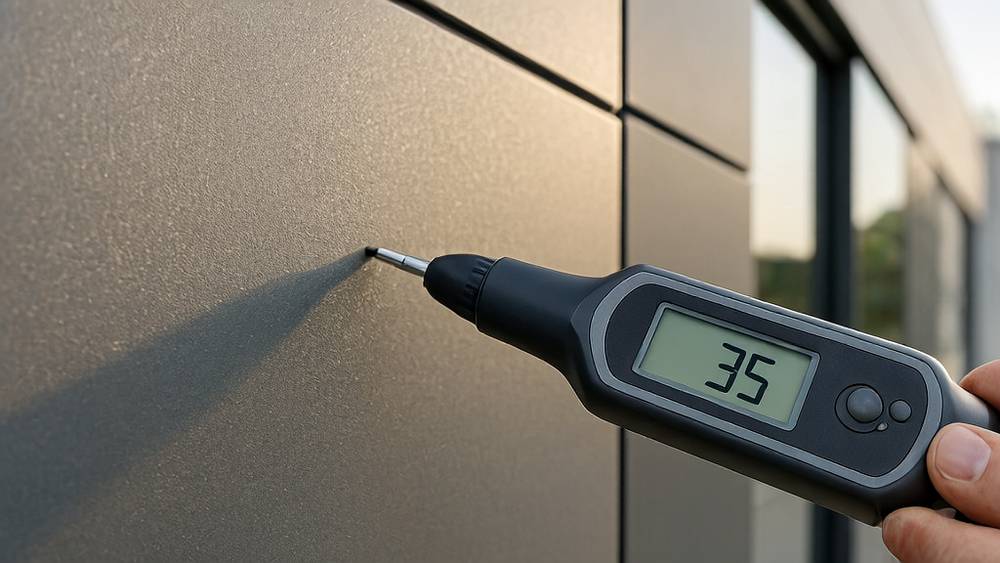
When a project specification calls for metal clad walls on a high-traffic institutional building, the conversation almost always pivots to one uncomfortable question: how long will these panels actually look new? The answer depends less on the metal substrate and more on what separates the aluminium from the atmosphere. That separator is the coating system, measured not in marketing claims but in microns. For solid aluminium cladding panels, the difference between a 25-micron general-purpose spray and a 35-micron architectural PVDF system can mean the difference between a facade that weathers gracefully for three decades and one that chalks within five years. This article examines coating thickness standards for metal clad walls, why those 10 microns matter more than most specifiers realise, and how to verify what you are actually buying before panels arrive on site.
Why Coating Thickness Dictates Facade Longevity on Metal Clad Walls
Solid aluminium panels do not rust, but they do oxidise. Uncoated aluminium forms a natural oxide layer within hours of exposure, and while that layer provides some protection, it is aesthetically unpredictable. Coatings serve three functions on metal clad walls: barrier protection against moisture and airborne contaminants, UV resistance to prevent polymer degradation, and colour retention for architectural consistency. Each function degrades at a rate proportional to film thickness. A coating that is 20 microns thick has roughly 40% less sacrificial polymer than one at 35 microns, and that math shows up in the field within the first decade.
The mechanism is straightforward. UV photons penetrate the coating and break polymer chains in the binder. When the film is thin, photons reach the pigment-resin interface faster. Once the binder erodes, pigment particles sit exposed on the surface. The result is chalking: that white powder that transfers to your hand when you touch an ageing metal wall. Chalking itself is cosmetic, but it signals that the protective resin matrix is gone. After that point, gloss fades accelerate and colour shifts become measurable.
Field surveys of metal clad walls installed across Southeast Asia and the Middle East show a consistent pattern. Panels with a total dry film thickness below 25 microns exhibited visible chalking within 7 to 10 years, while those at or above 35 microns maintained AAMA 2605 colour retention thresholds for over 20 years. The data confirms what coating chemists have long argued: thickness is not a secondary specification, it is the primary predictor of service life.
AAMA 2605 vs 2604 vs 2603: The Micron Numbers That Define the Specification
The Architectural Aluminium Manufacturers Association publishes three tiers of coating performance standards that directly govern metal clad walls. The differences between them are measured in laboratory cycles, but they translate to real-world durability differences that every specifier should understand.
| Standard | Minimum Total DFT (Microns) | Colour Retention (ΔE) – 10 Years South Florida | Chalk Resistance – 10 Years | Gloss Retention – 10 Years | Typical Application |
|---|---|---|---|---|---|
| AAMA 2605 | 30-35 (2-coat); 40+ (3-coat metallic) | ΔE ≤ 5 | Rating ≥ 8 (minimal) | ≥ 50% | Premium architectural facades, coastal high-rises, landmark buildings |
| AAMA 2604 | 25-30 | ΔE ≤ 5 (5 years) | Rating ≥ 6 (moderate) | ≥ 30% (5 years) | Commercial buildings, industrial parks, mid-tier projects |
| AAMA 2603 | 20-25 | No long-term guarantee | Rating ≥ 4 (noticeable) | Not specified | Interior panels, sheltered soffits, short-life enclosures |
The 2605 standard, often specified with 70% PVDF (polyvinylidene fluoride) resin systems such as Kynar 500 or Hylar 5000, demands a minimum total dry film thickness of 30 microns for two-coat systems and 40 microns or more for three-coat metallics. These numbers are not arbitrary. Accelerated weathering tests at AAMA-accredited laboratories correlate 30+ microns of PVDF to 20-plus years of South Florida-equivalent exposure with colour change below 5 ΔE units. Drop below that threshold and the warranty shrinks, the chalking accelerates, and the owner notices.
The 3-Coat Metallic Exception
Metallic and mica finishes on metal clad walls require an additional clear coat layer. The aluminium flakes that create the metallic effect are susceptible to oxidation if the clear coat is too thin. AAMA 2605 for metallic finishes mandates a minimum 40-micron total system: roughly 5-8 microns of primer, 20-25 microns of colour coat with metallic pigment, and 12-15 microns of clear PVDF topcoat. Some manufacturers, including Futeng®, push this to 45 microns for projects within 5 kilometres of breaking surf, where airborne salt accelerates clear-coat erosion. Cutting the clear coat to save cost on a metallic facade is one of the fastest ways to generate a warranty claim in coastal environments.
How Coating Thickness Is Measured and Why On-Site Verification Matters
Specifying 35 microns on a datasheet accomplishes nothing if the panels arriving on site measure 22. The gap between specification and reality on metal clad walls is wider than most project teams assume. Three measurement methods exist, and understanding their differences can prevent accepting non-conforming material.
Eddy Current (ISO 2360). This non-destructive method uses a probe placed on the coated aluminium surface. The instrument induces eddy currents in the conductive substrate and measures the coating thickness based on the lift-off effect. It is fast, portable, and suitable for on-site spot checks. Accuracy is typically ±1 micron for films under 50 microns. Every site supervisor managing metal clad walls installation should have access to a calibrated eddy-current gauge, such as an Elcometer 456 or equivalent.
Cross-Section Microscopy (ISO 1463). This destructive laboratory method involves cutting a cross-section, mounting it in resin, polishing, and measuring the coating layer under a calibrated microscope. It is the referee method when disputes arise. Resolution can reach 0.5 microns, but it destroys the sample and requires lab facilities.
Beta Backscatter (ISO 3543). Less common on construction sites but still referenced in some specifications, this method uses radioactive isotopes to measure coating thickness. Its accuracy on thin films is good, but regulatory hurdles around radiation sources have reduced its use in favour of eddy current.
The practical takeaway for project teams: request a statistical thickness report from the coater that shows minimum, maximum, and mean readings across at least five measurement points per panel. Then independently verify 10% of panels with an eddy-current gauge upon delivery. Panels that measure below the specified minimum at any single point should be rejected or documented for concession. This protocol, aligned with ISO 2360, takes 30 minutes for a typical shipment and prevents years of facade degradation.
"We have seen projects where the specification clearly stated AAMA 2605 with 35 microns DFT, but on-site eddy-current measurements showed 18 to 22 microns. The coating was a polyester system sprayed thin to reduce cost. The panels looked identical when installed. Three years later, the colour difference between sun-exposed and shaded elevations exceeded 8 ΔE."
Environmental Exposure Categories and Their Thickness Implications
Not all metal clad walls face the same environment. ISO 12944-2 defines atmospheric corrosivity categories that should inform coating thickness selection far more than they currently do in architectural specifications.
- C1 (Very Low): Heated buildings with clean atmospheres. AAMA 2603 at 20-25 microns is technically adequate, though rarely specified because even interior panels in public view benefit from the durability of a 2604 system.
- C2 (Low): Rural areas with low pollution. AAMA 2604 at 25-30 microns provides reliable performance for 15-20 years on metal clad walls.
- C3 (Medium): Urban and industrial atmospheres with moderate SO₂ pollution. Minimum AAMA 2604, with 2605 recommended for south-facing elevations that receive maximum UV dose.
- C4 (High): Industrial areas and coastal zones with moderate salinity. AAMA 2605 at 35+ microns is the baseline. Three-coat systems for metallics should target 45 microns.
- C5-I/C5-M (Very High Industrial/Marine): Heavy industrial zones, offshore installations, and buildings within 500 metres of breaking surf. AAMA 2605 with 40+ microns minimum DFT. Some specifications add a shop-applied epoxy primer under the PVDF system, bringing total DFT to 50+ microns.
The cost difference between a C3-appropriate 25-micron 2604 system and a C5-appropriate 40-micron 2605 system on solid aluminium panels is approximately $8 to $15 per square metre. On a 5,000-square-metre facade, that represents $40,000 to $75,000 in additional coating cost. Spread across a 30-year building life, the annualised premium is negligible compared to the cost of recladding after 12 years when an under-specified coating fails in a marine environment.
Primer: The Layer Nobody Sees But Everybody Needs
Total dry film thickness figures on metal clad walls specifications include the primer layer, but many procurement comparisons ignore it. Primer serves two critical functions: adhesion promotion and corrosion inhibition. Without adequate primer thickness, even a thick PVDF topcoat can delaminate when moisture penetrates at cut edges or fastener holes.
A proper pretreatment sequence for architectural aluminium panels follows ASTM B449 for chromatation or the more recent chromium-free conversion coatings driven by REACH and EPA regulations. After conversion coating, a 5-8 micron epoxy or acrylic primer is applied before the PVDF colour coat. Some manufacturers reduce primer thickness to 2-3 microns to cut costs, and the panels will pass initial adhesion tests because the conversion coating provides temporary grip. The problem emerges after thermal cycling: differential expansion between aluminium (23 × 10⁻⁶/°C) and the PVDF film (roughly 100 × 10⁻⁶/°C) creates shear stress at the interface. A thin primer cannot absorb that stress over thousands of cycles, and micro-cracks initiate.
Specifiers should require a minimum 5-micron primer thickness as a separate line item in the coating schedule. It should be measurable by cross-section microscopy if a dispute arises. This detail is easy to overlook and expensive to regret.
PVDF Resin Quality: Not All Kynar Is Equal
The 70% PVDF resin specification on metal clad walls is widely cited but poorly understood. PVDF resin must constitute 70% of the total resin solids by weight in the colour coat, with the remaining 30% typically being acrylic resins that aid pigment dispersion and film formation. This ratio is critical because PVDF provides UV resistance and chemical inertness, while acrylic improves adhesion and gloss. Dropping PVDF content to 50% or 30% significantly reduces weather resistance, but panels look identical at installation.
Resin quality matters equally. Arkema's Kynar 500 and Syensqo's Hylar 5000 are the two PVDF resins with multi-decade field-exposure data backing their performance. Generic PVDF resins from other manufacturers may meet the 70% threshold chemically but lack the molecular-weight distribution and crystallinity that give the branded resins their proven track record. For projects where a 20-year or 25-year facade warranty is required, specifying "70% PVDF based on Kynar 500 or Hylar 5000 resin" rather than just "70% PVDF" closes a loophole that some coaters exploit.
Cost-Per-Micron: The Economic Case for Thicker Coatings
Procurement teams evaluating bids for metal clad walls often compare panel prices per square metre without disaggregating the coating cost. This creates a perverse incentive for coaters to bid at the minimum allowable thickness. A more useful metric is cost per micron per square metre, which reveals the value each bid actually delivers.
Consider two bids for a 3,000-square-metre facade requiring AAMA 2605 compliance:
- Bid A: $95/m², measured DFT averaging 31 microns (just above the 30-micron minimum). Coating cost per micron per m² = approximately $3.06.
- Bid B: $102/m², measured DFT averaging 38 microns. Coating cost per micron per m² = approximately $2.68.
Bid B appears 7.4% more expensive on a square-metre basis but delivers 22.6% more coating thickness. The actual cost per unit of protection is lower. Over a 25-year service life, Bid B's thicker coating will show measurably lower colour change and chalking. This analysis is straightforward to perform during bid evaluation and can justify the selection of a higher-quality coater to cost-sensitive stakeholders.
Factory Quality Control: What to Demand Before Panels Ship
The best time to verify coating thickness on metal clad walls is before panels leave the coating line, not after they arrive on site. A competent PVDF coating operation should provide the following quality control documentation for every batch:
- DFT measurement records: At minimum five measurement points per panel or per square metre for continuous coil coating, with minimum, maximum, mean, and standard deviation reported. Compliant with ISO 2360 or ASTM D7091 for non-destructive measurement.
- Oven cure verification: Peak metal temperature (PMT) logs showing the panel reached the specified cure temperature (typically 232-249°C for PVDF) for the required dwell time. Under-cured PVDF will pass initial thickness tests but fail prematurely in service.
- Adhesion test results: Cross-hatch or pull-off tests per ASTM D3359, performed on retained samples from the production batch.
- Gloss and colour readings: Using a calibrated spectrophotometer, with ΔE values reported against the approved colour standard.
- Resin certification: Documentation from the PVDF resin supplier (Arkema or Syensqo) confirming that the licensed coater used the specified resin.
For projects where metal clad walls represent a significant portion of the facade budget, a third-party coating inspection during production costs roughly $3,000 to $5,000 and provides independent verification of all the above parameters. It is insurance against the most expensive kind of failure: one that is invisible until years after practical completion.
Field Performance: What 20 Years of Exposure Data Tells Us
Accelerated laboratory weathering (QUV, Xenon arc) provides useful comparative data, but nothing replaces actual field performance records. AAMA 2605-certified PVDF coatings on metal clad walls have now accumulated over 40 years of South Florida exposure data, the global benchmark for architectural coating durability.
Key findings from published long-term studies:
- 70% PVDF coatings at 35+ microns DFT on properly pretreated aluminium show ΔE colour change below 3 units after 20 years of South Florida exposure at 45° south-facing. This is well within the AAMA 2605 limit of ΔE ≤ 5.
- Coatings at 25-28 microns DFT (AAMA 2604 territory) show ΔE values of 5-8 after the same period, with noticeable chalking beginning around year 12.
- Dark colours (blues, reds, dark greys) degrade faster than light colours at equivalent thickness because higher pigment loading reduces the effective resin-to-pigment ratio at the film surface. A dark blue panel at 35 microns may perform similarly to a white panel at 28 microns.
- Matte finishes (gloss below 30 units at 60°) typically use silica-based matting agents that slightly increase moisture permeability. Specifiers should add 5 microns to the minimum DFT for matte PVDF compared to the equivalent gloss specification.
These data points reinforce a simple rule: the minimum thickness in the standard is exactly that—a minimum. Designing to the minimum leaves zero margin for production variation, colour effects, or environmental severity. A prudent specification for metal clad walls on buildings intended to last 30-plus years adds 5 to 10 microns above the AAMA minimum.
Regional Climate Considerations for Coating Specification
The same coating specification that performs flawlessly in London may fail prematurely in Jeddah or Singapore. Metal clad walls in different climate zones face fundamentally different degradation mechanisms, and coating thickness should be adjusted accordingly.
Hot-Humid (Southeast Asia, Gulf Coast): High humidity combined with UV drives hydrolysis of the acrylic component in PVDF coatings. The 30% acrylic modifier in a 70% PVDF system is the weak link. Thicker films provide more PVDF mass between the acrylic domains and the environment, slowing moisture ingress. Minimum 35 microns DFT, with 40 microns recommended for dark colours.
Hot-Dry (Middle East, North Africa, Australian Interior): Extreme UV and diurnal temperature swings exceeding 30°C create thermal fatigue in the coating-substrate interface. The primer layer becomes disproportionately important. A minimum 8-micron epoxy primer under 35 microns of PVDF topcoat is a prudent specification.
Marine (Coastal anywhere): Salt spray deposits chlorides that catalyse aluminium corrosion if they reach the substrate. Edge coverage matters as much as face thickness. Panels should be specified with a minimum 25 microns coating thickness at cut edges, achieved through post-fabrication touch-up or by specifying that all cut edges receive a shop-applied repair coating before shipping.
Temperate (Northern Europe, Pacific Northwest): Lower UV and moderate temperatures are forgiving, but extended wetness periods promote fungal growth on coating surfaces with high acrylic content. 70% PVDF at 30 microns is generally adequate, but specifying a fungicide-additive topcoat for sheltered north-facing elevations can prevent streaking that mimics coating failure.
Some manufacturers, including Futeng®, maintain separate coating specification guidelines for each climate zone based on project experience across 40-plus countries. Asking your panel supplier for climate-specific coating recommendations rather than accepting a one-size-fits-all specification is a low-effort way to improve long-term facade performance.
Verification Protocol: A Practical Checklist for Site Teams
Closing the loop between specification and installation on metal clad walls requires a systematic approach to coating verification. The following checklist distils the key steps into a workflow that a site quality manager can execute without specialised laboratory equipment beyond a calibrated DFT gauge.
- Before fabrication: Request the coater's AAMA certification documentation, resin supplier certification, and a sample panel with certified thickness measurements. Measure the sample yourself with a calibrated eddy-current gauge and compare readings. Discrepancies above 10% warrant investigation before production begins.
- During production: If budget permits, commission a third-party inspector to visit the coating line and pull random samples for cross-section microscopy. If not, request that the coater provide DFT measurement records for every panel with identification that traces back to specific production dates.
- Upon delivery: Using a calibrated Elcometer or equivalent, measure DFT on 10% of panels at a minimum of five points per panel (four corners and centre). Record all readings. Reject panels where any single reading falls below the specified minimum, or where the mean of five readings is more than 10% below the specified target.
- After installation: Document the installed panel locations with photographs. If a colour or gloss issue arises later, knowing which batch went where enables targeted investigation rather than a facade-wide panic.
This protocol adds perhaps two hours of work to a typical panel delivery inspection. Against the cost of a coating failure on metal clad walls that may not become apparent until the contractor's defects liability period has expired, that two hours is among the highest-return investments a project team can make.
Coating thickness on solid aluminium cladding panels is not a cosmetic detail. It is the primary determinant of how many years pass before someone notices that the building looks tired. The standards exist, the measurement tools are accessible, and the field data is unambiguous. What remains is the discipline to specify the right number, verify it, and reject material that does not meet it.