5052 H32 vs 3003 H14 Solid Aluminium Panel Alloy Selection for Marine Facades
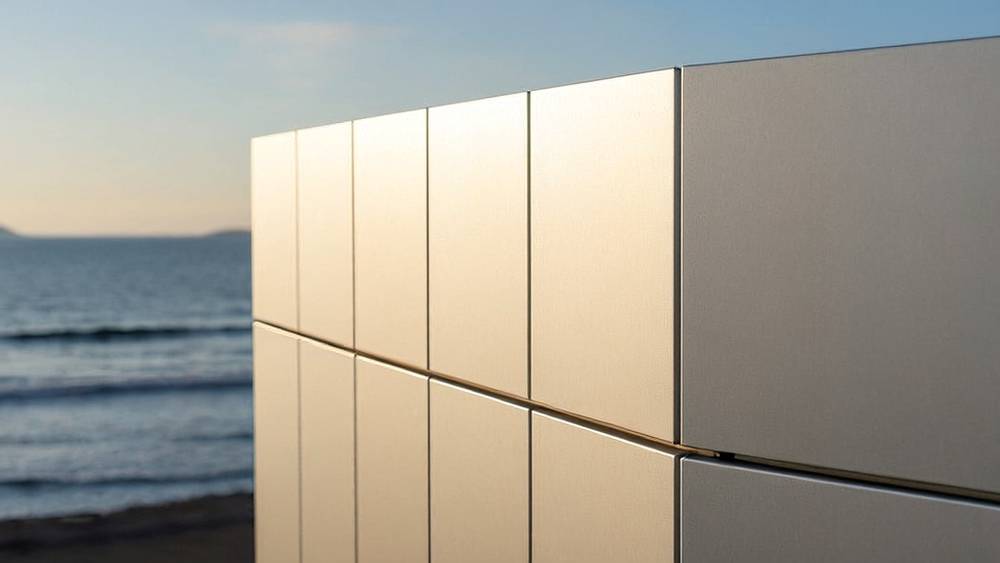
When a facade consultant specifies 3mm 5052 marine-grade solid aluminium panel for a coastal hospital in Queensland, the conversation shifts from generic cladding to a very specific material decision: aluminium alloy grade 5052 H32 versus the more common 3003 H14. This distinction matters because it determines whether the panels will resist pitting corrosion from salt-laden winds over a 30-year service life, or begin showing surface degradation within the first decade. The solid aluminium panel market has quietly split along an alloy-grade divide that many project specifications overlook until a failure occurs. Understanding what separates 5052 from 3003, and where each belongs on a building, is the difference between a facade that performs and one that becomes a maintenance liability.
Why Alloy Grade Determines Everything in Solid Aluminium Panel Selection
A solid aluminium panel is not a commodity product where one sheet equals another. The alloy designation stamped into every mill-finish sheet defines its magnesium content, work-hardening temper, yield strength, and ultimately its resistance to the specific environmental stressors a building will face. The two grades that dominate architectural cladding are 3003 H14 and 5052 H32. Both are classified under ASTM B209 for aluminium and aluminium-alloy sheet, but their mechanical properties and corrosion resistance profiles diverge sharply enough that mixing them on the same project can create differential weathering patterns visible within five years.
The 3003 alloy contains approximately 1.2% manganese as its primary alloying element, giving it roughly 20% higher strength than commercially pure 1100 aluminium while retaining excellent formability. Mills produce it in H14 temper, meaning strain-hardened to half-hard condition, yielding a tensile strength around 150-170 MPa. For inland commercial buildings, shopping centres, and interior applications, 3003 H14 solid aluminium panels perform adequately. The material bends cleanly into cassette profiles, accepts PVDF coil coatings uniformly, and costs 12-18% less than 5052.
However, 5052 H32 tells a different story. With 2.5% magnesium and 0.25% chromium, this alloy achieves tensile strengths of 215-260 MPa while maintaining elongation above 12%. The magnesium content directly improves resistance to chloride-induced pitting, the primary failure mode for aluminium in marine and industrial atmospheres. For a solid aluminium panel specified on a building within 5 kilometres of breaking surf, or on any structure where de-icing salts or chemical plant emissions contact the facade, the choice is not optional: building codes in Australia, Singapore, and the Gulf Cooperation Council states increasingly mandate 5052 or equivalent marine-grade alloys for external cladding in these exposure categories.
The 5052 H32 vs 3003 H14 Technical Breakdown
Engineers evaluating solid aluminium panel submittals should look beyond the panel thickness and coating specification to the substrate metallurgy. The differences between 3003 H14 and 5052 H32 are not marginal. Yield strength, the stress at which the material permanently deforms, sits at approximately 125 MPa for 3003 H14 versus 160 MPa for 5052 H32. This 28% increase means a 5052 panel can span wider between fixing points at the same gauge, or maintain the same span at a thinner, lighter gauge, without oil-canning under wind suction.
Corrosion resistance is where the divergence becomes critical. In ASTM B117 neutral salt spray testing, 5052 specimens consistently outperform 3003 by a factor of 2-3 in hours-to-first-pitting. This laboratory result translates directly to building performance: a 3003 H14 solid aluminium panel installed on a beachfront apartment in the Gold Coast might show filiform corrosion initiating at cut edges and fastener penetrations within 8-12 years. The equivalent 5052 panel, properly fabricated and installed, should reach 25 years before comparable degradation appears. The cost of replacing even 10% of panels mid-life dwarfs the initial material premium for 5052.
Weldability also differs. Both alloys are considered weldable, but 5052's magnesium content requires careful filler metal selection (5356 or 5554 filler rods for TIG welding) to avoid hot cracking. For projects where solid aluminium panels are fabricated into complex 3D geometries with welded corners, the fabricator's familiarity with 5052 welding procedures becomes a qualification criterion. Some manufacturers, including Futeng®, maintain dedicated fabrication lines for 5052 alloy panels specifically to control these variables.
| Property | 3003 H14 | 5052 H32 | Relevance to Facade Engineering |
|---|---|---|---|
| Tensile Strength (MPa) | 150-170 | 215-260 | Determines span capacity and wind load resistance |
| Yield Strength (MPa) | ~125 | ~160 | Resistance to permanent deformation under suction |
| Elongation (%) | 8-12 | 12-18 | Formability for cassette folding and complex profiles |
| Magnesium Content (%) | ≤0.05 | 2.2-2.8 | Primary driver of marine corrosion resistance |
| Salt Spray Resistance (ASTM B117) | 500-800 hrs to first pitting | 1,500-2,000 hrs to first pitting | Direct predictor of coastal service life |
| Relative Material Cost | Base (1.0x) | 1.12-1.18x | Premium justified by longevity in harsh environments |
| Density (g/cm³) | 2.73 | 2.68 | Slightly lighter panels at same gauge |
| Typical Thickness Range (mm) | 1.5-3.0 | 2.0-4.0 | Thicker gauges common for 5052 in exposed locations |
Reading Mill Certificates: What Submittals Should Prove
Every batch of solid aluminium panel material arrives with a mill test certificate (MTC) that should reference EN 10204 Type 3.1 or equivalent. The MTC is not a formality. It contains the actual measured chemical composition and mechanical properties for that specific heat or lot number, and discrepancies between the MTC values and the alloy designation on the panel packaging are a red flag for material substitution.
Key checks on a 5052 H32 MTC include magnesium content between 2.2% and 2.8%, chromium between 0.15% and 0.35%, tensile strength above 215 MPa, and yield strength above 160 MPa. For 3003 H14, verify manganese between 1.0% and 1.5%, tensile above 140 MPa, and yield above 115 MPa. The temper designation H14 or H32 is equally important: H14 indicates strain-hardened only (for 3003), while H32 indicates strain-hardened and then stabilised by low-temperature heat treatment (for 5052), which relieves residual stresses and improves formability.
In regions where project specifications follow the International Building Code or Eurocode 9 for aluminium structures, the design values for these alloys come from published standards. For aluminium structural design to Eurocode 9 (EN 1999-1-1), the characteristic 0.2% proof stress for 5052 H32 is 160 MPa, with a partial safety factor γM of 1.1, giving a design strength of 145 MPa. For 3003 H14, the characteristic proof stress is 115 MPa, design strength 105 MPa. A facade engineer selecting a solid aluminium panel for a 3.5-metre span under 2.5 kPa wind pressure will find that 3003 H14 at 3mm thickness may be at its limit, while 5052 H32 at the same gauge provides a comfortable margin.
Coastal Exposure Categories and Alloy Selection Rules
The Australian Standard AS 4312:2019 classifies atmospheric corrosivity into categories C1 through CX. For buildings located in C4 (severe marine) or C5 (very severe marine/industrial) zones, the standard effectively rules out 3003 alloy for unpainted or edge-exposed applications. A solid aluminium panel with PVDF coating provides a barrier layer, but the reality of facade construction means that fasteners penetrate that coating, cut edges expose bare metal at panel returns, and fabrication stresses can create micro-cracks in the coating at fold lines. In these zones, the substrate alloy's inherent corrosion resistance becomes the last line of defence.
The Middle East presents a different but equally demanding environment. Sand abrasion combined with saline groundwater used in construction washing can create a corrosive slurry on facade surfaces. Projects in Dubai Marina and Abu Dhabi's Al Reem Island have increasingly specified 5052 H32 solid aluminium panel for external cladding, with some consultants now requiring 5754 alloy (a 3% magnesium variant) for the most exposed elevations. These decisions are data-driven: a 2018 forensic study of a 12-year-old residential tower in Jumeirah Beach Residence found that 3003 panels on the sea-facing elevation had an average of 4.3 pits per square metre exceeding 1mm depth, while the 5052 panels on the same building's side elevations showed fewer than 0.5 pits per square metre.
Fabrication Variables That Affect Alloy Performance
Even the correct alloy choice can be undermined by fabrication practices. A 5052 H32 solid aluminium panel that is over-bent at too small a radius will develop stress concentrations that accelerate corrosion in marine environments. The recommended minimum bend radius for 5052 H32 is 2t (twice the material thickness) for bends perpendicular to the rolling direction, and 2.5t for bends parallel to it. Some fabricators push these limits to achieve sharper corner aesthetics, and the result is micro-cracking that may not be visible under shop lighting but becomes initiation points for filiform corrosion once the building is exposed to salt spray.
Routed and return-folded cassette panels, the most common solid aluminium panel format for ventilated rainscreen facades, introduce another variable: the groove depth for folding. If the routing operation removes too much material at the fold line, the remaining metal thickness at the corner may be less than 1mm, creating a weak point regardless of alloy grade. For 5052 panels, which are often specified thinner than 3003 due to their higher strength, controlling the residual metal thickness at routed grooves becomes even more critical. Quality-conscious manufacturers, including Futeng®, specify a minimum residual thickness of 1.2mm at all routed fold lines for panels installed in C4 or higher corrosivity zones.
Cost Realities: Why the Alloy Premium Pays Back
Procurement managers evaluating solid aluminium panel tenders face a straightforward arithmetic problem with a hidden variable. The 12-18% material cost premium for 5052 over 3003 translates to roughly 6-9% on the total installed panel cost, once fabrication, coating, and installation labour are factored in. On a project with $500,000 in cladding scope, the alloy upgrade adds $30,000-$45,000 to the initial budget. The hidden variable is the building's exposure classification and the client's holding period.
For an owner-occupied institutional building with a 50-year design life, the case for 5052 is unambiguous. The net present value of avoiding even one mid-life panel replacement cycle, with its associated access costs (scaffolding or swing stages), material, labour, and operational disruption, exceeds the initial premium by a factor of three to five. For a speculative developer holding a building for five years, the calculus is less obvious, which is why some coastal apartment buildings are clad in 3003 panels that become the next owner's problem.
Specifiers can strengthen the case by referencing whole-life cost models. The ISO 15686-5:2017 standard for life-cycle costing provides a methodology that facade consultants can use to demonstrate the payback period for material upgrades. When applied to a solid aluminium panel specification on a C4-exposed building, a 5052 H32 option typically shows a lower 30-year net present cost than 3003 H14, even at higher initial capital expenditure.
Geographic Sourcing and Alloy Availability
The global supply chain for 5052 H32 aluminium sheet suitable for architectural cladding concentrates in a limited number of mills. China's Chalco and Southwest Aluminium, Korea's Novelis Asia, and Europe's Constellium and Elval produce 5052 coil in widths up to 2,000mm specifically for the facade market. Lead times for 5052 are typically 2-4 weeks longer than for 3003, and minimum order quantities can be higher, particularly for non-standard thicknesses like 2.5mm or 3.5mm.
For projects in Southeast Asia and the Middle East, where much of the world's solid aluminium panel fabrication occurs, proximity to Chinese and Korean mills can offset the lead time difference. However, specifiers should verify that the 5052 material meets the specific temper requirements: some mills produce 5052 in H34 or H36 tempers (harder conditions) for industrial applications, and these are not suitable for architectural folding without cracking. The H32 designation on the MTC is non-negotiable for cladding applications.
Testing Protocol for Alloy Verification on Site
Material substitution in the facade supply chain is not rare. A fabricator under margin pressure may substitute 3003 H14 for specified 5052 H32, relying on the fact that both are silver-coloured aluminium and the PVDF coating hides the substrate. The only reliable field verification methods are portable X-ray fluorescence (XRF) analysis, which measures magnesium content non-destructively, or laboratory optical emission spectroscopy on a coupon sample.
Portable XRF units, available from equipment rental firms globally, can quantify magnesium in aluminium alloys with reasonable accuracy when calibrated against known 5052 standards. A reading below 2.0% magnesium on a panel claimed to be 5052 is grounds for rejection. For projects where the consequences of alloy substitution are severe, such as high-rise facades in marine environments, specifying that the contractor provide XRF verification reports for each batch of panels before installation is a prudent quality assurance measure.
The AAMA 2605 standard for high-performance organic coatings references substrate preparation requirements, but does not itself govern alloy selection. That responsibility falls to the project specification writer, who must understand that coating standards and substrate standards address different failure modes. A PVDF coating meeting AAMA 2605 will protect the surface from UV degradation for 20+ years, but it will not prevent pitting corrosion at cut edges if the substrate alloy lacks sufficient magnesium to resist chloride attack.
When 3003 H14 Is the Right Choice
Not every project needs 5052. For interior wall cladding, lift lobbies, column covers, and suspended ceiling panels where environmental exposure is negligible, 3003 H14 solid aluminium panel provides adequate strength and formability at lower cost. The alloy's slightly higher density (2.73 vs 2.68 g/cm³) is irrelevant for interior applications where weight is not a wind-load consideration. Its lower cost and wider availability make it the default choice for projects where corrosion resistance is not a design factor.
For ventilated facades on buildings more than 5 kilometres inland, in climates without industrial pollutants, 3003 H14 with a properly specified PVDF or FEVE coating should perform satisfactorily over a 30-year design life. The key is honesty in exposure classification. A building 10 kilometres from the coast in a city with moderate rainfall and no heavy industry is not a marine environment, and specifying 5052 there adds cost without adding value. The skill of the facade engineer lies in knowing where the boundary sits.
The ISO 9223:2012 standard for corrosivity classification of atmospheres provides time-of-wetness and pollution-based categories that help define these boundaries objectively. Coupled with local meteorological data on prevailing wind direction and salt deposition rates, a specifier can make an evidence-based alloy selection rather than relying on rules of thumb.
Thickness Selection Interacts With Alloy Choice
Panel thickness and alloy grade are not independent variables. A common specification error is to select 5052 H32 for its corrosion resistance, then also specify 3mm thickness "to be safe," when 2.5mm 5052 H32 would have provided equivalent or better structural performance than 3mm 3003 H14. The higher yield strength of 5052 means that for a given span and wind load, the required thickness is proportionally lower.
Using the deflection limit of L/60 (span/60) commonly applied to rainscreen panels, a 1,200mm wide solid aluminium panel spanning 800mm between fixing rails under 2.0 kPa wind pressure (serviceability limit state) requires approximately 2.5mm thickness in 5052 H32 or 3.0mm in 3003 H14. The 5052 panel saves roughly 0.7 kg/m² in weight, which cascades into slightly lighter substructure, easier handling, and marginally lower shipping costs. For a 20,000 m² facade, the weight saving approaches 14 tonnes.
Practical Specification Language
A specification clause that adequately addresses alloy selection for a solid aluminium panel in a marine environment should read something like: "Panel substrate shall be aluminium alloy 5052 H32 per ASTM B209, with magnesium content 2.2-2.8% verified by mill certificate to EN 10204 Type 3.1. Substitute alloys are not permitted without engineer-of-record approval. Contractor shall provide XRF verification of alloy composition for 5% of panels per batch, randomly selected, prior to installation."
This language, or its equivalent adapted to local standards, closes the most common loophole in facade material specifications. It also signals to the supply chain that the specifier understands the metallurgical basis for the requirement, which tends to discourage substitution attempts before they begin.
The Aluminum Association publishes alloy designation tables and typical mechanical properties that should be referenced in any specification, alongside the relevant national standards for aluminium building products. For European projects, EN 485-2 covers mechanical properties of aluminium sheet, and EN 573-3 covers chemical composition, both of which align with the ASTM B209 values discussed here.
Final Engineering Judgment
The alloy grade of a solid aluminium panel is not a detail to be delegated to the fabricator or left to "or equal" substitution clauses. It is a primary design decision that determines whether the facade will meet its service life objectives in the specific environment where it is built. For marine, coastal, industrial, and high-pollution sites, 5052 H32 is the technically correct choice, and the cost premium over 3003 H14 is recoverable through reduced maintenance and extended replacement intervals. For benign inland environments, 3003 H14 remains an appropriate and economical option.
The decision should be documented with reference to the applicable corrosivity classification standard, supported by mill certificates and site verification where substitution risk exists, and integrated with the coating specification rather than treated as a separate procurement item. A facade is a system, and the substrate alloy is its foundation.