Why 29 Gauge Steel Cladding Costs More Than Solid Aluminium Over 25 Years
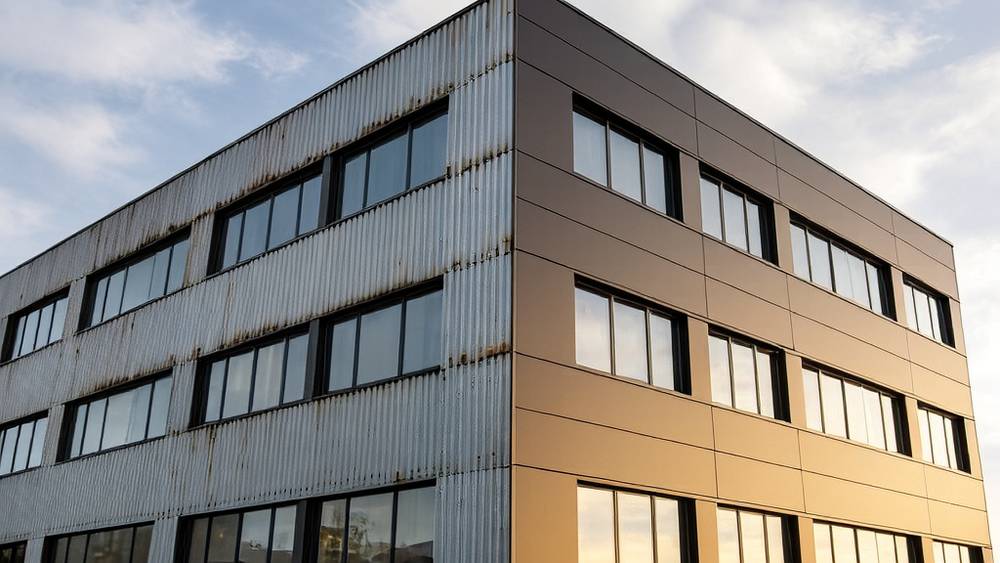
Steel siding looks tough on a warehouse. Brushed aluminium reads premium on a corporate headquarters. Powder-coated panels deliver vivid colour on a retail facade. But when a project team sits down to select outdoor metal cladding, the conversation almost always circles back to one question: what is this going to cost over the next 20 years, not just the next 12 months? The purchase price per square meter tells a fraction of the story. Scaffolding crews, replacement panel lead times, coating recoating cycles, and the downtime of occupied commercial space all feed into a number that procurement managers and facade engineers chase relentlessly: the 25-year total cost of ownership.
This article builds a cost model comparing three dominant outdoor metal cladding materials, solid aluminium panels, 29-gauge galvanized corrugated steel, and powder-coated aluminium sheet, across a standardized 1,500 m² commercial facade. The analysis pulls from current material pricing benchmarks, published coating durability data under ASTM B117 and AAMA 2605 protocols, and real-world maintenance cycle assumptions drawn from projects in humid subtropical and temperate marine climates. The goal is not to declare a universal winner. The goal is to give quantity surveyors, facade contractors, and building owners a set of numbers they can actually use when the value engineering meeting begins.
What the Square-Meter Price Actually Buys
Material cost dominates the early conversation because it is the easiest number to obtain. Three supplier quotes, a quick spreadsheet, and the procurement team has a ranking. For outdoor metal cladding on a mid-rise commercial building, the per-square-meter spread looks something like this in mid-2026 pricing:
29-gauge galvanized corrugated steel panels sit at roughly $8–15/m² for the sheet stock alone, depending on coating (galvanized G90 vs. Galvalume AZ50) and regional freight. The panel profile is simple, the manufacturing process is high-speed roll-forming, and the substrate is commodity steel. These numbers make steel the default choice for agricultural sheds, workshops, and budget-driven industrial envelopes where aesthetics rank below weather exclusion.
Solid aluminium panels, 2.5 mm or 3.0 mm thick with a fluoropolymer (PVDF) coating system, land in the $55–110/m² range for material only. The spread reflects alloy specification (3003-H14 vs. 5052-H32), custom perforation or forming complexity, and coating chemistry. A three-coat PVDF system meeting AAMA 2605 requirements costs more than a two-coat system meeting AAMA 2604, and that cost compounds when panels require brake-press forming for shadow-box reveals or integrated stiffener ribs.
Powder-coated aluminium sheet, typically 1.5–2.0 mm thick, occupies the middle ground at $25–50/m². The polyester powder coating is less expensive than liquid PVDF and cures rapidly on a conveyorized line. For projects with moderate performance demands, inland locations, low UV exposure, and budget sensitivity, this option reads as a sensible compromise on the bid tab.
Those are the numbers that go into the tender spreadsheet. They are also misleading, because the material line item represents roughly 30–40% of installed cost. The rest is substructure, thermal isolation, fasteners, labour, and access equipment. And none of those line items capture what happens in year 8, year 15, or year 22.
Coating Durability as a Cost Driver
Every coating system has a predictable degradation curve. The question is when, not whether, the curve forces a financial decision. Accelerated weathering data from ASTM G154 (QUV) and real-time Florida exposure testing provide enough correlation to build maintenance schedules for each material category.
PVDF coatings on solid aluminium panels carry the longest documented service life among architectural metal coatings. The Kynar 500® or Hylar 5000® resin systems, applied as a three-coat system (primer, colour coat, clear coat) meeting AAMA 2605, routinely deliver 20–25 years before the first colour shift exceeds 5 Delta E units. Independent testing published by the Arkema weathering program shows panels in south Florida retaining film integrity and chalk ratings below ASTM D4214 Method A rating 8 after two decades of exposure. For the cost model, this translates to zero recoating within a 25-year analysis window under most climate conditions.
Polyester powder coatings on aluminium sheet follow a steeper curve. Standard architectural polyester powders, based on TGIC or HAA chemistry and applied to meet AAMA 2604, typically show noticeable gloss reduction (below 50% retention) and colour drift (above 3 Delta E) after 10–15 years of south-facing exposure. Super-durable polyester powders extend that window to 15–20 years. The cost model therefore includes one recoating cycle at year 15 for standard powder-coated panels and an optional cycle at year 20 for super-durable systems, depending on the owner's tolerance for visual drift.
Galvanized steel's coating story is different. The zinc layer on G90 galvanized steel corrodes sacrificially, and its consumption rate is well-characterized in ISO 9223 atmospheric corrosivity classifications. In a C3 (medium) environment, typical of urban and light industrial areas, zinc corrosion rates run 0.7–2.1 µm/year. A G90 coating with roughly 20 µm of zinc per side has a theoretical life of 10–28 years before red rust appears, depending on exposure severity and whether the panel is sheltered or washed by rain. In C4 (high) environments, coastal or heavy industrial, that window shrinks to 5–12 years. Paint-over-galvanized systems (SMP or PVDF coil coatings) extend the timeline, but once the coating is breached at cut edges, fastener penetrations, or scratch damage, the underlying zinc becomes the only barrier. The cost model assumes one full replacement cycle within 25 years for steel panels in C3 environments and two cycles in C4 environments.
The 25-Year Cost Model: Assumptions and Methodology
The model normalizes around a 1,500 m² facade area on a 4-storey commercial building in a C3 (medium) atmospheric corrosivity environment, representative of inland urban locations across North America, central Europe, and eastern China. All costs are expressed in 2026 USD equivalents, with a 3% annual escalation factor applied to labour and access costs. Material costs are held constant at current benchmark pricing; the model does not speculate on commodity price trajectories.
Three scenarios run in parallel:
Scenario A: 3.0 mm solid aluminium panels, 3003-H14 alloy, three-coat PVDF (AAMA 2605), installed on a thermally broken aluminium rail system. Material cost: $85/m². Installed cost (including substructure, labour, access): $195/m².
Scenario B: 2.0 mm powder-coated aluminium sheet, super-durable polyester powder (AAMA 2604), installed on the same rail system. Material cost: $38/m². Installed cost: $135/m².
Scenario C: 29-gauge (0.34 mm base steel) Galvalume AZ50 corrugated steel, SMP coil-coated, installed on horizontal steel girts. Material cost: $12/m². Installed cost: $65/m².
Maintenance cost assumptions: scaffolding or swing-stage access at $18/m² of facade area (2026 base, escalated annually). Panel replacement labour at $45/m². Recoating (powder-coated panels only) at $35/m² including surface preparation. Full steel panel replacement at $65/m² installed (matching initial install cost). All maintenance events include a 10% contingency for mobilization and weather delays.
| Cost Category | Scenario A: PVDF Solid Aluminium | Scenario B: Powder-Coated Aluminium | Scenario C: Galvalume Steel |
|---|---|---|---|
| Initial installed cost (1,500 m²) | $292,500 | $202,500 | $97,500 |
| Year 15: Recoating cycle | N/A (no recoating required) | $52,500 (recoat) + $30,375 (access, escalated) = $82,875 | N/A (steel replacement at year 18) |
| Year 18: Steel panel replacement | N/A | N/A | $97,500 (material + labour, escalated) + $35,640 (access) = $133,140 |
| Year 20: PVDF inspection only | $3,500 (visual inspection, no repairs) | N/A | N/A |
| Year 22: Minor fastener/sealant refresh | $12,500 (sealant + access) | $12,500 (sealant + access) | $12,500 (sealant + access) |
| 25-Year Total Cost | $308,500 | $297,875 | $243,140 |
| 25-Year cost per m² (annualized) | $8.23/m²/year | $7.94/m²/year | $6.48/m²/year |
At first glance, the steel option wins on pure dollar outlay over 25 years. The initial cost advantage is so large ($195,000 less than PVDF aluminium) that even a full panel replacement at year 18 does not close the gap. But the numbers in this table omit three cost categories that routinely flip the analysis in real projects: energy performance, structural weight penalties, and downtime disruption.
Energy and Structural Penalties That the Spreadsheet Misses
Steel cladding weighs roughly 4.5–5.5 kg/m² for 29-gauge corrugated profiles. Solid aluminium panels at 3.0 mm weigh approximately 8.1 kg/m². The aluminium is heavier, and this would normally increase substructure cost. But the comparison is not that simple.
Steel cladding on horizontal girts creates a direct thermal bridge through the building envelope at every girt attachment point. Unless the design includes a thermally broken clip system, which adds $12–18/m² to the steel scenario's installed cost, the steel facade functions as a radiator fin. ASHRAE 90.1 compliance in climate zones 4 and above typically demands continuous insulation behind steel cladding, and the girt penetrations through that insulation layer reduce the effective R-value of the wall assembly by 15–25%, depending on girt spacing and clip design.
Aluminium cladding on a thermally broken rail system, by contrast, allows continuous insulation to run uninterrupted behind the panel plane. The rail-to-substrate connections are thermally isolated, and the point thermal transmittance (Chi-value) at each bracket is low enough that whole-wall U-value calculations show minimal degradation. For a building owner paying commercial energy rates, the difference in HVAC load attributable to the cladding attachment system can run $0.40–0.80/m²/year. Over 25 years on a 1,500 m² facade, that is $15,000–30,000 in additional energy cost that the base model does not capture.
Structural weight also matters when the facade is a retrofit. Solid aluminium panels at 8.1 kg/m² add roughly 12.2 tonnes to the building structure for a 1,500 m² facade. Steel at 5.0 kg/m² adds 7.5 tonnes. The 4.7-tonne difference is significant if the existing structure has limited residual capacity. But if the steel scenario requires a secondary steel girt system weighing 6–8 kg/m² to span between primary structure, the total system weight can actually exceed the aluminium-on-aluminium-rail system. The structural engineer needs to run both cases, not just compare panel weights.
When Downtime Becomes the Dominant Cost
The cost model above assumes maintenance can happen on a swing stage outside operating hours. That assumption holds for many building types. It does not hold for hospitals, data centres, pharmaceutical manufacturing facilities, or 24-hour logistics hubs. In those buildings, any exterior work that requires sealing windows, shutting down air intakes, or restricting access to loading docks generates operational losses that dwarf the cladding maintenance budget.
Consider a data centre with a 1,500 m² metal-clad exterior. Replacing steel panels at year 18 means 6–8 weeks of exterior work. The facility's air intake louvers are integrated into the cladding plane; they must be temporarily sealed during panel removal to prevent dust ingress into the server halls. The cost of sealing, filtration monitoring, and the risk premium assigned by the facility insurer can push the effective cost of that steel replacement cycle to 3–5 times the direct construction cost shown in the model.
For these occupancies, the PVDF solid aluminium scenario's "do almost nothing for 25 years" maintenance profile has a financial value that goes far beyond the line items in a cost table. It is an operational continuity insurance policy. The facade team at Futeng® has supplied solid aluminium panel systems for pharmaceutical cleanroom buildings and data centre facades where the owner's specification explicitly required a 25-year zero-maintenance exterior, a requirement that eliminated powder-coated and steel options from consideration before the cost model was even built.
Climate Zone Multipliers
The base model uses a C3 (medium) corrosivity environment. Moving to C4 (high) or C5-M (very high marine) changes every number. ISO 9223 provides the framework; the practical implication is that zinc consumption rates double or triple, and polyester powder coatings chalk and fade on an accelerated schedule.
In a C5-M coastal environment (within 500 metres of breaking surf), the steel scenario shifts from one replacement at year 18 to two replacements at years 10 and 20. The 25-year total for steel jumps to approximately $395,000, exceeding the PVDF aluminium scenario by nearly $87,000. The powder-coated aluminium scenario also degrades: the recoating cycle moves forward from year 15 to year 10, and a second recoating at year 20 pushes the 25-year total to roughly $345,000.
PVDF solid aluminium in C5-M requires only the year-22 fastener and sealant refresh, plus a more rigorous wash-down schedule (twice annually vs. once annually) that adds roughly $2,500/year in water-fed pole access costs. The 25-year total moves to approximately $371,000, still below the steel scenario and comparable to the powder-coated aluminium scenario, but with none of the operational disruption.
The climate sensitivity table below summarizes how environmental severity shifts the total cost ranking:
| Climate Zone (ISO 9223) | PVDF Solid Aluminium (25-Year Total) | Powder-Coated Aluminium (25-Year Total) | Galvalume Steel (25-Year Total) |
|---|---|---|---|
| C2 – Low (rural, dry) | $305,000 | $290,000 | $225,000 |
| C3 – Medium (urban, inland) | $308,500 | $297,875 | $243,140 |
| C4 – High (coastal, industrial) | $315,000 | $330,000 | $345,000 |
| C5-M – Very High Marine | $371,000 | $345,000 | $395,000 |
The crossover point sits between C3 and C4. Inland projects with low corrosion risk can legitimately select based on initial capital cost and accept the maintenance burden. Coastal projects that select based on initial cost alone are making an expensive mistake that will materialize in the facility manager's budget roughly a decade after the construction team has moved on.
What the Model Does Not Capture
No cost model is complete, and this one has intentional boundaries. It does not include the cost of planning approvals or facade engineering fees, which are roughly equal across scenarios. It does not price aesthetic degradation: a powder-coated panel that has chalked to a rating of 6 on ASTM D4214 is still weathertight, but the building owner may decide it looks unacceptable and trigger an early recoating cycle that the model did not predict. That decision is subjective and project-specific.
The model also does not include end-of-life salvage value. Aluminium panels have a well-established recycling stream; at the end of a 50-year building life, the scrap value of solid aluminium (roughly 40–50% of the London Metal Exchange ingot price at the time of demolition) offsets a portion of the removal cost. Steel panels also have scrap value, but the thin gauge and potential zinc contamination reduce the per-tonne payout.
Finally, the model assumes competent installation in all three scenarios. Poorly installed PVDF aluminium panels with inadequate drainage and ventilation will trap moisture and corrode from the reverse side regardless of the coating specification on the face. The best material selection cannot compensate for detailing errors at window heads, base flashings, and parapet caps. The AAMA installation guidelines (AAMA TIR-A9) and the Metal Construction Association best practices for wall panel drainage provide the detailing framework that makes any of these cost scenarios achievable.
Decision Framework for the Value Engineering Meeting
When the value engineering spreadsheet opens and the project team is staring at a $195,000 gap between the aluminium and steel initial cost columns, the conversation needs structure. The following decision sequence, derived from the model above, keeps the discussion anchored to long-term outcomes rather than bid-day impulses:
Step 1: Determine the climate zone. If the project is within 5 km of a coastline or in an industrial zone with SO₂ emissions, eliminate steel or price it with a two-replacement-cycle assumption. The model shows that in C4 and above, the 25-year cost advantage of steel evaporates.
Step 2: Assess operational sensitivity. If the building operates 24/7 or houses processes that cannot tolerate exterior construction activity, eliminate any option requiring a mid-life panel replacement. The downtime cost will not appear in the facade budget line, but the building owner will pay it.
Step 3: Check the thermal bridge penalty. If the project is targeting LEED, BREEAM, or Passive House certification, run a whole-wall U-value calculation for the steel-on-girts assembly vs. the aluminium-on-thermal-clips assembly. The energy cost delta over 25 years narrows the initial cost gap by $15,000–30,000.
Step 4: Run the 25-year total cost. Use the base model in this article, adjust for local labour rates and access costs, and present the annualized cost per square meter. An $8.23/m²/year number for PVDF solid aluminium vs. $6.48/m²/year for steel frames the decision in operational terms that facility managers understand.
The answer is not always aluminium. For a 10-year design-life industrial shed in an inland location, steel is the rational choice. For a 50-year institutional building in a coastal city, solid aluminium with PVDF is not an upgrade, it is the baseline specification. The cost model simply makes that logic visible before the wrong material order gets placed.
Selecting outdoor metal cladding on installed cost per square meter alone is the single most expensive shortcut a project team can take. The 25-year view costs nothing to calculate and saves everything that matters.