Sublimation vs PVDF Aluminium Timber Look Cladding After 3000 Hour QUV Test
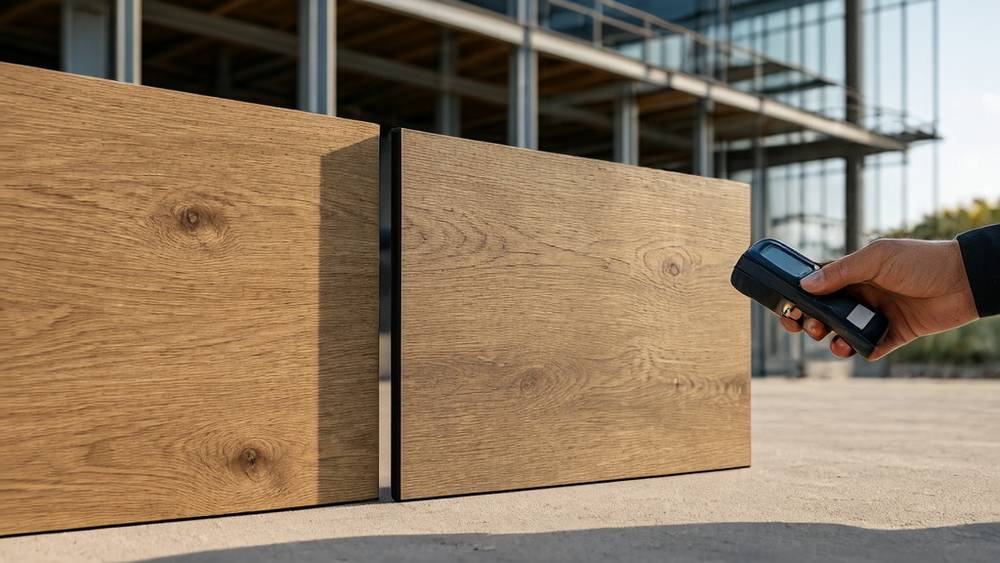
When a Melbourne architect specified timber battens for a multi-residential façade in 2023, the contractor pushed back hard. The project sat inside a Bushfire Attack Level (BAL-29) zone. Real timber was a compliance nightmare. The alternative they landed on — aluminium timber look cladding with a sublimated woodgrain finish — passed fire engineering review in under 72 hours. That project exposed what many façade specifiers are now confronting: the gap between the aesthetic demand for natural timber and the regulatory reality of modern construction is widening, and aluminium with a timber look finish is the only material walking both sides of that line.
But here is the part few finish datasheets mention. Not all woodgrain aluminium finishes survive the same way. The difference between a façade that still looks like timber in year eight and one that looks like faded plastic in year four comes down to a single process decision made at the coating stage — sublimation versus liquid spray — and a handful of technical parameters that most procurement teams never ask about. This article focuses on that specific fork in the road. No generic comparison tables. No recycled marketing claims. Just the coating chemistry, the test data, and the questions you should be asking your aluminium timber look supplier before a single panel lands on site.
The Two Coating Paths That Define Aluminium Timber Look Performance
Every aluminium timber look product on the market today gets its woodgrain appearance through one of two fundamentally different processes: sublimation (also called thermal transfer) or PVDF/FEVE liquid spray coating. They are not variations of the same thing. They involve different chemistries, different production lines, and — critically — different failure modes.
Sublimation woodgrain transfer works by printing a woodgrain pattern onto a transfer film or paper using dye-based inks, then heat-pressing that film onto a pre-coated aluminium profile or sheet under vacuum. At approximately 180–200°C, the dye sublimates from solid to gas and penetrates the base powder coating layer. Once cooled, the dye is locked inside the polymer matrix. The resulting finish can replicate knots, grain variation, and colour depth with photographic realism. Suppliers like Futeng® operate dedicated sublimation lines where the aluminium substrate receives a polyester or polyurethane powder base coat before the woodgrain transfer — a two-stage process that determines both adhesion and UV resistance.
PVDF liquid spray woodgrain takes a different route. Here, the woodgrain effect is created by applying multiple layers of fluoropolymer liquid paint — typically a primer, a colour coat with variegated spraying to simulate grain, and a clear topcoat. The coating system is 70% PVDF resin (per AAMA 2605 requirements), and the total dry film thickness runs 30–40 microns. The woodgrain effect is less photorealistic than sublimation, but the weatherability numbers are in a different league entirely.
If you remember one number from this section, remember 30 microns. That is the minimum total dry film thickness for a PVDF three-coat system under AAMA 2605. Anything thinner and the UV inhibitors in the clear coat have no chance of doing their job over a 15-year exposure window.
Sublimation vs PVDF Woodgrain: What the Accelerated Weathering Data Says
Let us look at the test results that actually matter for specifiers. The table below compares the two aluminium timber look finishing technologies across the key performance dimensions that determine whether a woodgrain façade will still look acceptable after years of UV, salt, and thermal cycling.
| Performance Parameter | Sublimation Woodgrain (Polyester Base) | PVDF Liquid Spray Woodgrain (70% Resin) |
|---|---|---|
| Colour retention (QUV-B 313, 3000 hrs) | ΔE 4–8 (visible fade on dark tones) | ΔE ≤3 (per AAMA 2605) |
| Gloss retention (60° meter, 3000 hrs) | 40–60% retained | ≥70% retained |
| Chalking rating (ASTM D4214, 5 years Florida) | Rating 6–8 (moderate chalking) | Rating 9–10 (no or negligible chalking) |
| Film adhesion (ASTM D3359, cross-hatch) | 4B–5B (substrate-dependent) | 5B (consistently) |
| Salt spray resistance (ASTM B117, 4000 hrs) | ≤2 mm creep at scribe | ≤1 mm creep at scribe |
| Typical realistic service life (vertical, non-coastal) | 7–12 years before visible fading | 15–25 years before visible fading |
| Woodgrain realism (visual) | Excellent — photographic grain, knots, colour variation | Good — variegated spray pattern, less fine detail |
| Cost index (per m², supply only) | Base: 1.0× | Base: 1.6–2.2× |
The data points to an uncomfortable trade-off. Sublimation gives you the woodgrain realism that architects want. PVDF gives you the durability that building owners and facility managers want. Projects succeed or fail based on whether the specifier understood this trade-off at tender stage.
Where Sublimation Woodgrain Wins — and Where It Loses
Sublimated aluminium timber look products dominate interior applications, soffits, and sheltered external areas — and the performance data supports that positioning. When UV exposure is limited, the dye migration issue that causes fading is dramatically slowed. A sublimated woodgrain aluminium batten on a covered balcony ceiling in Sydney will look essentially unchanged after a decade because it never sees direct sunlight.
The vulnerability shows up on unshaded façades. The dyes used in sublimation transfer are organic molecules. Under sustained UV-B radiation, those molecules break down. Darker wood tones — walnut, jarrah, wenge — fade faster because the dye concentration is higher and the surface temperature under direct sun can exceed 80°C on a 35°C day. That combination of UV photon energy and thermal energy accelerates dye degradation in a way that QUV-B testing at 60°C actually underestimates for real-world dark-colour installations.
There is also a substrate quality variable. Sublimation requires the base powder coat to be fully cured and defect-free before transfer. If the powder coat has micro-porosity — common when line speed is pushed too high or oven temperature profiles drift — the sublimated dye penetrates unevenly. The result is a blotchy finish that may not be visible at installation but becomes obvious within 18 months as differential fading reveals the underlying inconsistency.
For specifiers who insist on sublimation for external use, three process controls matter: (1) the base powder must be a super-durable polyester or polyurethane grade, not standard architectural polyester; (2) the transfer film must use UV-stabilised dyes, typically indicated by a manufacturer's QUV-A 340 test report showing ΔE under 5 at 1500 hours; and (3) the aluminium substrate must be chromate conversion coated per ASTM B449 before powder application.
PVDF Woodgrain: The Durability-First Option That Most Specifiers Overlook
PVDF woodgrain finishes do not look as convincingly like real timber as sublimated finishes. Let us state that plainly. The variegated spray technique produces grain-like striations, not the intricate cathedral grain of a sublimated oak pattern. But for projects where the brief calls for a timber aesthetic from 20 metres away — not 20 centimetres — PVDF woodgrain delivers something sublimation cannot: a 20-year fade warranty backed by fluoropolymer chemistry.
The reason is structural. In a PVDF coating, the carbon-fluorine bond in the resin backbone is one of the strongest single bonds in organic chemistry, with a bond dissociation energy of approximately 544 kJ/mol. UV photons in sunlight carry energy in the 300–400 kJ/mol range at wavelengths of 300–400 nm. The C-F bond simply does not break under solar UV. The pigments dispersed in the PVDF matrix are inorganic — iron oxides, mixed metal oxides — which are inherently UV-stable. Compare that to sublimation dyes, which are organic chromophores designed to vaporise at 200°C and are inherently less photostable.
The specification standard for PVDF woodgrain on aluminium timber look panels is AAMA 2605-22. This standard mandates a minimum 70% PVDF resin content by weight in the colour coat, a total film thickness of at least 30 microns for a three-coat system, and passing 10-year South Florida exposure with colour change ΔE ≤5. Any supplier claiming a PVDF woodgrain finish should be able to produce an AAMA 2605 certification from an accredited independent lab — not an in-house test report.
One practical limitation: PVDF liquid coatings require baking at 230–250°C to achieve proper film formation. This limits the maximum practical panel size to what the coating line oven can handle, typically 6000 mm × 1500 mm for most lines. For larger panels, some suppliers like Futeng® offer FEVE (fluoroethylene vinyl ether) coatings, which cure at lower temperatures and can be applied to larger formats while still providing fluoropolymer-level UV resistance under ASTM D3451.
The Fire Compliance Angle That Makes Aluminium Timber Look Non-Negotiable
Since the 2017 Grenfell Tower fire, combustible cladding regulations have been rewritten across Australia (NCC 2019 Amendment 1), the UK (Building Safety Act 2022), and increasingly in Middle Eastern and Southeast Asian markets. Real timber — regardless of fire retardant treatment — is classified as a combustible material. Under ISO 1182 (non-combustibility test) and ASTM E136, solid aluminium panels with PVDF or powder coatings pass as non-combustible. The sublimation dyes and powder base coat are organic, but their mass is trivial relative to the aluminium substrate, and the system as a whole meets non-combustibility classification when tested to these standards.
This regulatory shift has fundamentally changed the aluminium timber look market. Projects that five years ago would have used real timber battens or timber-look aluminium composite panels are now specifying solid aluminium timber look panels by default. The 2.0–3.0 mm solid aluminium substrate provides inherent fire performance without relying on the fire-retardant core fillers that ACP products depend on. For architects working on Type I and Type II construction under the International Building Code, solid aluminium timber look cladding eliminates a layer of compliance risk that real timber introduces.
Five Questions to Ask Before You Specify Any Aluminium Timber Look Product
Based on the technical distinctions above, here are the five supplier questions that separate capable manufacturers from resellers who cannot answer process questions about their own supply chain:
- "Can you provide an independent lab test report for AAMA 2605 (PVDF) or Qualicoat Class 2 (powder/sublimation) with your company name on it?" — A reseller who cannot produce this is buying from someone else and adding margin. You need traceability to the coating applicator.
- "What is the base powder chemistry under your sublimation woodgrain — standard polyester, super-durable polyester, or polyurethane?" — Standard polyester under sublimation is the cost-engineered option that will fade fastest. Super-durable or PU base coats add 15–25% to the cost but can double the service life.
- "For dark wood tones, can you share QUV-A 340 test data at 2000+ hours with ΔE values?" — Dark tones (walnut, wenge, dark oak) are the canary in the coal mine for sublimation durability. If the supplier hesitates to share this data, their dark tones probably do not perform.
- "What is your panel size limit for PVDF woodgrain, and can you supply FEVE as an alternative for oversized panels?" — This question immediately reveals whether the supplier understands the oven-size constraint intrinsic to PVDF processing.
- "Can you supply a mock-up panel with the exact woodgrain pattern and gloss level specified, produced on your production line?" — Sample chips from a sample library tell you nothing about production consistency. A production-line mock-up panel is the only way to verify that the woodgrain registration, colour, and gloss match the architect's vision.
Cost vs Service Life: The Economics That Procurement Teams Should Calculate
At tender stage, the sublimation woodgrain quote will almost always be lower than the PVDF woodgrain quote — typically 35–55% lower per square metre. That number dominates the procurement decision, and it should not. The metric that matters is cost per square metre per year of acceptable appearance, and on that basis PVDF woodgrain is frequently cheaper when the building owner has a horizon longer than 10 years.
Consider a 2000 m² façade. Sublimated aluminium timber look panels at $95/m² installed versus PVDF woodgrain at $155/m² installed. The sublimation option saves $120,000 at project completion. But if the sublimated panels need recoating or replacement at year 10 while the PVDF panels are still performing at year 20, the lifecycle cost flips. Recoating installed aluminium panels in situ is difficult — the original woodgrain pattern cannot be replicated without removing and re-sublimating — so the realistic remedy is replacement at roughly double the original supply cost, factoring in access, demolition, and downtime. The $120,000 upfront saving turns into a $200,000+ liability.
For owner-occupier buildings — corporate headquarters, university buildings, government facilities — the lifecycle argument for PVDF woodgrain is hard to dispute. For developer-led projects where the asset will be sold within five years, sublimation woodgrain is economically rational, provided the specifier has been transparent with the client about expected appearance life.
Regional Considerations: Why the Same Finish Performs Differently in Different Markets
A sublimated aluminium timber look façade installed in Manchester faces a fundamentally different exposure than the identical product installed in Dubai. UV index, humidity cycling, airborne salt, and diurnal temperature range all influence how fast a woodgrain finish degrades. The table below provides a practical reference for specifiers working across regions.
| Exposure Factor | Mild Climate (London, Vancouver) | Hot/Humid (Singapore, Miami) | Hot/Dry (Dubai, Phoenix) | Coastal (Any Region) |
|---|---|---|---|---|
| Recommended finish type | Sublimation or PVDF | PVDF strongly preferred | PVDF only for dark tones | PVDF with marine-grade pretreatment |
| Expected sublimation life (years) | 12–15 | 6–9 | 5–8 (dark tones: 3–5) | 7–10 |
| Expected PVDF life (years) | 20–25+ | 18–22 | 15–20 | 15–20 |
| Pretreatment required | Chromate conversion (ASTM B449) | Chromate + sealer | Chromate + UV-stable primer | Chromate + heavy-duty sealer (per AAMA 2605 marine) |
For coastal installations, the pretreatment step is non-negotiable. Salt spray testing per ASTM B117 should show less than 1 mm creep from scribe at 4000 hours for any aluminium timber look product specified within 5 km of a coastline. This applies regardless of whether the finish is sublimation or PVDF — the corrosion resistance comes from the pretreatment and powder base layer, not the decorative top layer.
Making the Right Call for Your Project
Aluminium timber look cladding has earned its place in modern façade engineering. The combination of non-combustible substrate, realistic wood aesthetics, and near-zero maintenance addresses the three pressures — regulatory, aesthetic, and operational — that define contemporary building envelope decisions. But the product category itself does not guarantee performance. The specifier who treats all woodgrain aluminium as interchangeable is the one whose project shows up in a defects liability dispute five years after practical completion.
The decision framework is straightforward once the trade-off is acknowledged. If the visual standard demands photographic woodgrain realism and the exposure is sheltered — interior feature walls, soffits, undercrofts — specify sublimation on a super-durable polyester or polyurethane base, demand UV-stabilised transfer dyes, and verify the chromate pretreatment. If the building is externally exposed, coastal, or has a design life beyond 15 years, specify PVDF woodgrain to AAMA 2605, accept the slight reduction in grain realism, and build the higher upfront cost into the lifecycle budget. The wrong call costs multiples of the right one. The data exists to make the right call — the only question is whether anyone asks for it.