AA1100 Alloy for แผ่น ผนัง อ ลู มิ เนียม Exterior Facades Risk or Acceptable Specification
When specifying แผ่น ผนัง อ ลู มิ เนียม for exterior cladding projects across Southeast Asia, one material grade appears in Thai supplier catalogues with remarkable frequency: AA1100. Walk through any building materials hub in Bangkok and you will find stacks of 1100-series aluminium sheets offered at competitive prices for wall panel fabrication. The alloy is ubiquitous, cheap, and readily formable. But here is the question that separates a durable facade from a maintenance liability: should you actually use AA1100 aluminium for exterior wall panels, or does its widespread availability mask performance limitations that will surface within the first five years of exposure? This article examines the mechanical properties, corrosion behaviour, and real-world fabrication constraints of AA1100 when pressed into service as solid aluminium cladding. The analysis draws on ASTM and AAMA data, mill certifications, and field observations from tropical and coastal environments where cheap alloy choices tend to unravel fast.
What AA1100 Actually Is and Why It Dominates Thai Supply Chains
AA1100 belongs to the commercially pure aluminium family, with a minimum aluminium content of 99.0%. The alloy contains trace amounts of iron and silicon as its primary impurities, intentionally kept low to preserve electrical conductivity and corrosion resistance in non-structural applications. In the aluminium industry, 1100 is classified as a non-heat-treatable wrought alloy with an H14 strain-hardened temper being the most common delivery condition for sheet stock.
The dominance of AA1100 in Thai and broader ASEAN markets for แผ่น ผนัง อ ลู มิ เนียม sheet supply comes down to three economic factors. First, it is the cheapest aluminium alloy available in coil and sheet form. Second, Thai service centres stock it in large volumes across common thicknesses from 0.5 mm to 3.0 mm. Third, its extreme softness makes it forgiving to bend, shear, and punch on basic fabrication equipment, which lowers the barrier to entry for small workshops producing wall panels. These are legitimate supply chain advantages. But none of them answer the question of whether the alloy belongs on a building exterior.
| Property | AA1100-H14 | AA3003-H14 | AA5052-H32 | Relevance to Exterior Cladding |
|---|---|---|---|---|
| Tensile Strength (MPa) | 110–145 | 150–200 | 230–280 | Wind load resistance and panel deflection under suction |
| Yield Strength (MPa) | 95–125 | 145–185 | 195–255 | Resistance to permanent deformation (oil canning threshold) |
| Elongation (%) | 3–10 | 4–10 | 8–18 | Formability for complex folding and perforation patterns |
| Modulus of Elasticity (GPa) | 69 | 69 | 70 | Stiffness under identical geometry; all alloys similar |
| Corrosion Resistance (General) | Good (rural/inland) | Very Good | Excellent (marine grade) | Pitting risk in coastal and industrial atmospheres |
| Approx. Sheet Cost Index | 100 (baseline) | 108–115 | 125–140 | Raw material budget impact on project procurement |
The Yield Strength Problem Nobody Discusses at Procurement Stage
The single most consequential number in the table above for แผ่น ผนัง อ ลู มิ เนียม specification is AA1100-H14's yield strength of 95–125 MPa. This is approximately half the yield strength of AA5052-H32, the alloy widely specified for architectural cladding in markets with mature facade engineering standards such as Australia, Singapore, and the Middle East.
Yield strength governs the stress at which the aluminium transitions from elastic (recoverable) deformation to plastic (permanent) deformation. On a building wall, this translates directly to whether a panel returns to flat after a wind gust passes, or retains a visible dent. The relationship is not linear with thickness, either. Doubling panel thickness from 2.0 mm to 4.0 mm increases the section modulus and reduces bending stress, but it also adds dead weight and material cost. A 2.5 mm AA5052-H32 panel can often outperform a 3.0 mm AA1100-H14 panel in deflection-limited design because the higher yield strength keeps the outer fibre stress below the elastic limit under identical spans.
For facade engineers working to ASTM E1300 or similar load-resistance standards, the allowable design stress for AA1100-H14 is typically capped at 40–50 MPa when applying a factor of safety of 2.5. AA3003-H14 and AA5052-H32 allow design stresses roughly 30% and 80% higher respectively. This gap means that AA1100 panels need either reduced spans, increased thickness, or additional stiffeners to meet the same wind load criteria, eroding the initial cost advantage.
Oil Canning: Why AA1100 Panels Show Waviness Faster
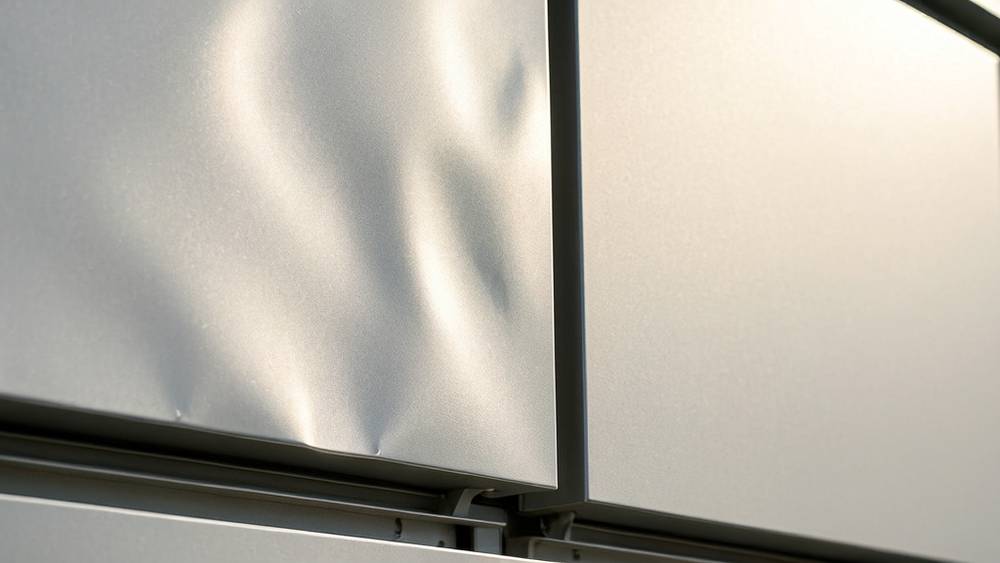
Oil canning, the visible waviness or buckling that appears on flat metal panels under certain lighting conditions, is the most common aesthetic complaint in metal facade projects. It is not a structural failure, but it drives architects and building owners to demand panel replacement. The phenomenon has multiple contributing factors: residual stresses from the rolling process, thermal expansion, fabrication-induced stress, and insufficient panel stiffness. AA1100 amplifies several of these.
Because AA1100 has low yield strength, the cold-working operations involved in fabricating แผ่น ผนัง อ ลู มิ เนียม, shearing, punching, folding, introduce plastic strain that relieves unevenly when the panel heats up on a facade. The aluminium tries to expand but is restrained by its fixings. In a higher-strength alloy, the material can carry the thermal compressive stress elastically. In AA1100, the stress more readily exceeds the yield point, producing permanent micro-buckling that accumulates cycle by cycle. After one hot season in Bangkok or Jakarta, panels that looked flat during installation can develop a visible orange-peel or washboard texture.
Fabricators familiar with this behaviour sometimes try to compensate by specifying thicker sheets or adding stiffener ribs. These measures help but do not eliminate the fundamental mismatch between the alloy's mechanical properties and the thermal-mechanical demands of a sun-exposed facade. The American Architectural Manufacturers Association (AAMA) technical information reports on metal wall panel systems recommend that specifiers evaluate the panel alloy's yield strength in relation to the project's thermal environment, a step often skipped in price-driven procurement.
Corrosion: Where AA1100's Purity Becomes a Liability
There is a persistent belief in some procurement circles that commercially pure aluminium offers the best corrosion resistance because it lacks alloying elements that can form galvanic couples. This is true in distilled water and certain chemical environments. It is demonstrably false in the chloride-rich atmospheres that define coastal Southeast Asia.
AA1100 relies on a thin, self-healing aluminium oxide film for protection. In the presence of chloride ions, this passive film breaks down locally, initiating pitting corrosion. The iron-rich intermetallic particles present in AA1100, though small in volume fraction, act as cathodic sites that accelerate localised attack. AA5052, by contrast, contains magnesium (2.2–2.8%) which strengthens the alloy and simultaneously forms a more chemically stable oxide film in marine exposures. Testing per ASTM B117 (neutral salt spray) consistently shows AA5052 outperforming AA1100 in pitting resistance by a factor of two to three times.
For แผ่น ผนัง อ ลู มิ เนียม projects within 5 kilometres of a coastline, or in industrial zones with SO₂ emissions, specifying AA1100 for exterior panels is a calculated risk that shifts maintenance costs onto the building owner. The PVDF or FEVE coating system provides the primary barrier, but any scratch, fastener penetration, or cut edge becomes an initiation point for underfilm corrosion that spreads beneath the coating. Once filiform corrosion takes hold under a Kynar 500® or Hylar 5000® PVDF finish, full panel replacement is the only permanent remedy.
Fabrication Trade-offs: Soft Alloy, Sharp Problems
AA1100's low strength is both its fabrication advantage and its downstream weakness. The alloy bends easily, requiring less tonnage on press brakes and reducing tool wear. Small workshops across Thailand, Vietnam, and Malaysia favour it for this reason. But the same softness creates problems at the detailing level that compound on the building.
Routed return flanges on AA1100 panels are more prone to cracking at the bend radius if the grain direction is not carefully controlled during nesting. The alloy's low work-hardening rate means that a formed corner does not gain much strength from the bending operation, so corner joints rely almost entirely on the welding or mechanical fastening method rather than the inherent stiffness of the formed shape. In high-wind events, AA1100 panel corners have been observed to open up at the seams before AA3003 or AA5052 panels of identical geometry show any distress.
Perforated panels, increasingly specified for ventilated facades and acoustic screens in tropical buildings, present a particular challenge. The perforation process removes material and creates stress concentrations around each hole. AA1100 panels with open areas exceeding 20% can exhibit a significant drop in effective stiffness, far greater than what simple net-section calculations predict, because the low yield strength allows localised yielding around perforations that propagates into global panel distortion. Suppliers such as Futeng® who manufacture solid aluminium cladding systems routinely recommend upgrading to AA3003 or AA5052 when open-area ratios exceed 15%, based on accumulated project data from Asian and Middle Eastern installations.
Coating Adhesion on Commercially Pure Aluminium
The chromate conversion coating that forms the substrate for architectural PVDF and FEVE paint systems relies on a chemical reaction with the aluminium surface. AA1100, with its high purity and minimal alloying elements, produces a conversion coating of different morphology than 3xxx or 5xxx alloys. The chromate film on pure aluminium tends to be thinner and less mechanically interlocked with the substrate.
This does not mean AA1100 cannot be successfully coated. Major coil coaters process 1100 alloy routinely for applications such as signage and interior panels. But for exterior แผ่น ผนัง อ ลู มิ เนียม where the coating must survive 20-plus years of UV exposure, thermal cycling, and occasional impact, the adhesion margin is narrower. Cross-hatch adhesion testing per ASTM D3359 on AA1100 substrates sometimes shows borderline 4B ratings where AA5052 consistently achieves 5B under identical pretreatment and coating conditions. The difference is small in laboratory terms but can translate to earlier delamination at cut edges and fastener holes in the field.
When AA1100 Makes Engineering Sense
This article is not a blanket condemnation of AA1100. The alloy has legitimate applications in building construction where its limitations are irrelevant or outweighed by other considerations. Interior wall panels, where thermal cycling is minimal and visual flatness is judged under controlled lighting, are a valid use case. Soffit panels under deep eaves or covered walkways, protected from direct rain and sun, can perform adequately in AA1100. Decorative interior screens, signage panels, and non-structural trim pieces all fall within the alloy's capability envelope.
The problem arises when cost pressure and supply chain convenience push AA1100 into exterior applications where the project specification, if one exists, would call for AA3003 or AA5052. The Bangkok and Ho Chi Minh City markets have seen multiple projects where subcontractors substituted 1100 for the specified 3003, reasoning that both are "aluminium" and the coating looks the same. The failures emerge two to three years later, long after the subcontractor's defects liability period has expired.
A Practical Specification Checklist for Procurement Teams
For procurement managers and facade contractors sourcing แผ่น ผนัง อ ลู มิ เนียม in Southeast Asia, the following decision framework can help avoid alloy-related failures:
- Project within 5 km of coastline: Specify AA5052-H32 minimum. The cost premium is roughly 25–40% on sheet price but typically less than 8% on the installed system cost once fabrication, coating, and substructure are included.
- Panel dimension exceeding 600 mm in any direction: Avoid AA1100 unless a deflection analysis using the lower yield strength confirms acceptable performance under the project wind load.
- Perforated panels with open area above 15%: Upgrade to AA3003-H14 or AA5052-H32. The stiffness degradation in perforated AA1100 is disproportionate to the material removed.
- High-visibility facades with glancing light conditions: Oil canning risk is significantly higher with AA1100. Specify the higher-yield alloy and consider adding stiffener ribs regardless of alloy choice.
- Interior or sheltered applications: AA1100 is technically acceptable provided flatness requirements are not stringent.
- Always request mill test certificates (MTC): Verify that the delivered material matches the specified alloy. MTCs should reference ASTM B209 for aluminium sheet and plate.
Cost Illusions: Why Cheap Alloy Can Cost More
The allure of AA1100 is a lower invoice price on the aluminium sheet. On a project requiring 2,000 square metres of 2.5 mm solid aluminium panels, the raw material cost difference between AA1100-H14 and AA5052-H32 might be USD 8,000–12,000. Spread across the total facade package including substructure, installation, coating, and project overhead, this represents perhaps 2–4% of the contract value.
Against that saving, the project carries the risk of oil canning claims, corrosion remediation, or full panel replacement. A single scaffold mobilisation to replace 50 panels on a completed building can consume the entire alloy-cost saving and more. Insurance claims for facade defects in tropical markets have risen steadily over the past decade, and several major underwriters now ask for alloy specifications in their project risk assessments for buildings over four storeys.
The engineering community working with แผ่น ผนัง อ ลู มิ เนียม across Thailand and neighbouring countries is increasingly aware of these trade-offs. Specification practice is slowly shifting, but the gap between what engineers specify and what procurement buys remains wide. Closing that gap requires not just better specifications but a clearer understanding among contractors and developers that the cheapest aluminium sheet is rarely the cheapest facade over the building's service life.
The decision to use AA1100 for exterior wall panels is not inherently wrong. It is context-dependent. The mistake is using it in contexts where its properties are provably inadequate, and then being surprised by the results.